Case file · Geopolitics · 12 min read
Who Gets to Start Wars? The Senate Just Forced the Question
Senate Democrats blocked a $1.15T defense bill to force a war powers vote on Iran, reopening the Article I vs Article II fault line.
The Arc of Power ·
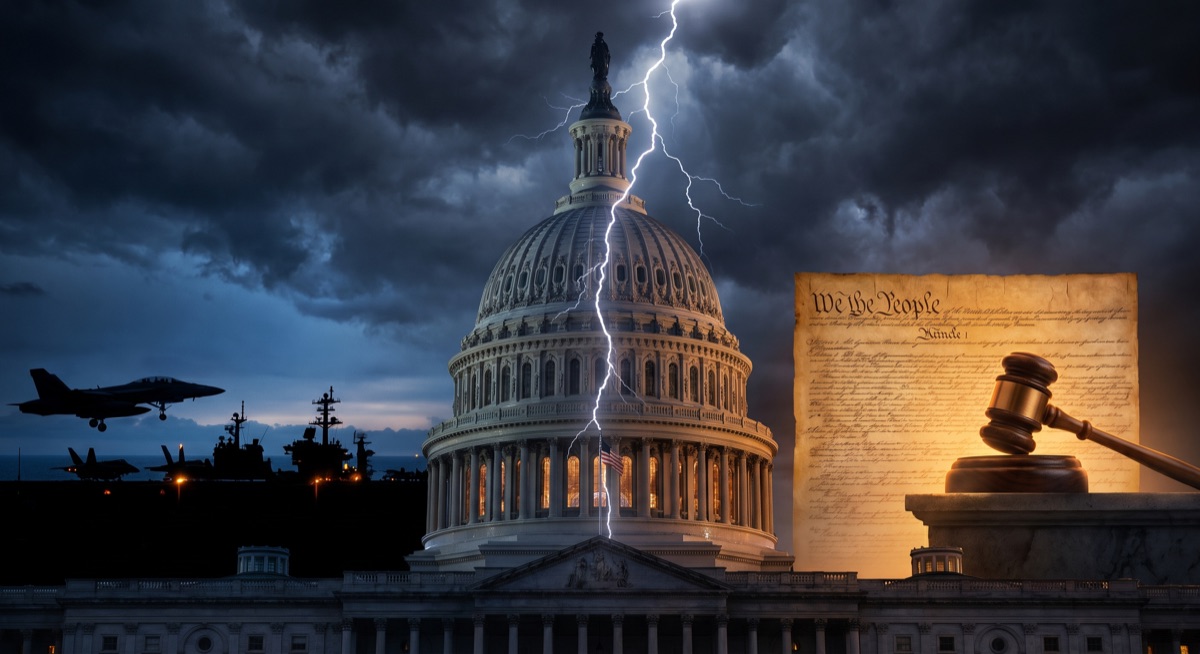
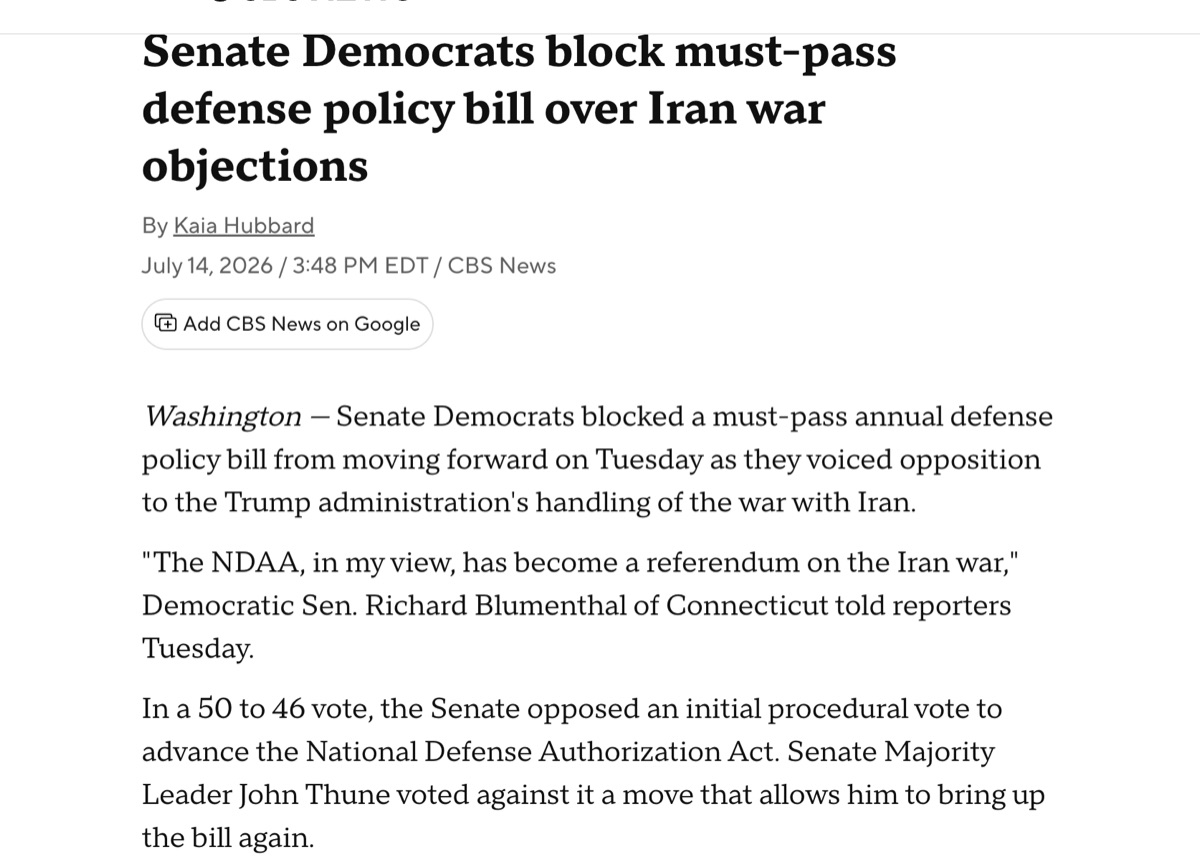
On Tuesday, July 14, the United States Senate voted 50-46 against opening debate on the National Defense Authorization Act — the $1.15 trillion annual defense bill that funds every branch of the military, authorizes a 3.6% troop pay raise, and has passed for 66 consecutive years. Every Democrat present voted no. The bill is not dead, but it is grounded — and the reason is not money.
Our thesis: This is not a budget fight. It is the most consequential Article I vs. Article II confrontation since the War Powers Act of 1973. Senate Democrats are using the one constitutional lever that actually binds the executive — the power of the purse — to force a vote on whether the Iran war has legal authorization. The question is whether this procedural revolt can overcome a 75-year pattern of Congress voluntarily surrendering war authority to presidents.
Senate Minority Leader Chuck Schumer framed the stakes plainly: "Donald Trump does not get to drag the American people deeper into a war he cannot explain and does not know how to end — and then demand that Congress look the other way."
View original article on CBS News
PBS NewsHour captured the full floor proceedings — the most direct way to watch the procedural mechanics of the blockade:
What the Senate Actually Did — and Why It Matters
The procedural move is technically narrow: Democrats denied the 60-vote supermajority needed to open debate on the NDAA. Senate Majority Leader John Thune can bring it back. The bill will almost certainly pass eventually — it always does.
But the tactical significance is real. As Senator Richard Blumenthal put it: "The NDAA, in my view, has become a referendum on the Iran war." By blocking it, Democrats are forcing a binary choice: either the bill includes a vote on war authorization, or the Pentagon does not get its budget. That is not symbolism. It is leverage.
Three specific objections drove the blockade:
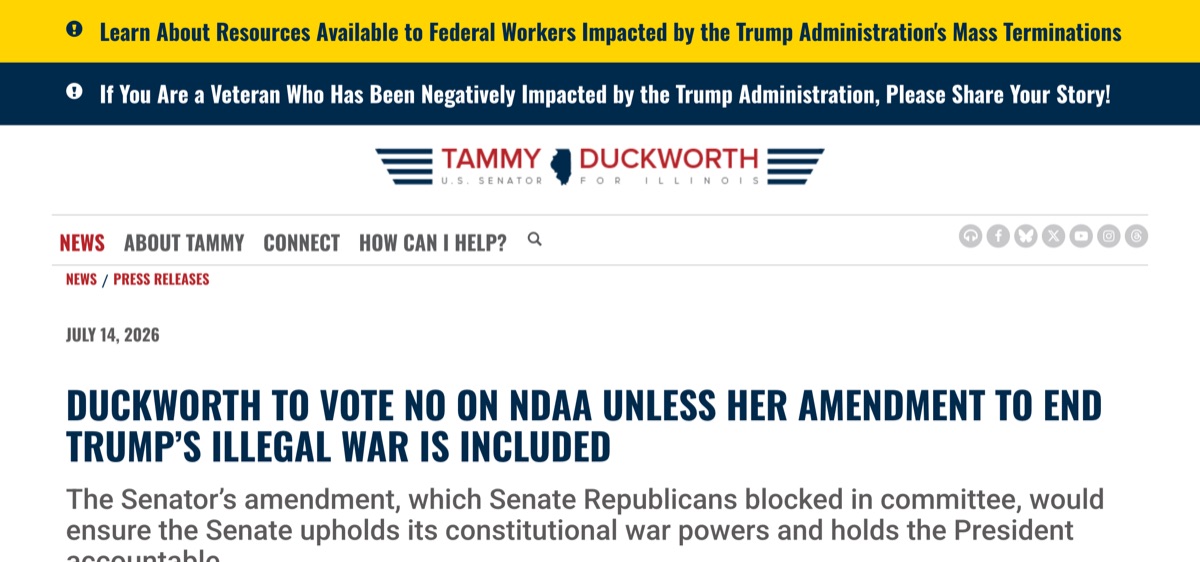
First, the war itself. The US-Iran conflict is now in its fifth month with no congressional authorization and no clear endgame. Senator Tammy Duckworth — a combat veteran who flew helicopter missions in Iraq — announced she would vote no unless the bill included her amendment to halt offensive operations until Congress authorizes the war. Her amendment would also withhold the Secretary of Defense's travel funding until the Pentagon reports on the war's impact on military readiness. Senate Armed Services Committee Republicans blocked the amendment in committee last month.
View original press release on Duckworth.senate.gov
Second, the budget topline. The White House requested $1.5 trillion in total defense spending — up from roughly $900 billion last year. Senator Angus King noted the asymmetry: "The increase in defense is four times the increase" in nondefense spending. A separate $67 billion supplemental request specifically for Operation Epic Fury — the administration's name for Iran operations — adds fuel to the argument that Congress is being asked to fund a war it never approved.
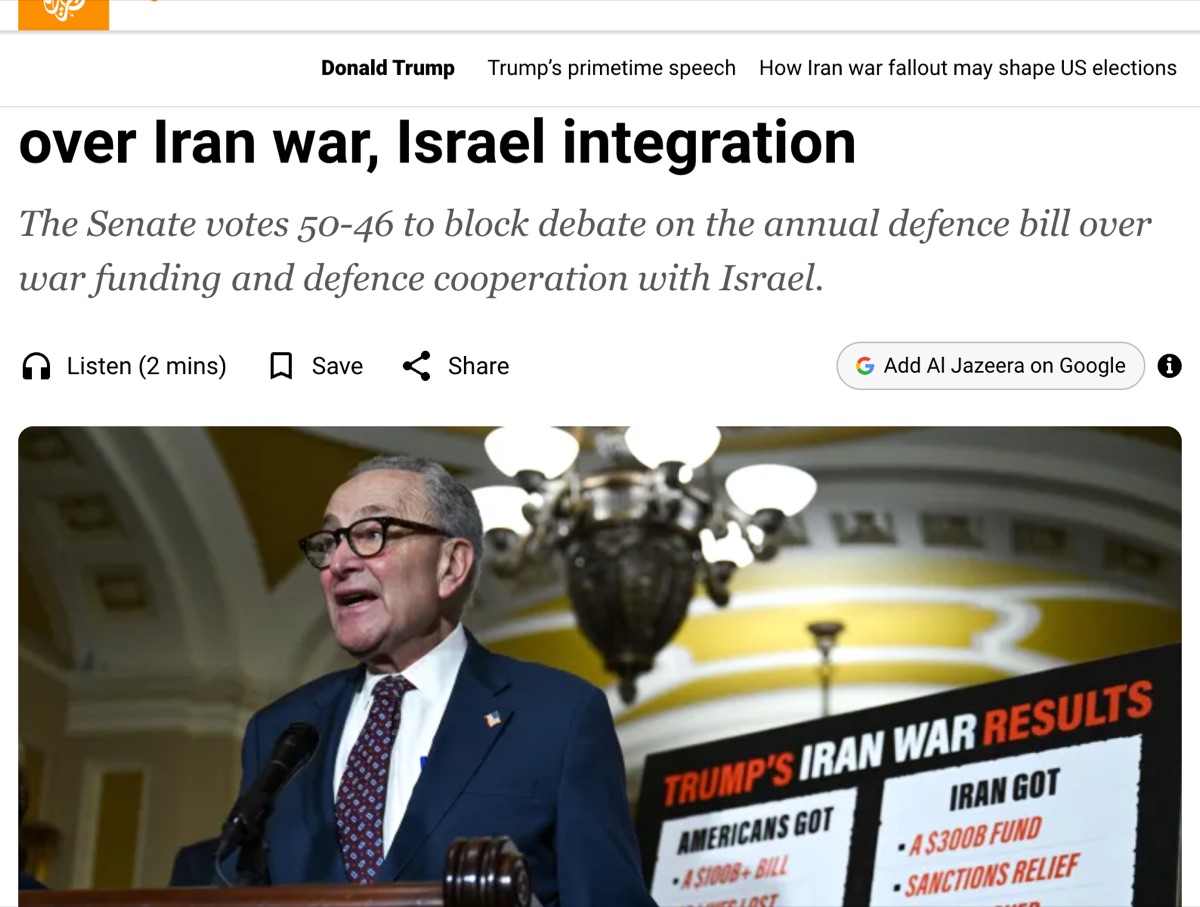
Third, Israel military integration. The NDAA included provisions to deepen US-Israel military cooperation — a Pentagon official coordinating joint defense technology, combined weapons research, data fusion for targeting, and expanded intelligence sharing. Senators Chris Van Hollen, Bernie Sanders, Elizabeth Warren, Ed Markey, Jeff Merkley, and Peter Welch signed a letter urging opposition, with Van Hollen asking why Congress would "order the executive branch to share more intelligence, regardless of what the government of Israel is doing."
View original article on Al Jazeera
Al Jazeera reported a striking data point: Democratic support for Israel has fallen from 59% in 2018 to 22% in May 2026. The Israel integration provisions may not have been the primary driver of the blockade, but they transformed a two-front fight (war + budget) into a three-front one.
Three Lessons This Revolt Teaches About American War Authority
Lesson 1: The Power of the Purse Is the Only Constitutional Lever That Works
Congress has tried everything else. Both chambers have now voted more than ten times on various war powers resolutions. In June, both the House (215-208) and the Senate (50-48) passed a concurrent resolution directing the president to remove forces from Iran — the first time both chambers have agreed on such a resolution since the War Powers Act was enacted in 1973.
It did not matter. The resolution is widely viewed as symbolic. It does not require the president's signature. It does not carry the force of law. The administration ignored it.
The NDAA blockade is different because the power of the purse is the one congressional authority the executive cannot simply disregard. A president can ignore a nonbinding resolution. A president cannot deploy forces without a budget.
William Spaniel's analysis of the constitutional mechanics — why this specific confrontation differs from previous symbolic gestures — is the best deep-dive available:
Lesson 2: The 60-Day Clock Is Now Officially Broken
The War Powers Resolution of 1973 requires the president to withdraw forces within 60 days unless Congress authorizes the conflict. The Iran war began on February 28. The 60-day window expired in late April.
The administration's workaround is legally creative and constitutionally corrosive: it declared that hostilities "terminated" during the April ceasefire, then restarted the clock when fighting resumed. Senator Adam Schiff and others argue this is fiction — the military objectives, theater of operations, and adversary never changed. It is one continuous campaign with a tactical pause, not two separate conflicts.
If this interpretation holds, any future president can wage indefinite war by cycling through 59-day bursts separated by brief pauses. The War Powers Resolution would functionally cease to exist as a constraint.
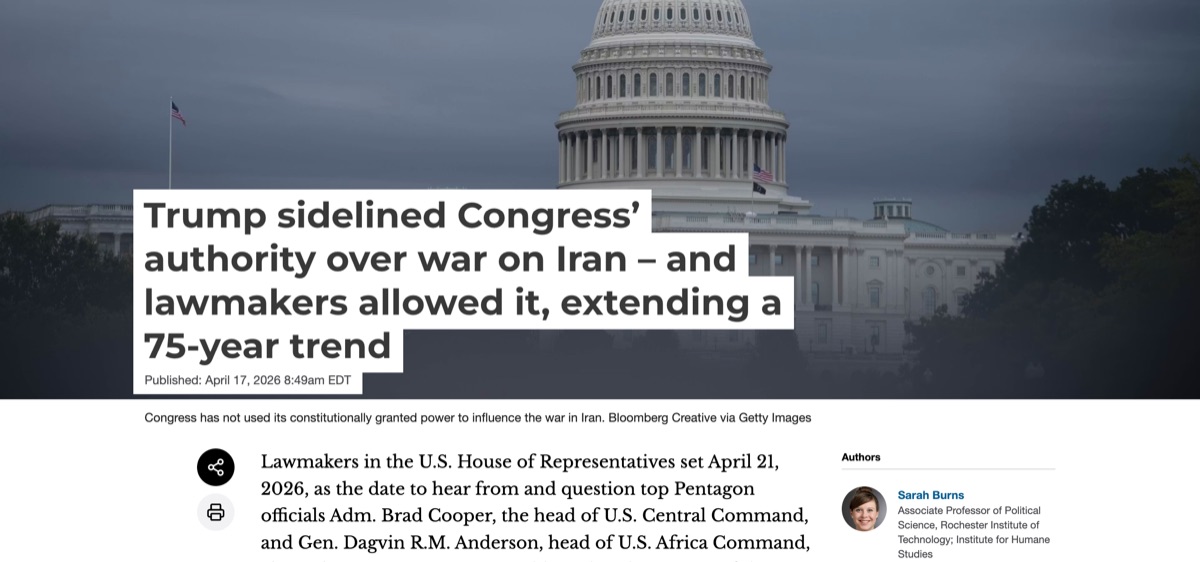
View original analysis on The Conversation
This is not a new pattern. The erosion of congressional war authority has been accelerating since Truman bypassed Congress for Korea in 1950 — using the UN Security Council as authorization instead. Senator Robert Taft called it a "usurpation of war powers authority," yet Congress took no action. The Gulf of Tonkin Resolution gave LBJ vague authority to escalate Vietnam as he "saw fit." Every modern president has pushed the boundary further. But Trump's approach breaks even the established protocol: previous presidents at least acknowledged the War Powers Resolution in their notifications to Congress. The current administration has relied solely on executive orders, bypassing even the pretense of consultation.
Lesson 3: Republican Dissent Is Real but Disciplined Into Silence
The June war powers vote revealed genuine bipartisan opposition: four Republican senators — Rand Paul, Susan Collins, Lisa Murkowski, and Bill Cassidy — broke ranks to vote with Democrats.
Then the White House applied pressure. Paul raised "grave concerns about the financial implications" of a war that had already cost at least $12 billion. But when the Senate held a subsequent revote, Paul voted "present" and Cassidy switched to "no." Trump had publicly warned dissenting Republicans: "Vote for us, and don't call me great... I'd rather have the vote, than the statement... those people, hopefully, will someday be gone."
The message was received. On the NDAA blockade vote Tuesday, every Republican present voted to advance the bill.
Critical
The Contrarian Read: The Senate revolt may actually entrench executive war powers rather than constrain them. Here is the logic: Democrats block the NDAA. Thune brings it back in two weeks. The bill passes — it always does — with minor concessions that fall short of actual war authorization. The precedent becomes: Congress objected at the highest possible volume, using its strongest constitutional lever, and the war continued anyway. Every future president can point to this episode as proof that even the nuclear option does not work. The revolt's failure would be more damaging than its absence.
The Cost Debate Hacker News Won't Stop Having
The war's financial trajectory has been a persistent discussion on Hacker News, where an open-source cost tracker has been cataloging expenditures since March:
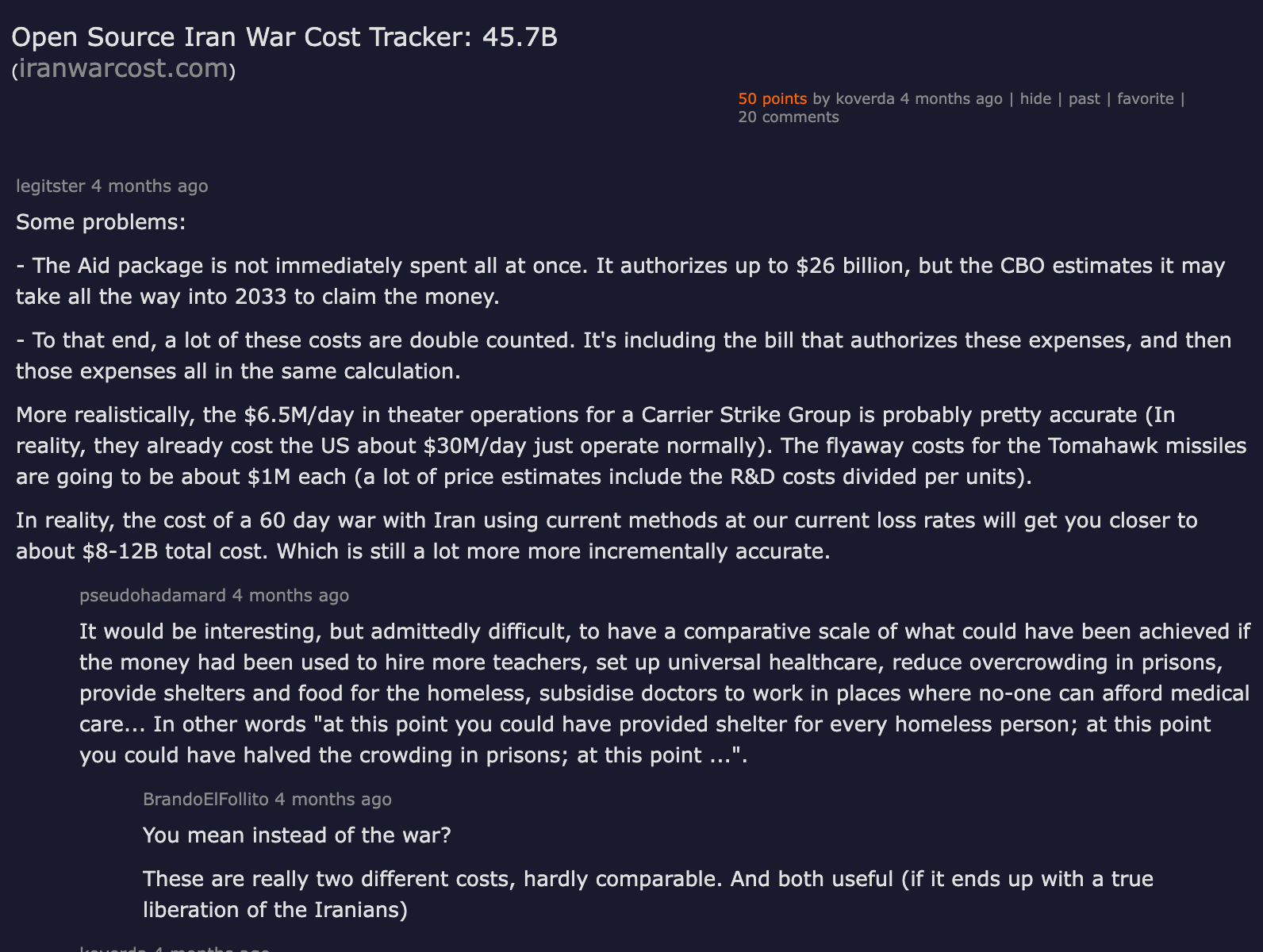
View original thread on Hacker News
The broader strategic implications have drawn hundreds of comments across multiple threads, with contributors drawing parallels to every American conflict since Korea:
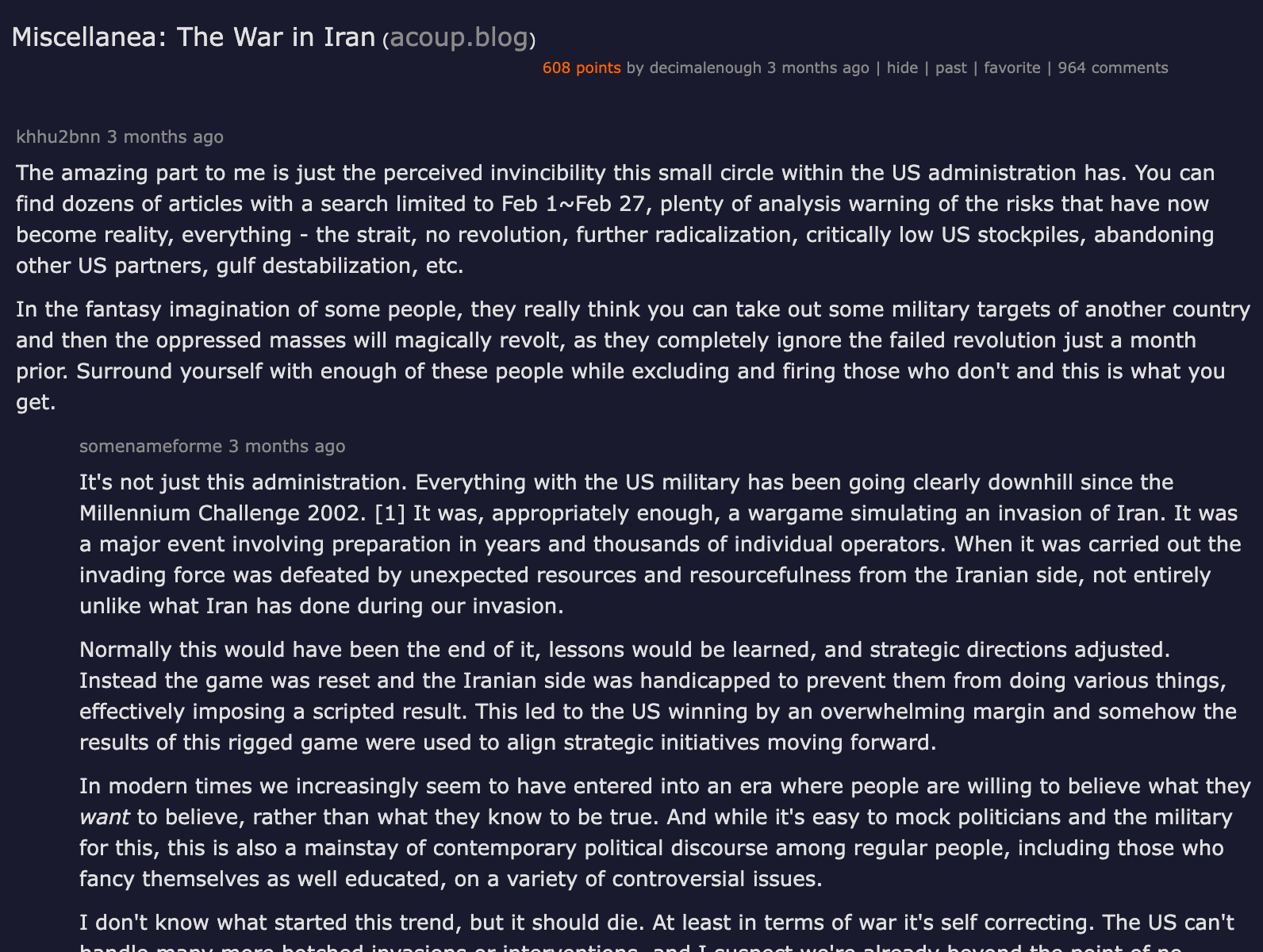
View original thread on Hacker News
The numbers from Breaking Defense frame the Senate's case:
- $1.14 trillion in proposed Defense Department funding for FY2027
- $67 billion supplemental request for Operation Epic Fury (Iran operations)
- $29 billion estimated Iran war cost to date
- $152 billion in defense reconciliation dollars already approved
- 15 servicemembers killed, per Sen. Duckworth
Duckworth framed the budget question as a strategic one: "The Senate cannot authorize $1.14 trillion in defense spending — the largest defense budget ever proposed in our nation's history — for Donald Trump to continue his illegal and disastrous war."
A coalition of 14 civil liberties organizations — including the ACLU, J Street, and CODEPINK — wrote to lawmakers urging them to use Congress's constitutional power of the purse, calling for the NDAA to be withheld until a vote is guaranteed on an amendment barring funding for unauthorized Iran operations.
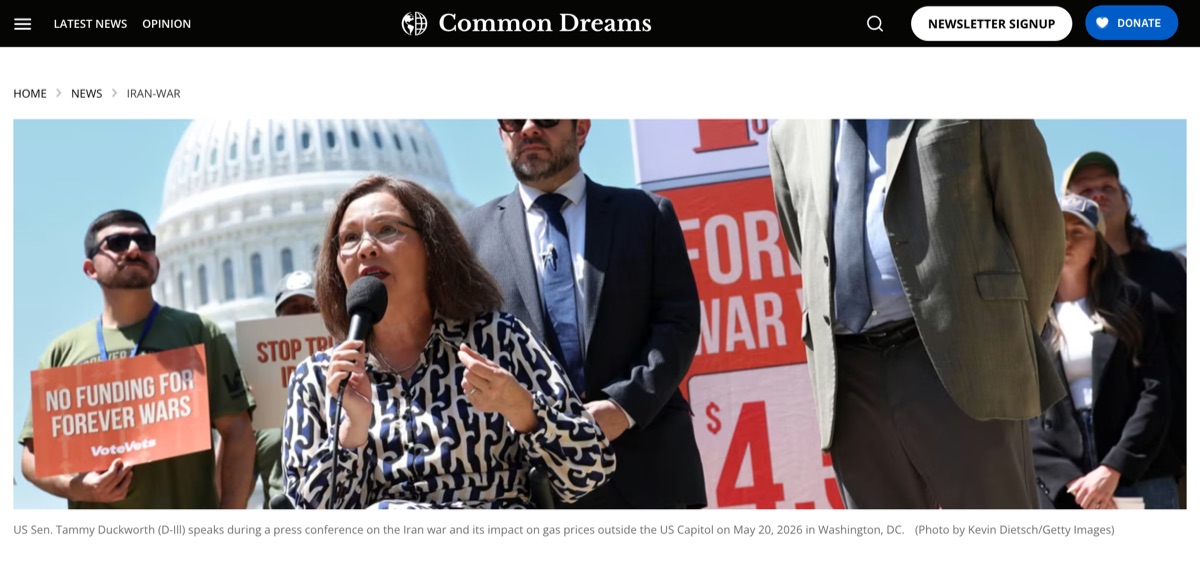
View original article on Common Dreams
Prediction Markets Index the Tail Risk
Polymarket's prediction markets on Iran have attracted over $529 million in cumulative trading volume in 2026 — making the Iran conflict one of the most heavily traded geopolitical events in prediction market history.
The current odds tell a nuanced story:
Note
Polymarket Snapshot (July 2026): US ground invasion before 2027: 17% Yes / 83% No. Ground invasion probability peaked at 62% in April during the heaviest fighting, then declined after the ceasefire. But the ceasefire collapsed in July, and new strikes on 80+ Iranian targets have reopened the question. The "military action against Iran ends on..." market shows active trading with no dominant timeframe — traders are pricing an indefinite conflict.
The gap between prediction markets and congressional reality is instructive. Markets price ground troops at 17%. But Congress has now voted more than ten times to end a conflict that the executive branch simply continues. If the NDAA blockade fails to produce war authorization — and it almost certainly will — what does that tell us about congressional capacity to prevent escalation?
The prediction markets may be pricing the probability of a presidential decision. They are not pricing the probability of congressional constraint.
For deeper context on how prediction markets have tracked this conflict, see our earlier analysis: Iran's Prediction Markets Tell Two Stories.
What Happens Next
Procedurally, the path is straightforward. Thune will bring the NDAA back after negotiations. The most likely outcome is a cosmetic concession — a nonbinding sense-of-the-Senate amendment on war authorization, or a reporting requirement — that gives Democrats enough cover to vote yes. The bill passes before the August recess. The war continues.
The House version faces a parallel challenge. House Democrats have already blocked the bill once. Conference reconciliation between the two chambers will be the next pressure point.
But the structural question outlasts this bill cycle. The Iran war has now produced a historic first: both chambers passing a concurrent war powers resolution against a sitting president. It has produced a second historic first: one party blocking the NDAA specifically over an unauthorized war. Neither action has changed the war's trajectory.
The constitutional question is no longer whether Congress has the authority to control war. Article I is unambiguous. The question is whether Congress has the political capacity to exercise it — and 75 years of evidence says it does not.
The next president — of either party — inherits the precedent. And the precedent is: Congress objected to an unauthorized war using every tool in its constitutional arsenal, and nothing changed.
That is the real story this week. Not what happened on the Senate floor. What it means for every war that comes after.
Related Arc of Power analysis:
- The Iran-US Ceasefire Is Built on Sand — Why the April ceasefire was repositioning, not peace
- The Apache Exchange: US-Iran Goes Direct — The military escalation timeline
- The Iran Ceasefire Is Theater — Strategic theater and the enrichment endgame
- Trump's Hormuz Toll Play — The 88% market spike and blockade economics
The Desk
About The Arc of Power
The Arc of Power editorial desk delivers rigorous analysis of geopolitics, defense, economic statecraft, and intelligence — examining the forces that shape the global order.
Briefing Access
Request Briefing Access
In-depth geopolitical analysis — power dynamics, defense strategy, and economic statecraft — three times a week. No noise.
Request briefing access