Case file · Geopolitics · 11 min read
The Apache Exchange: US-Iran Goes Direct
An Apache downed, five sites struck, three Gulf bases hit. Polymarket's $282M peace market is pricing out a 2026 deal.
The Arc of Power ·
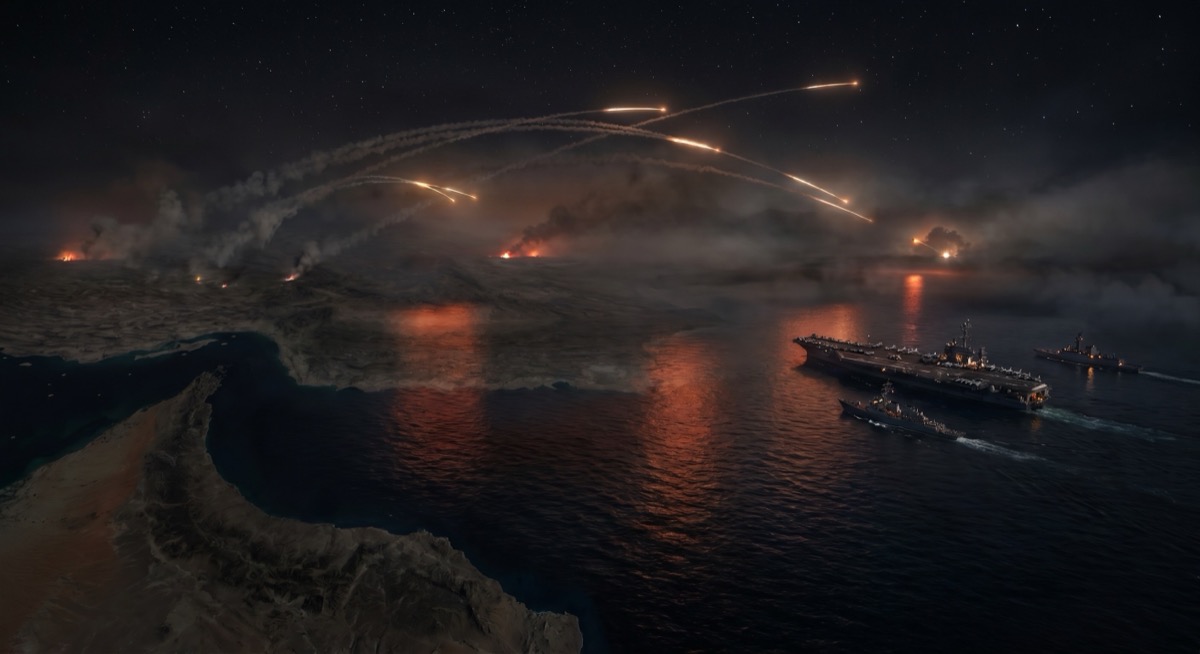
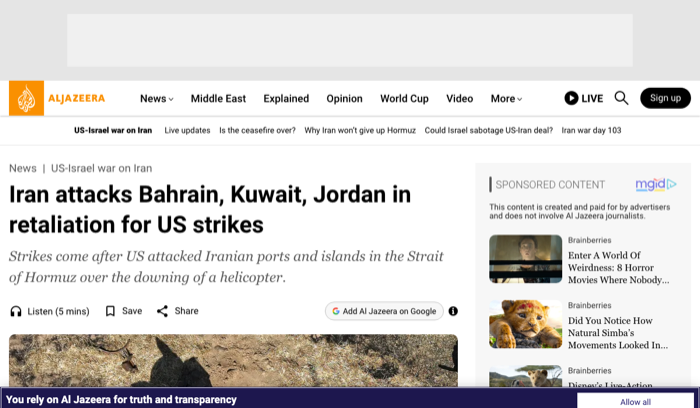
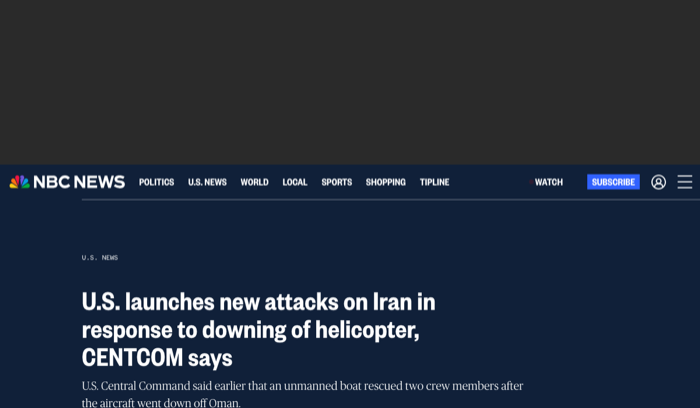
At 7:33 PM Eastern on Tuesday, June 9, an Iranian drone struck a US Army AH-64 Apache helicopter patrolling near the Strait of Hormuz. Both crew members were rescued by an unmanned surface vessel. Within hours, US Central Command launched strikes on Iranian air defense systems, radar sites, and ground control stations across five locations — Sirik, Jask, Minab, Qeshm Island, and Bandar Abbas. By Wednesday morning, Iran's Islamic Revolutionary Guard Corps had fired drones at the US Fifth Fleet headquarters in Bahrain and Ali Al Salem airbase in Kuwait, and launched long-range solid-fuel missiles at the American base in Azraq, Jordan.
The Pakistan-brokered ceasefire from April? Technically still in place. Functionally, the United States and Iran just fought a direct shooting war.
The Timeline: From Proxy to Direct
This isn't the first time US and Iranian forces have traded fire since the April truce. But it's the first time the exchange followed a clean escalation ladder — provocation, response, retaliation — with both sides striking the other's sovereign or deployed military assets directly, not through proxies.
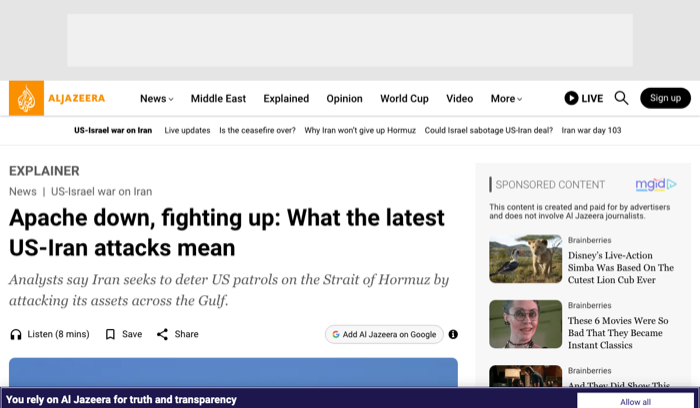
Here's the sequence, as reported by Al Jazeera, NBC News, and Bloomberg:
Tuesday, June 9:
- ~1:30 AM local / 7:33 PM ET: Iranian drone strikes US Apache helicopter over the Strait of Hormuz. The helicopter crashes; both crew rescued uninjured by Corsair unmanned surface vessel.
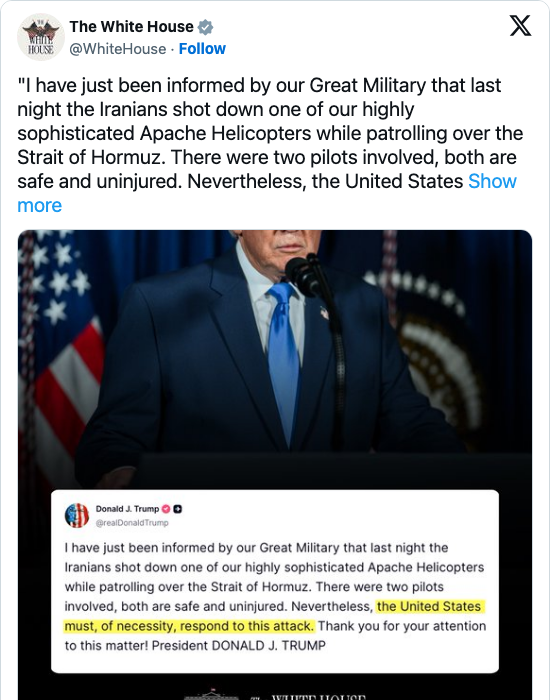
- Hours later: Trump posts that Iran "shot down one of our Apache Helicopters" and declares the US "must, of necessity, respond to this attack." Axios reported that Trump vowed the US would "continue attacking Iran very hard."
- 5:00 PM ET: CENTCOM launches "self-defense strikes" against Iranian air defense, ground control stations, and surveillance radar at five sites near Hormuz.
Wednesday, June 10:
- Early morning local: IRGC launches retaliatory strikes across the Gulf:
- Drones target US Fifth Fleet headquarters in Bahrain
- Drones target Ali Al Salem airbase in Kuwait
- Long-range solid-fuel missiles strike Azraq airbase in Jordan
- Jordan intercepts five Iranian missiles
- Kuwait activates national air defense; at least one Indian civilian killed by drone debris near Kuwait's main airport
- IRGC claims it attacked 21 US targets, destroyed four (including F-35 hangars and a command center at Azraq), and downed an MQ-9 Reaper drone — none verified by the US
Critical
Critically, Iran has not directly claimed responsibility for the initial Apache shoot-down. Iranian state broadcaster IRIB reported "no offensive military operations had been carried out in the strait in the last 24 hours." This deniability is deliberate — it preserves the fiction that the ceasefire wasn't broken first.
The US response tells you how Washington read it: not as an accident, but as a deliberate test. Trump said the US plans to "continue attacking Iran very hard" and that Iran will "pay the price" for taking "too long to negotiate a deal." That language — linking military action to the pace of diplomacy — is the tell. This isn't punishment for the Apache. It's leverage for the stalled negotiations.
What the Markets Say
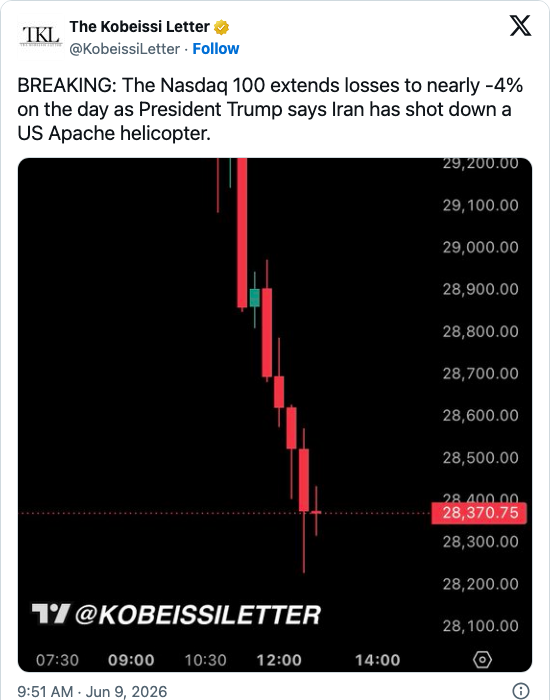
The prediction markets moved before the missiles landed, and they've kept moving since. As CNBC reported, the Pakistan-brokered ceasefire remains technically in place but is "severely tested" — and the Nasdaq 100 extended losses to nearly -4% on the news.
The US-Iran permanent peace deal market — $281.8 million in total volume, the largest geopolitical contract on Polymarket — tells the clearest story:
| Resolution Date | Current Odds | Movement |
|---|---|---|
| June 15 | 4.3% | Collapsed from 72% in May |
| June 30 | 15% | Down from 40%+ |
| July 31 | 29% | Steady decline |
| December 31 | 68% | Down from 88% peak |
Late May was the high-water mark for peace. Trump announced a "largely negotiated" framework, and December 31 resolution odds hit 88 cents. Then came the rejections, the new conditions (Trump linking any deal to the Abraham Accords), the Treasury sanctions on Iran's military oil-sales division, and now the direct exchange of fire.
The near-term buckets are gutted. June 15 went from viable to noise. The market is now pricing a 32% chance that there is no permanent deal in 2026 at all — and that number has been climbing every week since the Apache incident.
Note
The adjacent markets confirm the direction. Israel-closes-airspace ($13.4M traded) is pricing a 32% chance of closure by June 30 — up 9% week-over-week. The ceasefire-extension market is down 21% over the same period. Smart money isn't hedging for peace. It's positioning for escalation.
Why This Escalation Is Different
The ceasefire that collapsed before was between Israel and Iran — a proxy chain with layers of deniability. This is the United States and Iran striking each other's military infrastructure directly. The geography of Iran's retaliation — Bahrain, Kuwait, Jordan — demonstrates that Tehran can reach American assets across the entire Gulf theater, not just at the Strait of Hormuz.
As Al Jazeera's analysis reported, Iranian analyst Abas Aslani explained the IRGC's logic: establishing deterrence by demonstrating that "military pressure carries consequences beyond the Strait of Hormuz." The message to Washington: you can't confine the escalation to a geographic corridor we don't control.
Trita Parsi put it more directly: "The Iranians are trying to make clear that any attack on them would be responded to, regardless of the size and the scope."
But the restraint is equally telling. Retired General Mark Kimmitt assessed: "I would be very surprised at this point if this escalates." Jordan intercepted all five missiles. The US reports no casualties or significant damage. Iran's IRGC claims four destroyed targets — claims the Pentagon has not confirmed. Both sides demonstrated capability and resolve while carefully limiting actual damage.
This is the Hormuz pattern we've tracked playing out in its most dangerous form yet: controlled escalation designed to improve negotiating position, not to start a war. The risk is that one side miscalculates, and the "controlled" part fails.
The Gulf States in the Crosshairs
The geography of Iran's retaliation deserves its own analysis. Bahrain hosts the US Fifth Fleet — the command and control hub for all American naval operations in the Gulf. Kuwait's Ali Al Salem airbase is the primary logistics node for US air operations across the region. Jordan's Azraq base houses the F-35 squadron that represents America's air superiority overmatch.
Iran didn't strike random targets. It struck the three pillars of the US military architecture in the Gulf: naval command, logistics, and air superiority. The message wasn't just to Washington — it was to Manama, Kuwait City, and Amman. The IRGC demonstrated that hosting American forces makes you a target, not a protected party.
For the Gulf states, this creates an impossible calculus. The US presence is their security guarantee against Iranian aggression. But that same presence now draws direct Iranian fire onto their territory. Kuwait's response — activating national air defense and confirming a civilian casualty near the airport — underscores the reality: these aren't theoretical risks on a strategy map. They're missiles in the airspace over your capital.
Euronews reported that at least one Indian civilian was killed by debris from a drone strike near Kuwait's main airport area. That casualty — a non-combatant from a neutral country killed as collateral from a US-Iran exchange — is the kind of incident that can shift domestic politics in the Gulf states in ways that are hard to predict and impossible to undo.
Jordan's interception of all five missiles represents a notable defensive success. But the fact that Iran felt confident enough to fire missiles at a country that shares a peace treaty with Israel — and hosts American forces critical to the broader Middle Eastern security architecture — tells you something about how Tehran now calculates the costs and benefits of escalation.
The AI Trade Through-Line
If you're reading The Arc of Power for the geopolitics, you already know the through-line: the same Strait of Hormuz that Iran can threaten carries the energy that powers the data centers that train the models that generate the revenue that justifies the capex that depends on the energy flowing through Hormuz.
The AI trade unwind thesis hasn't changed. What's changed is the probability. When the ceasefire was holding and peace talks were progressing (late May, 88% December deal), the Hormuz risk was priced as background noise. Now that the US and Iran are directly striking each other's military assets, the tail risk re-enters the pricing.
The Polymarket numbers give you a real-money read: the market has moved from pricing peace as the base case to pricing it as merely probable. That's a material shift for anyone modeling energy supply risk, data center capex timelines, or the sustainability of the AI infrastructure buildout.

The Ceasefire That Won't Die (But Won't Live Either)
The April ceasefire, brokered by Pakistan, remains technically in force. Both Washington and Tehran have framed their strikes as defensive — the US calling them "self-defense strikes," Iran describing them as retaliation for aggression. Neither side has formally declared the ceasefire void.
This is the uncomfortable equilibrium: a ceasefire that permits direct military exchanges as long as both sides maintain the fiction of proportional self-defense. The previous analysis of this ceasefire described it as "built on sand." The sand is still there. It's just that both sides are now shooting through it.
The structural sticking points remain unchanged:
- Nuclear enrichment: Iran's program has continued during the ceasefire
- Ballistic missiles: The IRGC's use of long-range solid-fuel missiles against Jordan demonstrates the very capability the US wants constrained
- Sanctions relief: Iran demands it; the US has added new sanctions during talks
- Hormuz control: The April framework included a plan to de-mine and reopen the strait — now moot after the Apache shoot-down
Trump's public linkage of any deal to the Abraham Accords added a new conditionality that Iran has rejected. The prediction market on the ceasefire extension reflects this: the odds of a formal extension have dropped 21% in the past week alone.
What Comes Next
The pattern from previous US-Iran escalations suggests a cooling period — statements of resolve followed by diplomatic back-channels, followed by another attempt at talks. The Pakistan channel that brokered the original ceasefire remains active.
But the Polymarket trajectory tells you where the weight of money sits: peace is still more likely than war (68% by December), but the confidence has eroded systematically since late May. Every military exchange narrows the window and adds conditions. Every new set of strikes gives both sides' hardliners evidence that diplomacy is failing.
Critical
The single-source caveat from our research: Reddit's geopolitical communities have been dark for multiple days (HTTP 403 across all subreddits), and the X geopolitical desk is out of scope for our current monitoring. This analysis draws primarily from the Polymarket data, Al Jazeera's reporting, and multi-network news convergence. The community-level signal — what practitioners and analysts are saying in real time — is thinner than we'd like.
Watch the Polymarket numbers. They update faster than the diplomatic statements, they aggregate information from actors with real money at stake, and they've been directionally correct on every major inflection point in this conflict since January. When December 31 drops below 50 cents — when the market says a 2026 deal is less likely than not — that's the signal that controlled escalation has failed and the pricing models need to shift from "delayed peace" to "sustained conflict."
The Strait of Hormuz is 21 miles wide. The margin for error is about the same.
The Desk
About The Arc of Power
The Arc of Power editorial desk delivers rigorous analysis of geopolitics, defense, economic statecraft, and intelligence — examining the forces that shape the global order.
Briefing Access
Request Briefing Access
In-depth geopolitical analysis — power dynamics, defense strategy, and economic statecraft — three times a week. No noise.
Request briefing access