Case file · Geopolitics · 12 min read
China's K3 Gambit Is a Power Move, Not a Launch
Moonshot's 2.8T open-weight model plus Xi's WAIC pledge is standards warfare. The target is the 130 nations outside Pax Silica.
The Arc of Power ·
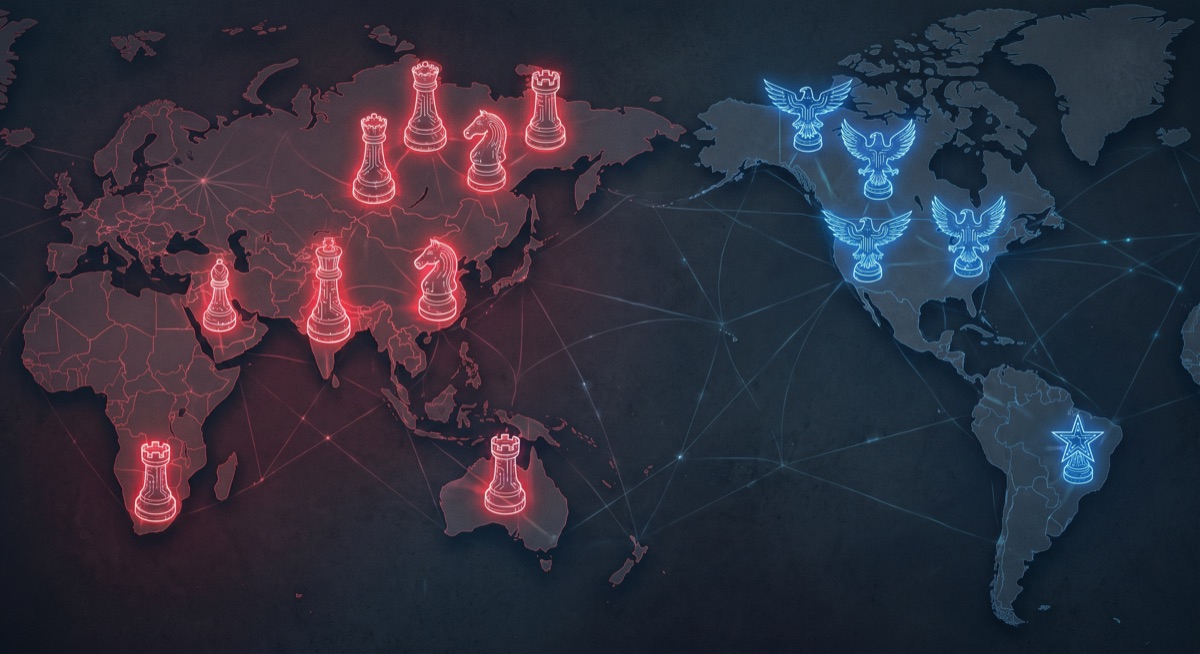
On Thursday, Beijing-based Moonshot AI released Kimi K3 — a 2.8-trillion-parameter model, the largest open-weight AI system ever published. Full weights drop July 27 on Hugging Face. Anyone, anywhere, can download them.
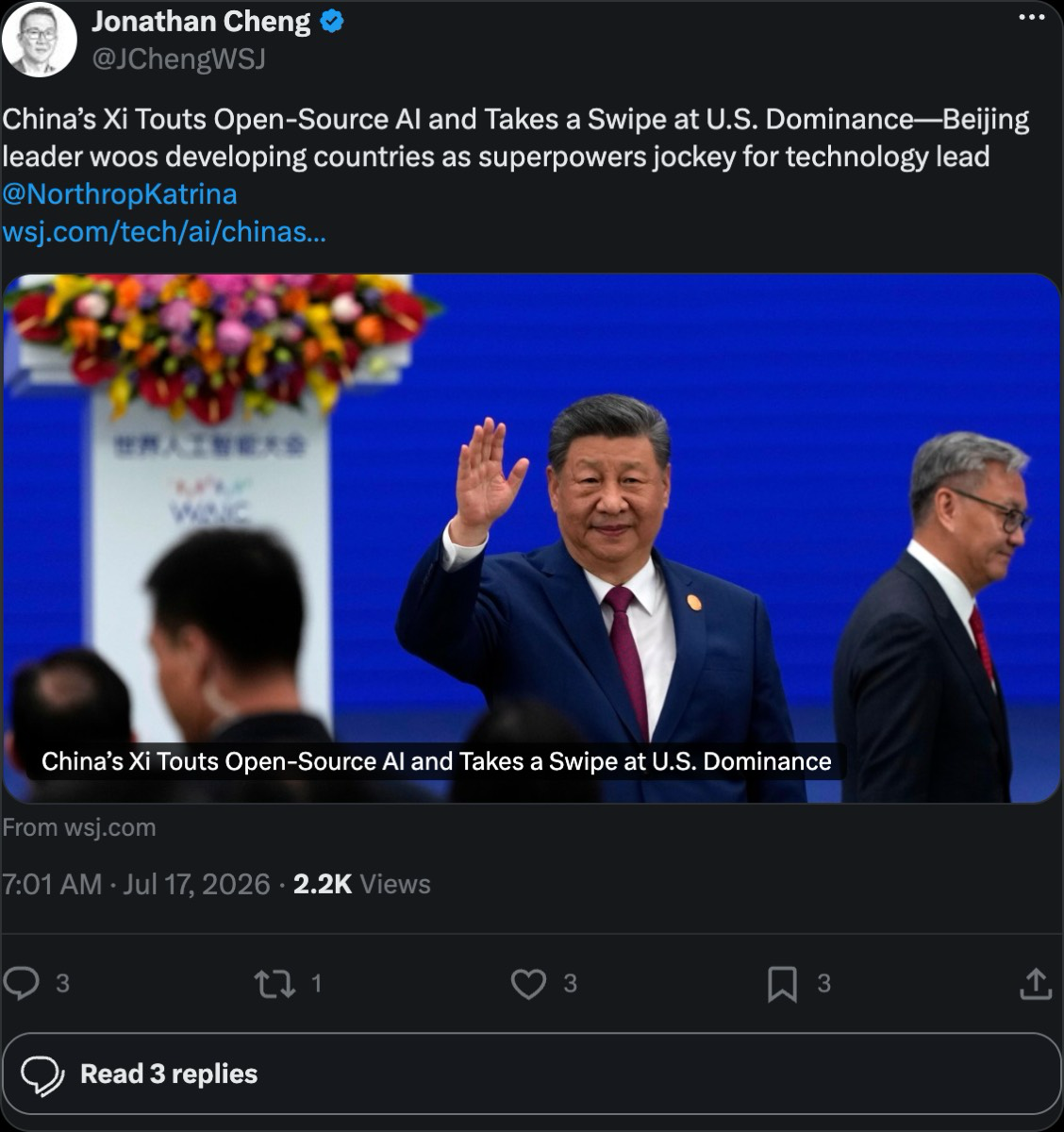
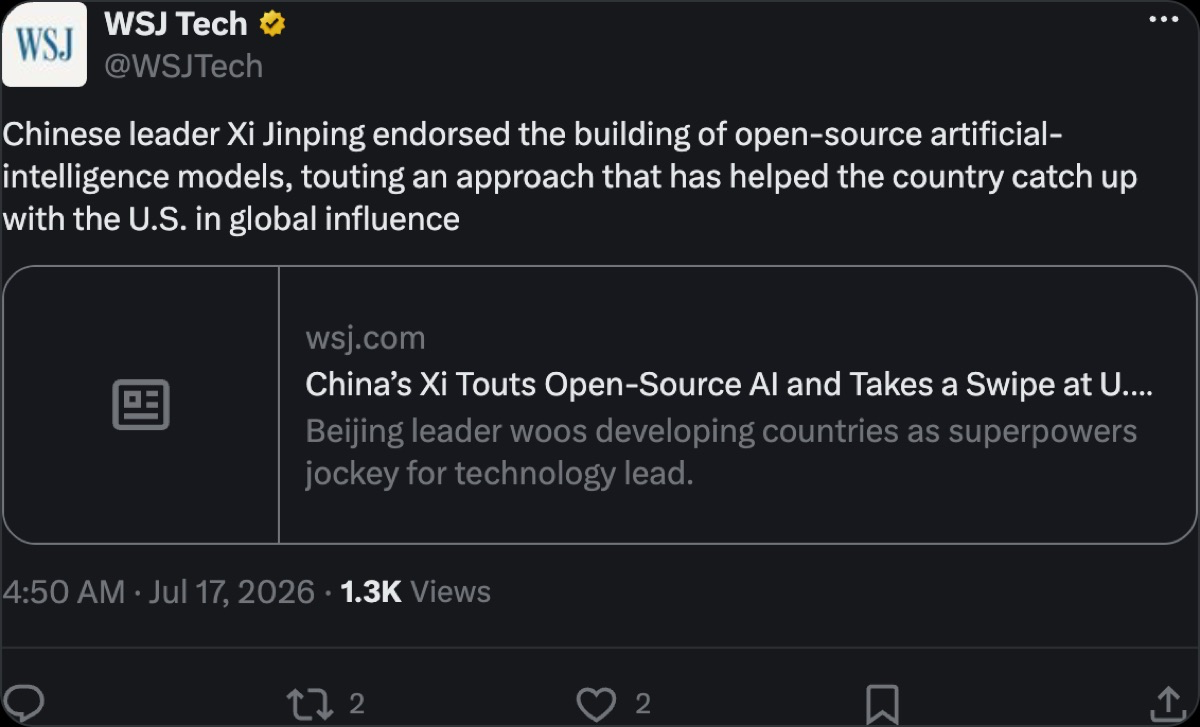
The same day, Xi Jinping took the stage at the World Artificial Intelligence Conference in Shanghai and told delegates from 29 countries that AI development "should not be a solo performance by one country." He announced the formal launch of the World AI Cooperation Organization (WAICO), headquartered in Shanghai, with founding members spanning BRICS (minus India), ASEAN, the African Union, and the Arab League.
These two events are not coincidentally timed. They are the same move. And the audience is not Silicon Valley — it is the 130+ nations outside Washington's Pax Silica bloc that need AI capacity they cannot build themselves.
What K3 Actually Is
The numbers first. Kimi K3 is a sparse Mixture-of-Experts model activating 16 of 896 experts from a 2.8-trillion-parameter base. It introduces two proprietary architectural innovations: Kimi Delta Attention — a hybrid linear attention mechanism enabling 6.3x faster decoding at million-token contexts — and Attention Residuals, which deliver roughly 25% higher training efficiency at under 2% additional cost. The result is approximately 2.5x better overall scaling efficiency than its predecessor, Kimi K2.
On benchmarks, K3 leads on five measures: Program Bench (77.8), SWE Marathon (42.0), BrowseComp (91.2), Automation Bench (30.8), and OmniDocBench (91.1). It trails Claude Fable 5 and GPT-5.6 Sol on aggregate but outperforms Claude Opus 4.8 on most individual tests. Pricing: $3/$15 per million tokens (input/output), with 90%+ cache hit rates pulling effective input costs down to $0.30/MTok.
The gap between open-weight and closed-source has not disappeared. But it has narrowed to the point where the gap is no longer the story. The story is distribution.
Xi's WAIC Speech: The Policy Wrapper
Xi's WAIC keynote was not about AI technology. It was about AI governance — specifically, who writes the rules.
His concrete commitments: "encourage open source, openness, collaboration and sharing"; 5,000 AI training spots for developing countries over five years; AI application cooperation centers with ASEAN, the Arab League, the African Union, and BRICS; a weather-warning AI system extended to 30 countries; and the formal launch of WAICO as a permanent intergovernmental institution.
Xi framed open-source AI as a "public good for the Global South" and warned that unequal access risked creating "new historical injustices." This is not the language of a product launch. This is the language of institutional standard-setting — and it came wrapped around the largest open-weight release in history.
WAICO vs. Pax Silica: The Institutional Split
The geopolitical architecture is now explicit. Two rival AI governance frameworks, each with institutional backing:
Pax Silica (US-led, launched December 2025): 24 countries plus Taiwan. Focus: supply-chain security, semiconductor control. Strategy: control the hardware backbone — chips, cloud infrastructure, AI platforms.
WAICO (China-led, launched July 2026): 29 founding signatories, targeting 40-50 members. Focus: AI governance standards and international cooperation. Strategy: set the rules for deployment, not the supply chain for hardware.
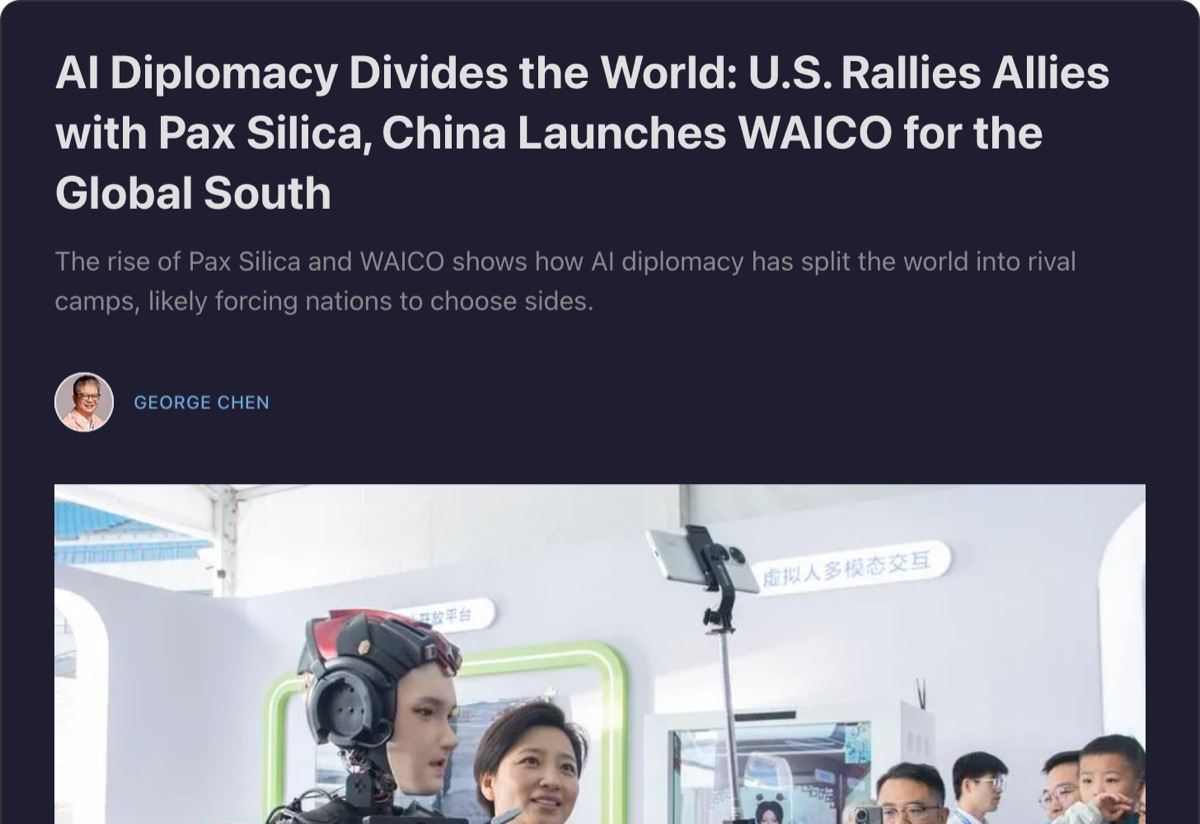
Pax Silica controls the pipes. WAICO writes the rules of the game. As George Chen noted on Substack, this mirrors COVID-era vaccine diplomacy — geopolitical influence following technological distribution.
Notable: all BRICS members except India have signed onto WAICO. India's abstention is the single most significant strategic signal of the week — it preserves optionality across both blocs. UN Secretary-General Guterres attended WAIC in person, lending institutional legitimacy to Beijing's bid.
Note
Three Lessons This Gambit Teaches
Lesson 1: The Distillation Debate Is Already Obsolete
Anthropic has accused Moonshot and other Chinese labs of "industrial-scale distillation" — using millions of exchanges with American models as training data. The Trump administration calls it "adversarial" and has vowed to crack down.
But MIT and Google DeepMind researcher Michiel Bakker stated the quiet part: "These results seem impossible to explain through distillation alone."
K3's Mooncake training stack, its proprietary Delta Attention mechanism, and its MoE routing innovations are not artifacts of distillation. They are genuine architectural advances born from compute scarcity. As researcher Anika Somaia argues, "scarcity has forced innovation" — Moonshot built the Mooncake stack because "a small lab with taste can compress the compute needed to make a frontier model."
The strategic implication: Washington's distillation-focused enforcement regime is fighting the last war. China does not need to steal weights when it can publish competitive ones. The export-control logic assumed a permanent compute gap that K3 just disproved.
We traced this paradox three weeks ago: the embargo gates American models while Chinese alternatives run free. K3 makes the contradiction terminal.
Lesson 2: Open-Weighting Is the Huawei 5G Playbook Applied to Software
In the 2010s, Huawei offered 5G infrastructure at 30-50% below European competitors, embedding Chinese-standard equipment across Africa, Southeast Asia, and Latin America. By the time Washington raised security concerns, Huawei was the default in 170+ countries. Ripping it out was prohibitively expensive.
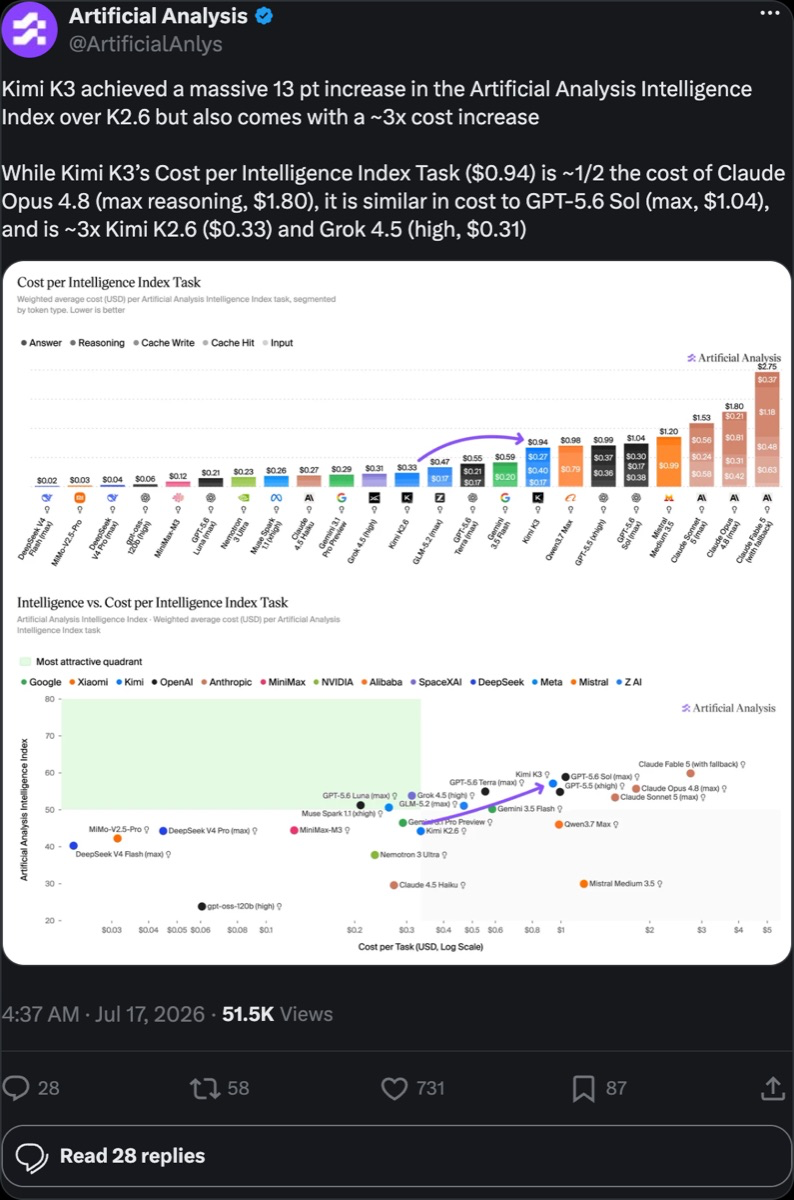
K3 applies the same logic to AI. At $0.94 per task (Artificial Analysis benchmark), K3 undercuts Claude Opus 4.8 ($1.80) by nearly half. When the weights go open on July 27, the cost drops to whatever you can rent a GPU for. For a ministry of health in Nairobi, a fintech in Jakarta, or a university in Sao Paulo, the calculation is not "is K3 as good as Fable 5?" It is "is K3 good enough, and can we actually afford anything else?"
The answer, for most of the world, is obvious.
Lesson 3: The Target Audience Is Not Silicon Valley — It Is the Rest of the World
Xi's WAICO speech makes the customer explicit. Five thousand AI training slots. Cooperation centers with every major Global South bloc. An institutional home in Shanghai.
This is infrastructure diplomacy — the same model China used with Belt and Road, but for cognitive infrastructure instead of physical. The playbook: provide the technology, train the workforce, set the standards, and let dependency follow naturally.
We analyzed the physical chokehold already: China owns the atoms (rare earths). Now it is positioning to own the default weights. Hardware and software chokepoints, controlled by a single state actor. The sovereign compute thesis predicted this split: nations that cannot build their own AI stack must choose whose stack to adopt.
K3 + WAICO is China's bid to be the default answer.
Critical
The Contrarian Case: Why K3 Might Serve US Interests
Not everyone agrees this is a crisis. Transformer News argues that K3 "is not at the frontier" — it trails Fable 5 and Sol on aggregate — and that releasing sub-frontier open weights "carries minimal security risk."
The argument has merit: commoditized intelligence below the dangerous capability threshold is genuinely useful for developing nations. It accelerates development, generates goodwill, and reduces the premium closed labs can charge. If you believe frontier models with advanced cyber capabilities are the real risk, then K3 is a distraction, not a threat.
There is also an argument that bilateral US-China agreements limiting frontier model releases could prove feasible, since neither government benefits from widespread access to models with dangerous capabilities.
The problem with the contrarian case: it assumes the gap between K3 and the frontier is durable. Moonshot's trajectory — K2 to K2.6 to K3 in under a year, each time closing more of the gap — suggests it is not. The contrarian case works today. Six months from now is a different calculation.
What the Community Is Saying
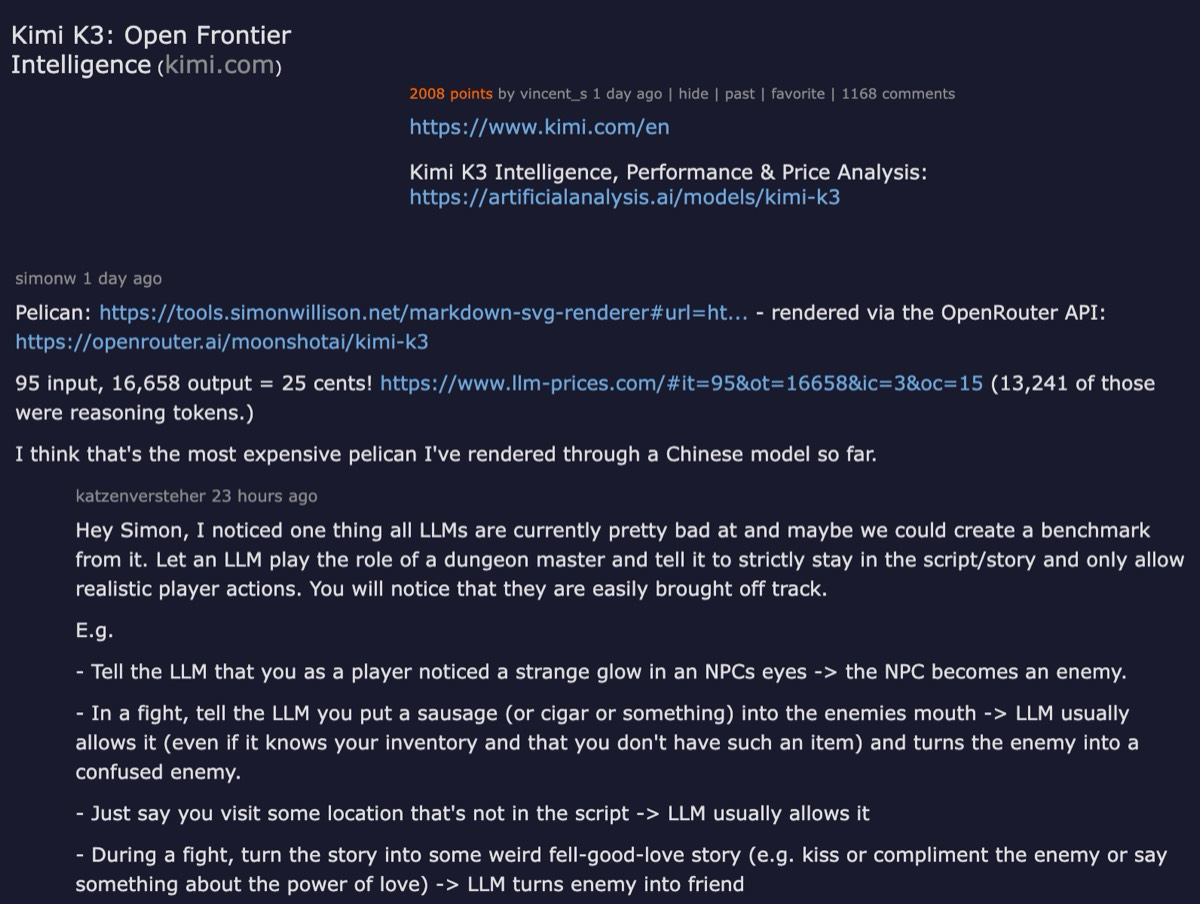
The Hacker News thread on K3's release pulled 2,008 points and 1,168 comments — among the largest AI discussions of the year. The conversation split between technical admiration and strategic anxiety: developers praised K3's desktop UI generation capabilities and long-horizon coding performance, while strategists debated whether open-weighting is a calculated bid to commoditize the layer where American companies extract their margins.
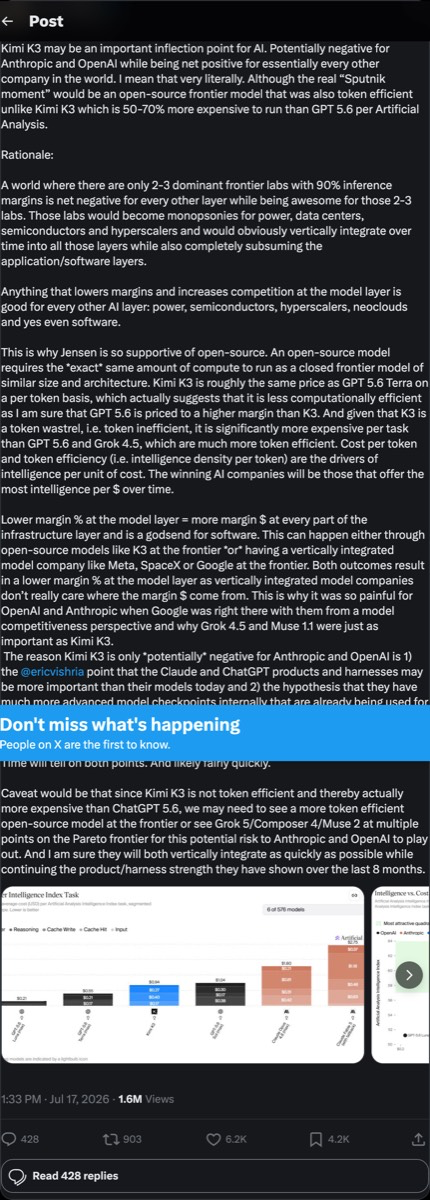
Investor Gavin Baker crystallized the market read: K3 is "an important inflection point for AI" — potentially negative for Anthropic and OpenAI, net positive for essentially every other company on earth.
The Strategic Calculus
Here is what matters, stripped of hype:
Distribution beats performance. K3 is not the best model. It does not need to be. It needs to be the most accessible model — and after July 27, it will be.
WAICO institutionalizes the distribution advantage. Open weights plus an institutional framework for adoption across the Global South creates lock-in. Once a country builds its AI stack on Chinese-standard open weights, switching costs compound — the same way they did with Huawei base stations.
Export controls are fighting the last war. The embargo regime targets hardware chokepoints and distillation enforcement. K3 proves Chinese labs can build competitive models despite compute constraints. Dylan Patel of SemiAnalysis notes that "Chinese companies can easily rent GPUs outside of China," limiting restriction effectiveness. The enforcement focus needs to shift — but to what, exactly, remains unclear.
The real competition is not model quality. It is model availability. Washington's Pax Silica offers hardware access to trusted allies. Beijing's WAICO offers ready-to-deploy models to everyone else. For 130+ countries, the choice is not philosophical. It is practical.
Note
What Comes Next
Three weeks ago, we wrote that the distillation paradox was unsustainable — that Washington could not simultaneously gate American models and watch Chinese alternatives run free. K3 does not resolve the paradox. It makes it irreversible.
The question is no longer whether China can build frontier AI. It is whether the US can compete on distribution when its own models are gated, priced for enterprise margins, and restricted to a coalition of 24 nations — while China offers open weights to the other 170.
That is not a technology question. That is a power question. And on power questions, incumbents who control the pipes have lost to challengers who set the standards before. The Washington consensus on export controls assumed that controlling supply was the same as controlling the market. K3 + WAICO is the empirical test of that assumption — and the early results are not encouraging for the incumbent.
The weights drop July 27. The clock is running.
The Desk
About The Arc of Power
The Arc of Power editorial desk delivers rigorous analysis of geopolitics, defense, economic statecraft, and intelligence — examining the forces that shape the global order.
Briefing Access
Request Briefing Access
In-depth geopolitical analysis — power dynamics, defense strategy, and economic statecraft — three times a week. No noise.
Request briefing access