Case file · Geopolitics · 14 min read
Trump's Hormuz Toll Play and the 88% Market Spike
Trump declared the US 'Guardian of Hormuz,' demanding a 20% cargo toll. Polymarket's blockade market spiked 88.8%. What the money is pricing.
The Arc of Power ·
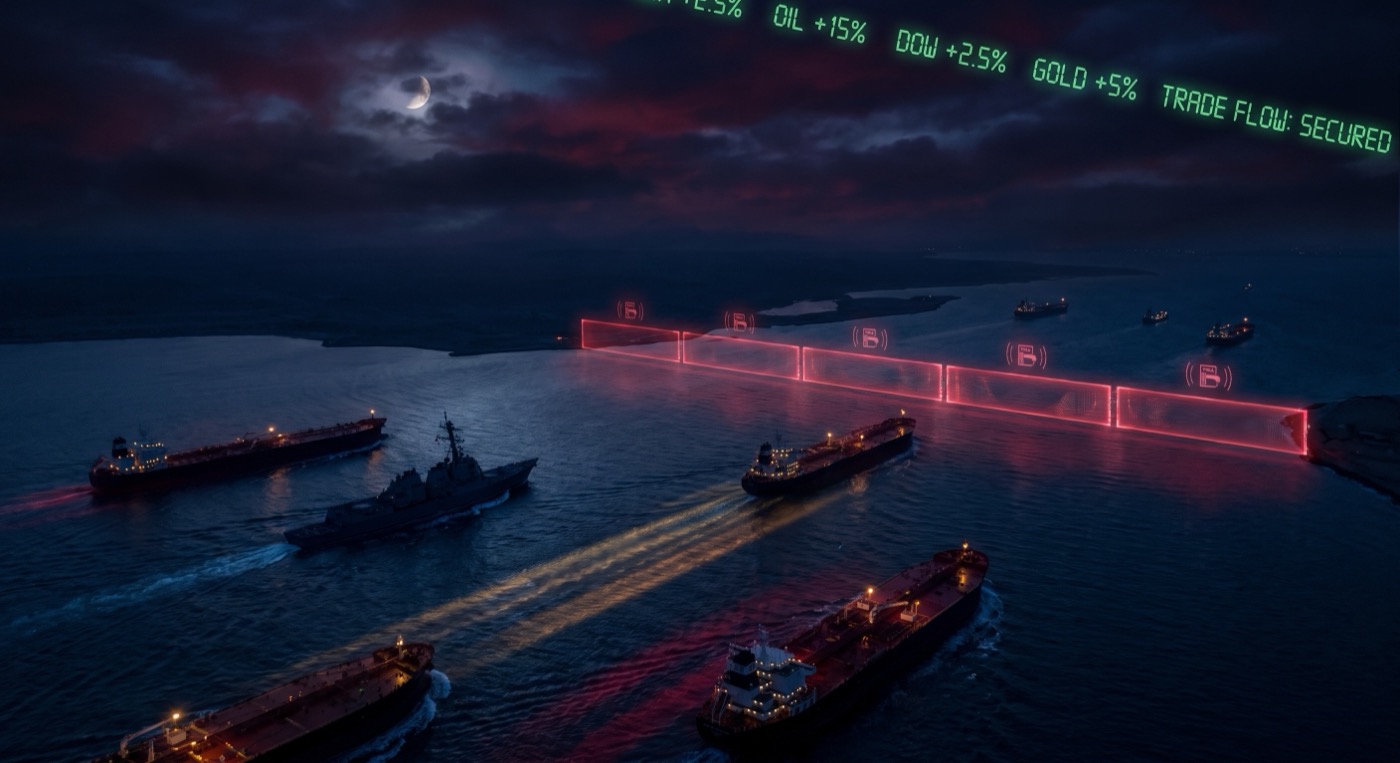
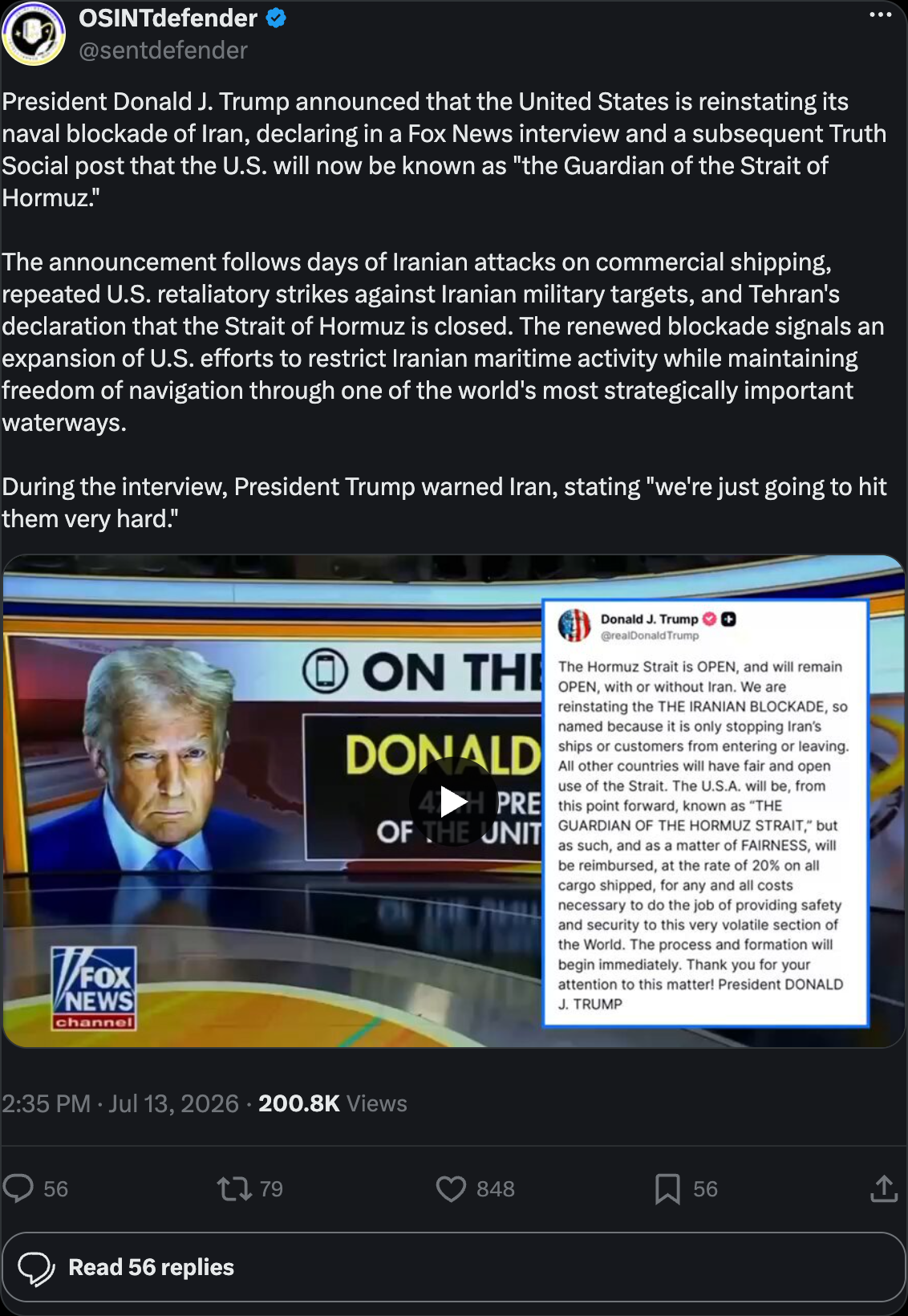
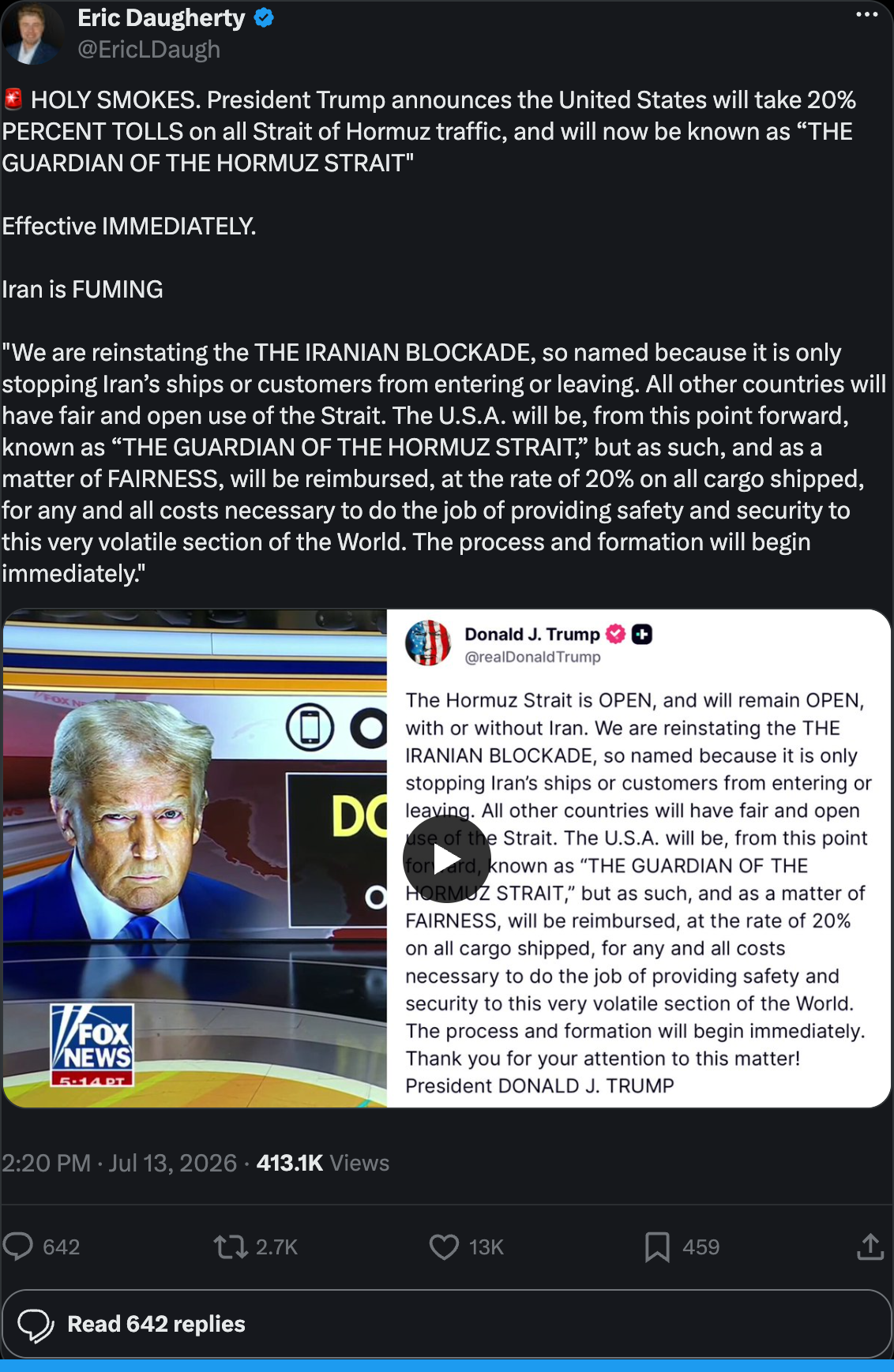
On July 13, President Donald Trump posted to Truth Social that the United States would reimpose its naval blockade of Iranian ports, effective Tuesday at 4 p.m. ET. That alone would have been news. But Trump added something new: the US would charge a 20% levy on all cargo transiting the Strait of Hormuz. "The U.S.A. will be, from this point forward, known as 'THE GUARDIAN OF THE HORMUZ STRAIT,'" he wrote, "but as such, and as a matter of FAIRNESS, will be reimbursed, at the rate of 20% on all cargo shipped."
Within hours, Polymarket's "US announces blockade on Iran" market hit 100% on all near-term buckets -- up 88.8% in a single week. That is not a poll. It is $705,763 in 24-hour trading volume, $2.4 million in total wagers, with real money confirming that the blockade is operational fact, not rhetorical posturing. A separate market tracking Iranian military action against a Gulf state surged 33.4% today to 78%, while Iran's withdrawal from the memorandum of understanding climbed 34% this week.
Brent crude jumped 9.6% to $83.30 per barrel -- the international benchmark's largest single-day gain since May 2020. Vessel traffic through the strait fell to just 14 ships on Sunday versus 37 a week earlier, a two-month low. An increasing number of vessels have switched off their AIS transponders entirely, going dark through the world's most contested waterway.
Our thesis: The toll is not a sideshow to the blockade. It is the point. Trump is converting temporary military leverage into a permanent revenue claim on the world's most important oil chokepoint -- and in doing so, is adopting the exact playbook that Iran pioneered and that his own Secretary of State called illegal three weeks ago. The Polymarket spike tells you something the headlines miss: money is pricing not just a blockade but a structural change in how the Strait of Hormuz operates.
The Rubio Contradiction: Three Weeks from "Illegal" to Policy
On June 23, Secretary of State Marco Rubio stated publicly that "no country is allowed to charge tolls or fees on an international waterway. That's existing international law." He was responding to Iran's attempt to charge ships for safe passage through the strait -- fees that Iran's "Strait Authority" had been collecting in yuan and cryptocurrency since April, at rates reportedly reaching $2 million per vessel.
Twenty days later, Trump proposed the same thing at ten times the scale.
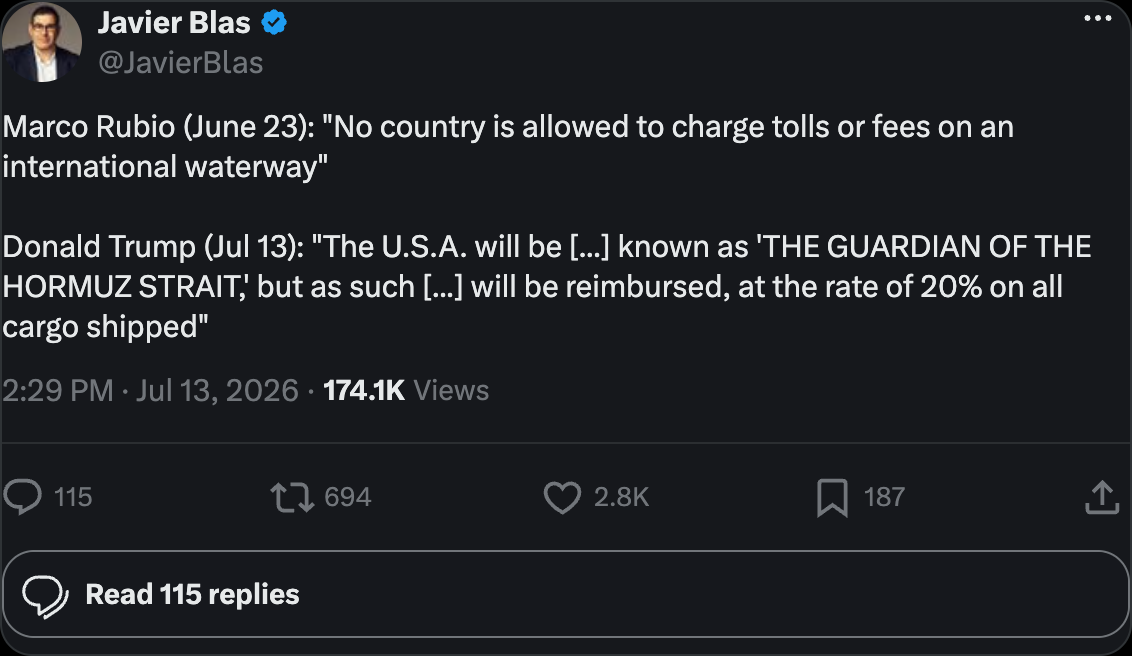
Bloomberg energy columnist Javier Blas captured the contradiction in a single post: Rubio's June 23 statement that no country may charge tolls on the strait, placed directly against Trump's July 13 declaration that the US will do exactly that. The post went viral for a reason -- it is the clearest distillation of the policy reversal.
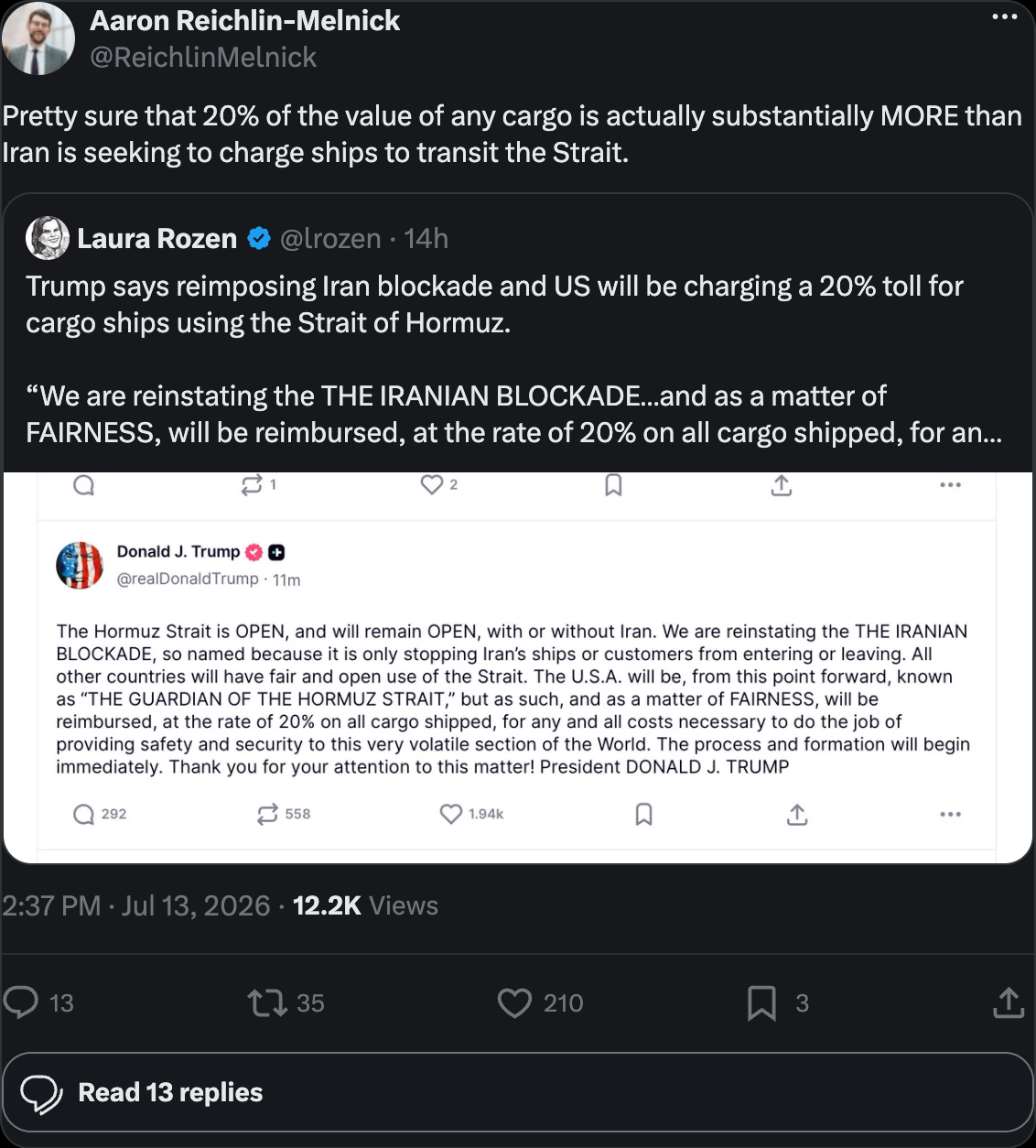
As policy analyst Aaron Reichlin-Melnick noted: "Pretty sure that 20% of the value of any cargo is actually substantially MORE than Iran is seeking to charge ships to transit the Strait." He is correct. Iran's $2 million per-vessel fee was exorbitant by any standard. A 20% ad valorem cargo levy on a waterway handling roughly $970 billion in annual trade could theoretically generate nearly $200 billion per year -- dwarfing Iran's crude shakedown by orders of magnitude.
Three Lessons the Toll Doctrine Teaches
Lesson 1: The US Has Adopted Iran's Playbook -- and Escalated It
Fortune's analysis frames this directly: Trump is taking a page from Iran's playbook. Since April, Iran weaponized the Strait of Hormuz by closing navigation and demanding tolls for safe passage. Trump has now adopted the identical leverage, monetizing American military protection of a waterway where the US previously guaranteed free passage at no charge.
But there is a critical escalation. Iran's toll was a flat per-vessel fee -- a crude shakedown that most ships avoided by routing around. Trump's 20% ad valorem levy is a tariff on trade itself. It scales with cargo value. A supertanker carrying $150 million in crude would owe $30 million for transit. A container ship moving $50 million in manufactured goods: $10 million. This is not a toll. It is a chokepoint tax.
The operational reality is even more revealing. Despite US protection efforts, "the U.S. has not stopped every Iranian projectile aimed at commercial ships" -- undermining the security guarantee that supposedly justifies the toll. Ships now face compounded costs: Iranian attack risks plus Trump's 20% tariff. Traffic through the US-protected corridor has nearly disappeared, with vessels increasingly using darkened routes instead.
Lesson 2: International Law Is No Longer the Constraint -- Only Power Is
The International Maritime Organization responded within hours: "IMO stands firmly against charging fees for passage through straits used for international navigation. There is no legal basis through which to introduce mandatory tolls simply to transit through a strait."
Just Security's legal analysis is even more definitive. Article 37 of UNCLOS establishes a "non-negotiable right of transit passage" through international straits. Article 26 prohibits charges "by reason of passage alone." These rights constitute customary international law binding all states regardless of UNCLOS ratification -- meaning both the US and Iran are bound despite neither having ratified the convention.
But here is the lesson the legal scholars will not say plainly: it does not matter. Iran has been charging illegal tolls since April. The IMO condemned it. Nothing happened. Now the US is proposing the same thing at a larger scale. The IMO has condemned that too. Nothing will happen. The Strait of Hormuz is teaching us in real time that international maritime law is only as strong as the navy willing to enforce it -- and when both competing navies are the ones violating it, the law becomes advisory.
Critical
Contrarian Corner: Is the toll actually unenforceable theater? Energy analyst Bob McNally of Rapidan Energy called it "a distraction" -- arguing Trump has no mechanism to collect 20% of cargo value from foreign-flagged vessels. There is no toll booth at Hormuz. No customs authority. No international agreement. The counter-argument: Trump does not need a collection mechanism. He needs the threat. The US Navy already inspects vessels as part of the blockade. Adding a "protection fee" to transit approval is operationally trivial -- and legally irrelevant if no court can enforce a ruling against the force doing the inspecting.
Lesson 3: The Prediction Markets Have Already Priced the Endgame
The Polymarket data tells a story that the news cycle has not caught up to. Consider what the money is actually saying:
- US blockade on Iran: 100% on all near-term buckets (up 88.8% this week). $705,763 in 24-hour volume. The market is not pricing a possibility -- it is pricing a fact.
- Iran military action against a Gulf state: 78% for the nearest bucket (up 33.4% today). $221,497 in 24-hour volume. Money is pricing Iranian retaliation targeting Gulf allies, not just the US.
- Iran withdrawal from MOU: 43% (up 34% this week). $313,329 in 24-hour volume. The ceasefire framework is being priced as dead.
- US-Iran nuclear deal: 30% by December (down 15% this week). $252,987 in 24-hour volume. The diplomatic path is being sold.
- Hormuz traffic returns to normal by July 31: 3%. The market is pricing months of disruption, not weeks.
Read those numbers together. The money is not just betting on a blockade. It is betting on a sustained confrontation where Iran retaliates against Gulf states, the MOU collapses formally, nuclear diplomacy stalls, and Hormuz traffic stays disrupted for the foreseeable future. The toll proposal is the mechanism that makes all of this self-reinforcing: it gives Trump a financial incentive to maintain the disruption.
The Iran Counter-Move Nobody Is Watching
Iran's response was extraordinary and underreported. Foreign Minister Abbas Araghchi posted on X: "Whoever provides secure and safe passage of commercial vessels through the Strait of Hormuz should be compensated for this service. Iran has always been the GUARDIAN of the Strait and will remain so FOREVER. 20% is of course too much. We will be fair."
Read that again. Araghchi did not reject the toll concept. He endorsed it -- and counter-offered. Iran's foreign minister just told the world that his government also believes whoever controls Hormuz should be paid for the privilege. He is haggling over price, not principle.
This is the moment when the Strait of Hormuz stopped being an international waterway under the law of the sea and started being a revenue asset contested between two governments, each claiming the right to charge for passage. Iran has its "Strait Authority." Trump has declared himself "Guardian." The IMO can condemn both as vigorously as it likes. Neither party has shown any interest in listening.
The Oil Price Signal Is Structural, Not Speculative
Oil's 9.6% single-day surge is not just a fear premium. It reflects three compounding factors that the toll doctrine makes permanent:
First, supply contraction. The Pentagon estimates that the original April-June blockade cost Iran $4.8 billion in oil revenue in its first 18 days. By May 22, the US had "turned 94 vessels away." Kuwait, Iraq, Saudi Arabia, and the UAE collectively lost 10+ million barrels per day of export capacity during the first blockade. Reimposing it recreates that contraction.
Second, a transit tax on top of supply disruption. Even non-Iranian vessels now face a theoretical 20% cargo levy. Whether or not the toll is enforceable, the ambiguity itself is a cost. Shippers will price the risk, insurers will raise premiums, and buyers will seek alternatives. Roughly 20 million barrels of oil -- 20% of global seaborne supply -- transit Hormuz daily.
Third, the AIS dark zone. Ships are switching off transponders to avoid both Iranian and US attention. This creates an information vacuum that raises insurance costs, complicates maritime security, and makes price discovery harder. The Strait has effectively become a dark corridor where neither side can fully account for what is moving through.
The Gulf Allies Were Not Consulted
Axios reported that a senior Gulf source confirmed the US had not discussed the toll proposal with its regional allies. This matters enormously. Saudi Arabia, the UAE, Kuwait, and Iraq depend on the Strait for the bulk of their oil exports. A 20% cargo toll on their shipments -- imposed by their security partner -- amounts to a tax on their primary revenue stream, levied without their consent.
Iran's military command has already warned regional allies against cooperating with US operations, calling such support "an act of war." Gulf states are now caught between a security partner demanding 20% of their export revenue and an adversary threatening military consequences for cooperation.
Slate's analysis places the toll in a broader pattern: Venezuela's forced oil exports to the US, the $1 billion "Board of Peace" fee for Gaza reconstruction, equity stakes demanded from private companies. The Hormuz toll is the maritime version of the same template -- extracting payment for services previously provided freely, using military leverage as the collection mechanism.
Note
What the Polymarket Cluster Signals: When you see blockade confirmation at 100%, Gulf state military action at 78%, MOU withdrawal at 43%, and nuclear deal odds falling to 30% -- all in the same week, all with six-figure daily volumes -- the market is pricing a regime shift, not an incident. The toll doctrine converts a temporary military operation into a permanent economic claim. That is what 88.8% in a week looks like when money confirms structural change.
What Comes Next: The Toll Doctrine's Endgame
The toll is unlikely to be collected in any conventional sense. There is no customs authority, no billing mechanism, no international agreement authorizing collection. But that misses the point. The declaration itself restructures the strategic calculus in three ways:
It creates a precedent for monetizing naval protection. Every US military operation protecting commercial shipping -- from the Red Sea to the South China Sea -- now has a potential revenue justification. If the US can charge for Hormuz, why not the Strait of Malacca? The Suez approaches? The Chatham House analysis of the broader Hormuz crisis warned this precedent could "unravel the freedom-of-navigation framework that has underpinned global trade since 1945."
It makes de-escalation more expensive. Lifting the blockade now means forfeiting a $194 billion annual revenue claim. Even if the number is theoretical, backing down from it carries a domestic political cost. The toll doctrine makes the blockade self-reinforcing.
It aligns US and Iranian interests in a perverse way. Both governments now claim the right to charge for Hormuz transit. Both have a financial incentive to maintain disruption, because peace eliminates the justification for the fee. Araghchi's counter-offer was not diplomacy -- it was a signal that Iran sees the toll framework as legitimizing its own claims.
The NPR reporting frames this as "the US and Iran fighting for control of the Strait of Hormuz." That undersells it. They are not fighting for control. They are competing to be the toll collector.
The Bottom Line
The Hormuz toll doctrine is the clearest signal yet that the post-1945 maritime order -- free navigation through international straits, guaranteed by US naval power at no charge -- is being replaced by something transactional. The US Navy still patrols Hormuz. But it is no longer doing so as a guarantor of global commons. It is doing so as a vendor of security services, billing at 20% of cargo value.
Polymarket has priced this faster than any policy analyst. The 88.8% weekly spike on the blockade market, combined with 78% odds on Iranian Gulf retaliation and 3% odds on traffic normalization, tells you the market sees a new normal, not a crisis that resolves. The money is right more often than the diplomats.
Three prior Arc of Power articles analyzed the Hormuz crisis from different angles: the ceasefire collapse and trade unwind, the French vessel strike and the 78% peace misprice, and the UK refusal and NATO fracture. This article introduces a new variable: the toll. The blockade was coercion. The toll converts coercion into a business model. That is the structural shift that $2.4 million in prediction market volume is confirming today.
The Desk
About The Arc of Power
The Arc of Power editorial desk delivers rigorous analysis of geopolitics, defense, economic statecraft, and intelligence — examining the forces that shape the global order.
Briefing Access
Request Briefing Access
In-depth geopolitical analysis — power dynamics, defense strategy, and economic statecraft — three times a week. No noise.
Request briefing access