Case file · Geopolitics · 11 min read
Netanyahu's 18-Point Collapse
Polymarket's biggest geopolitics bet is a 38-38 dead heat on Israel's next PM. What $1.39M in 24-hour volume knows about the coming power transition.
The Arc of Power ·
Netanyahu's 18-Point Collapse: Israel's Leadership Coin-Flip and What a $1.39M Bet Knows
Polymarket's Israel next-PM market is now the single largest active geopolitics bet on the platform: $1.39 million in 24-hour volume, $1.7 million in liquidity. The odds tell a story that Israeli headlines are still catching up to:
- Netanyahu: 38%
- Gadi Eisenkot: 38%
- Naftali Bennett: 12%
That's a dead heat — the first time in his career that Benjamin Netanyahu has been tied for the premiership with a challenger on a liquid prediction market. And the trajectory is worse: Netanyahu has fallen 18 points this month alone, from a comfortable 56% to a coin-flip. When $1.39 million in 24-hour capital prices your tenure as a literal 50/50, the political ground beneath you has shifted.
Note
The Polymarket read: This is not a poll. This is capital at risk — traders putting real money on the outcome. The market's size ($1.7M liquidity) makes it the platform's most-traded geopolitics contract, bigger than the Iran ceasefire markets and the Taiwan escalation bets. When smart money moves this aggressively, it's pricing information that polls haven't published yet.
The Eisenkot Lane
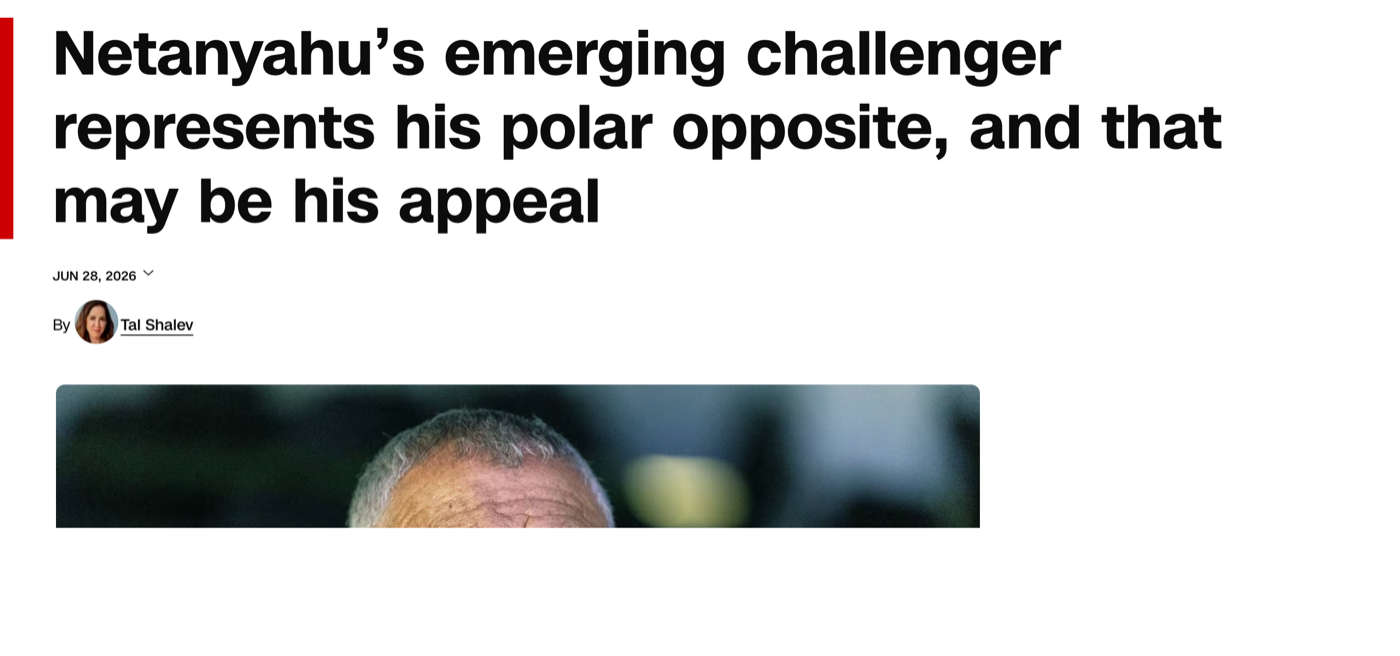
The man who has swallowed Netanyahu's margin is not Naftali Bennett, the previous challenger-in-chief. It's Gadi Eisenkot — former Chief of the General Staff of the Israel Defense Forces, founder of the Yashar party, and a man who has never held elected office.
Times of Israel polling now shows Eisenkot's Yashar overtaking Bennett's Together alliance for the first time. Jerusalem Post data has Yashar tying Likud at 21 seats — a number that would have been unthinkable three months ago.
The lane Eisenkot occupies is the security-establishment lane: the voter who wants a strong military posture but has lost faith that Netanyahu can deliver one. His personal tragedy — his son Gal was killed fighting in Gaza — gives him a moral authority that no other Israeli politician currently holds. He is the grieving father who commanded the military that sent his son. That combination of personal sacrifice and institutional credibility is the most powerful political brand in Israeli politics right now.
In head-to-head polling, Netanyahu leads Eisenkot only 37% to 36% — within the margin of error. In another poll, 43% prefer Eisenkot and 39% Netanyahu as prime minister. The signal is the same in both datasets: the gap has closed to nothing.
Bennett's Disappearing Act
The prediction market's most underappreciated signal is Bennett's collapse. Naftali Bennett — the man who replaced Netanyahu in 2021, the man who has consistently led opposition polling for the past two years — has fallen to 12% on Polymarket. His Together alliance has dropped from 17 to 15 seats in recent Maariv polling.
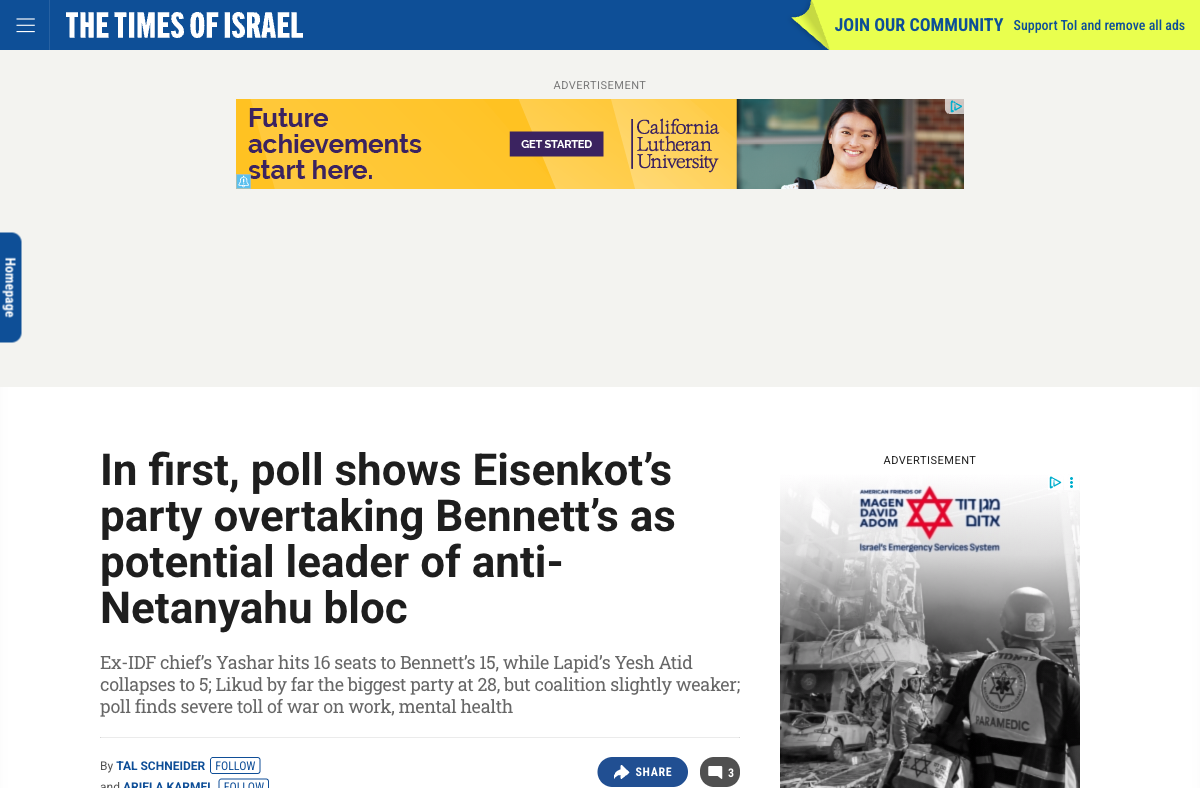
Bennett's problem is structural: he built a brand as the anti-Netanyahu centrist, but Eisenkot occupies that lane now with more credibility. Bennett governed; Eisenkot commanded the military and buried his son. In Israeli security politics, that hierarchy of sacrifice matters. Polls show that even if Yashar and Together united under Eisenkot's leadership, they would win 37 seats — but Eisenkot has signaled he won't head a coalition he doesn't lead.
The Bennett-Lapid Together alliance is bleeding voters upward to Eisenkot and downward to smaller parties. The once-dominant centrist bloc is fracturing at the exact moment it needs to consolidate. This is the chaos that keeps Netanyahu's 38% alive — the opposition's inability to agree on a leader may be the only thing preventing a decisive defeat.
The Coalition Math
The numbers that matter aren't the head-to-head polls — they're the Knesset seat projections.
Haaretz's latest aggregation shows:
- Coalition bloc: 49-52 seats
- Opposition bloc (excluding Arab parties): 58-61 seats
- Opposition bloc (including Arab parties): 65-68 seats
The 61-seat majority threshold is the number that determines who forms a government. The opposition has been above it consistently since June. Netanyahu's coalition has not cracked 55 in months.
55% of Israelis surveyed now say they would prefer Netanyahu not run in the upcoming election and instead retire from political life — 38% want him to run. That 17-point retirement gap is the clearest signal of political exhaustion since Netanyahu's first term ended in 1999.
The Iran Backlash
The catalyst for Netanyahu's collapse is not a single event — it's the cumulative weight of the Iran policy's failure to produce the decisive victory he promised.
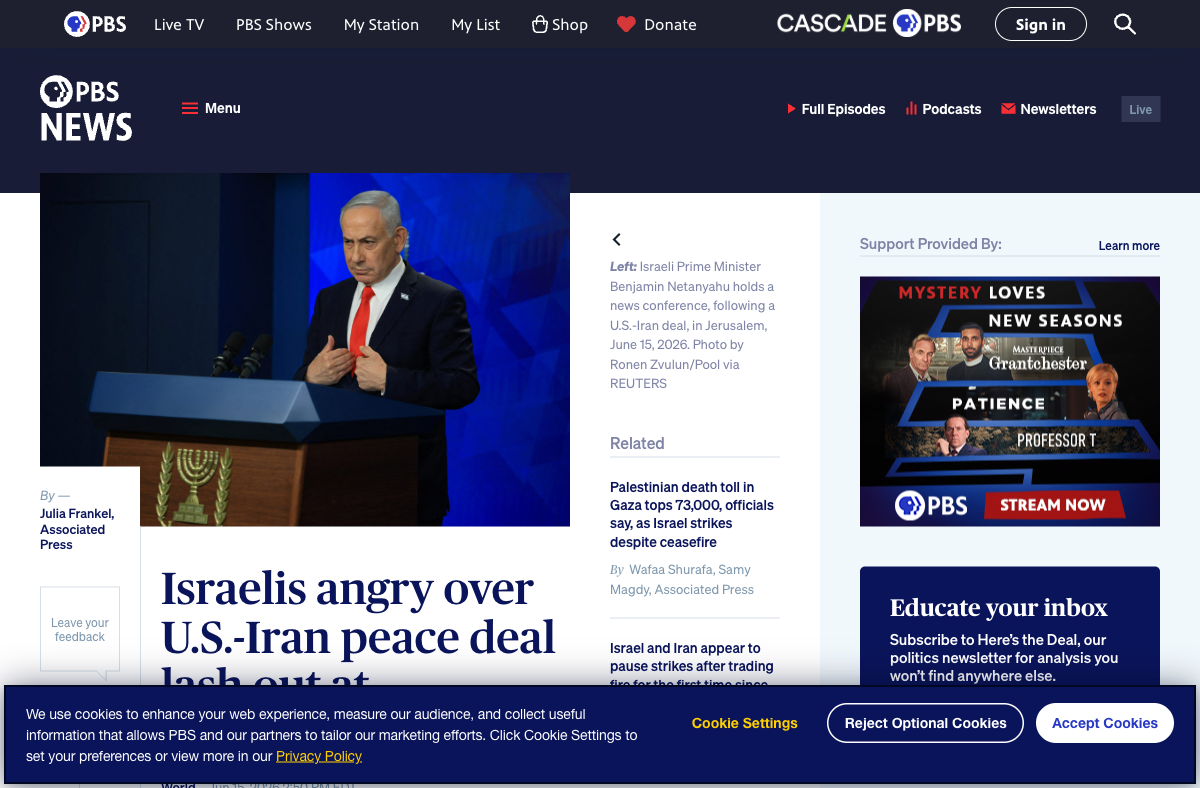
PBS reports that Israelis reacted angrily to the US-Iran ceasefire deal, with 61% rejecting the ceasefire and directing their fury at Netanyahu. The criticism has a specific shape: Netanyahu led Trump into Operation Epic Fury, overpromised what it could achieve, and was outflanked by Iran in negotiations. He bet on regime change in Tehran and got a ceasefire that binds Israel to terms it wasn't party to.
Critical
The strategic trap: Chatham House analysis frames Israel under Netanyahu as a "Super-Sparta" model — a state of perpetual mobilization that demands total social buy-in. The problem: strategic fatigue is setting in. The public supports the objectives but increasingly resents a government that cannot define or deliver an end-state. That's not a policy failure — it's a legitimacy failure.
Netanyahu is caught between the US, the Lebanon war, and the Iran ceasefire — a three-front political crisis that mirrors the multi-front military posture he championed. Each front demands a different answer, and the answers contradict each other: hawkish on Lebanon requires defying the US ceasefire framework, accepting the ceasefire means conceding the Iran war's failure, and doubling down on the Begin Doctrine opens questions about what comes after.
The Election Clock
Israel's next legislative election is scheduled for fall 2026, though the exact date has not been set. Netanyahu's coalition, weakened by defections and poll erosion, faces pressure to either call early elections or attempt to hold together through the mandated term.
The timing matters because it intersects with three external deadlines: the Iran ceasefire review period, the US midterm election cycle, and the Lebanon withdrawal framework. Each of these creates a window of constraint — Netanyahu cannot credibly campaign as a wartime leader if the wars are winding down, but he cannot credibly campaign as a peacemaker if the public views the peace as an American imposition.
The Polymarket contract resolves on who becomes PM after the next election — not whether there will be an early election. But the market's 24-hour volume spike suggests traders are pricing in a higher probability that elections come sooner rather than later. A coalition that polls at 49-52 seats is a coalition that rational members start leaving to protect their own careers.
What Changes If Netanyahu Falls
The prediction market isn't just pricing a political transition. It's pricing a geopolitical one. A non-Netanyahu Israel would face three immediate repricing events:
1. The Iran posture. Netanyahu's Iran policy is maximalist: regime change or nothing. Eisenkot comes from the security establishment that advised a more surgical, deterrence-focused approach. A transition from the Begin Doctrine's maximalism to calibrated deterrence would be Israel's biggest strategic shift since Oslo. The Iran ceasefire dynamics would shift from Israeli obstruction to potential engagement.
2. The US alignment. Netanyahu's relationship with Trump has been the centerpiece of his foreign policy — and the source of his vulnerability when Trump's priorities diverged. Eisenkot would need to rebuild on a different basis: institutional alignment rather than personal alliance. The Hormuz de-escalation dynamics that matter to global energy markets would be shaped by this shift. A defense establishment PM would naturally gravitate toward Pentagon-to-Pentagon channels rather than the Mar-a-Lago direct line that defined Netanyahu's approach.
3. The coalition structure. A post-Netanyahu government would almost certainly lack the ultra-Orthodox and settler-movement parties that anchor his current coalition. That means budget priorities shift, conscription exemptions end, and the West Bank policy calculus changes fundamentally. The downstream effects on US foreign aid, European relations, and Gulf normalization are massive.
4. The judicial and legal landscape. Netanyahu faces ongoing criminal proceedings. A new government would have no incentive to shield him from prosecution — and strong incentive to demonstrate institutional independence by letting the process proceed. The political calculation that has suspended full legal accountability for the sitting PM would evaporate on inauguration day.
5. The Gulf normalization track. Saudi Arabia has signaled willingness to normalize relations with Israel, but only under conditions that Netanyahu's far-right coalition partners have rejected. An Eisenkot government could unlock the Abraham Accords expansion that has been stalled for two years — a geopolitical prize that would reshape the Middle East's alignment structure more profoundly than any military campaign.
Reading the Market's Signal
Prediction markets are not oracle machines. They aggregate available information more efficiently than polls, but they carry their own biases: recency bias, liquidity-driven momentum, and the tendency of crypto-native traders to overweight dramatic narratives. The Netanyahu market has all three risk factors.
But the volume tells a different story than a normal political contract. $1.39M in 24 hours is not retail noise — it's institutional capital or whale traders moving with conviction. The liquidity depth ($1.7M) means these positions can be entered and exited without moving the price significantly, which means the 38-38 reading reflects genuine disagreement between large, informed traders, not a thin market being moved by one bet.
The comparable data point: Polymarket's Trump 2024 presidential market peaked at similar daily volumes only in the final month before the election. The Netanyahu market is hitting those volumes with the election still months away. Either the market is wrong, or something fundamental has shifted that Israeli polling has not yet captured.
The Honest Read
Polymarket is pricing a coin-flip on the longest-serving prime minister in Israeli history. The 18-point monthly collapse is real — it's not noise, it's capital voting on information that conventional polls are still processing.
But prediction markets have limitations. They price the most likely next event, not the most likely long-term outcome. Netanyahu has survived worse — he's been investigated, indicted, removed from office, and returned to power before. The man's survival instinct is his most reliable political asset.
What the market is saying is narrower and more specific: right now, at this moment, the smart money cannot tell whether Netanyahu will be Israel's next prime minister. That's not a prediction of his fall. It's a recognition that the outcome is genuinely uncertain for the first time in a decade.
And when the outcome of Israeli leadership is genuinely uncertain, everything downstream — Iran, the Strait of Hormuz, US Middle East policy, Gulf normalization, the prediction market integrity we rely on to track these shifts — all of it enters a repricing window that hasn't closed yet.
The $1.39 million bet isn't just about who becomes prime minister. It's about whether the strategic architecture of the Middle East — built around Netanyahu's maximalism, Trump's personal alignment, and the Begin Doctrine's logic of preemption — survives the Israeli voter's judgment that the man who built it has run out of road.
The fall election is months away. Netanyahu has time, and time is the resource he has historically converted into survival more reliably than any other politician on Earth. But the Polymarket odds suggest something different this time: the conversion rate is falling. Each week that passes without a decisive win — in Lebanon, in the polls, in the courts — the market ticks another point away from the man who has defined Israeli politics for a generation.
At 38-38, the market is saying: the era may end. Or it may not. And the fact that we genuinely cannot tell the difference is itself the story.
The Desk
About The Arc of Power
The Arc of Power editorial desk delivers rigorous analysis of geopolitics, defense, economic statecraft, and intelligence — examining the forces that shape the global order.
Briefing Access
Request Briefing Access
In-depth geopolitical analysis — power dynamics, defense strategy, and economic statecraft — three times a week. No noise.
Request briefing access