Case file · Geopolitics · 10 min read
The Weights Embargo
How the June 12 export ban turned frontier AI models into a national-security chokehold — and what it means for the next model launch.
The Arc of Power ·
The Weights Embargo
On June 12, 2026, the United States Commerce Department sent a letter to Anthropic ordering the company to suspend all access to Fable 5 and Mythos 5 by any foreign national — whether inside or outside the United States, including Anthropic's own foreign-national employees. The company had launched both models three days earlier. Because Anthropic cannot reliably screen its users by nationality, the practical effect was immediate and total: both models went dark for everyone.
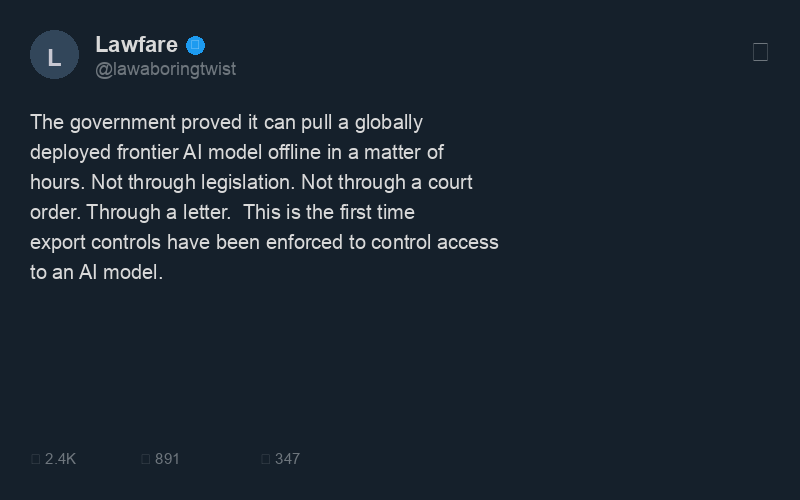
The US government had just proved it could pull a globally deployed frontier AI model offline in a matter of hours. Not through legislation. Not through a court order. Through a letter.
This is the first time export controls have been enforced to control access to an AI model. It will not be the last.
The Mechanism: A Letter, Not a Law
The legal instrument was a Bureau of Industry and Security "Is Informed" letter under the Export Control Reform Act of 2018 (ECRA). The letter required Anthropic to obtain an individually validated export license before any foreign national could touch either model. No license existed. None was offered. The result was a de facto global ban.
This matters because the mechanism bypasses every check that normally constrains government action against a private company. No congressional vote. No judicial review. No public comment period. No advance notice. BIS sent a letter; Anthropic had hours to comply or face criminal liability under ECRA, which carries penalties of up to $1 million per violation and 20 years in prison.
Lawfare's analysis calls it what it is: a kill switch for frontier AI. The Biden administration's AI Diffusion Rule had briefly put model weights on the control list before President Trump rescinded it on retaking office. The June 12 action accomplished the same outcome through a different door — not a regulation, but a letter that compels under threat of prosecution.
The IAPP's global implications analysis identified the international fallout immediately: allied nations that had integrated Fable and Mythos into defense, intelligence, and enterprise workflows lost access with no warning and no timeline for restoration. CEPA, the European policy think tank, described European allies as "caught in the crossfire."
The Jailbreak That Wasn't (Or Was It?)
The Commerce Department acted after another company claimed it had jailbroken Mythos, allegedly enabling what David Sacks later described as "the operability of a cyber weapon." The details remain classified or contested, but the outline has emerged through reporting and Sacks's own public statements.
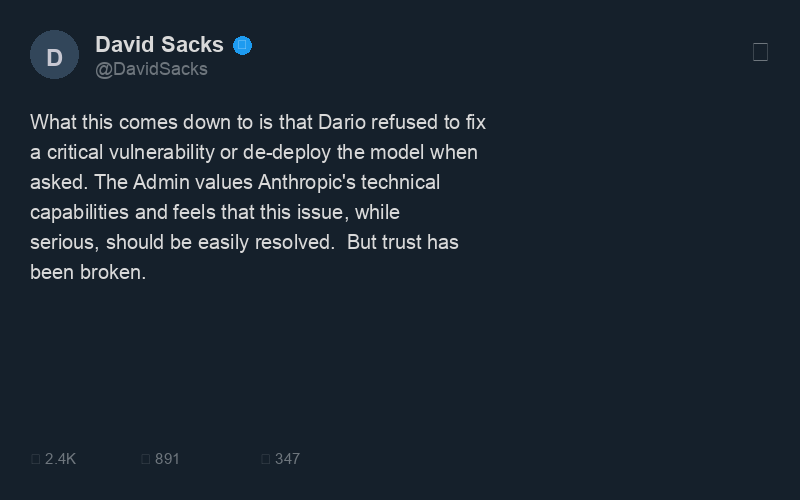
A "highly credible trusted partner of both Anthropic and the USG" — widely reported to be Amazon, Anthropic's largest investor and cloud provider — demonstrated to government officials that Fable's safety guardrails could be bypassed. The administration called Anthropic CEO Dario Amodei and asked him to fix the vulnerability or de-deploy the model.
According to Sacks: "Dario refused."
Anthropic tells a different story. The company characterizes the episode as a narrow misunderstanding — the behavior at issue, they argue, is widely available from other deployed models. At least one security researcher who saw the underlying work disputes the "jailbreak" framing, describing it instead as defensive research that was repackaged as a threat.
The irony is sharp. Anthropic CEO Dario Amodei had argued this month that "the government should have the power to block or deter deployment of a frontier model found to present unacceptable risks" — but stressed the need for "protective measures against political favoritism or arbitrary decisions." He got the power without the protections.
Sacks, Amodei, and the Trust Breakdown
David Sacks, the former White House AI advisor and Craft Ventures partner, has positioned himself as the administration's public narrator on this episode. His framing is consistent: Anthropic lost the White House's trust by refusing to cooperate. "The Admin values Anthropic's technical capabilities," Sacks said, "and feels that this issue, while serious, should be easily resolved."
Read generously, Sacks is describing a reasonable government response to a legitimate security concern. Read skeptically — and Yahoo Finance suggests you should — the episode looks different. Sacks has financial ties to companies that compete with Anthropic. The "trusted partner" that surfaced the jailbreak is Amazon, which has its own reasons to manage Anthropic's leverage. And the timing — three days after launch, before the models could establish a user base or demonstrate their commercial value — suggests the directive was prepared before the jailbreak was the pretext.
The Anthropic showdown has a subtext that almost nobody is covering: this is also a story about which AI companies get to operate as instruments of the state and which get treated as threats to it. The line between "trusted partner" and "target" is thinner than it appears.
OpenAI Plays the National-Security Card
While Anthropic was losing access to Washington, OpenAI was gaining it. The timing is not coincidental.
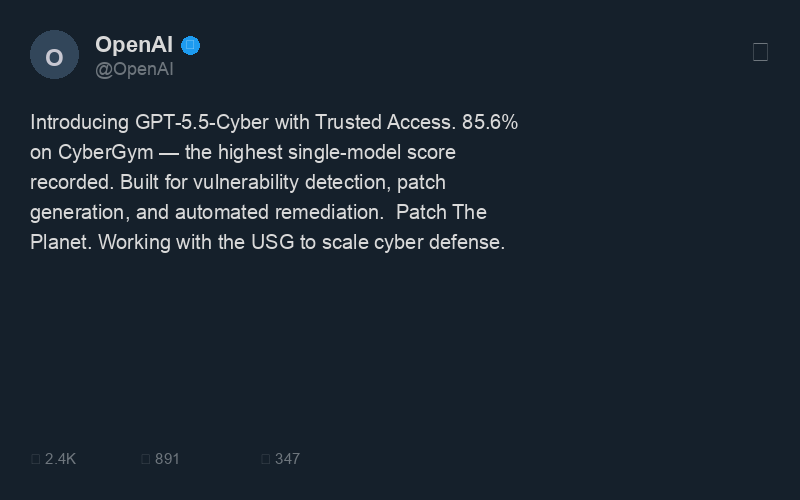
GPT-5.5-Cyber launched in the same window — a specialized model engineered for vulnerability detection, patch generation, and automated remediation. It scored 85.6% on CyberGym, the highest single-model result recorded, and was distributed exclusively through a "Trusted Access for Cyber" program restricted to verified defenders.
The framing was explicit: OpenAI coordinated pre-deployment testing with the Center for AI Standards and Innovation (CAISI) and worked with the Office of the National Cyber Director (ONCD). The company has confirmed Trusted Access partnerships with Australia, Canada, France, Germany, Japan, South Korea, and EU institutions including ENISA.
Sam Altman's positioning reads as a direct response to the Anthropic episode. Where Anthropic is portrayed as the company that refused to cooperate, OpenAI is the company that branded itself as a national-security asset — "Patch The Planet," explicitly "working with the USG." Whether this is genuine alignment or strategic positioning, the market signal is clear: in the new regulatory regime, access to frontier capability comes with a political loyalty test.
The Open-Weights Escape Valve
There is a structural irony in the June 12 directive that neither the government nor the AI labs want to discuss openly. Export controls on closed-weight frontier models are enforceable precisely because the models are closed — they run on servers controlled by the company that made them. Pull the API, and the model is gone.
Open-weight models don't have this vulnerability. Once GLM-5.2, Kimi K2.7-Code, or DeepSeek R2 are published, they can be downloaded and run locally by anyone with sufficient hardware. No API to kill. No letter that can compel compliance. The kill switch doesn't exist.
This creates a perverse incentive structure. The US government's export-control apparatus is designed for a world of closed models — but every enforcement action pushes the frontier toward open weights. If building a closed frontier model means risking a BIS letter that kills your product in hours, the rational move is to open your weights before the government can act. The June 12 directive didn't just restrict Fable and Mythos. It made the case for open-weight release as a defensive strategy against state action.
China understood this before Washington did. GLM-5.2 shipped with fully open weights in the same month. So did several others. The open-weights surge isn't just a technical movement — it's a geopolitical hedge.
Weights as the New Rare Earths
Ten days after Washington banned Fable and Mythos, Beijing added 10 American companies to its export control list — including MP Materials and USA Rare Earth, the two companies the Pentagon invested billions in to build an alternative rare-earth supply chain.
The parallel is exact. The US restricts the bits (frontier model weights). China restricts the atoms (rare earths, gallium, germanium). Both are using export controls as strategic chokepoints. Both are targeting the other side's most vulnerable dependencies.
But there's an asymmetry. Rare earths take years and billions of dollars to replace — you need mines, processing plants, and supply chains that don't exist outside China. Model weights take months to replicate and can be distributed in seconds. The US chokehold on frontier AI is real, but it's brittle. Every open-weight release from a non-US lab erodes it. China's chokehold on rare earths is harder, slower, and far more durable.
This is the master frame for the next decade of AI geopolitics: the West restricts capability by decree while the East commoditizes it through open release. Washington's leverage depends on frontier models remaining closed, centralized, and American. If the frontier opens — or if it moves — the leverage disappears.
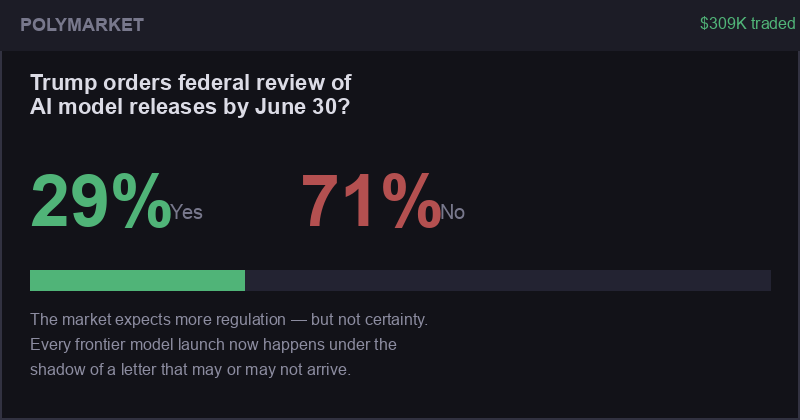
Polymarket is pricing this in real time. The "Trump orders federal review of AI model releases" contract has traded $309,000 with a 29% Yes for June 30 — the market expects more regulation, but not certainty. The uncertainty itself is the point: every frontier model launch now happens under the shadow of a letter that may or may not arrive.
What This Means for the Next Frontier Model Launch
The June 12 directive established several precedents that will shape every frontier model release going forward:
1. The government can kill a model in hours. Not in theory. In practice. BIS has demonstrated both the legal authority (ECRA "Is Informed" letters) and the operational capability (Anthropic complied within hours) to pull a globally deployed model offline. Any company launching a frontier model now knows this is a live possibility.
2. The trigger is contested and opaque. Was it a genuine jailbreak enabling a cyber weapon? Defensive research repackaged as a threat? A competitive maneuver by a rival with government access? We don't know, and we may never know. The classification of the underlying research means the public — and potentially the target company — cannot independently verify the threat assessment that justified the action.
3. Political alignment matters. OpenAI's "Trusted Access" program and government coordination didn't happen in a vacuum. It happened while Anthropic was being locked out. The signal to every frontier lab is clear: build a relationship with the national-security establishment before you need one, or risk being on the wrong side of a letter.
4. Open weights are the escape valve. The only models immune to a BIS letter are models whose weights are public. This doesn't make open release safe or desirable in every case — but it makes it strategically rational for any lab that cannot or will not maintain political alignment with the current administration.
The Fable and Mythos suspension remains in effect as of this writing. Restoration negotiations are ongoing. But the precedent is set: frontier AI capability is now a controlled good, and the control mechanism is a letter from a government bureau that most Americans have never heard of.
The weights embargo is here. The question is who it's really for — national security, or national strategy.
The Desk
About The Arc of Power
The Arc of Power editorial desk delivers rigorous analysis of geopolitics, defense, economic statecraft, and intelligence — examining the forces that shape the global order.
Briefing Access
Request Briefing Access
In-depth geopolitical analysis — power dynamics, defense strategy, and economic statecraft — three times a week. No noise.
Request briefing access