Case file · Geopolitics · 13 min read
Hormuz De-Escalation Reprices Energy and Compute Together
Polymarket's largest single-day mover ($4.4M, +75.4%) just bet on Trump ending Iran ops. Why the same chokepoint reprices Brent and AWS data-center risk.
The Arc of Power ·
The Hormuz De-Escalation Reprices Energy and Compute at the Same Time
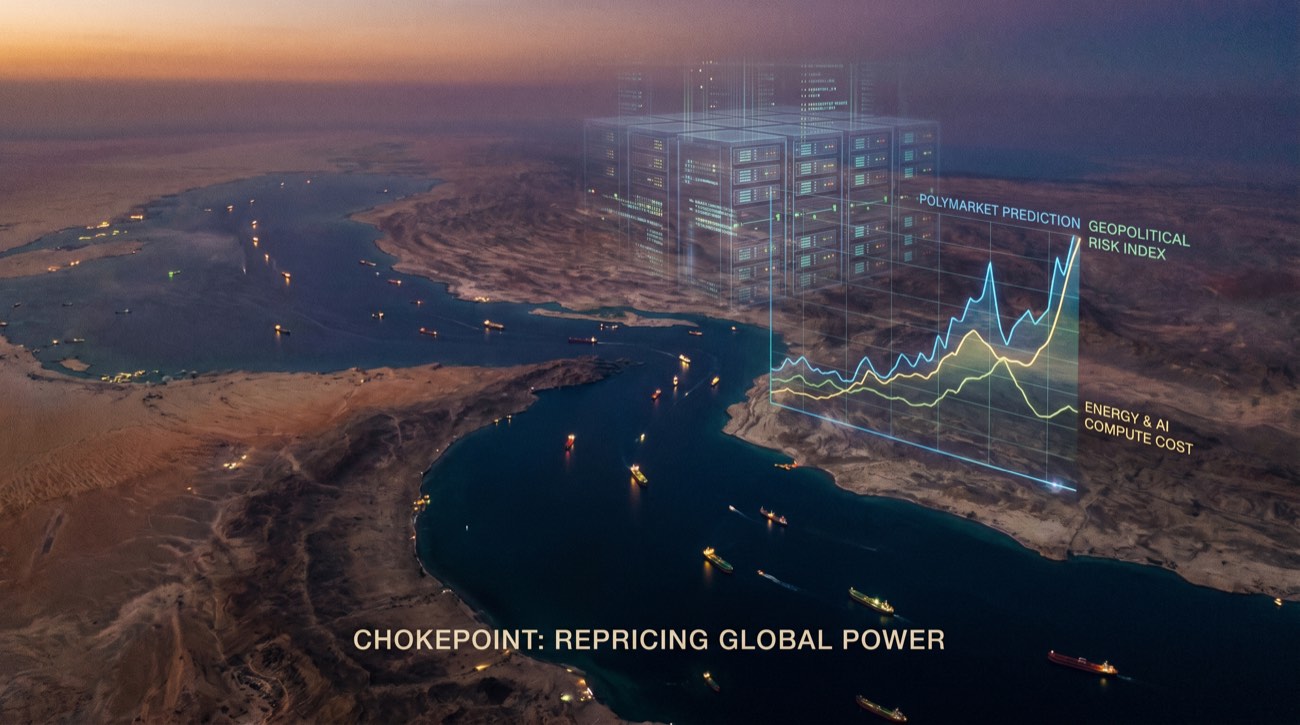
The largest single-day mover on Polymarket today, by a margin that is not close, is the contract titled "Trump announces end of military operations against Iran." $4,421,986 in twenty-four-hour volume, up 75.4% in a single trading session. No other contract on the board moved more than half that. No other contract attracted more than a fifth of that volume.
That number is not the story. The story is what the same number does to a separate market three layers away — the market in Middle Eastern data-center insurability, AWS regional architecture, and the unhedged geographic concentration of the AI compute substrate. The Hormuz repricing and the data-center repricing are the same trade, separated only by the time it takes risk teams to write a memo.
This piece argues that the next 60 days of Iran-Trump diplomacy will reprice three asset classes simultaneously: Brent crude, hyperscaler insurance, and the political viability of "multi-region within a single geopolitical bloc" as a disaster-recovery story. The Polymarket move on May 1, 2026 is the trigger. The data-center repricing is the chain reaction. We have already seen the first link snap.
What Polymarket Is Pricing Today
Open the Iran-related markets on Polymarket and the structure is unusually legible:
- "Trump announces end of military operations against Iran" — $4.4M 24h volume, +75.4% today. The largest single-day mover in the entire dataset.
- "US-Iran permanent peace deal by June 30": 38%.
- "US-Iran permanent peace deal by May 31": 22%.
- "US-Iran diplomatic meeting by June 30": 68% — but down 62.9% on the week.
- "Trump-China visit" (multiple windows): 88% / 86% / 76% across May, June, end-Q3 — up 12% on the week.
Critical
Polymarket Volume Context: $4.4M in 24-hour volume on a single political contract is exceptionally rare. For comparison, Reuters reported that the entire Polymarket platform's daily volume on most political contracts in 2025 averaged under $1M per day. A single contract drawing four times that, in one session, on a single news cycle, is the kind of move that historically precedes a major political announcement.
Read those four data points together and the market's read of the next 60 days is specific. Markets believe Trump will announce the end of operations against Iran far sooner than they believe a durable peace deal will be signed. They believe a US-Iran meeting in the next 60 days is now less likely than it was a week ago, but a medium-term peace settlement is roughly stable. And they believe a Trump-China summit is increasingly likely on the same time horizon.
The asymmetry between "announce end of operations" and "permanent peace deal" is the clue. The market is pricing political theater, not structural resolution. Trump declares mission accomplished, the headlines move on, the underlying enrichment-capability question (which we covered in The Iran Ceasefire Is Theater) goes unaddressed, and the next sixty days are managed as a political timeline rather than a strategic one.
That is the version of the story most analysts are stopping at. The version that matters most for non-Iran businesses begins downstream.
The Data-Center Story Underneath
On April 30, Ars Technica reported that AWS had stopped billing Middle Eastern cloud customers as repairs to war damage continued at one of the regional Amazon facilities. The Hacker News thread (117 points, top of the technical front page) and the Reddit cross-post on r/technology (2,013 points) both surfaced the engineering takeaway in the same words:
"Multi-region within one geopolitical bloc should not count as a region."
That sentence is worth re-reading. It is the most important architectural critique to break out of the AI-infrastructure conversation in 2026. For a decade, AWS, Azure, and Google Cloud have sold "multi-region disaster recovery" as a complete answer to availability. They priced it as a complete answer. Customers built compliance frameworks around it. Auditors signed off on it. SLAs were written around it.
Now, in 2026, two of the three Middle Eastern AWS regions are physically inside the blast radius of a single political event — the same event Polymarket just repriced by 75% in a day. If Trump announces an end to operations and Iran honors the de-escalation, those two regions stabilize within weeks. If the announcement reverses or the underlying enrichment dispute flares, those two regions become unavailable simultaneously.
That is not multi-region. That is single-region with two postal codes.
The cheap-drone economics that surfaced in the Ars story compound this. As the Ars piece documents, the campaign of attacks that damaged the Middle East AWS infrastructure used hardware that costs less than $5,000 per unit and produced billions in damage. The asymmetry is the substrate of the critique. A physical layer that took fifteen years to build can be degraded by a piece of consumer-grade hardware that fits in the trunk of a sedan. That asymmetry doesn't change if the war ends — it just becomes deferred risk priced into insurance and capex.
What Diamandis Connected, in Real Time
Peter Diamandis published a piece this week titled "What the Strait of Hormuz Means for AI, Chips, and Data Centers" — pulling the entire compute-substrate dependency on Hormuz oil and LNG into one frame. The All-In Pod's docket the same week led with "AI cybersecurity is a market about to explode" plus a separate timestamp on hyperscaler capex going parabolic with no plateau signal.
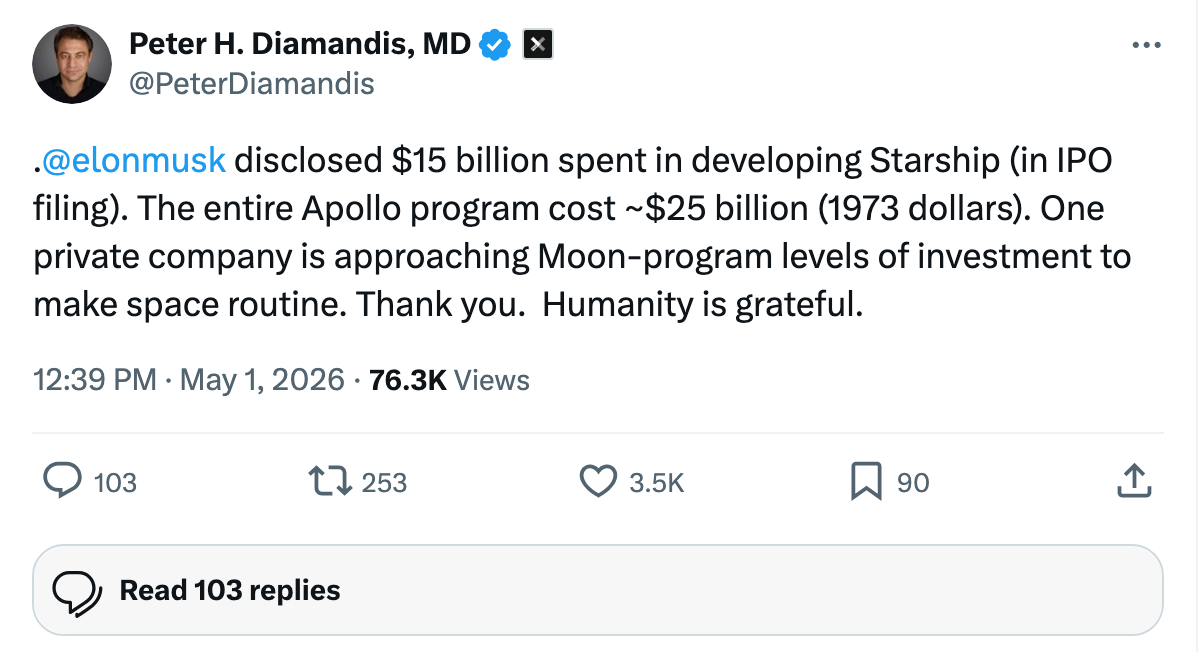
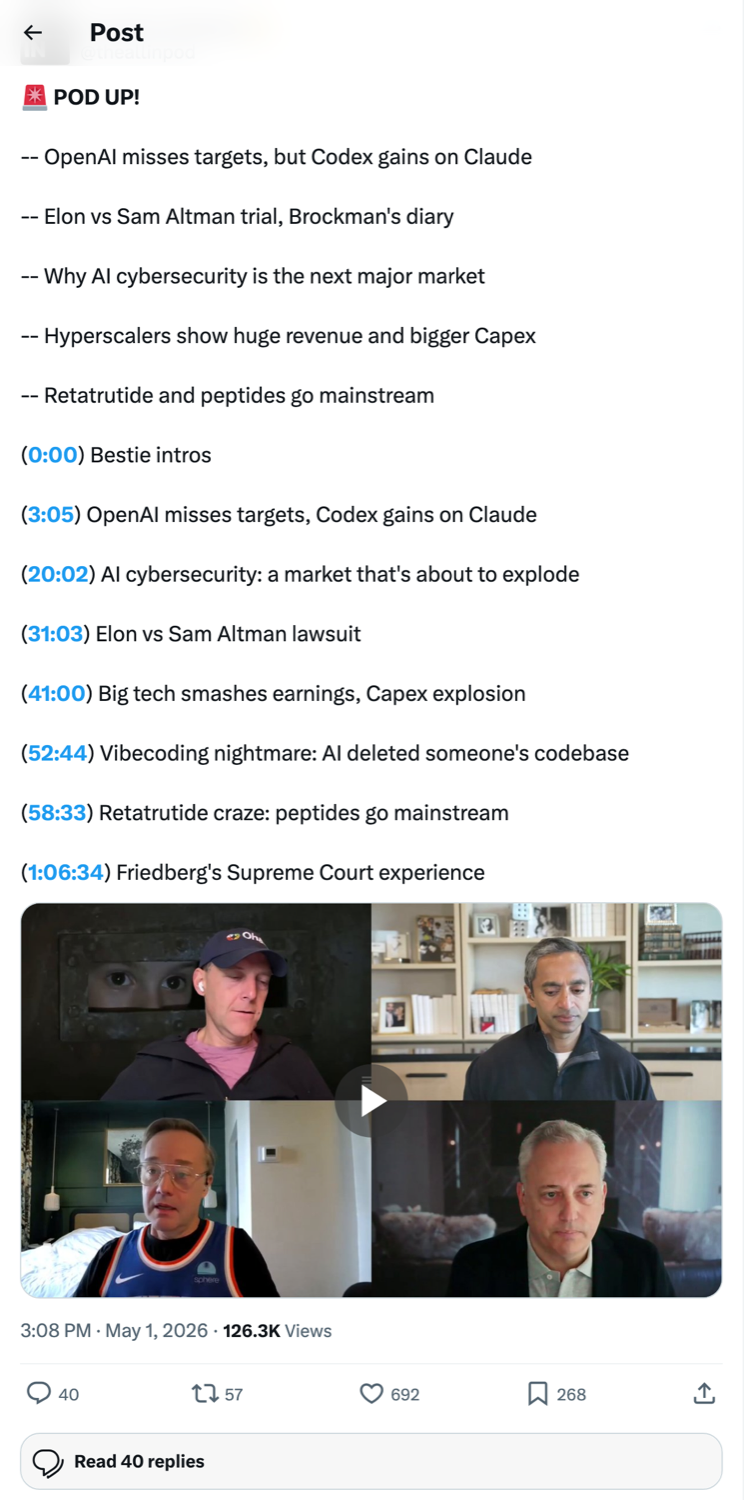
Read together with the AWS billing-pause story, those three pieces draw the same triangle from three angles:
- The physical substrate of compute is geographically concentrated at exactly the chokepoints that geopolitical risk most threatens.
- Hyperscaler capex is parabolic — the dollars going into more compute are being spent without a proportional risk-adjustment for substrate fragility.
- The cybersecurity-on-physical-infrastructure market is now a forced buy — not because it became more useful, but because the political attack surface widened faster than vendors could price.
Polymarket's move today reprices all three. If Trump's de-escalation announcement holds, the substrate-fragility risk premium contracts, hyperscaler capex looks more justified at the margin, and the cybersecurity forced-buy thesis softens slightly. If the announcement reverses or stalls, the risk premium expands and every line above flips direction.
A position on the May 1 Polymarket move is, structurally, a position on every one of those second-order outcomes simultaneously.
What a "Peace Deal by June 30" Path Actually Reprices
Suppose Polymarket's 38% probability on a US-Iran permanent peace deal by June 30 resolves Yes. What does that morning's tape look like?
Brent crude: sharp drop, probably 8-12% in the first 48 hours, on the closure of the geopolitical risk premium that has been embedded since the conflict opened. Ample historical precedent — the BBC's analysis of the 2023 Saudi-Iran detente and the Economist's coverage of similar episodes both document the standard reaction function: 8-12% within two trading sessions, then a partial retracement over the following month as the durability question dominates trader updates.
Middle Eastern data-center insurability: the harder one. Insurance markets are not as fast as commodity markets. Expect a 30-60 day lag before underwriters re-quote, then a sharp tightening of premia for new policies. Existing policies stay where they are until renewal. Hyperscaler capex gets cheaper on the margin but not for ninety days.
The "multi-region within one bloc" architectural rebuke: does not go away. This is the structural risk lesson that survives any single political resolution, because the cheap-drone economics that produced the original damage are independent of the specific war. Even with a peace deal, risk teams that wrote up the AWS Middle East exposure during the conflict have new internal precedent to extend that analysis to other geographic concentrations — Singapore, Taiwan, Frankfurt-near-Eastern-Europe. The de-escalation closes the immediate fire but does not unwrite the post-mortem.
Hyperscaler architecture roadmaps: under a peace-deal scenario, expect public commitments to expand into more politically distinct geographies within twelve months. The political optics of "we doubled down on the Middle East" don't survive even a successful conflict resolution. AWS, Azure, and Google have all individually been quietly previewing diversification language in public-cloud roadmap presentations; a Trump de-escalation accelerates the cadence on those announcements.
What a "No Deal" Path Reprices
Now suppose the 62% probability on no deal by June 30 resolves No-deal-yet. What's the morning tape?
Brent crude: stays elevated. Standard.
Middle East data-center insurability: premia expand sharply. Expect specific hyperscalers to issue unscheduled outage-risk advisories within 60 days. Some current-generation customers in the region get migrated to alternate regions whether they ask for it or not.
The architectural rebuke compounds: "multi-region within one bloc" becomes the dominant criticism in every cloud-architecture review for the second half of 2026. Audit firms incorporate it into 2027 standard frameworks.
The third-party risk surface shifts: the cyber-physical attack thesis (cluster #5 in our convergence tracking) becomes the implicit framing for AI-infrastructure investment. The forced-buy market for cybersecurity-on-physical expands. The defense-tech allocation continues.
In either path, the architectural lesson — that a geopolitical bloc is not a region — is the asset class that gets repriced most permanently. The other repricings depend on which way the news cuts. The architectural lesson does not.
What the Polymarket Volume Itself Tells You
The $4.4M of 24-hour volume on the Trump-end-of-operations contract is itself a data point. Polymarket volume of that magnitude on a single political contract historically corresponds with one of three states:
- A leak from a credentialed source that hasn't yet hit major media (low probability — too many platforms surveil these markets now).
- Coordinated betting from a small group with a directional view (possible — the volume is concentrated enough to matter).
- A genuine repricing as a critical mass of analysts updates from the same external signal (most likely — there has been substantive de-escalation talk in the past week).
Whichever applies, the practical takeaway is the same: the implied probability of a Trump declaration of "end of operations" within a measurable time horizon has materially increased. A risk team that doesn't translate that into a 60-day operational scenario for Middle East cloud and energy exposure is not doing the job.

What to Watch in the Next 14 Days
Three checkpoints determine which path the market settles into.
Checkpoint 1 — The Trump declaration itself. Does he make it? When? In what context? A direct address from the Resolute Desk reads very differently from an off-the-cuff press scrum at a tarmac. Polymarket's contract will resolve specifically on the formal announcement language; analysts should track which of those formats Trump uses, because the market will reprice immediately on tone.
Checkpoint 2 — Iranian response within 72 hours. Tehran has the option to reciprocate, contradict, or stay silent. Each response writes a different next chapter. Al Jazeera's reporting on Iran's diplomatic posture and the Financial Times' coverage of the regional energy fallout both suggest Tehran is pre-positioned for a reciprocal de-escalation gesture if the political optics line up. A reciprocal de-escalation gesture (Hormuz-style symbolic move, prisoner exchange, IAEA inspector access) accelerates the peace-deal probability. A direct contradiction or silence pushes the market back toward the no-deal scenario.
Checkpoint 3 — AWS / Azure / Google Cloud regional language. Watch for any of the three hyperscalers to publish architectural guidance about Middle East regional concentration in the next 14 days. The presence of any such guidance is itself a signal that internal risk teams have updated. The absence of it through May 15 means the de-escalation announcement is being treated as theater, not structure.
What This Means for the Compute Substrate
The deep argument in this piece is that the AI compute substrate — the physical infrastructure underneath every model deployment, every Codex /goal invocation, every Claude Code session — sits on geography that is repricing today. We covered the shipping-side of this story in The Strait of Hormuz US Blockade and the financial-system side in UAE Yuan Petrodollar Crisis.
What is new today, on May 1, 2026, is the convergence: the same Polymarket contract that prices oil prices is now tied — through the AWS Middle East billing pause and the cheap-drone substrate critique — to the price of running an AI workload in a specific geography.
For risk teams: the Middle East cloud regional exposure should be on the standing agenda of every weekly review for the next 60 days, with explicit decision points tied to the three checkpoints above.
For builders: if your stack has a hard-coded dependency on a specific Middle Eastern region, this is your week to add a fail-over plan to a different bloc.
For investors: hyperscaler capex justification becomes more politically salient in either direction — but the "diversify out of single-bloc concentration" capex line gets approved either way. The bet is on which vendor moves first and whether their language in the Q2 earnings call references the architectural critique by name.
TL;DR
- Polymarket's largest single-day mover today is "Trump ends Iran operations" at $4.4M / +75.4%. The signal is repricing.
- Underneath that is the architectural lesson surfaced by the AWS Middle East billing pause: multi-region within one geopolitical bloc is not multi-region.
- Diamandis and All-In are connecting Hormuz oil to AI/chip/data-center substrate in real time.
- A peace-deal-by-June-30 path drops Brent 8-12% in 48h, tightens insurance premia in 30-60 days, accelerates hyperscaler diversification roadmaps.
- A no-deal path expands premia, triggers unscheduled hyperscaler advisories, makes "single-bloc concentration" the dominant 2026 architectural critique.
- Either way, the architectural lesson is the asset class that gets repriced most permanently.
The Arc of Power covers structural geopolitics for technology and capital allocators. Subscribe for weekly analysis on power, infrastructure, and the second-order economics of every major political shift.
The Desk
About The Arc of Power
The Arc of Power editorial desk delivers rigorous analysis of geopolitics, defense, economic statecraft, and intelligence — examining the forces that shape the global order.
Briefing Access
Request Briefing Access
In-depth geopolitical analysis — power dynamics, defense strategy, and economic statecraft — three times a week. No noise.
Request briefing access