Case file · Geopolitics · 16 min read
Trump vs the Alliance: What the Ankara NATO Summit Revealed
Ankara exposed NATO's new operating system: militarily stronger, politically conditional, and one bilateral deal away from irrelevance.
The Arc of Power ·

On July 7-8, 2026, thirty-two NATO heads of state convened in Ankara, Turkey, for what was supposed to be a summit about defense spending and Ukraine. Within 48 hours, President Donald Trump had threatened to cut off all trade with Spain, renewed his demand that the United States control Greenland, and dangled F-35 fighter jets in front of Turkey while Israel begged him not to. He then declared there was "a lot of love" and "a lot of unity" and flew home.
The conventional read is that Trump disrupted another summit. The more important read is what the disruption pattern reveals: NATO is no longer operating as a collective security alliance. It is operating as a transactional bilateral marketplace where the United States sets prices, names favorites, and punishes defectors — all inside the framework of a mutual-defense treaty that still formally declares an attack on one to be an attack on all.
Our thesis: The transformation is already complete, and Ankara was not the crisis but the proof of concept.
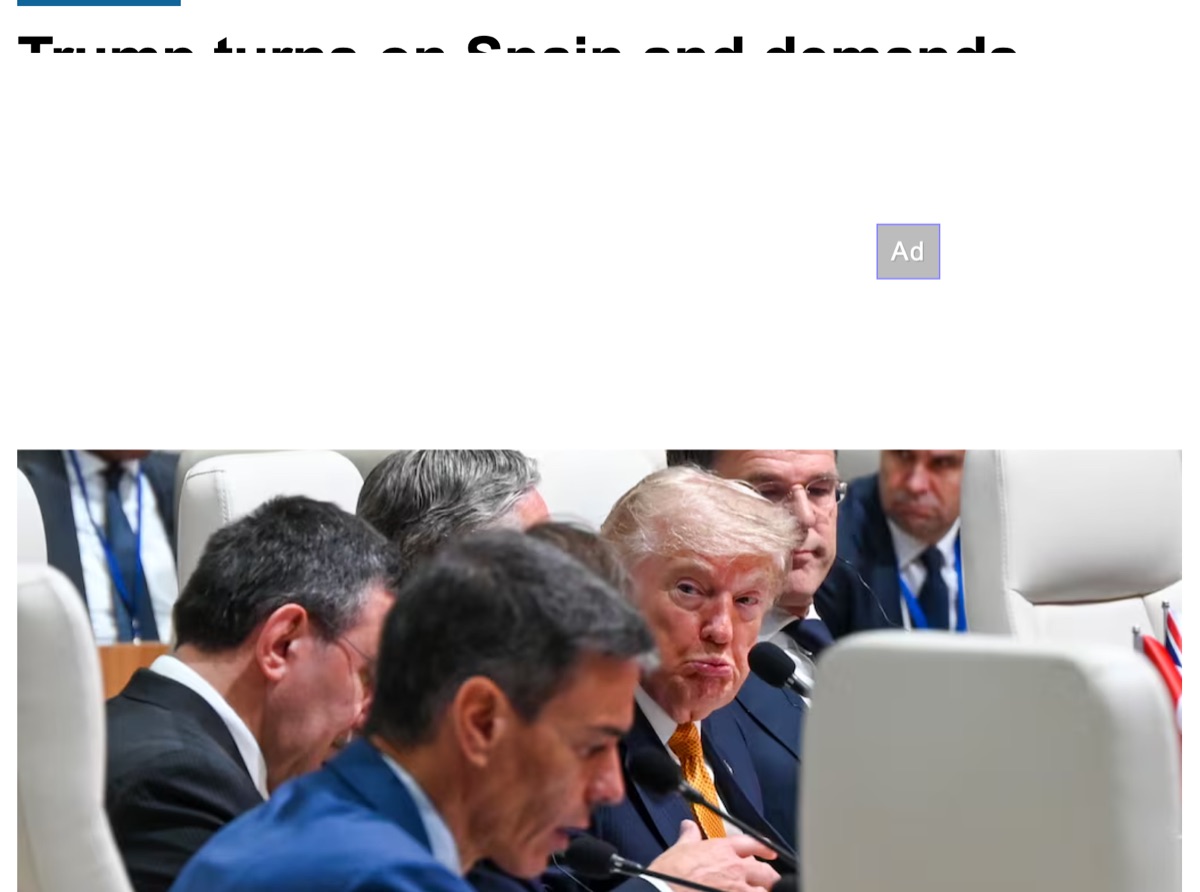
View original article on Defense News →
Three Provocations in 48 Hours
Strip the summit to its constituent moves. Each one follows the same logic.
Move 1: Spain. Trump ordered Treasury Secretary Scott Bessent to halt all trade with Spain, calling Madrid "a terrible partner in NATO" that "doesn't participate" and "doesn't pay." The trigger was specific: Spain refused to let the US use its airspace or military bases for operations against Iran, and it is the only NATO member that has not committed to the new 5% GDP defense spending target by 2035. Spanish Health Minister Monica Garcia responded: "We are a sovereign, democratic country that defends multilateralism and peace." She called the approach "confusing diplomacy with bullying."
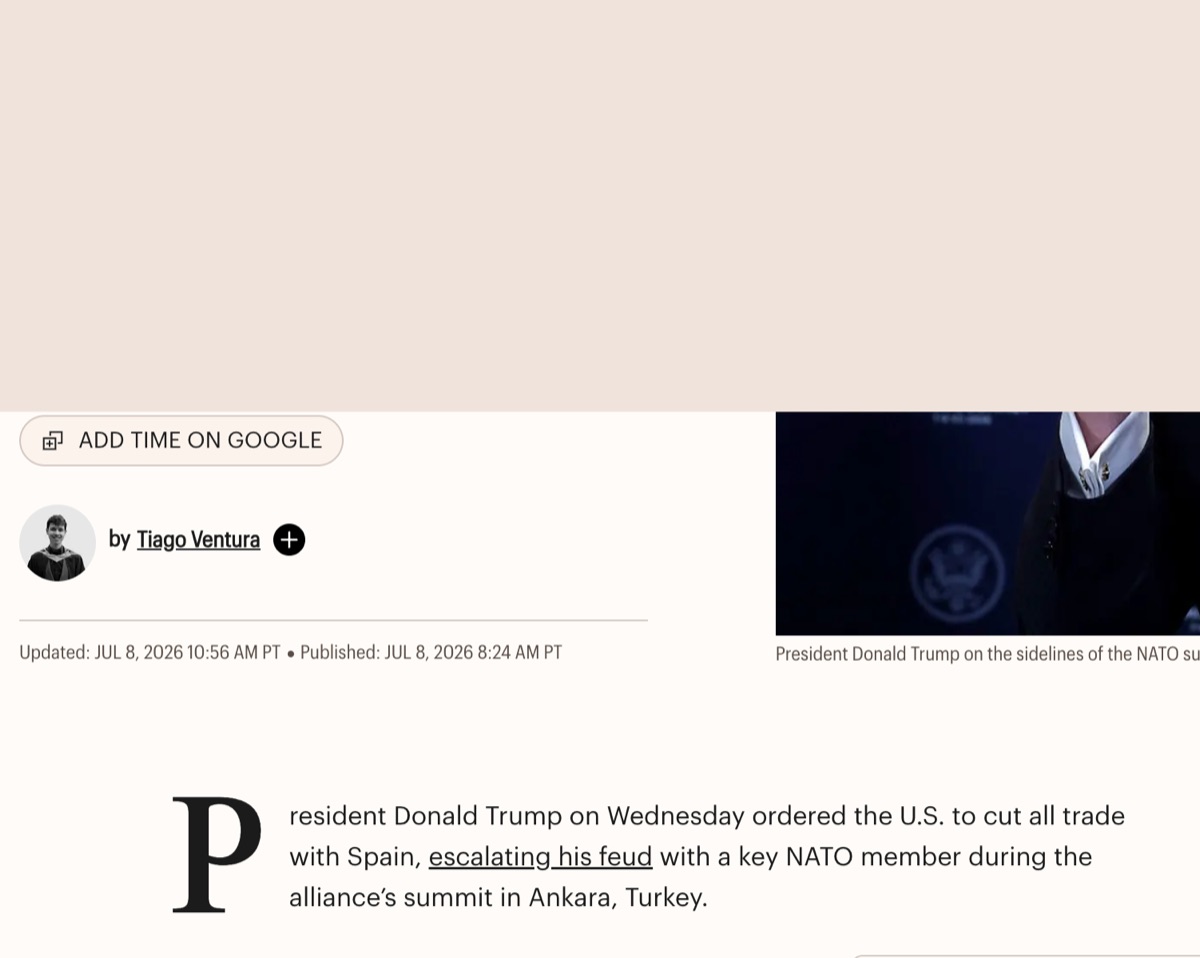
View original article on TIME →
Move 2: Greenland. Trump told reporters Greenland "should be controlled by the United States, not by Denmark", reviving the territorial claim that has strained allied relations since 2019. Danish Prime Minister Mette Frederiksen responded with the sentence that defined the summit: "We are ready to defend every inch of NATO, including our own territory." The UK, Norway, and EU officials all backed Denmark. Trump speculated about withdrawing US forces from Europe if Greenland remained off the table.
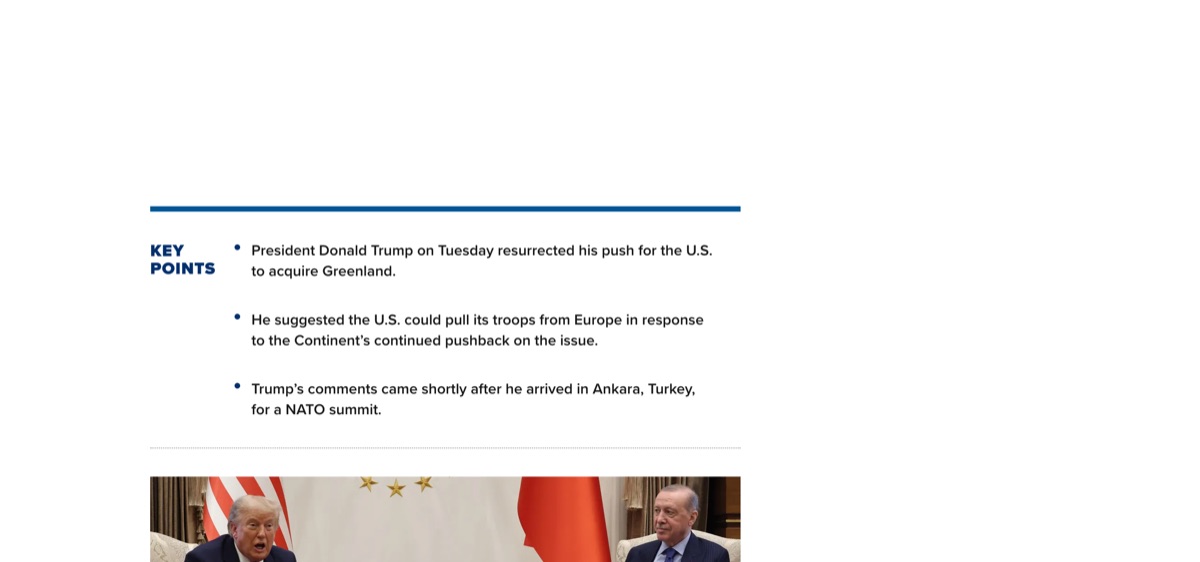
View original article on CNBC →
Move 3: Turkey and the F-35. Sitting alongside Erdogan, Trump said the US "would consider" selling F-35 fighter jets to Turkey and confirmed the administration would lift the CAATSA sanctions imposed after Ankara purchased Russia's S-400 missile defense system. This came days after Netanyahu urged Trump not to sell Turkey fighter jet engines, calling Erdogan's government "a regime infected by the Muslim Brotherhood." Erdogan dismissed the Israeli and Greek objections as concerns that have "no place in my world."
Three moves. Three bilateral pressure campaigns. Zero multilateral process. That is the pattern.
The Transactional Doctrine
What Ankara revealed is not dysfunction. It is doctrine.
Each of Trump's provocations follows a formula: identify a bilateral grievance, escalate it inside a multilateral setting to maximize leverage, reward compliance (Turkey gets F-35 consideration), and punish defection (Spain gets trade threats). The multilateral framework — NATO itself — becomes the stage, not the mechanism. Article 5 is never formally repudiated. It is simply rendered conditional: if you want the security guarantee, here are the terms.
The Carnegie Endowment crystallized the shift. Analyst Sophia Besch wrote that European allies have moved from attempting to "stop this administration from shrinking its role in Europe" to hoping "to work with it to keep the damage of the transition to a minimum." The Pentagon has advanced what officials call "NATO 3.0" — a structural realignment where Europe assumes conventional defense leadership while America maintains nuclear deterrence and reinforcement. Stephen Wertheim called this "bigger than Trump" — a shift that "will outlast him."
But here is the part the NATO 3.0 framing obscures: what makes a good ally is no longer determined by defense spending. Besch warns that "what makes a good ally appears determined by politics and not defense spending alone." Spain spends 2.1% of GDP on defense — below the 2.53% European average, yes, but up from 1.4% in 2021. The punishment isn't proportional to the spending gap. It's proportional to the political defiance: Spain blocked US airbases for Iran operations. That's the transgression.
Critical
The transactional tell. When the price of alliance protection is not a spending threshold but political compliance, the alliance has become a protection arrangement. Collective defense and conditional security provision are not the same thing — and Ankara showed the latter is now the operating system.
The Atlantic Council's post-summit analysis named this directly: "The price of NATO's military strength is a more transactional alliance, in which US reassurance is tied to deference, flattery and compliance." The declaration reaffirmed the "ironclad commitment" to Article 5 — the same language used in the last five summit declarations. But as the Council noted, "celebrating its inclusion highlights the extent to which the principle has been weakened."
Turkey: The Template
If Spain is the stick, Turkey is the carrot — and Erdogan played the transactional game better than anyone in Ankara.
Turkey has been locked out of the F-35 program since 2019, when it purchased Russia's S-400 missile defense system and drew CAATSA sanctions. For seven years, Ankara has tried every diplomatic channel to get back in. At the summit, Erdogan got what years of conventional diplomacy couldn't deliver: Trump publicly saying "we would consider" the sale and confirming sanctions would be lifted. Trump praised Erdogan's loyalty: "Turkey has been in many ways much more loyal than other countries."
The price was visible. Erdogan hosted the summit — giving Trump the optics of a warm welcome. He praised the US-Turkey relationship lavishly. He positioned Turkey as a reliable partner on Iran, offering staging and logistics cooperation that Spain refused. As the Times of Israel analyzed, the summit "boosted Turkey's standing" precisely as "Israel sees clout erode."
But there's a legislative catch the template doesn't address. Congress still controls arms sales, and the F-35 has bipartisan legal protections tied to the S-400 purchase. Trump can signal all he wants — conversion to an actual sale requires Ankara to dispose of the Russian system, something Turkey has not committed to. The Atlantic Council's Grady Wilson noted that Trump "moved Turkey closer to F-35s without going all the way." The signal is the product, not the sale itself.
Note
Turkey's dual game. Turkish Foreign Minister Hakan Fidan said at the summit that "the era of absolute reliance on a single alliance is over." Turkey wants NATO membership and freedom to hedge — supplementing the alliance with bilateral deals, regional partnerships, and selective cooperation. That's the logical endpoint of transactional NATO: every member hedges, because nobody trusts the collective commitment unconditionally.
The Numbers Tell Two Stories
The summit produced genuinely impressive defense commitments. European allies and Canada increased investments by $139 billion since the 2025 Hague summit. Average European spending hit 2.53% of GDP — up from 1.4% when the 2% target was set in 2014. The Ankara declaration committed allies to $50 billion in new defense procurement, $26 billion in integrated air and missile defense, $40 billion in counter-drone capabilities over five years, and 70 billion euros for Ukraine.
NATO Secretary General Mark Rutte framed the spending increases as the "Trump trillion" — explicitly crediting the pressure campaign. In dollar terms, the argument that Trump's approach works has real evidence behind it. European defense spending is at Cold War levels. Procurement is diversifying. The defense-industrial base is expanding.
View original analysis on Atlantic Council →
But the numbers tell a second story. Only 5 of 32 members are projected to meet the new 3.5% target by 2026. The 5% GDP target agreed for 2035 is aspirational at best — Spain hasn't even committed to it. And the most revealing metric isn't spending at all: it's the fact that no summit was scheduled for 2027. The Atlantic Council's analysts noted that "resistance grew to avoid tense Trump encounters." Ankara may have been, as they put it, "the last NATO summit for a while."
A military alliance whose members are spending more but meeting less is an alliance that has substituted inputs for cohesion. The spending is real. The coordination gap it's meant to fund — the interoperability, the joint planning, the strategic unity of purpose — is widening at the same time.
Former US Ambassador to NATO Ivo Daalder told PBS that the summit's primary goal was damage limitation: "The 32 leaders came with their large entourages to Ankara with the aim to ensure that nothing bad happened, nothing would blow up, and to manage the president of the United States." When the purpose of a summit is to survive the summit, the alliance is not in a great state — even if its checkbook is.
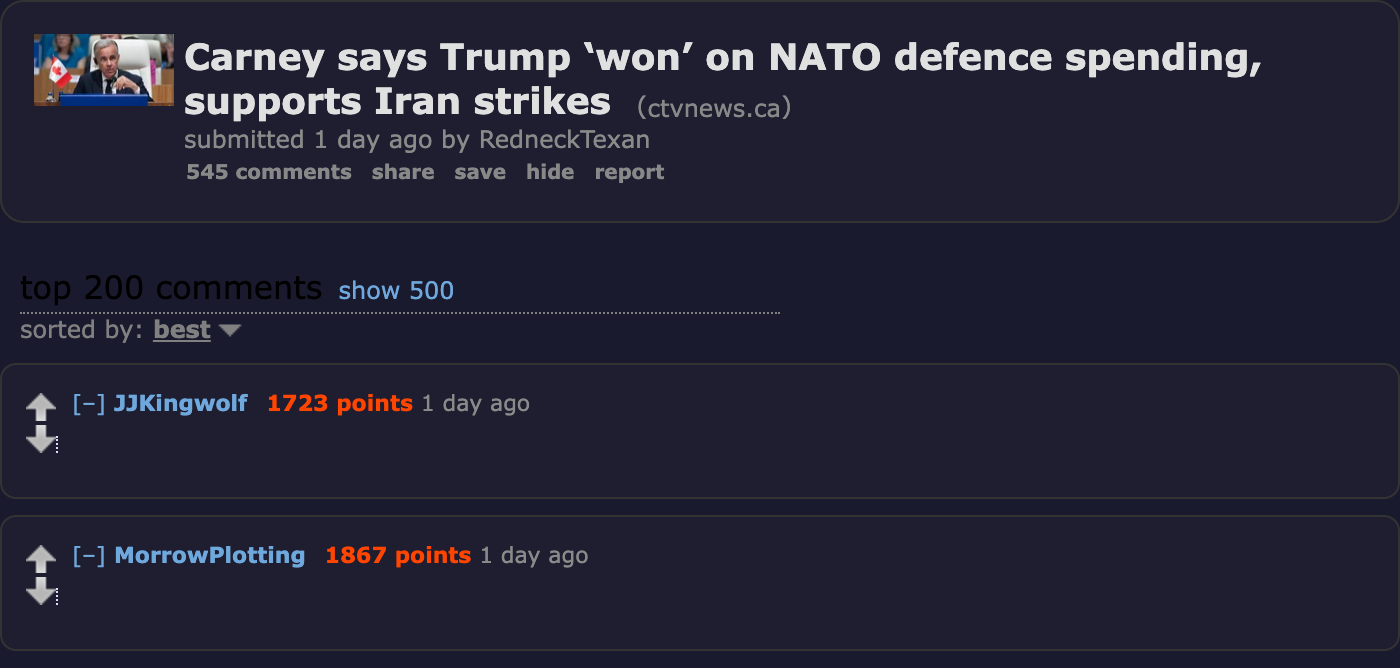
View original discussion on Reddit →
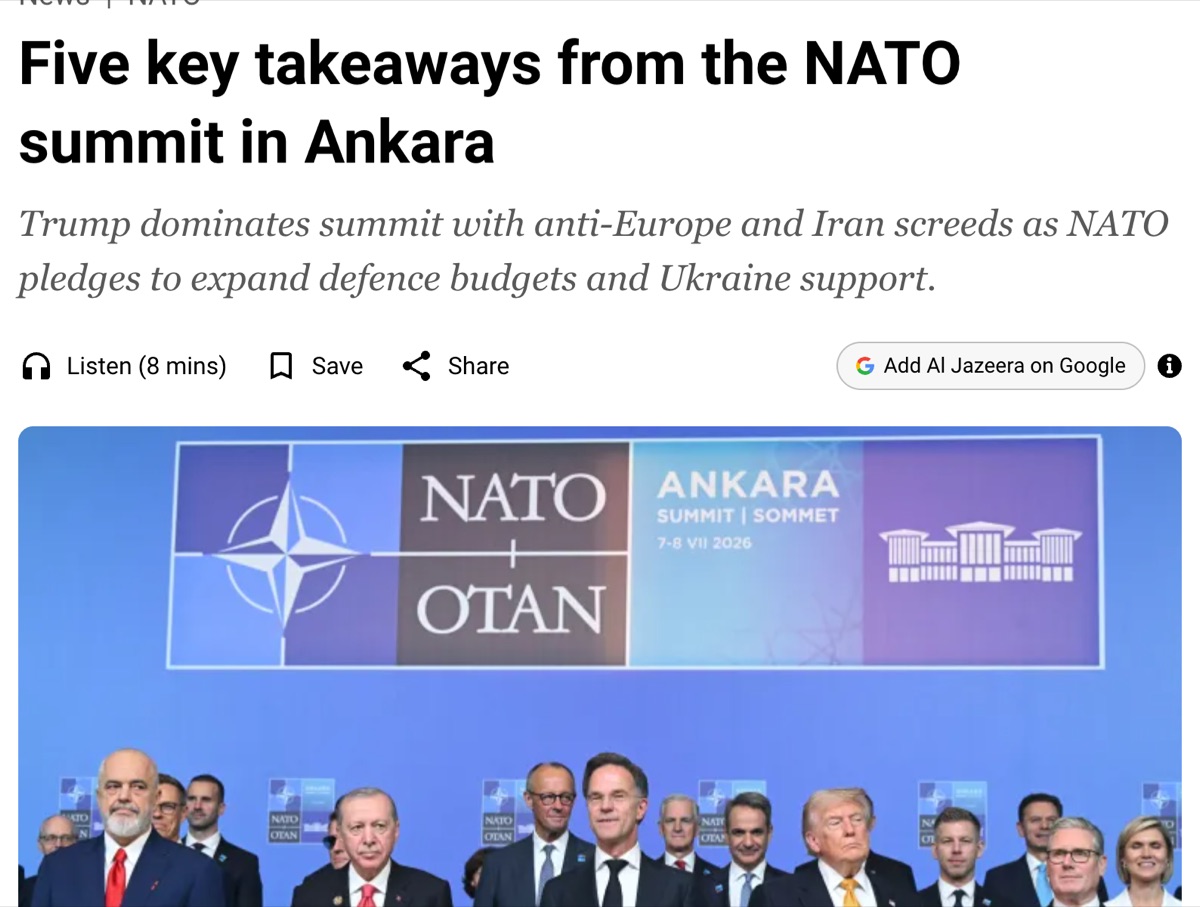
View original article on Al Jazeera →
Critical
Contrarian corner: NATO has never been stronger. Here's the honest counter-argument. European defense spending is at historic highs. The Ukraine support package is $80 billion. Counter-drone and air defense investments are real capabilities, not wish lists. Trump's chaos is performative — and the alliance has absorbed every storm since 2017 without losing a single member. The functional case is that NATO works because it's resilient to disruption, not despite it. The crisis narrative risks giving Moscow and Beijing a false reading of alliance fragility. The steel-man version: the quarrels are now part of the system, and NATO is learning to function around disruption rather than through consensus. That's adaptive, not broken.
What the Money Says: A Prediction Market Sidebar
The NATO summit happened alongside a telling divergence in prediction markets that underscores the optics-versus-substance gap.
On Polymarket, the probability of a Russia-Ukraine diplomatic meeting surged 21% in one week — the biggest weekly mover on the geopolitics board. But the probability of an actual ceasefire agreement dropped 5% to 40%, and "peace talks" sat flat.
Russia-Ukraine diplomatic meeting probability
Read those together: traders are pricing in a handshake — an optics event — while fading the substance of an actual deal. That's the same dynamic playing out in NATO. The Ankara declaration reaffirmed Article 5. The spending numbers were impressive. The communique language was solid. But the operational reality — US troop drawdowns, no 2027 summit, conditional reassurance — tells a different story.
Meanwhile, on the Iran front — which dominated Trump's rhetoric at the summit — the blockade market climbed 8% to 42% on the highest volume of any geopolitics market ($248K/24h), while the nuclear deal fell 10% to 38%. The two biggest geopolitics trades are Iran, moving in opposite directions — blockade up, deal down. That's a coherent escalation story, and it's the backdrop against which Trump's demand for allied support on Iran becomes a loyalty test rather than a policy ask.
Note
The Polymarket tell. When prediction markets price meetings up and agreements down simultaneously, they're pricing optics. When they price blockades up and deals down simultaneously, they're pricing escalation. NATO's Ankara summit sits at the intersection of both: an optics success (declaration signed, spending pledged) layered over an escalation trajectory (US-Iran conflict resuming, allied compliance demanded). The smart money is fading the declaration.
Three Lessons from Ankara
Lesson 1: The Alliance Tax Is Now Political, Not Financial
The old burden-sharing argument was about money — spend 2% of GDP, preferably more. Ankara revealed that the new burden-sharing argument is about political alignment. Spain's spending is below average but rising. Its sin was not underpayment but defiance: blocking US airbases for Iran operations, refusing the 5% commitment. Trump's trade threat was punishment for a political transgression, not a financial one.
This changes the alliance calculus fundamentally. Under a financial burden, members can pay their way to safety. Under a political burden, they must choose between sovereignty and security. A NATO where allies must align politically with US military priorities to maintain the security guarantee is a NATO where Article 5 has an asterisk — and every member knows it.
Lesson 2: Arms Sales Are the New Alliance Currency
The F-35 is not a fighter jet at the Ankara summit. It is a reward token. Turkey gets consideration because Turkey was "loyal." Israel objects because Turkey is geopolitically inconvenient. The sale is governed by law (CAATSA), managed by Congress, and decided by politics.
This is the template for every future arms negotiation within the alliance. The US has the leverage — it makes the weapons — and allies must earn access through compliance. That's not partnership. It's clientelism. And it is the natural endpoint of transactional alliance management.
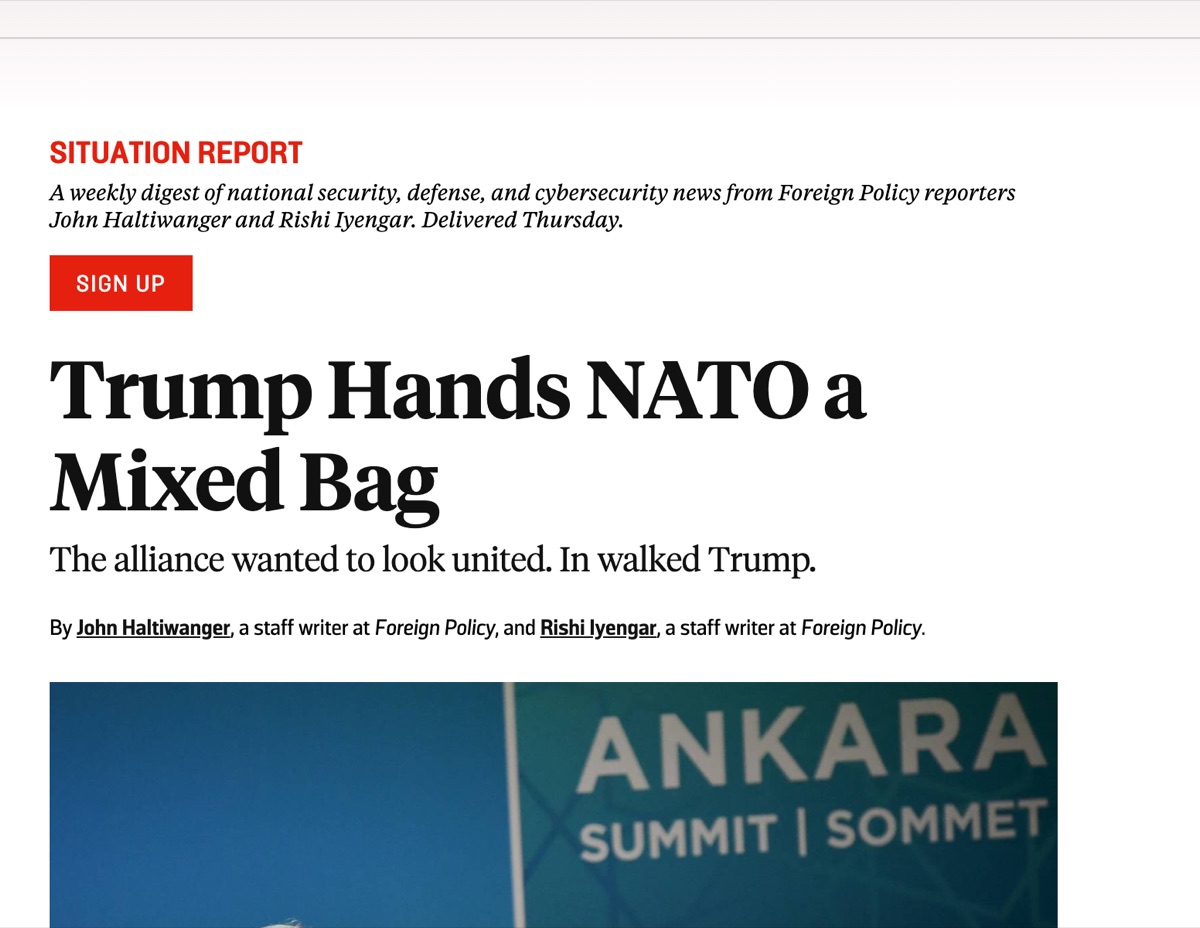
View original article on Foreign Policy →
Lesson 3: "NATO 3.0" Is Real — But Nobody Agreed to It
The Carnegie Endowment calls the emerging framework "NATO 3.0": Europe leads conventional defense, America provides nuclear deterrence and reinforcement. This is probably the correct long-term trajectory regardless of who occupies the White House. But it's being implemented by default — through US troop withdrawals and conditional reassurance — rather than by negotiation.
The difference matters. A negotiated transition would include clear trigger mechanisms for US reinforcement, agreed command structures, and binding commitments. A default transition leaves European allies guessing: if we're attacked, does America come? Under what conditions? What's the price? When the answers to those questions depend on a bilateral relationship rather than a treaty obligation, the treaty has been hollowed out even as it is formally reaffirmed.
The Congressional Research Service flagged exactly this in its pre-summit report: "Trump's statements criticizing NATO and casting doubt on the alliance's value to the United States have caused some allied governments to question the Administration's commitment to the alliance." Those governments are correct to question it. The commitment is conditional. The condition is compliance.
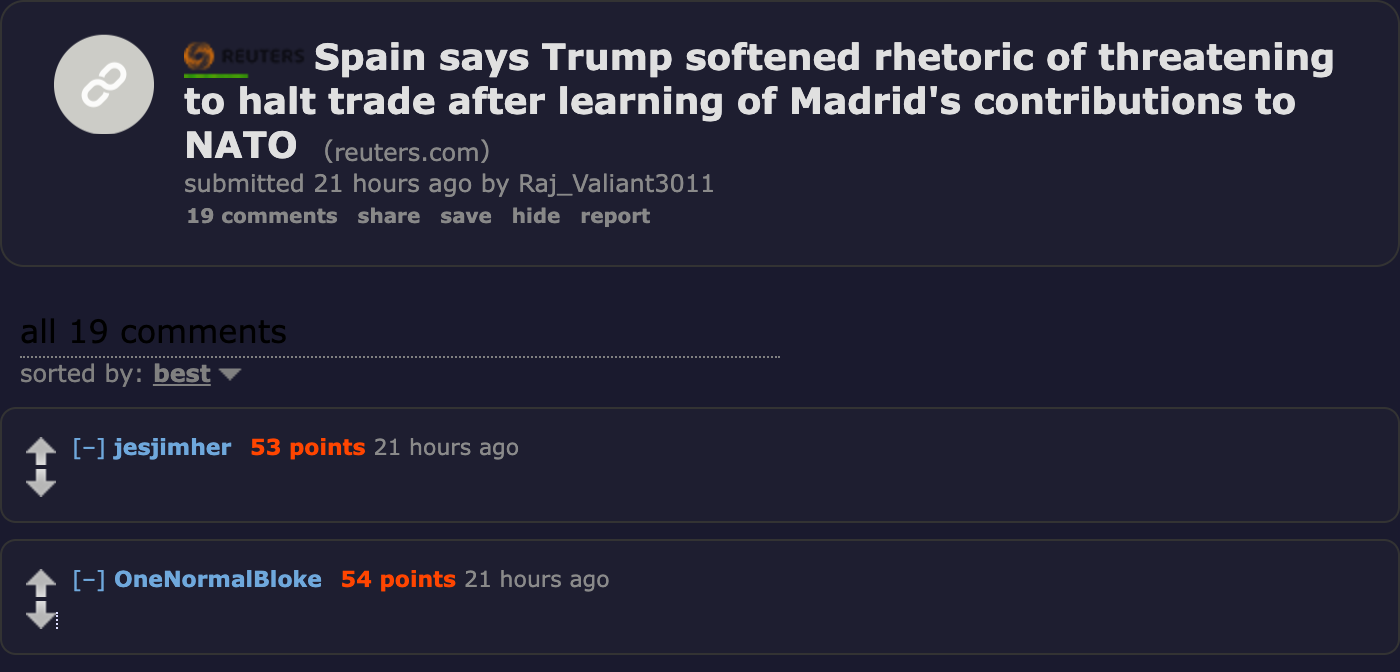
View original discussion on Reddit →
What to Watch in the Next 30 Days
Six data points will tell you whether Ankara was a blip or a pivot:
-
The Spain trade order. Does Bessent actually implement trade restrictions, or does the order die on the vine? If implemented, it's the first time a US president has imposed trade sanctions on a NATO ally. If abandoned, it confirms the theatrical reading.
-
US troop movements in Europe. Trump speculated about withdrawals over Greenland. Any movement orders — or lack thereof — signal whether the threats are operational or rhetorical.
-
Turkey's S-400 status. For F-35 sales to proceed, Congress requires Turkey to dispose of the Russian system. Any movement toward divestiture is the tell that the Ankara deal was real, not performative.
-
The 2027 summit question. The Ankara declaration notably did not commit to a summit next year. If no summit is scheduled by autumn, the alliance is retreating from collective leadership to bilateral management — exactly the transactional model this analysis describes.
-
European defense coordination. Watch for EU-level defense procurement coordination — joint buys, shared production, integrated command. If NATO 3.0 is real, Europe needs its own operational capacity, not just higher spending. The 70 billion euro Ukraine package is the test case.
-
Polymarket movement. If the Russia-Ukraine meeting market keeps climbing while the ceasefire market stays flat or drops, the crowd is confirming what Ankara suggested: optics are the product, substance is the afterthought.
The Ankara summit was not NATO's funeral. It was its performance review — and the review says: the alliance is richer, stronger, and less trustworthy than at any point in its 77-year history. That's the paradox the next 30 days will either resolve or entrench.
Related: The Iran-US Ceasefire Is Built on Sand | China's Panda Bond Play for European Leverage
The Desk
About The Arc of Power
The Arc of Power editorial desk delivers rigorous analysis of geopolitics, defense, economic statecraft, and intelligence — examining the forces that shape the global order.
Briefing Access
Request Briefing Access
In-depth geopolitical analysis — power dynamics, defense strategy, and economic statecraft — three times a week. No noise.
Request briefing access