Case file · Geopolitics · 12 min read
The Xi Variable: How China Is Breaking Maximum Pressure
China buys Iranian oil, signals MANPADS supply, and offers mediation. Maximum pressure requires bilateral isolation. Beijing has broken all three.
The Arc of Power ·
The Hormuz blockade is two days old. The headline story is US Naval enforcement, oil at $104, and the UK's refusal to participate — all covered here on April 13. The story beneath that story is Beijing.
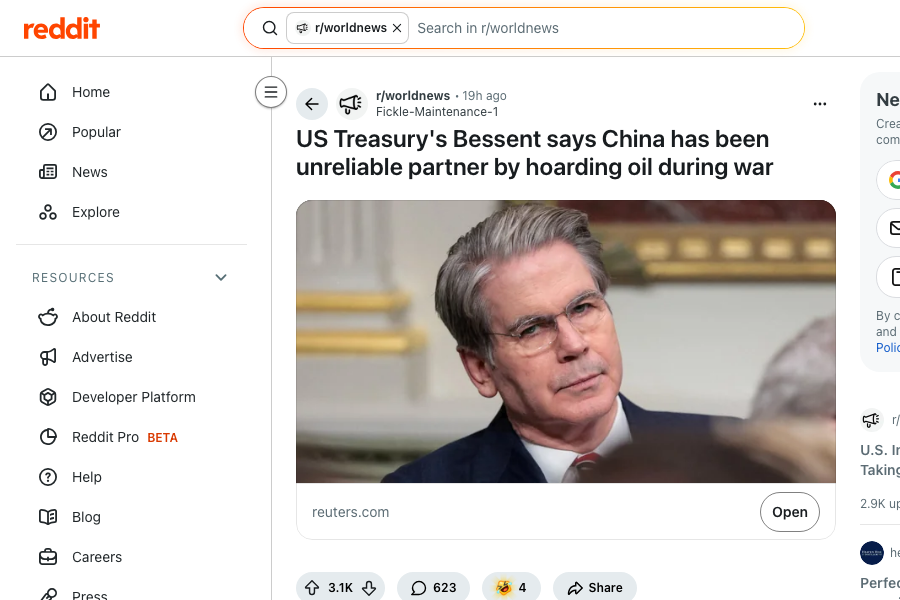
Treasury Secretary Scott Bessent publicly called China an "unreliable partner" on Tuesday. CNN ran an exclusive reporting that US intelligence indicates China is preparing a MANPADS shipment to Iran. And a BusinessToday investigation reported that Iran used a Chinese-built satellite — with Chinese ground control infrastructure — to monitor US military assets at the Strait. If any of these three developments holds up to scrutiny, "maximum pressure" is not a strategy. It is a plan written for a world that no longer exists.
Our thesis: Maximum pressure is a bilateral doctrine. It requires that you can isolate your target economically, militarily, and diplomatically. China has structurally broken all three. Beijing is not helping Iran incidentally — it is running an optimal three-player strategy that extracts leverage from US-Iran tension, positions for post-conflict regional influence, and signals to the non-Western world that aligning with China provides insulation from US economic coercion. Washington's model has a variable — call it the Xi Variable — that doesn't appear in the calculation. When your model is missing the most consequential variable, the model breaks.
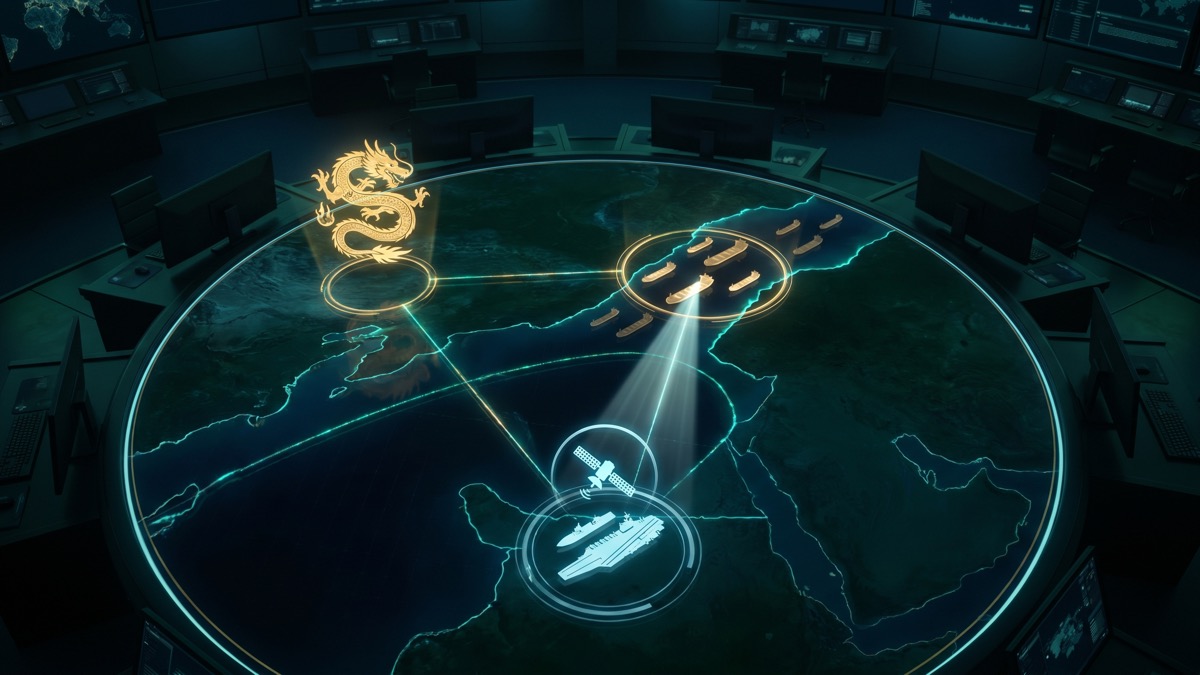
The Bilateral Assumption Hidden Inside "Maximum Pressure"
"Maximum pressure" as a foreign policy doctrine emerged from the Iran nuclear negotiations and the North Korea playbook. The premise: apply comprehensive economic and diplomatic sanctions to make the cost of the target's behavior prohibitive. Cut off oil revenues, freeze assets, deny access to SWIFT, prevent arms supply. The target eventually calculates that the cost of maintaining its position exceeds the cost of capitulating.
The doctrine has a foundational assumption buried inside it: the target cannot find a sufficiently powerful third party willing to absorb those costs in exchange for strategic benefit. Every historical instance where maximum pressure has worked — Libya post-Lockerbie sanctions, Iraq in the early 1990s, even Iran in the 2015 JCPOA negotiations — operated in a world where the third-party escape valve was limited. The Soviet Union was gone. China was still developing.
That world is gone. China is the world's largest oil importer. It has the second-largest economy. It has its own global financial infrastructure (CIPS, the Cross-Border Interbank Payment System). And it has a precise strategic incentive to undermine US unilateral sanctions wherever it finds them: every successful US sanctions campaign that China does not participate in expands the scope of what Washington can impose without Beijing's consent. China's opposition to maximum pressure is not ideological — it is self-interested risk management.
China's Three Simultaneous Plays
Beijing is not playing one card. It is playing three simultaneously, which is what makes this configuration structurally different from prior Iran crises.
Play 1: Economic absorption. China has continued purchasing Iranian oil at a discount throughout the blockade period, using ship-to-ship transfers and alternative documentation to obscure origin. Bessent explicitly cited this in his "unreliable partner" statement, referencing three prior instances of China acting against US economic preferences: COVID-era PPE hoarding, the 2025 rare earths export restrictions, and now Iranian oil purchases during an active US military operation. The significance of the Bessent statement is not the accusation — it is the public nature of the accusation. When a Treasury Secretary says "unreliable partner" on CNBC, he is signaling that the administration has concluded that private pressure has failed.
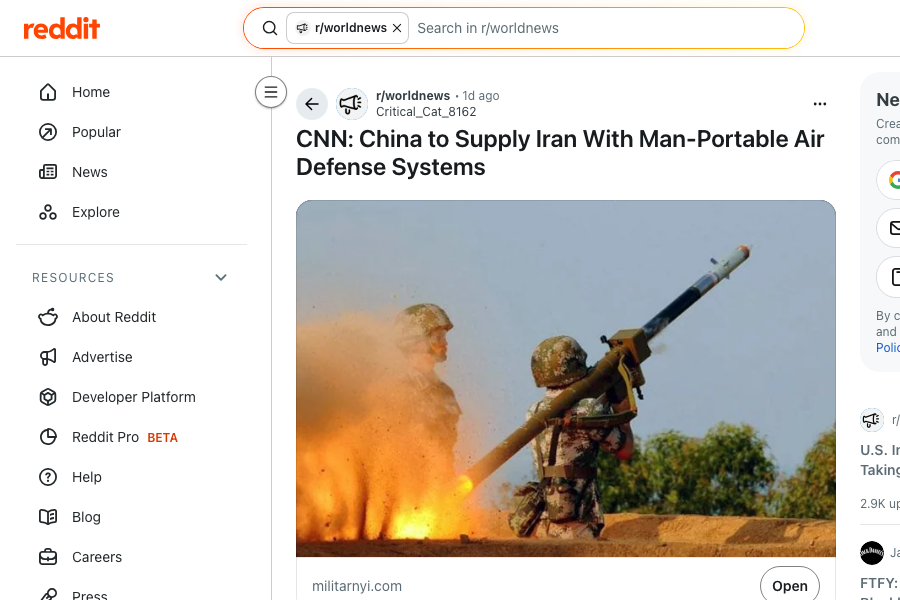
Play 2: Military signaling. CNN reported on Tuesday that US intelligence indicates China is preparing to supply MANPADS — man-portable air defense systems — to Iran. MANPADS are shoulder-fired surface-to-air missiles capable of targeting low-flying aircraft and helicopters. The significance: this is not a strategic weapons system. It is a tactical force multiplier for exactly the kind of asymmetric harassment that Iran would use against US naval air operations near the Strait. If US intelligence is correct, China is not providing Iran with a military capability it lacks — it is filling a specific operational gap that Iran has identified in its anti-access posture. That is calibrated escalation support, not a generic arms deal.
Play 3: Diplomatic positioning. Polymarket puts a Trump-China summit by June 30 at 79% on $464.5M in conflict volume. The crowd expects Trump to attempt diplomacy with Xi while simultaneously watching China arm Iran. Beijing has made public statements offering to mediate in the Iran conflict — a posture that costs China nothing and positions it as the diplomatic off-ramp for any Iranian face-saving exit that does not involve direct capitulation to Washington. China as mediator means China controls the terms of Iran's exit, which means post-conflict Iran is oriented toward Beijing, not Washington.
The ISR Question: The Detail No One Wants to Write About
The BusinessToday report on the Chinese-built TEE-01B satellite — reportedly operated with Chinese ground control infrastructure and used by the IRGC to monitor US military positions near the Strait — is the most explosive and least-covered element of this cluster. A Small Wars Journal analysis published this week framed the threshold question directly: there is a categorical difference between selling a weapon system and operating the ISR infrastructure that directs it.
Selling Iran a satellite is an arms sale. Maintaining Chinese ground control over a satellite that an IRGC-operated system uses to target US military assets is something else. It is intelligence sharing in a hot conflict zone, in real time, directed against a US military operation. The legal and strategic designation for that is not "arms dealer." It is co-belligerent.
Critical
The verification problem: The TEE-01B / ground control reporting remains unverified by US government officials on the record. The Small Wars Journal analysis is credible but secondary-source. Before drawing the co-belligerence conclusion, the intelligence community needs to confirm: (1) Chinese nationals operated the ground control infrastructure during the relevant period, (2) the satellite data was used to direct IRGC targeting decisions. If both are true, this is a genuine escalation threshold. If either is false or ambiguous, the claim is premature. This is exactly the class of claim the convergence report flagged as "most likely to be wrong suddenly."
What the Crowd Is Pricing
The Polymarket structure on the Iran conflict is unusually stable for Day 2 of a naval enforcement action. The major contracts:
- Blockade lifted by May 31: 80% — the crowd expects short duration
- Ceasefire extended: 63% — modest majority
- Trump-Xi summit by June 30: 79% — high confidence on diplomatic channel
The crowd is pricing the blockade as a negotiating tool, not an indefinitely sustained military operation. At 80% for "blockade lifted by May 31," the market is implying roughly six weeks of enforcement before some form of de-escalation. The 79% Trump-Xi summit figure is the most interesting data point: if the crowd is right, Trump is going to try to use the summit to get Chinese cooperation on Iran. If Bessent's "unreliable partner" framing is the current US position, a summit within six weeks is a significant posture shift.
The interpretation that reconciles these signals: the Trump administration is simultaneously applying military pressure (blockade), economic pressure (Bessent statements), and planning diplomatic outreach (summit) across two separate channels — Iran and China — in the hope that the combination produces a faster resolution than either can achieve alone. This is not irrational. It is also not a tested playbook for a three-party conflict where the third party (China) has active incentives to extend the conflict rather than resolve it.
What Tehran Looks Like From the Ground
The abstract analysis of strategic triangles runs alongside a concrete human reality that changes the political calculus in ways that game theory tends to underweight.
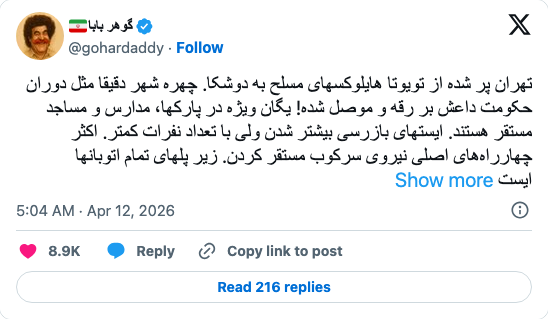
"Tehran is filled with Toyota Hiluxes armed with DShKs. The face of the city has become exactly like the era of ISIS's rule over Raqqa and Mosul." — 8,902 likes, 3,093 retweets, 419K views. The tweet's reach-to-like ratio signals broad, anxious sharing rather than enthusiastic endorsement: people are forwarding it as alarm, not as confirmation of something they wanted to see.
The ISIS/Raqqa comparison carries a specific analytical claim: the IRGC has shifted from its normal urban posture — present but not visible — to a Hilux-and-heavy-machinegun occupation pattern. That pattern historically accompanies two things: imminent military threat from ground forces, or internal security crackdown against a population the regime has reason to fear. In the current context, it is most plausibly the former. The regime is preparing for something it expects on the ground, not just in the air.
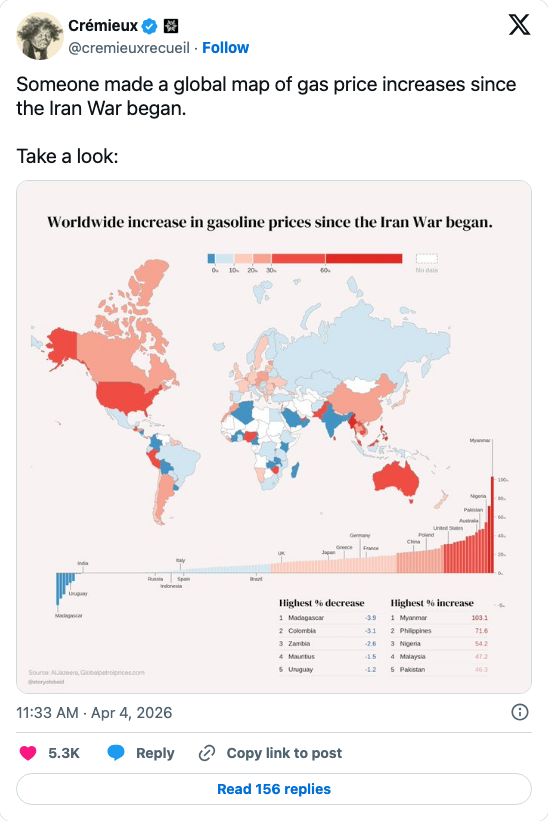
The gas price map — widely shared, 5,314 likes — makes the distribution of costs visible in a way that raw price numbers don't. The color gradient shows that the US and Europe are paying, but so is Southeast Asia, South Asia, and sub-Saharan Africa. Countries that had no say in the decision to blockade Hormuz are paying a significant fraction of the cost. This is the global political dimension of the conflict that is consistently underweighted in Western analysis: the countries not at the table are losing economically, and that creates political leverage for whoever offers them a faster path out. China, not coincidentally, is in a position to offer exactly that.
What This Does to "Maximum Pressure"
The doctrine requires bilateral isolation. China has structurally broken it across all three dimensions:
- Economic: China buys Iranian oil, providing revenue that partially offsets the blockade's financial squeeze. Pressure is not maximum; it is partial.
- Military: If the MANPADS report is accurate, China is specifically filling operational gaps in Iran's anti-access posture. US air operations near the Strait face enhanced threat from shoulder-fired systems. The military cost of enforcement rises.
- Diplomatic: China is positioned as mediator, giving Iran a face-saving exit channel that does not require negotiating directly with Washington. Any deal brokered by Beijing is a deal where Beijing writes the terms.
Taken together, these three plays mean that maximum pressure is achieving economic damage but not behavioral change — which is the definition of a sanctions campaign that is not working. WTI at $104 and an internet blackout past 1,000 hours tell you the cost on both sides is real. The IRGC's continued control of internal security and the Polymarket 80% "blockade lifted by May 31" tells you the crowd does not expect the cost to produce capitulation.
Note
The counter-argument: China may be overplaying its hand. If the Trump-Xi summit (79% by June 30) produces a genuine deal — Chinese cooperation on Iran in exchange for tariff relief — Washington could flip the triangle. The "unreliable partner" framing from Bessent may be deliberate pressure before a negotiation, not a conclusion. If Trump gets Xi to withdraw MANPADS support and enforce oil sanctions in exchange for trade concessions, maximum pressure becomes workable again. This is a coherent scenario. It requires believing that Trump will prioritize the Iran deal over the tariff leverage — a significant assumption given his negotiating pattern.
The Strategic Implication
The Xi Variable is not a new development. China has been absorbing Iranian oil since the 2018 sanctions reimposition. What is new is the simultaneity and the escalatory signals: MANPADS supply, satellite ISR, and public "unreliable partner" designations happening in 48 hours, while a summit is 79% likely within six weeks. The speed suggests that both sides have moved to the pressure-and-posture phase before any diplomatic channel is formally open.
For Iran, the three-player dynamic is structurally favorable: US pressure is partially absorbed by China, military threat is partially offset by Chinese tactical systems, and a diplomatic off-ramp exists through Beijing that does not require formal surrender to Washington. This does not mean Iran wins. It means Iran can fight longer than the bilateral model predicts, and any settlement will reflect Chinese interests alongside Iranian and American ones.
For Washington, the lesson of this configuration is a familiar one from the Cold War that has not been adequately internalized: unilateral military and economic pressure against a state that has a great-power patron is not maximum pressure — it is maximum cost sharing. The question is whether the administration's model includes the Xi Variable or whether it is still operating on the assumption that China's behavior is a cost, not a structural feature of the problem.
The convergence report's closing observation is the right frame: "the geopolitics floor is rising." The Iran conflict is not a temporary disruption with a clear off-ramp. It is the first high-visibility test of whether the US can project decisive military and economic power in a world where China has both the capability and the incentive to constrain that power. The answer, so far, is: not decisively.
The Arc of Power publishes three times weekly on the geopolitics of the AI and technology era. Previous coverage: The Hormuz Blockade: UK Refuses, NATO Fractures · Iran-US Ceasefire: Built on Sand
The Desk
About The Arc of Power
The Arc of Power editorial desk delivers rigorous analysis of geopolitics, defense, economic statecraft, and intelligence — examining the forces that shape the global order.
Briefing Access
Request Briefing Access
In-depth geopolitical analysis — power dynamics, defense strategy, and economic statecraft — three times a week. No noise.
Request briefing access