Case file · Geopolitics · 10 min read
Money Bets on Iran Peace, Bails on Ukraine
Polymarket prices US-Iran ceasefire at 100% while Russia-Ukraine diplomatic odds drop 19.5% in a month. What two de-escalation bets reveal about power.
The Arc of Power ·
On October 7, 2026, the largest geopolitics prediction market on Polymarket — the US-Iran ceasefire continuation — sits at approximately 100% through October, up 18% in a single week, on $186,600 in daily trading volume. It is the heaviest-traded geopolitical contract on the platform.
Three clicks away on the same exchange, the Russia-Ukraine diplomatic meeting market has dropped 19.5% over the past month. The peace talks market prices a meeting by October 31 at just 26% — down 9.5% this week alone. And the actual ceasefire contract? Ten percent by December.
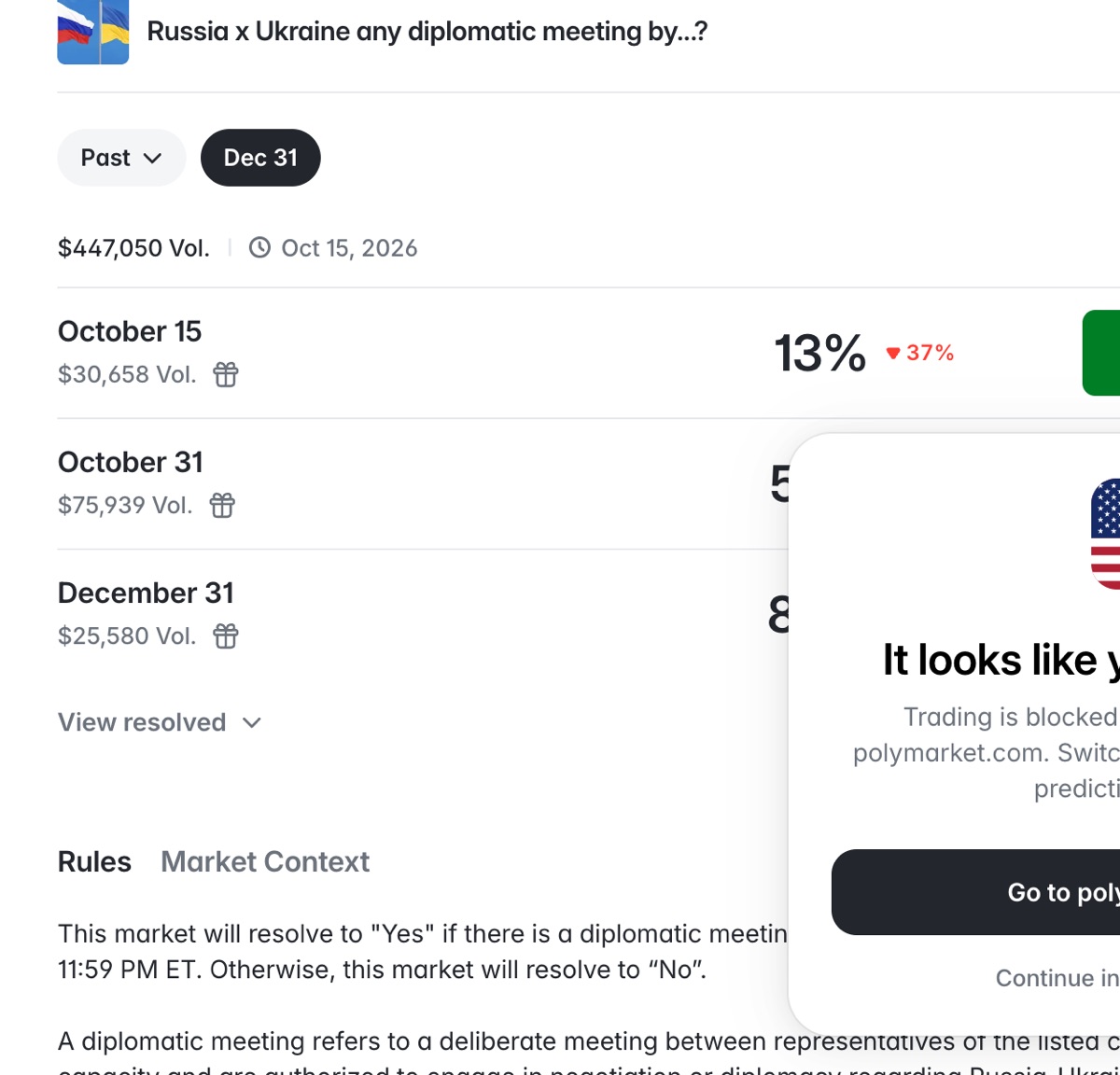
This is not two separate stories. It is one story about how American diplomatic bandwidth functions as a finite, geographically rationed resource — and about what happens when prediction markets make that rationing visible in real time.
The Numbers Tell a Story Headlines Won't
The divergence is stark enough to deserve a table:
| Market | Current Price | Trend | Volume |
|---|---|---|---|
| US-Iran ceasefire continues (Oct) | ~100% | +18%/week | $186.6K/day |
| Russia-Ukraine diplomatic meeting | Falling | -19.5%/month | $136K liquidity |
| Russia-Ukraine peace talks (Dec 31) | 60% | -9.5%/week | Moderate |
| Russia-Ukraine ceasefire (Dec 31) | 10% | -8%/month | $1.2M liquidity |
The market is telling us three things simultaneously.
First, it separates talking from stopping. Traders price a 60% chance of some form of Russia-Ukraine talks by year-end, but only a 10% chance of an actual ceasefire. That 50-percentage-point gap is the market's way of saying: diplomacy theater is likely; actual de-escalation is not.
Second, it reveals the opportunity cost of the Iran war. The Congressional Research Service noted in August that formal peace talks between Russia and Ukraine have not resumed since US-Israeli military operations against Iran began in late February 2026. The market's trajectory confirms what the CRS put in bureaucratic prose: Iran consumed Washington's diplomatic oxygen, and Ukraine suffocated.
Third, the Iran ceasefire market's climb to near-certainty is not optimism — it is resignation. The ceasefire began on April 7 and has been extended multiple times. Bloomberg Government reported that Trump extended it indefinitely while maintaining the naval blockade — a freeze that benefits both sides more than resolution does. The market says this frozen peace will hold because neither side has incentive to break it.
Note
The prediction market's cleanest signal: traders see a 60% chance of Russia-Ukraine talks by year-end but only a 10% chance of a ceasefire. That 50-point gap is the price of diplomatic theater.
Ukraine's October Window — and Why the Market Doesn't Buy It
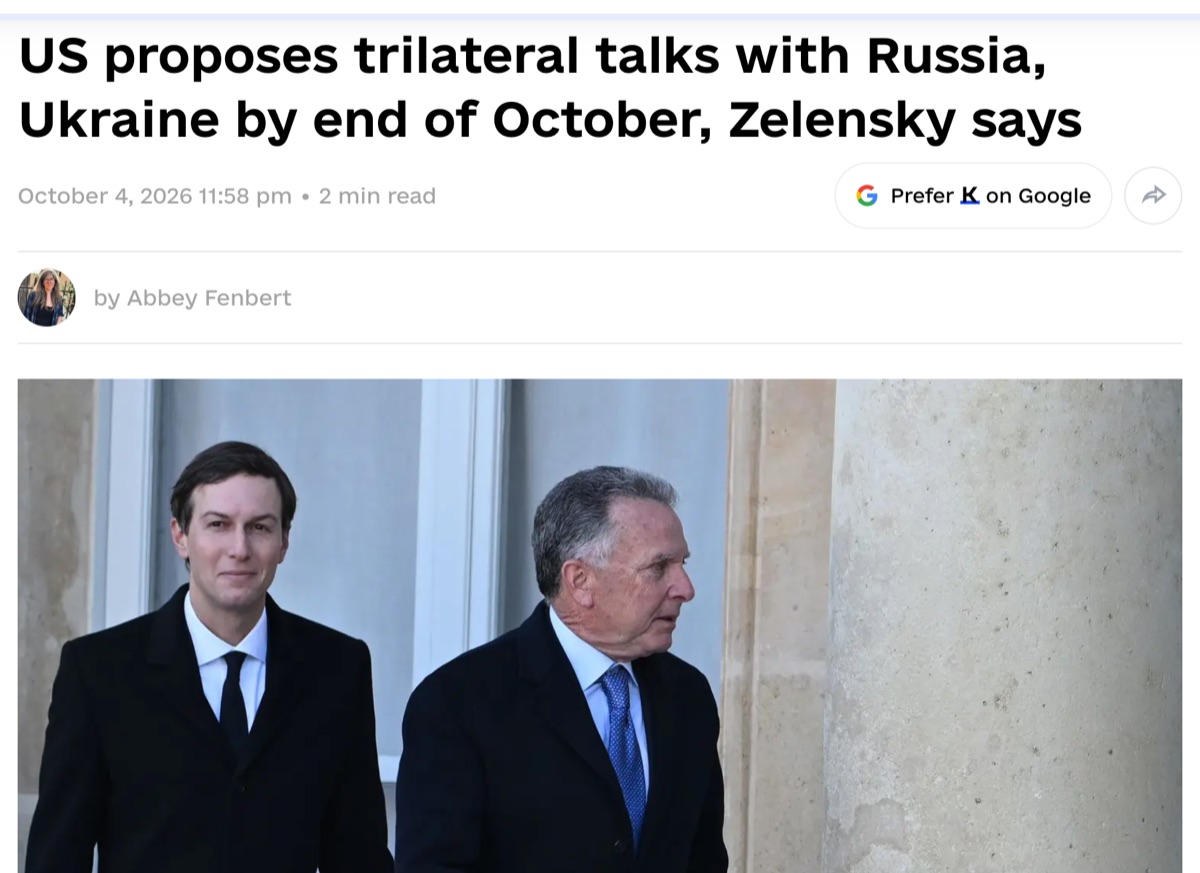
On October 4, Zelensky told reporters that the United States had proposed trilateral talks with Russia and Ukraine at the technical level before the end of the month. Al Jazeera confirmed that Ukraine is ready to participate, whether in the UAE or elsewhere. Ukraine's intelligence chief Kyrylo Budanov said in September that Kyiv was preparing for October trilateral talks, without naming a venue.
Read the full report on Kyiv Independent →
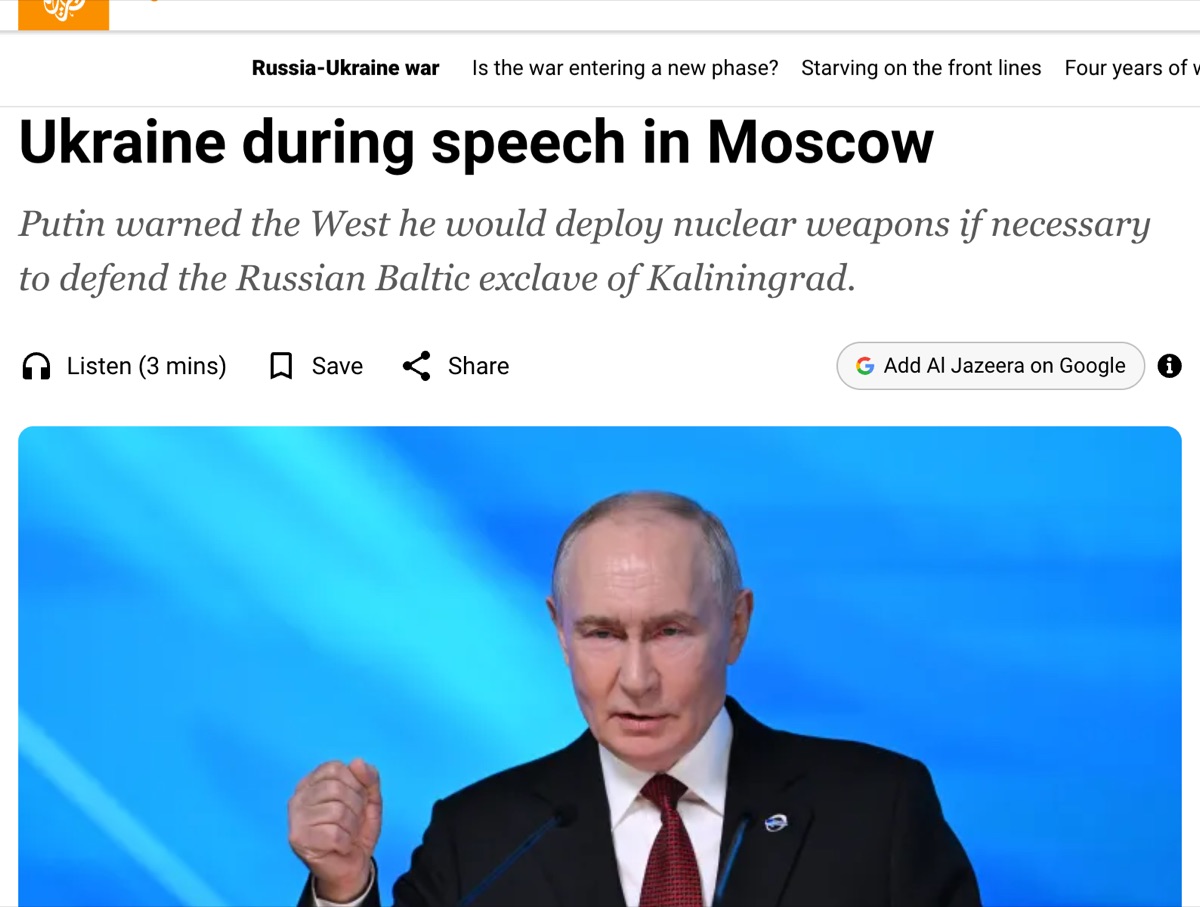
Three days before Zelensky's announcement, Putin ruled out a ceasefire on long-range strikes during a Moscow speech, even as Russian drones struck a key Kyiv bridge during German Chancellor Friedrich Merz's visit — a signal that combined contempt for Western diplomatic gestures with raw operational escalation.
The Kremlin's response to the October proposal was revealing. Spokesman Dmitry Peskov said Russia was "not ruling out" talks — the bureaucratic equivalent of "we'll return your call." Compare that to the Kremlin's language in January, when Russia actively participated in trilateral sessions in Abu Dhabi, or in February, when follow-on rounds moved to Geneva. The language has downshifted from engagement to non-rejection.
The market reads this correctly. The diplomatic meeting contract continues falling because "not ruling out" is not the same as "scheduling." And the timeline tells us why: the last trilateral session was February 26 in Geneva. That is 223 days without a meeting — the longest gap since the US-brokered process began.
Critical
Contrarian Corner: The optimistic read is that Zelensky's October 4 announcement could mark the inflection where Washington finally re-engages on Ukraine. The Iran ceasefire is stable enough that diplomatic bandwidth should be freeing up. But the market's response — continued decline — suggests traders believe the Kremlin has no urgency to engage while its battlefield position improves and Western attention drifts toward midterm elections.
Three Lessons from the Divergence
1. De-Escalation Is Rationed, Not Global
The conventional narrative treats de-escalation as a policy choice — governments decide to pursue peace or not. Prediction markets reveal something different: de-escalation is a resource allocation problem. Washington settled with Iran because it had to. The Strait of Hormuz threatened global energy markets. Domestic politics — including vocal MAGA backlash against the Iran war and a mounting missile supply crisis — created electoral pressure. Oil prices created economic pressure. The ceasefire was not a choice born of strategy but one forced by constraint.
Ukraine receives diplomacy-theater because the electoral cost of stalemate is lower than the cost of the concessions required for peace. No oil price spikes. No maritime chokepoint. The domestic constituency for Ukraine engagement is real but diffuse. The market prices this asymmetry precisely: near-100% confidence that the forced peace holds, declining confidence that the optional diplomacy materializes.
2. The Kremlin Learned the Iran Lesson
Moscow watched Washington's Iran playbook unfold in real time: escalation, overextension, ceasefire-as-exhaustion, and now a frozen settlement that consumes American attention without resolving anything. Putin's October 1 speech — ruling out a ceasefire while Russia steps up aerial attacks on Kyiv — reads as a party that believes time is on its side.
The prediction market confirms this. If Moscow believed Washington was about to apply serious pressure, the diplomatic meeting odds would be rising — not falling 19.5% in a month. The Kremlin is pricing in an America that is distracted by midterms, drained by the Iran campaign, and offering talks as a procedural gesture rather than a strategic commitment.
We warned in August that the crowd reads headlines while the market reads incentives. That divergence has widened. The headlines say "US proposes talks." The market says "Russia sees no reason to show up."
3. Prediction Markets as Diplomatic Intelligence
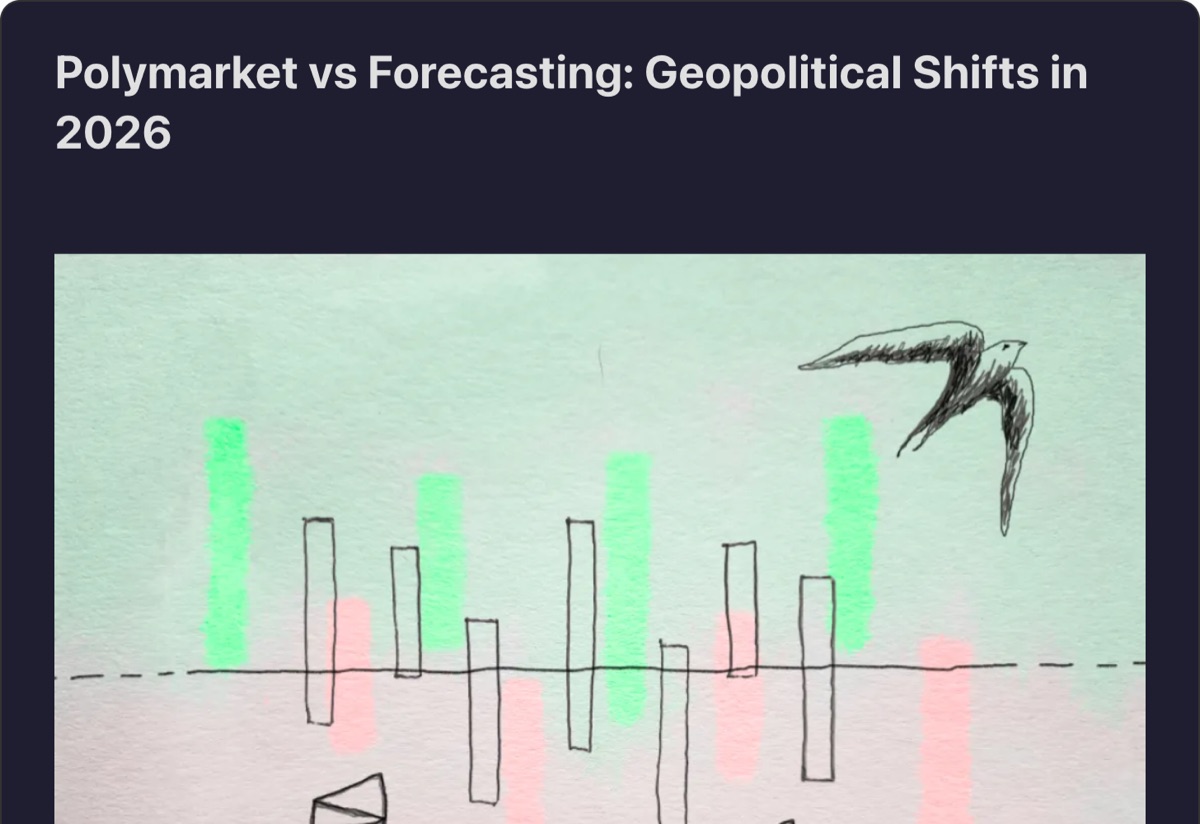
This brings us to the most underappreciated role prediction markets are playing in 2026: they are becoming a real-time diplomatic intelligence layer. When the Swift Centre compared its own forecasters against Polymarket in January, it found significant divergences — their analysts put the Russia-Ukraine ceasefire at 22% versus Polymarket's 43%. Six months later, the market's trajectory (now 10% for a ceasefire by December) has moved closer to the forecasters' skepticism than to its own January optimism.
Read the Swift Centre analysis →
But markets also carry noise. The insider trading controversy around Iran ceasefire bets — where at least 50 new accounts placed large bets hours before Trump's April announcement — demonstrated that these markets are susceptible to information asymmetry. On-chain analytics firm Bubblemaps found that a cluster of linked accounts profited over $600,000 on war-and-peace bets, while a similar cluster had earlier collected $1.2 million on timely strike bets.
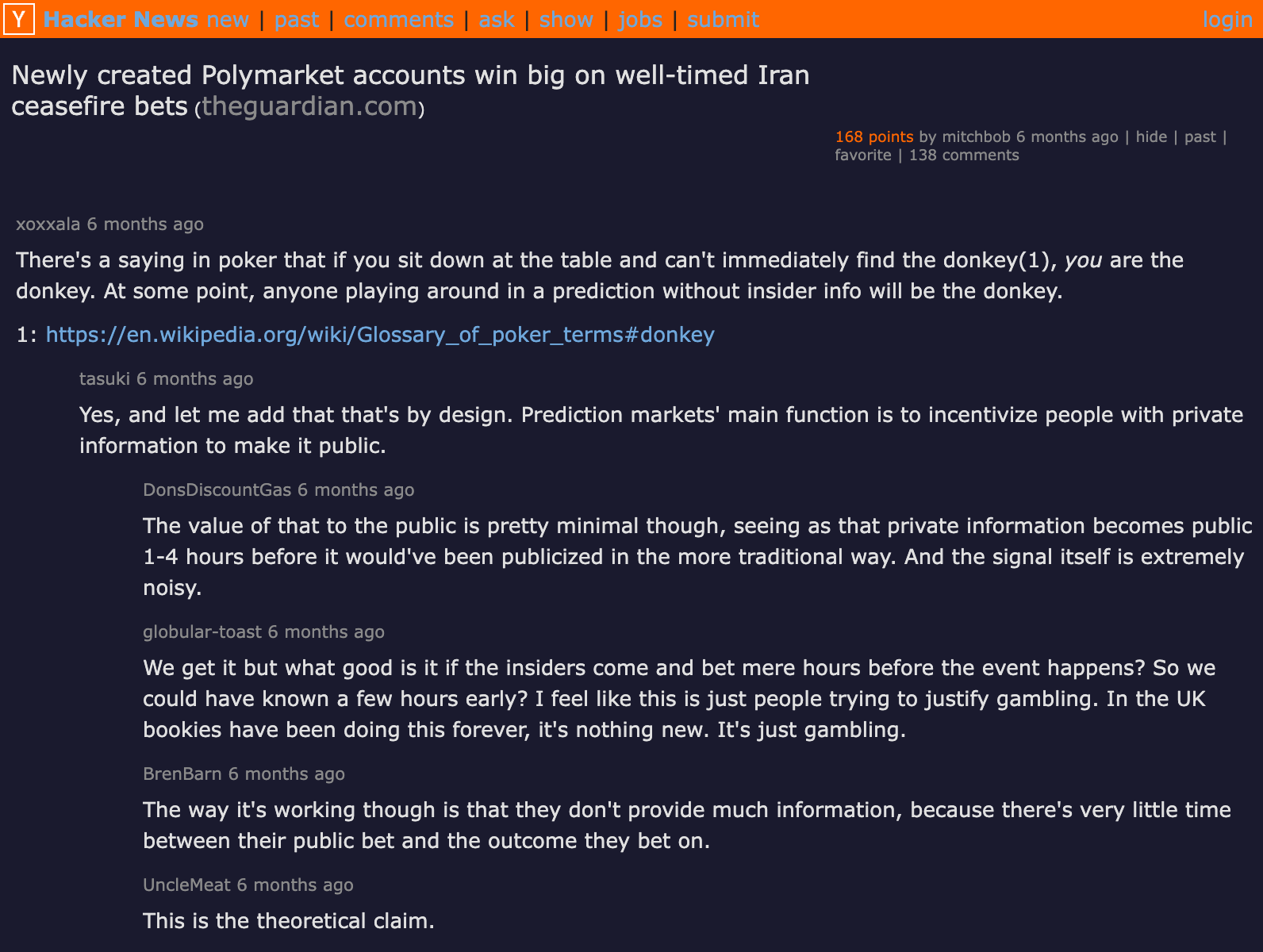
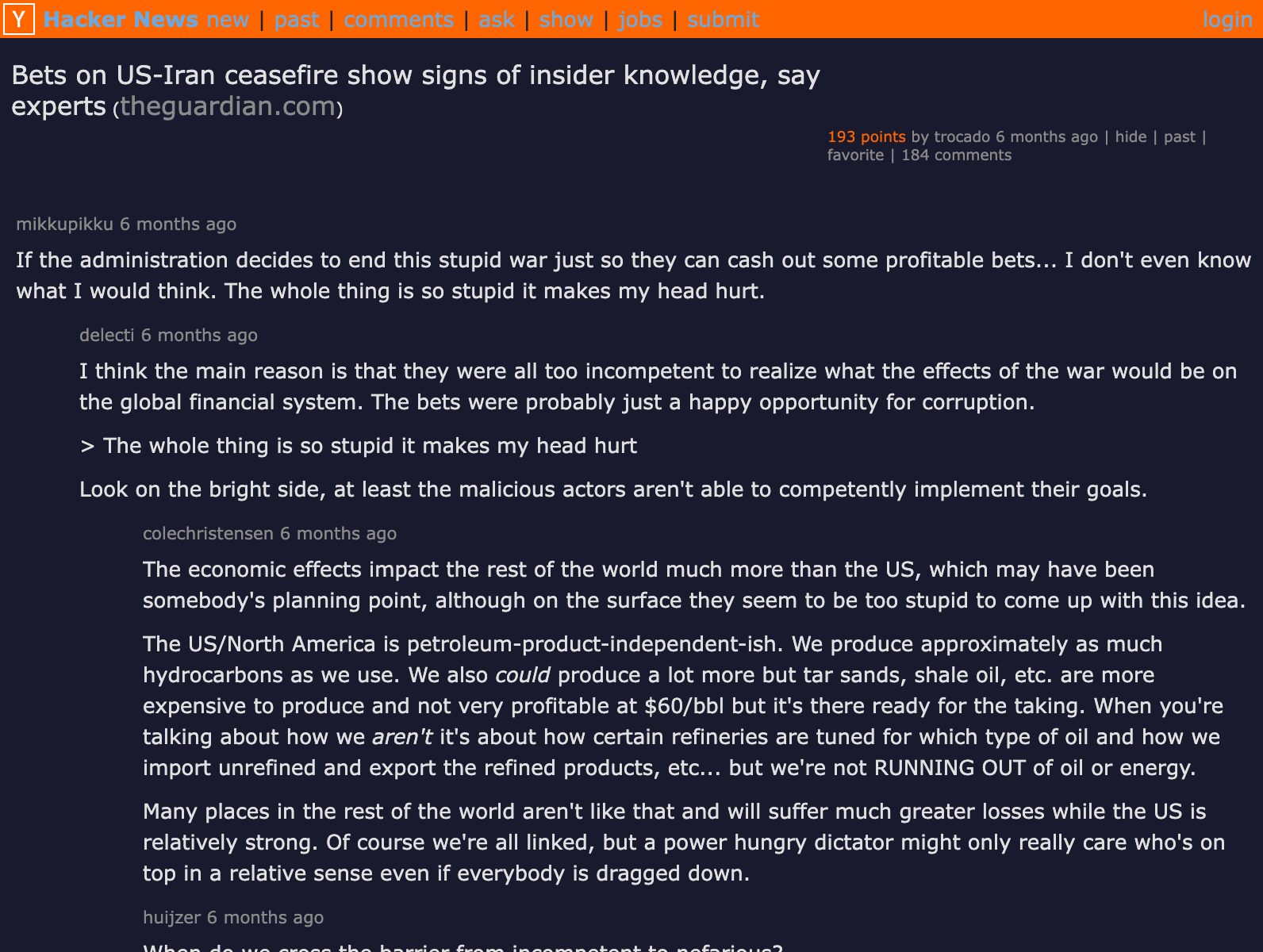
The Hacker News community debated this vigorously. A thread on the AP investigation into well-timed ceasefire bets drew 138 comments and 168 points, while an earlier thread on insider trading signals reached 184 comments — with commenters split between those who saw prediction markets as a genuine information tool and those who saw them as an insider's arbitrage playground.
View the full thread on Hacker News →
View the full thread on Hacker News →
Tip
As we covered in our earlier analysis of Iran prediction markets, these markets tell two stories simultaneously: the consensus price, and the pattern of who is moving that price. Both matter. Read our deep dive: Iran's Prediction Markets Tell Two Stories.
The value is not in trusting the number blindly — it is in watching the rate of change. The Iran ceasefire market climbing to 100% is less informative than the Ukraine diplomatic meeting market falling 19.5% in a month. The first is consensus hardening. The second is consensus breaking. And breaking consensus is where the signal lives.
What to Watch
The next 30 days will test whether this divergence narrows or widens.
On Iran: Watch the ceasefire continuation market's decay rate past October. The current near-100% price assumes the frozen settlement holds indefinitely. The real question is whether the blockade — still in force as of the latest CENTCOM statements — becomes the kind of irritant that forces renegotiation. If the November and December legs start declining, it signals the market sees the freeze thawing.
On Ukraine: The October trilateral proposal is the test. If a meeting materializes by month-end and the diplomatic meeting contract rebounds, the market was wrong to price declining odds. If no meeting occurs and the contract falls further, it confirms what the market already suspects: Ukraine talks are a function of American political calendars, not strategic commitment.
On the divergence itself: The gap between Iran-at-100% and Ukraine-at-10% is the market's most legible statement about American geopolitical priorities. As we wrote when the Hormuz de-escalation first repriced energy markets, prediction markets are increasingly functioning as the first draft of geopolitical history. This divergence writes the chapter title: America can settle the war it has to. It cannot settle the war it chooses not to.
For more on how prediction markets have tracked the Iran conflict, see our coverage of the ceasefire's structural fragility and the insider trading questions that remain unresolved. On the European dimension of the Ukraine stalemate, our analysis of Europe's sanctions rollback explores what happens when the continent hedges against a peace that never arrives.
The Desk
About The Arc of Power
The Arc of Power editorial desk delivers rigorous analysis of geopolitics, defense, economic statecraft, and intelligence — examining the forces that shape the global order.
Briefing Access
Request Briefing Access
In-depth geopolitical analysis — power dynamics, defense strategy, and economic statecraft — three times a week. No noise.
Request briefing accessRelated Files
GeopoliticsThe 'Bretton Woods of Super Intelligence' Is a Bluff
GeopoliticsSeptember 30, 202612 min read
US-Iran Talks This Week: What the Money Already Prices
GeopoliticsSeptember 28, 202612 min read
Anthropic Said No to the Pentagon. It Got Blacklisted.
GeopoliticsSeptember 25, 202613 min read