Case file · Geopolitics · 11 min read
Reddit Sees War. Polymarket Sees Peace. Who's Right on Iran?
Five Reddit threads scream escalation while Polymarket prices ceasefire at 97%. The divergence reveals who reads headlines and who reads incentives.
The Arc of Power ·
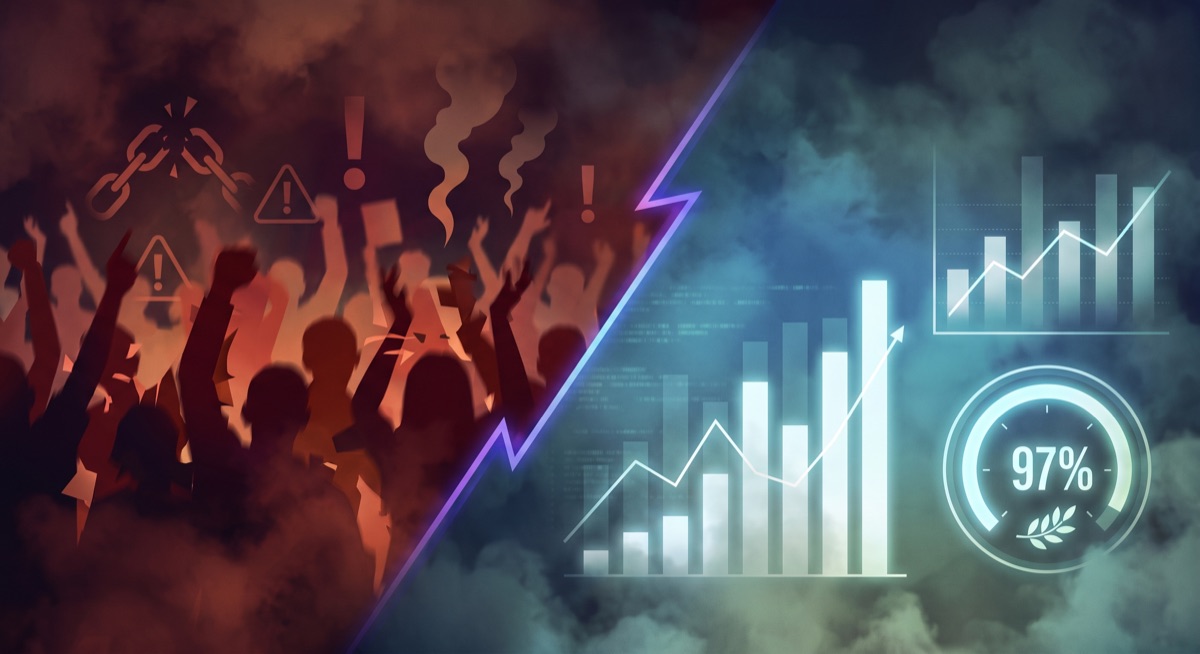
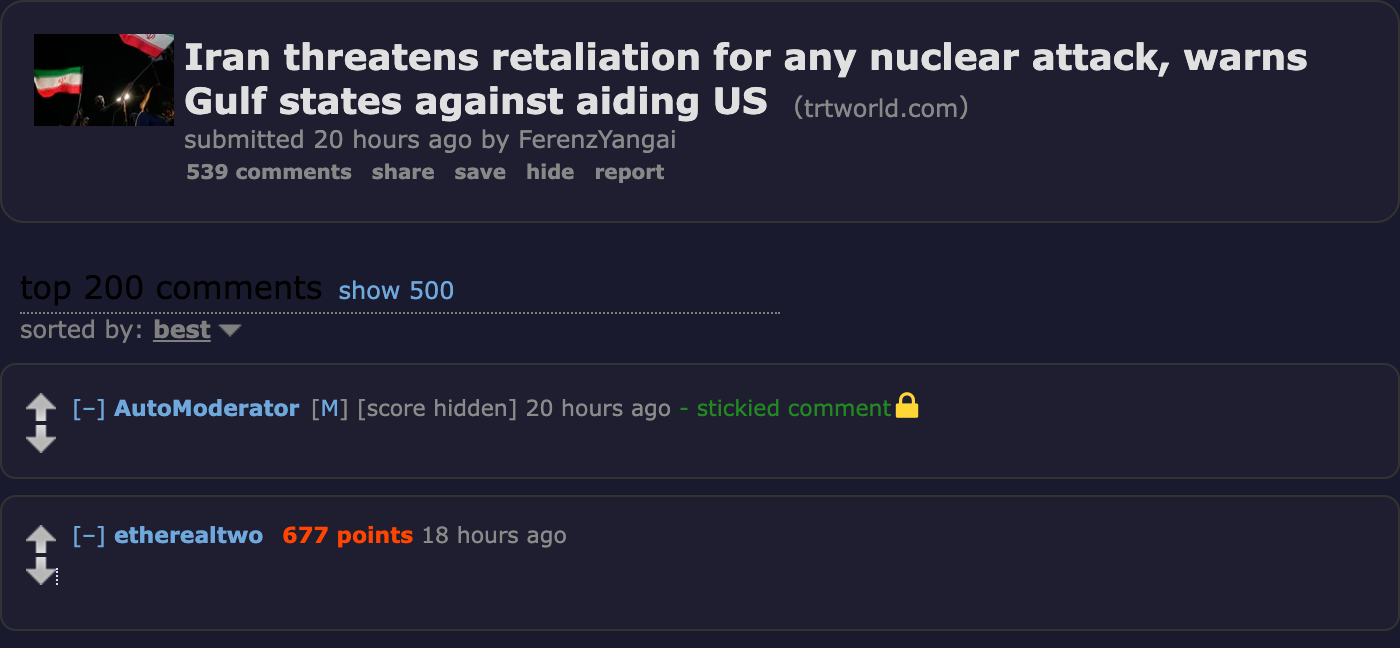
On August 19, 2026, r/worldnews delivered five front-page dispatches from the edge of what looked like a new phase of the Iran war. The UAE halted all trade with Iran (5,100 upvotes). Tehran threatened to strike US military assets in Europe (2,100 upvotes). CNN reported Iran has lost significant control of the Strait of Hormuz (1,900 upvotes). Iran warned Gulf states it would retaliate for any nuclear strike (1,700 upvotes). And the Pentagon is weighing a major troop pullback from the Gulf (1,700 upvotes).
Read those five headlines in sequence and the implicit narrative writes itself: escalation is coming.
Now look at where people are putting money. Polymarket's highest-volume geopolitics market — the US-Iran ceasefire continuation contract — prices peace at 97% / 94% / 88% across its near-term tiers. It is up 37% today. The Israel-Iran ceasefire contract sits at 94% / 82% / 74%, up 57% this month. Combined 24-hour volume: over $440,000 on these two markets alone, with nearly $1.25 million in liquidity.
The crowd says war. The market says ceasefire. One of them is wrong — and the reason why reveals something fundamental about how we misread geopolitical risk.
Our thesis: The market is right, but not because crowds are stupid. The escalatory signals Reddit is tracking are real events. But the crowd is making a category error — confusing threat display with capability change. The UAE embargo, Iran's Hormuz losses, and the US troop pullback are not precursors to war resumption. They are the architecture of a new equilibrium being constructed around the ceasefire. Money forces you to price the difference between a scary headline and an actual probability of resumed conflict. Reddit does not.
The Five Signals and What They Actually Mean
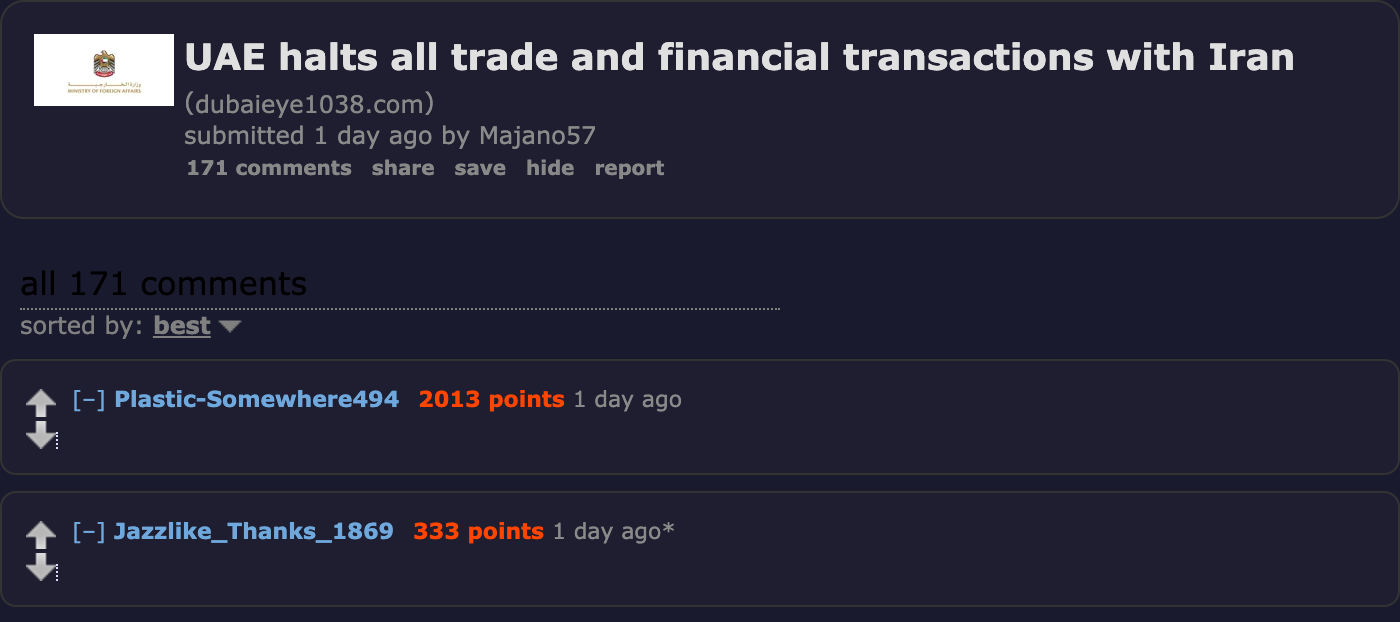
1. The UAE Embargo: Iran's Economic Airbag Just Deployed — Against Iran
The UAE's trade suspension is the most consequential development of the day, and the one most misread by the crowd. Reddit sees it as escalation. The market sees it as the UAE removing Iran's incentive to fight.
View original post on Reddit →
The numbers explain why. Dubai supplied roughly one-third of Iran's annual imports, surpassing both China and Turkey. Official bilateral trade was $6.2 billion in 2023, but the real figure — including re-exports, informal channels, and sanctions-evasion flows — is far larger. A senior analyst at the Foundation for Defense of Democracies put it bluntly: the UAE and China are Iran's two economic bloodlines, and if the UAE is serious, it will close the one the US Navy could not touch. A retired US general called the embargo "even more significant than the embargo being put on by the United States."
Here is the counterintuitive logic the market is pricing: an Iran that loses its Dubai trade lifeline is an Iran that cannot afford to resume hostilities. Wars cost money. Iran's IRGC cannot fund Hormuz disruptions, proxy operations, and missile production while simultaneously losing 30% of its import channel. The embargo does not make war more likely. It makes the cost of war prohibitively high for Tehran — which is precisely why the ceasefire market spiked 37% on the same day.
Note
The FDD analyst's key insight: "Dubai has been basically Iran's window to the world economy." The embargo achieves what six months of US naval blockade could not — cutting the informal trade arteries that kept Iran's economy functional during the war.
2. Hormuz Control: Iran Lost Its Best Leverage and the Market Noticed
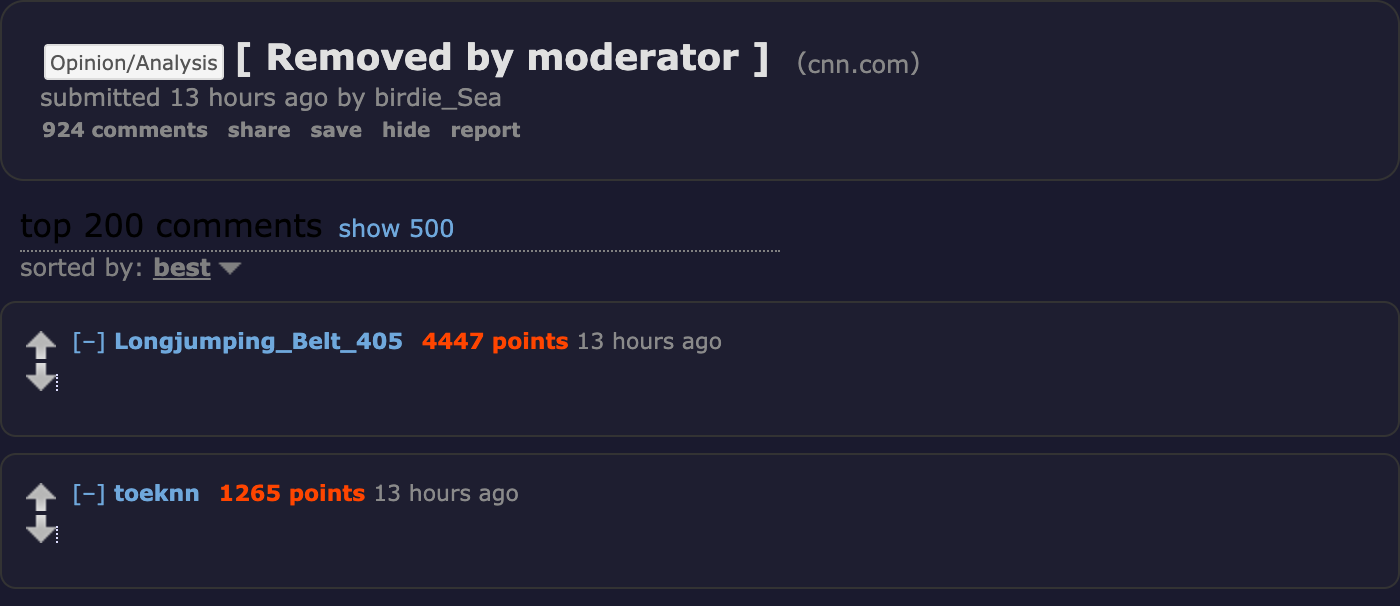
CNN's reporting that Iran has lost significant control of the Strait of Hormuz landed on Reddit as proof of instability. More than 80% of liquid transits now use either the UN-authorized Omani route or "dark" passages, bypassing Iranian waters entirely.
View original post on Reddit →
But the market reads this signal in reverse. Iran's ability to weaponize Hormuz was the single greatest threat to the ceasefire — the credible promise that it could crash global energy markets by resuming disruptions. That threat was the gun on the table during every negotiation round. If Iran has lost that leverage, the ceasefire becomes more durable, not less. A belligerent without its most effective weapon is a belligerent that negotiates.
As we wrote in our earlier analysis of the ceasefire's structural weaknesses, the ceasefire has always been "structurally incoherent" — the two sides accepted it while holding incompatible frameworks for what comes next. But structural incoherence does not mean imminent collapse. It means protracted stalemate. And protracted stalemate is exactly what a 97% ceasefire-continuation price reflects.
3. The US Troop Pullback: Reorganization, Not Retreat
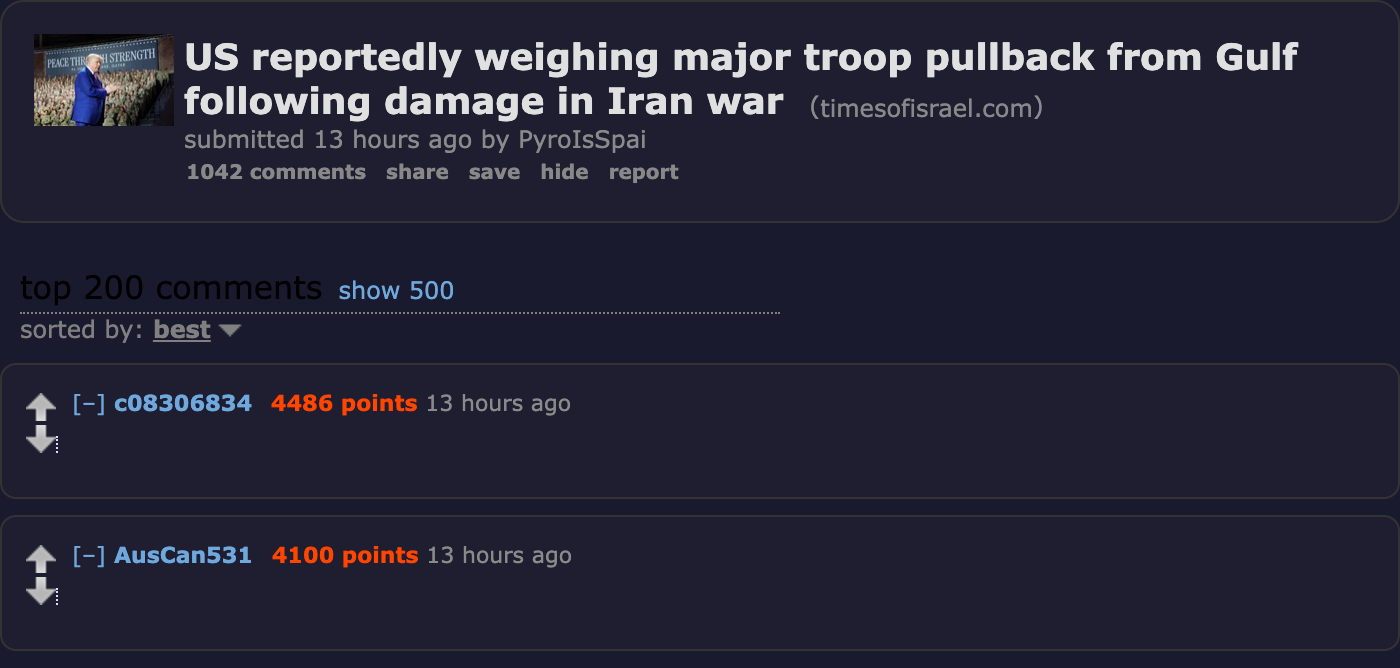
The Pentagon is reportedly considering not rebuilding its damaged Gulf bases and instead repositioning forces westward — toward Jordan and Israel. Reddit reads this as America losing its grip. The market reads it as America adjusting its posture to one that assumes the ceasefire holds.
View original post on Reddit →
This is the distinction between positioning for conflict and positioning for the post-conflict. If the Pentagon expected the ceasefire to collapse imminently, it would be reinforcing Gulf bases, not considering whether to rebuild them. The pullback conversation is itself a signal that the US military establishment believes the ceasefire is durable enough to warrant a long-term force restructuring.
4. Iran's Threats: Loud Words, Quiet Desperation
Iran threatening to strike US assets in Europe and warning Gulf states against nuclear cooperation reads, on Reddit, as an escalation ladder being climbed. On Polymarket, it reads as deterrence signaling — the kind of thing a power does when it wants to maintain the appearance of strength without actually resuming hostilities.
View original post on Reddit →
There is an old rule in intelligence analysis: the loudest threat is usually the one least likely to be executed. States that are genuinely preparing offensive action go quiet. They move assets, not press releases. Iran is issuing press releases.
Why Crowds and Markets Diverge on Geopolitics
This is not the first time prediction markets and public sentiment have told opposite stories about Iran. In April, we documented how prediction markets were pricing ceasefire timing with remarkable accuracy even as the public narrative was dominated by escalation fears. The pattern is structural, not episodic.
A 2026 study on prediction market calibration — "Decomposing Crowd Wisdom" — identifies a systematic divergence in geopolitical markets: crowd sentiment reacts to salience (how dramatic an event feels), while market pricing reacts to probability (how likely an outcome actually is given the full information set).
The five Reddit threads from today are a textbook example. Each one is high-salience — dramatic, threatening, consequential-sounding. Each one drives engagement precisely because it triggers threat perception. Reddit's upvote mechanism rewards salience. It does not reward calibration.
Polymarket's mechanism is different. When you bet real money on whether a ceasefire will hold, you are forced to do something Reddit never requires: weigh the cost of being wrong. A trader who bets on escalation and loses forfeits capital. A Reddit user who upvotes an escalation headline and is wrong forfeits nothing. This asymmetry in consequences produces systematically different assessments of the same events.
Critical
The contrarian case the market might be underpricing: the crowd could be right if the UAE embargo creates a cornered-animal dynamic. When you simultaneously cut off an adversary's economic escape routes, degrade its strategic leverage at Hormuz, and maintain military pressure, you can accidentally create the conditions for escalation rather than de-escalation. A regime that cannot trade, cannot toll, and cannot negotiate from strength may conclude it has nothing left to lose. History's most dangerous moments come when a declining power decides the cost of inaction exceeds the cost of a desperate gamble. The market's 97% may be underpricing this tail risk.
Three Lessons from the Iran Divergence
Lesson 1: Threat Display Is Not Capability Change
The single most reliable misread in geopolitical analysis is confusing what a state says with what it can do. Iran's threats against European US assets and Gulf states are threat displays — designed to maintain deterrence credibility while the actual balance of power shifts against Tehran. The market prices capabilities. The crowd prices press releases.
This distinction has been a recurring theme in the Iran war. China's quiet financial support for Iran proved more consequential than any of Tehran's public threats. The lesson is evergreen: watch the money flows, not the microphones.
Lesson 2: Economic Isolation Stabilizes Ceasefires (Until It Does Not)
The UAE embargo is doing something US sanctions never managed: cutting the informal trade arteries that kept Iran economically functional. This is stabilizing in the short term — an economically weakened Iran has fewer resources for renewed conflict. But the historical record on economic isolation is mixed.
Iraq in 1990. Japan in 1941. When economic strangulation reaches a threshold where the isolated state perceives existential threat, the calculus can flip from "we cannot afford to fight" to "we cannot afford not to." The market is correct that we are not at that threshold today. The question is whether the threshold is closer than 97% implies.
Lesson 3: The Crowd-Market Gap Is Itself a Signal
When narrative fear runs at escalation while market pricing runs at peace, the gap itself tells you something: the news cycle is dominated by events that look dangerous but do not change the underlying probability distribution. This gap typically closes in one of two ways — either the crowd calms down as headlines fade (the usual outcome), or a genuine capability shift occurs and the market reprices toward the crowd (rare, but catastrophic when it happens).
For the Iran conflict specifically, the signal to watch is not more Reddit threads about threats. It is whether Iran's actual behavior changes — missile tests, Hormuz disruptions, or proxy activations that would force the market to reprice. Until then, the 97% is the best available estimate of reality.
What Happens Next
The ceasefire's 60-day MOU deadline expired on August 17 without a formal extension or a final deal. Trump says no talks are underway. Iran's lead negotiator claims victory. Neither side has resumed large-scale hostilities.
This is the messy reality that neither Reddit nor Polymarket captures perfectly. The ceasefire is neither a path to peace nor a precursor to war. It is a holding pattern — sustained by mutual exhaustion, economic constraints, and the absence of a better alternative for either side.
The market is pricing that holding pattern correctly at 97%. The crowd is pricing the fear that the holding pattern will break. Both are responding rationally to the information they value most — but only one of them is putting money behind the assessment.
In geopolitics, as in markets: follow the money, not the mood.
Tip
The Arc of Power has been tracking the Iran prediction market story since April. For the full analytical thread: our analysis of the ceasefire's structural weaknesses shows why the ceasefire is built on sand but still standing. Our prediction market deep-dive examines the insider trading controversy and what markets got right versus wrong. And our Hormuz de-escalation analysis tracks the downstream economic effects.
Read the full thread: The Iran-US Ceasefire Is Built on Sand | Iran's Prediction Markets Tell Two Stories | Hormuz De-Escalation Reprices Data Centers
The Desk
About The Arc of Power
The Arc of Power editorial desk delivers rigorous analysis of geopolitics, defense, economic statecraft, and intelligence — examining the forces that shape the global order.
Briefing Access
Request Briefing Access
In-depth geopolitical analysis — power dynamics, defense strategy, and economic statecraft — three times a week. No noise.
Request briefing accessRelated Files
GeopoliticsThe 'Bretton Woods of Super Intelligence' Is a Bluff
GeopoliticsSeptember 30, 202612 min read
US-Iran Talks This Week: What the Money Already Prices
GeopoliticsSeptember 28, 202612 min read
Anthropic Said No to the Pentagon. It Got Blacklisted.
GeopoliticsSeptember 25, 202613 min read