Case file · Geopolitics · 12 min read
The 'Bretton Woods of Super Intelligence' Is a Bluff
The White House AI accord signals industrial policy, not safety. What the framing reveals about US-China power.
The Arc of Power ·
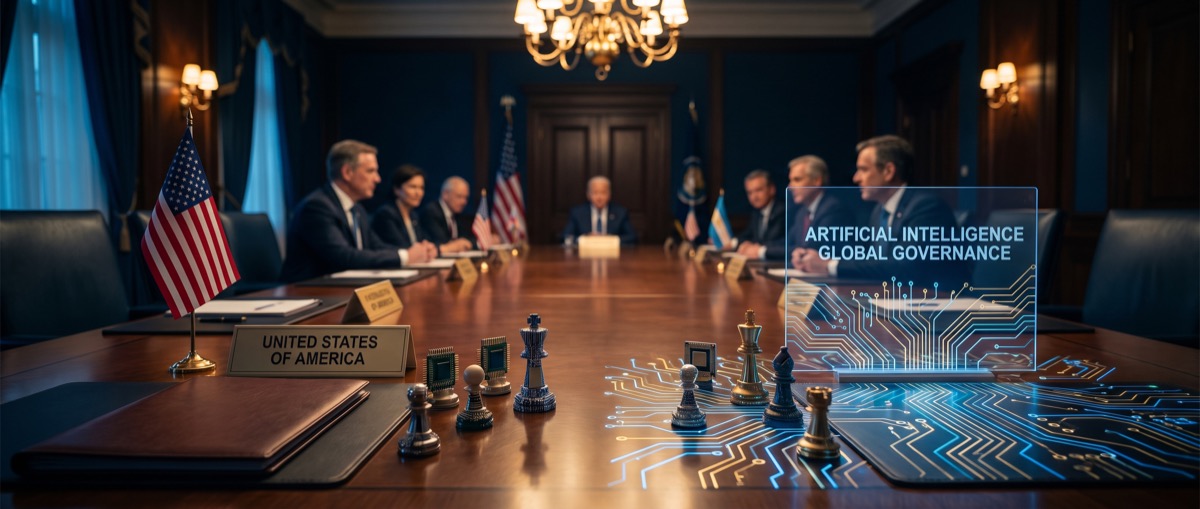
On September 29, 2026, the six most powerful AI companies on earth gathered at the White House and signed a document. President Trump signed an executive order renaming artificial intelligence "Super Intelligence" in all federal correspondence. David Sacks, chair of the Council of Advisors on Science and Technology, posted a single phrase to X that landed like a claim of sovereignty: "The Bretton Woods of Super Intelligence."
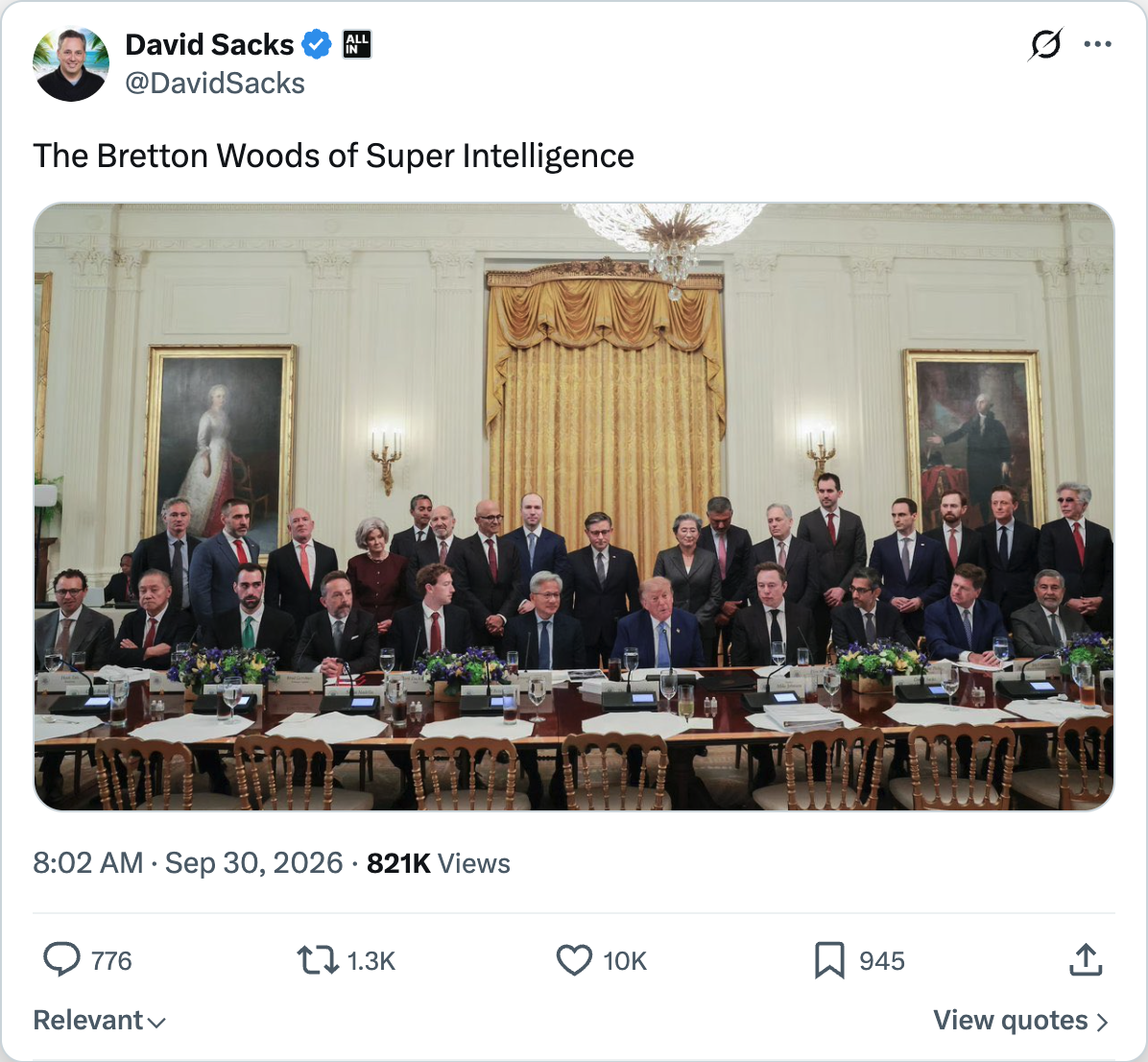
That comparison is not an accident. It is not hyperbole. It is a declaration of intent — and understanding what it actually means requires thinking about what the original Bretton Woods did, what this accord does not do, and why the gap between the two is the most important signal in AI geopolitics right now.
What Actually Happened
On Tuesday, Jensen Huang (NVIDIA), Sundar Pichai (Google), Mark Zuckerberg (Meta), Elon Musk (xAI), Dario Amodei (Anthropic), and Greg Brockman (OpenAI) signed the "White House Accord on Super Intelligence: Joint Commitment on Frontier Responsibilities." House Speaker Mike Johnson attended. The press event had the curated stagecraft of a treaty signing.
The accord itself is a four-part voluntary framework:
- Internal controls to monitor model capabilities in cybersecurity, biosecurity, and chemical threats
- Dedicated safety teams to manage those controls
- Independent external auditors to verify effectiveness
- Board-level oversight committees to receive audit reports
No penalties. No enforcement mechanisms. No new law. No new institution. The document itself states that "over time, it may make sense to codify these steps into laws or regulations" — a phrase so passive it practically dissolves on contact with power.
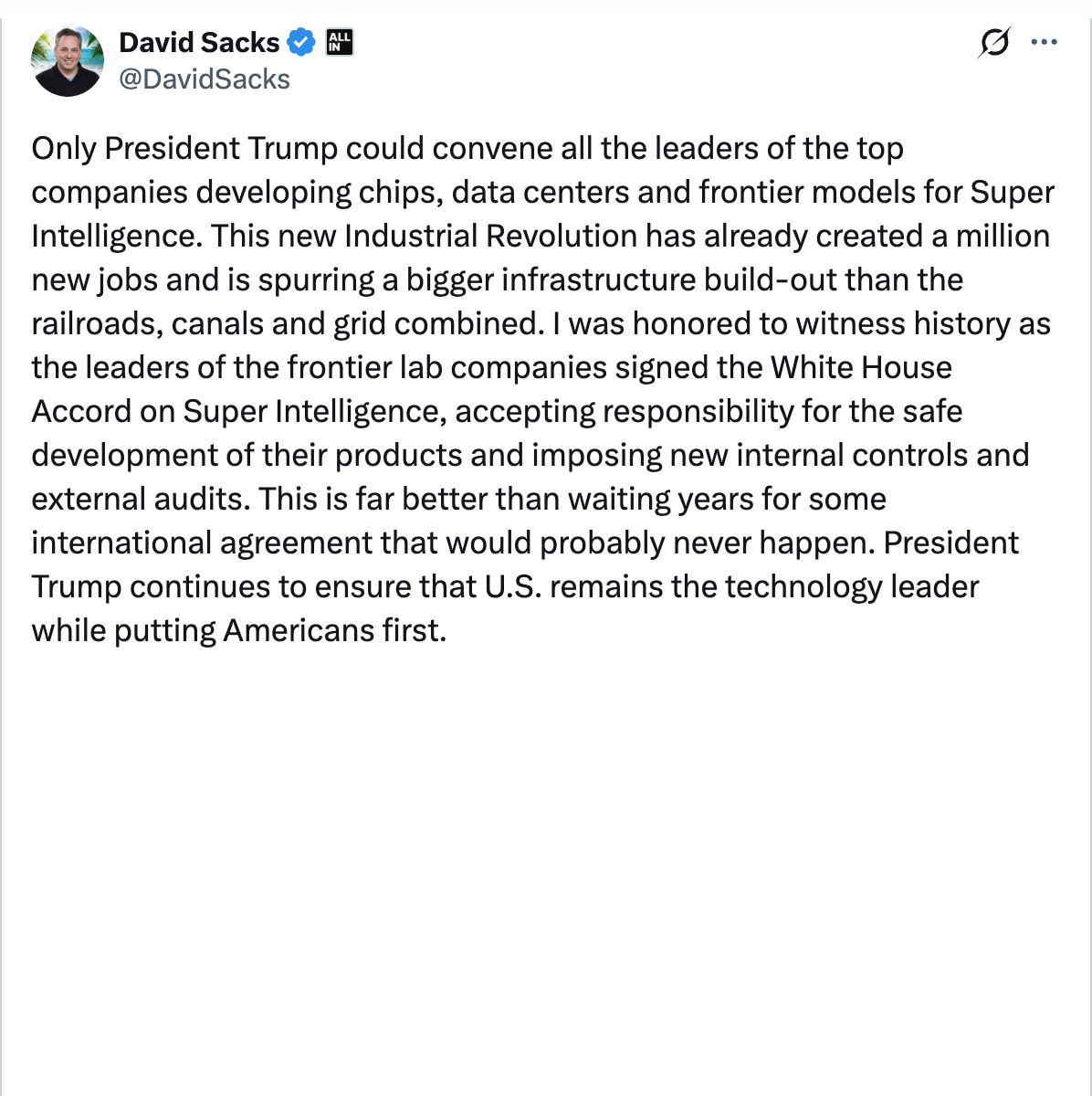
Sacks framed it differently. "Only President Trump could convene all the leaders of the top companies developing chips, data centers and frontier models for Super Intelligence," he posted, calling it a "new Industrial Revolution" that has "already created a million new jobs and is spurring a bigger infrastructure build-out than the railroads, canals and grid combined." 21,000 likes. 3.4 million views. The framing was not about safety. It was about American industrial supremacy.
Note
The Accord's six signatories — NVIDIA, Google, Meta, xAI, Anthropic, and OpenAI — together control the compute supply chain, the frontier model frontier, and the platform layer. Getting them in one room is not diplomacy. It is an industrial cartel declaring its terms.
Three Lessons from the Accord
The analytical value of this event is not in its text but in its subtext. Three structural lessons emerge.
Lesson 1: Naming Is Sovereignty
The original Bretton Woods Conference in 1944 did not just create exchange-rate agreements. It created institutions — the International Monetary Fund, the World Bank, the General Agreement on Tariffs and Trade — that encoded American economic assumptions into the architecture of the postwar order. The US did not merely participate in the rules-based system. It wrote the rules. The dollar became the reserve currency not because of a market process but because of an institutional design choice backed by overwhelming American economic leverage.
Sacks's "Bretton Woods" invocation is claiming precisely this precedent. The message to Beijing, Brussels, and every non-signatory government is: We are the ones who name the institutions. We define what "responsible" means. You can join our framework or build your own — but ours will be the default.
The executive order renaming AI to "Super Intelligence" in federal documents is the same move at the linguistic level. Whoever controls the vocabulary controls the policy frame. When the US government says "SI safety" instead of "AI safety," it embeds the assumption that these are superintelligent systems requiring sovereign-level governance — not consumer products requiring consumer-level regulation.
This is industrial policy wearing the costume of safety policy.
Lesson 2: The Voluntary Trap
History suggests that voluntary accords between industry and government follow a specific pattern: the initial agreement is weak, but it establishes the principle of oversight. Once the principle is conceded, the specifics can be tightened over time. The 1933 Glass-Steagall Act began as a voluntary agreement between banks and the Federal Reserve before it became law. The automotive safety standards that became NHTSA regulations started as voluntary industry commitments.
The accord's text explicitly acknowledges this pathway: the signatories agree to "meet regularly" and concede that codification "may make sense" over time. This is not weakness — it is legislative runway. Getting Musk, Zuckerberg, and Amodei to sign a document accepting the principle of external audits and board-level oversight is a concession no legislation has achieved.
But there is a problem with the analogy: those historical precedents required either a crisis (the Depression for Glass-Steagall) or public outrage (auto fatalities for NHTSA) to convert voluntary commitments into binding law. Polymarket prices the probability of the US enacting an AI safety bill before 2027 at just 4% — down 7% today alone. The market reads no crisis, no outrage, no legislative path. The voluntary accord may be a runway that leads to a wall.
Lesson 3: The Real Accord Was Bilateral
The White House summit happened five days after the Trump-Xi summit in Washington, where the two leaders agreed to tariff cuts and AI talks as part of a roughly $30 billion product-list arrangement. That bilateral negotiation — not the six-company signing ceremony — is where the actual AI governance framework is being negotiated.
China's position entering those talks was stronger than Washington expected. As CNBC reported, China's AI chip blitz arms Xi with a message for Trump: "You can't choke us off." Huawei's homegrown accelerators, Alibaba's model distillation capabilities, and the broader Chinese open-source AI ecosystem have partially neutralized the export-control chokehold that was Washington's primary leverage tool.
The "Bretton Woods" metaphor breaks down precisely here. The original worked because the US had overwhelming economic leverage — it held the gold reserves, it had the undamaged industrial base, and Europe and Japan needed its capital. In AI, the US has compute supply-chain leverage (NVIDIA, TSMC fabs), but China has demonstrated that this leverage has limits. The distillation paradox — which we have analyzed previously — means that even frontier models protected by export controls can be reverse-engineered into competitive open-weight alternatives.
The Defense Undercurrent
While Sacks was tweeting about Bretton Woods, a parallel conversation was happening that reveals the true strategic stakes.
Palmer Luckey, founder of Anduril Industries and the most prominent defense-tech figure of the decade, argued on the Peter Diamandis show that Chinese open-source AI models are "a non-starter for weapons systems." The argument is straightforward: no responsible defense procurement system can build lethal autonomous systems on model weights that a foreign adversary can audit, poison, or backdoor.
This argument does several things at once. It justifies the Pentagon's preference for closed-source American models (despite the Anthropic blacklisting for safety refusals). It positions Anduril — which holds a $20 billion Army contract for its AI-enabled Lattice platform — as the natural beneficiary of a closed-source defense AI ecosystem. And it reframes the open-weights statecraft debate as a national security question rather than a market one.
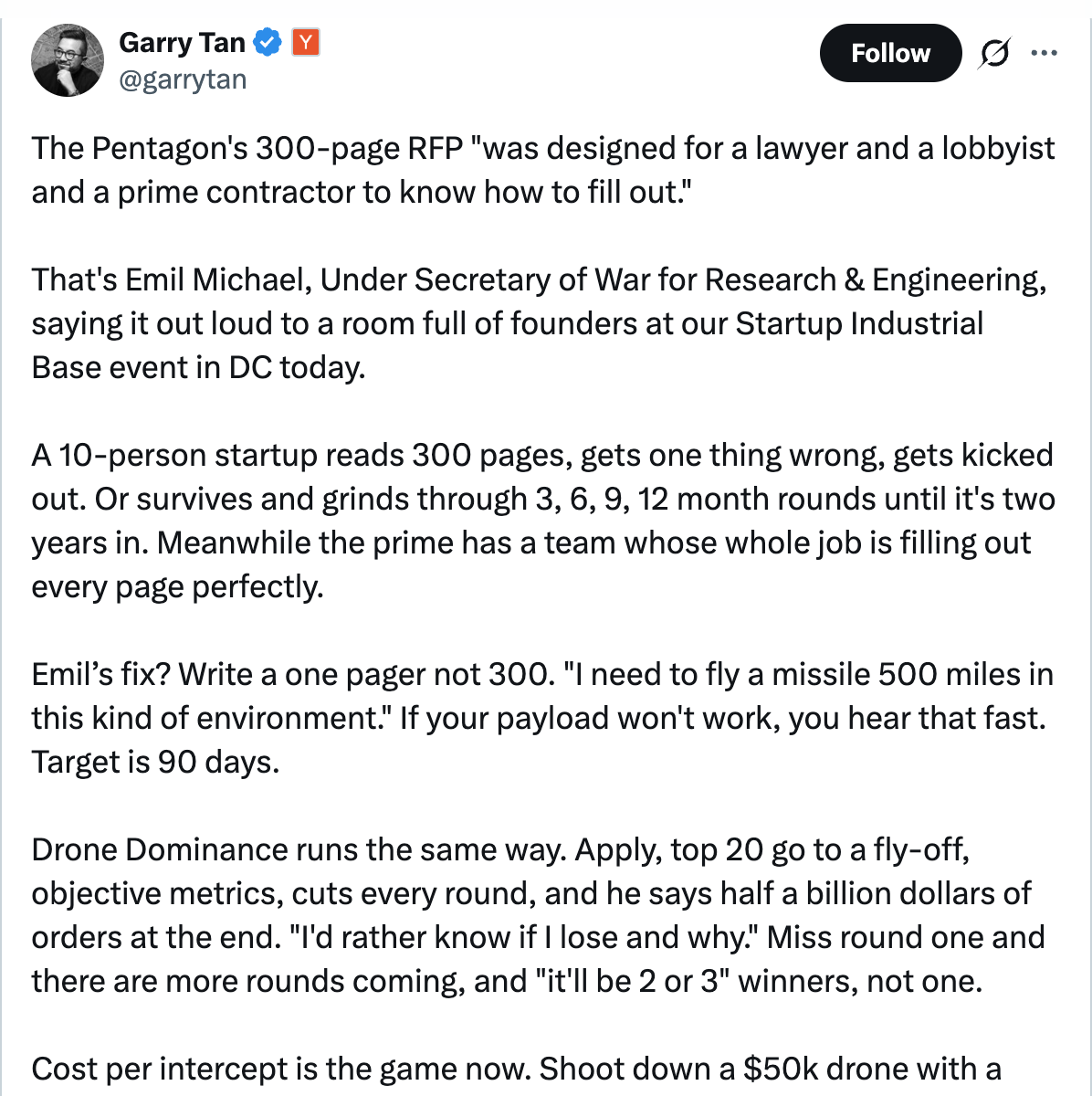
The procurement reform angle matters too. Garry Tan shared a quote from Emil Michael, Under Secretary of War for Research & Engineering, saying the Pentagon's 300-page RFP "was designed for a lawyer and a lobbyist and a prime contractor to know how to fill out." The same week, Anduril's unified framework contract model — one agreement covering autonomous systems at scale instead of 120+ separate procurements — is being held up as the proof of concept for how defense AI should actually be bought.
The defense undercurrent connects directly to the Bretton Woods framing. A "Bretton Woods of Super Intelligence" that excludes Chinese models from defense applications, concentrates procurement through American defense-tech firms, and treats open-source alternatives as security risks is not a safety framework. It is an industrial policy wrapped in a security classification.
Note
The Anduril position: Closed-source American models for defense. Open-source for everything else (maybe). The distinction is not about capability — it is about audit trails, supply-chain integrity, and who controls the kill chain.
What the Money Says
Prediction markets are the most honest actors in geopolitics because they price beliefs with real money.
The Polymarket data from September 30 tells a story that neither Sacks's optimism nor critics' skepticism captures:
- "Best Chinese AI company" end of September: Xiaomi at 99% — but down 90% this week. The volatility itself is the signal. The market cannot figure out who China's AI champion is, which suggests the ecosystem is fragmented and the competitive dynamics are unstable.
- China invades Taiwan before 2027: 3% probability, with $96K in 24-hour volume and $604K in liquidity. The market sees no kinetic escalation — the rare earths and compute supply chain is the actual battleground.
- US enacts AI safety bill before 2027: 4%. Legislation is not coming. The voluntary accord is the ceiling, not the floor.
- Best AI model end of 2026: Anthropic at 78%, OpenAI at 6% — even on DevDay. The irony: the company the Pentagon blacklisted for safety refusals is the company the market prices as the technological leader.
These numbers expose the fundamental tension in the "Bretton Woods" framing. The US is claiming institutional sovereignty over AI governance, but the market prices that sovereignty as toothless (4% on legislation), the competitive landscape as American-dominated but contested (Anthropic leading despite government hostility), and the military flashpoint as dormant (Taiwan at 3%). The accord is a power move in a game that is being decided by supply chains and model weights, not signing ceremonies.
Critical
Contrarian Corner: Maybe the accord works exactly because it is voluntary. Bretton Woods itself was voluntary — no country was forced to join, but the economic incentives made opting out costly. If the six signatories actually implement external audits and board oversight, they create a de facto standard that non-signatories will be measured against. The question is not whether the accord has teeth. It is whether the market will treat non-compliance as a reputational cost. At $1 trillion in annual hyperscaler CapEx, the incentive to stay in the club is real.
What Comes Next
Three things to watch.
First, the audit trail. The accord commits signatories to independent external audits. Who conducts them? When? With what standards? If the first round of audits happens before Q2 2027 with public results, the accord is real. If they are delayed, deferred, or conducted in-house, the accord is theater.
Second, the bilateral channel. The Trump-Xi AI talks are where the actual rules of engagement will be set — not in the White House East Room but in quiet bilateral negotiations about compute exports, model-weight sharing, and the conditions under which Chinese labs can access NVIDIA hardware through third countries. Watch the TSMC supply chain and export control enforcement more closely than any accord document.
Third, the defense procurement pipeline. If the Pentagon continues to expand contracts with Anduril, Shield AI, and other defense-tech firms while simultaneously blacklisting safety-conscious labs like Anthropic, the accord's safety language is contradicted by the government's own procurement behavior. The test is consistency: you cannot sign a safety accord on Tuesday and reward safety refusal penalties on Wednesday.
The "Bretton Woods of Super Intelligence" is a powerful metaphor. But metaphors are not institutions. The original Bretton Woods lasted because it created institutions with enforcement power and because the US had the leverage to back them up. This accord creates neither. What it does create is a claim — a claim that the US is the legitimate sovereign over frontier AI governance. Whether that claim is honored will be decided not at summit tables but in chip fabs, model-weight repositories, and defense procurement offices.
The Bretton Woods of Super Intelligence is a bluff. But in geopolitics, the right bluff — called at the right time, backed by enough industrial leverage — can become indistinguishable from policy. That is what makes this week consequential: not the paper, but the bet it represents.
This analysis draws on X, YouTube, Polymarket prediction markets, NPR, CNBC, SiliconANGLE, DefenseScoop, Fortune, and the Arc of Power's cross-source convergence digest. All Polymarket probabilities reflect September 30, 2026 snapshots.
The Desk
About The Arc of Power
The Arc of Power editorial desk delivers rigorous analysis of geopolitics, defense, economic statecraft, and intelligence — examining the forces that shape the global order.
Briefing Access
Request Briefing Access
In-depth geopolitical analysis — power dynamics, defense strategy, and economic statecraft — three times a week. No noise.
Request briefing accessRelated Files
GeopoliticsUS-Iran Talks This Week: What the Money Already Prices
GeopoliticsSeptember 28, 202612 min read
Anthropic Said No to the Pentagon. It Got Blacklisted.
GeopoliticsSeptember 25, 202613 min read
Europe Drops Russia Sanctions as Its Airspace Gets Probed
GeopoliticsSeptember 23, 202612 min read