Case file · Geopolitics · 13 min read
Open Weights Are Now Statecraft
Lambert's Congressional briefing reveals the US is losing the open-model race to China. Four strategic lessons.
The Arc of Power ·
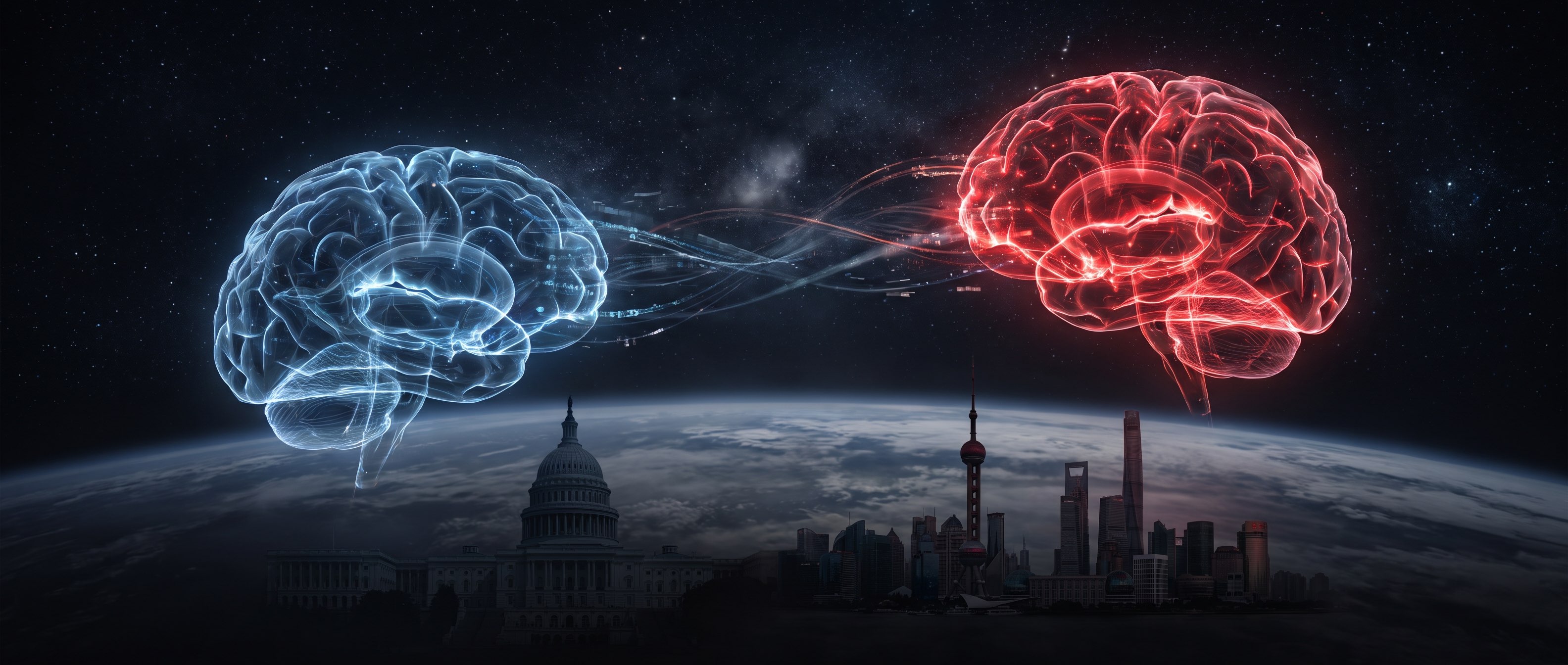
Nathan Lambert, an AI researcher at the Allen Institute for AI and one of the most closely watched voices on open-model ecosystems, was recently invited to brief members of Congress and their staff on the state of open-weight AI models. His prepared remarks, published September 21, 2026 on Interconnects, read less like a tech policy briefing and more like a strategic intelligence assessment. The core finding: Chinese open-weight models now command over 80% of global usage on major routing platforms, up from roughly 70% a year ago. American open models are not just behind — they are falling further behind.
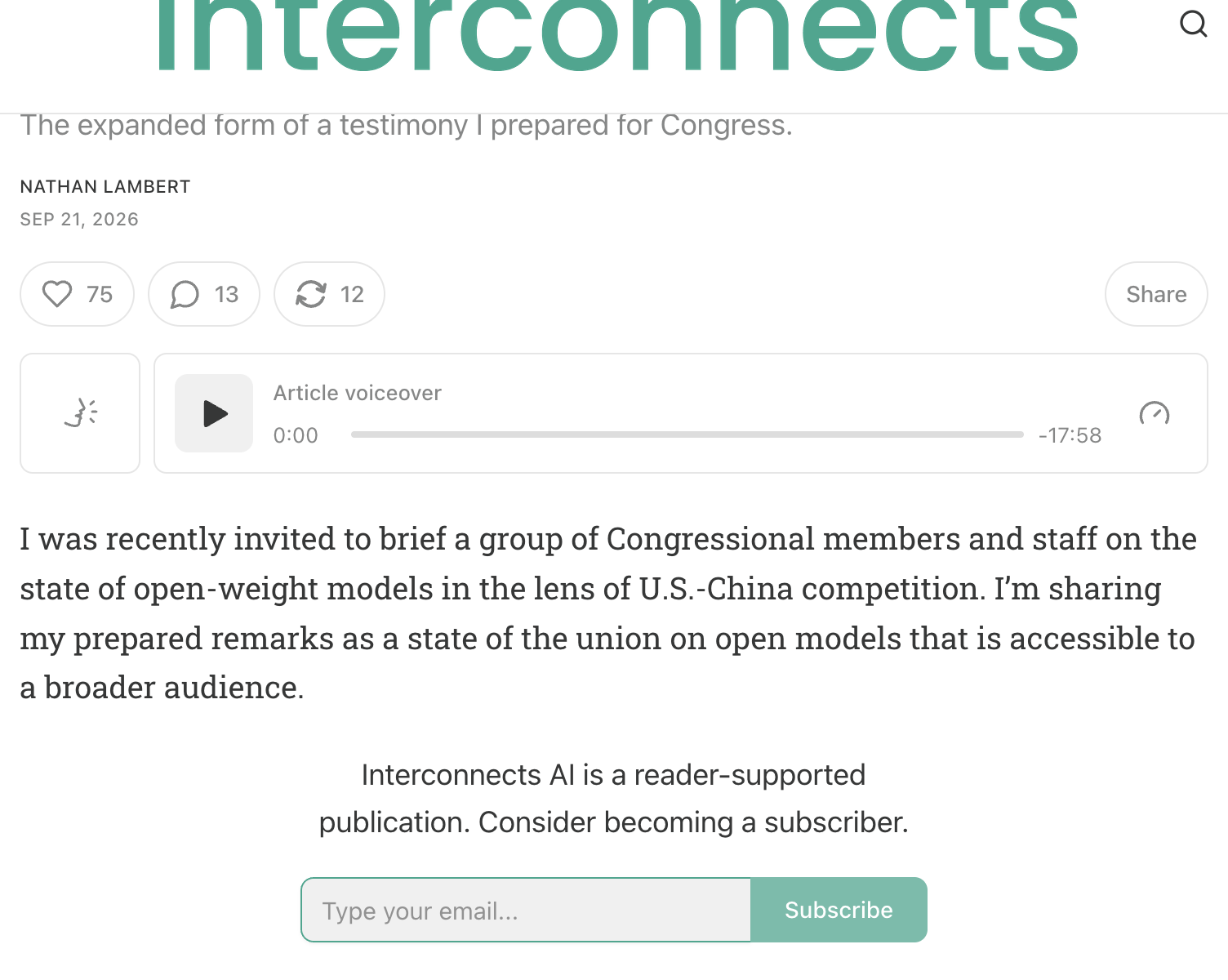
View original article on Interconnects →
This is not a licensing debate. It is a balance-of-power problem. When 80% of the world's downloadable AI infrastructure runs on Chinese weights, the implications extend well beyond Silicon Valley's competitive anxieties. They reach into defense planning, alliance structures, and the global distribution of technological influence — the traditional domain of statecraft.
The timing is not accidental. Lambert's briefing lands in a policy environment shaped by three converging forces: a USCC report documenting China's "Two Loops" strategy for reinforcing AI dominance through manufacturing, a 270-company industry letter urging Congress not to restrict open weights, and a prediction market pricing the probability of federal AI safety legislation before 2027 at 6%. The legislative vacuum is not a bug — it is the operating environment.
Four Lessons from the Briefing
1. China Won the Open-Model Race While Washington Debated Whether to Run
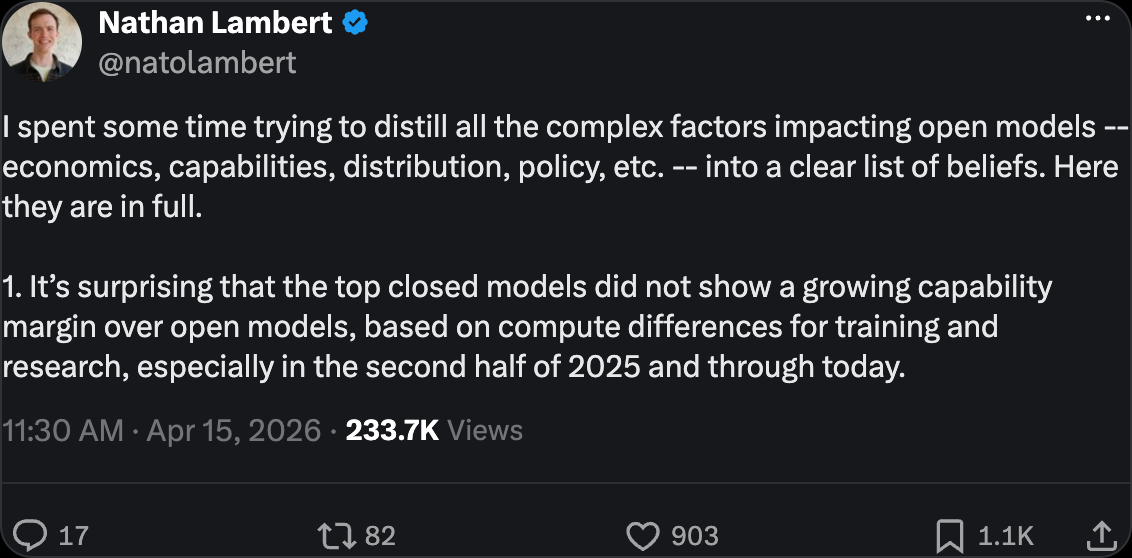
Lambert's numbers are stark. On OpenRouter, the largest neutral LLM routing platform, Chinese models account for over 80% of token consumption. On OpenCode, the dominant coding agent, the figure approaches 95%. Alibaba's Qwen family alone appears in 30% of academic papers on arXiv, compared to Meta's Llama at 21%. Qwen crossed 1 billion cumulative downloads on Hugging Face faster than any model family in history. Download ratios run roughly 2:1 in China's favor.
The performance gap tells the same story from a different angle. Lambert estimates the top Chinese open models — GLM-5.3, Kimi K3, and successors — sit 2 to 5 months behind the leading closed American frontiers (Claude, GPT-4). American open models lag 6 to 9 months behind those same frontiers. That means Chinese open models are meaningfully closer to the state of the art than anything the US open ecosystem produces.
This is not a DeepSeek anomaly. It is the output of a deliberate industrial strategy. Beijing's AI+ Initiative prioritizes government support for open-source AI development. Since early 2025, the Chinese government has promoted open models with the explicit goal of establishing Chinese architecture as the global default — not through coercion, but through adoption.
2. The "Two Loops" Are the Real Strategic Framework
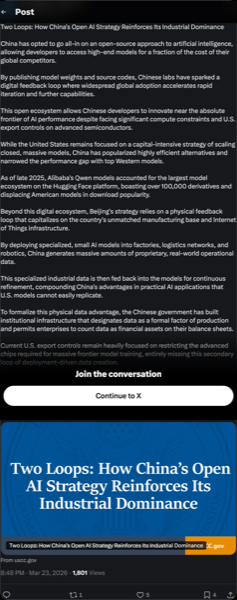
The most consequential document in this debate is not Lambert's briefing or NVIDIA's letter. It is a March 2026 report from the U.S.-China Economic and Security Review Commission titled "Two Loops." Its argument is structural, and it reframes the entire competition.
China's advantage operates in two reinforcing loops. The digital loop is the one Washington understands: open-model training, community-driven iteration, rapid weight releases. It is the loop that export controls — restricting access to advanced training chips — are designed to slow.
The physical loop is the one Washington largely ignores: the deployment of AI models across China's manufacturing base, logistics networks, and robotics infrastructure. This deployment generates massive real-world data that feeds back into model improvement. The models most consequential for industrial application, the USCC notes, are not frontier LLMs but small language models fine-tuned for specific operational tasks — models that US export controls do not touch.
The two loops are mutually reinforcing. Open models accelerate low-cost AI deployment across factories. Factories generate operational data. Operational data improves models. Better models attract more deployment. Beijing has institutionalized this flywheel: data is now classified as a formal factor of production in China, and enterprises can carry data assets on their balance sheets.
US policy targets the digital loop while the physical loop compounds unchecked. This is the core strategic mismatch.
3. Open Weights Are a Soft-Power Vector — and China Is Deploying Them as One
The geopolitical significance of open models extends far beyond the US-China bilateral. A RAND Corporation analysis published in March 2026 frames open-weight AI as a soft-power instrument: whoever ships the most widely adopted model shapes the global AI stack, and the global AI stack shapes everything built on top of it.
China's strategy here is explicit. At the 2026 World AI Conference, Xi Jinping pitched free, open-source Chinese AI models directly to developing nations. The value proposition is straightforward: download the weights, run them on your own infrastructure, keep your data sovereign. No American cloud subscription required. No dependency on services that could be sanctioned or withdrawn.
David Sacks, co-chair of President Trump's Council of Advisors on Science and Technology, framed the problem bluntly: "We now have a Chinese open-weight model that is as good as the currently available models from OpenAI and Anthropic." Andrew Ng, the Stanford professor who co-founded Google Brain and served as chief scientist at Baidu, has made the same point from the opposite direction: the adaptability and cost structure of Chinese open models gives them an inherent advantage in global markets that American closed models cannot match.
Stanford HAI's research adds another dimension: China's open-weight ecosystem is not a one-lab story. DeepSeek, Qwen, Kimi, GLM, Doubao — the breadth of the ecosystem means that even if one lab is sanctioned or restricted, the supply of competitive open models continues. ByteDance is simultaneously a model developer, a distribution platform (through TikTok/Douyin), and an infrastructure provider — a vertical integration that no Western AI company currently matches.
For countries choosing their AI infrastructure, the calculus is increasingly simple. Chinese open weights are free, performant, and come without geopolitical strings. American closed models are expensive, access-controlled, and subject to policy changes in Washington. The infrastructure decisions being made today — which weights to fine-tune, which APIs to build on, which cloud to host in — will shape technological dependencies for a decade.
4. Washington's Response Is a Lobbying Letter, Not a Strategy
On July 24, 2026, NVIDIA CEO Jensen Huang made his first-ever post on X. It was a three-page letter — "Open Weights and American AI Leadership" — co-signed by NVIDIA, Microsoft, Meta, IBM, Palantir, and eventually 270+ companies. The letter argues that open-weight models are essential to US competitiveness and urges Congress not to restrict them.
We analyzed the lobbying dynamics behind this letter when it dropped. The core tension has not changed: the letter treats open weights as a domestic innovation policy question. Lambert's briefing reveals it is actually a geopolitical one.
The letter asks Congress to expand compute access for startups, fund shared training assets, and avoid "premature restrictions" on open models. These are reasonable asks. They are also entirely focused on the digital loop — making it easier to train models in the US. They say nothing about the physical loop, nothing about global adoption patterns, nothing about the soft-power implications of 80% Chinese market share.
Meanwhile, Foreign Policy reports that a new consensus is forming in Washington — "in favor of open models and closed frontier models" coexisting. Treasury Secretary Bessent has floated sanctions against Chinese AI companies. China's Ministry of Commerce has called such proposals "AI hegemonism." Neither side has articulated a strategy for the physical loop, for global adoption, or for the structural advantages that China's manufacturing-AI integration creates.
Note
Polymarket signal: The crowd prices the probability of any US AI safety bill passing before 2027 at just 6% — down 19% in a single week, the sharpest AI-policy move on the board. With $1.49M in liquidity backing that view, federal inaction is not a forecast. It is the base case. The regulatory vacuum that open-weight policy is supposed to fill does not exist, because the regulatory framework itself does not exist.
The Contrarian Case: Does Open-Model Dominance Actually Matter?
Critical
Contrarian Corner: The strongest counterargument runs like this: frontier capability is what matters, and the US still leads. Anthropic and OpenAI ship models that Chinese open weights cannot match. The "real" AI advantage is in compute infrastructure and capital — the US spent $300 billion on AI infrastructure in 2025-2026 alone. Open-weight models are commodities; the value accrues to whoever controls inference, not whoever releases weights.
There is something to this. Polymarket's deepest AI book prices Anthropic at 99% for "best AI model, end of September" — a near-certainty backed by seven figures of conviction money.
But the counterargument mistakes capability for influence. Frontier models serve the top of the market — the companies and governments that can afford API access. Open weights serve everyone else. And "everyone else" is where geopolitical influence actually accumulates. When Indonesia, Brazil, or Nigeria build their national AI infrastructure, they are not licensing Claude. They are downloading Qwen.
What the Community Is Saying
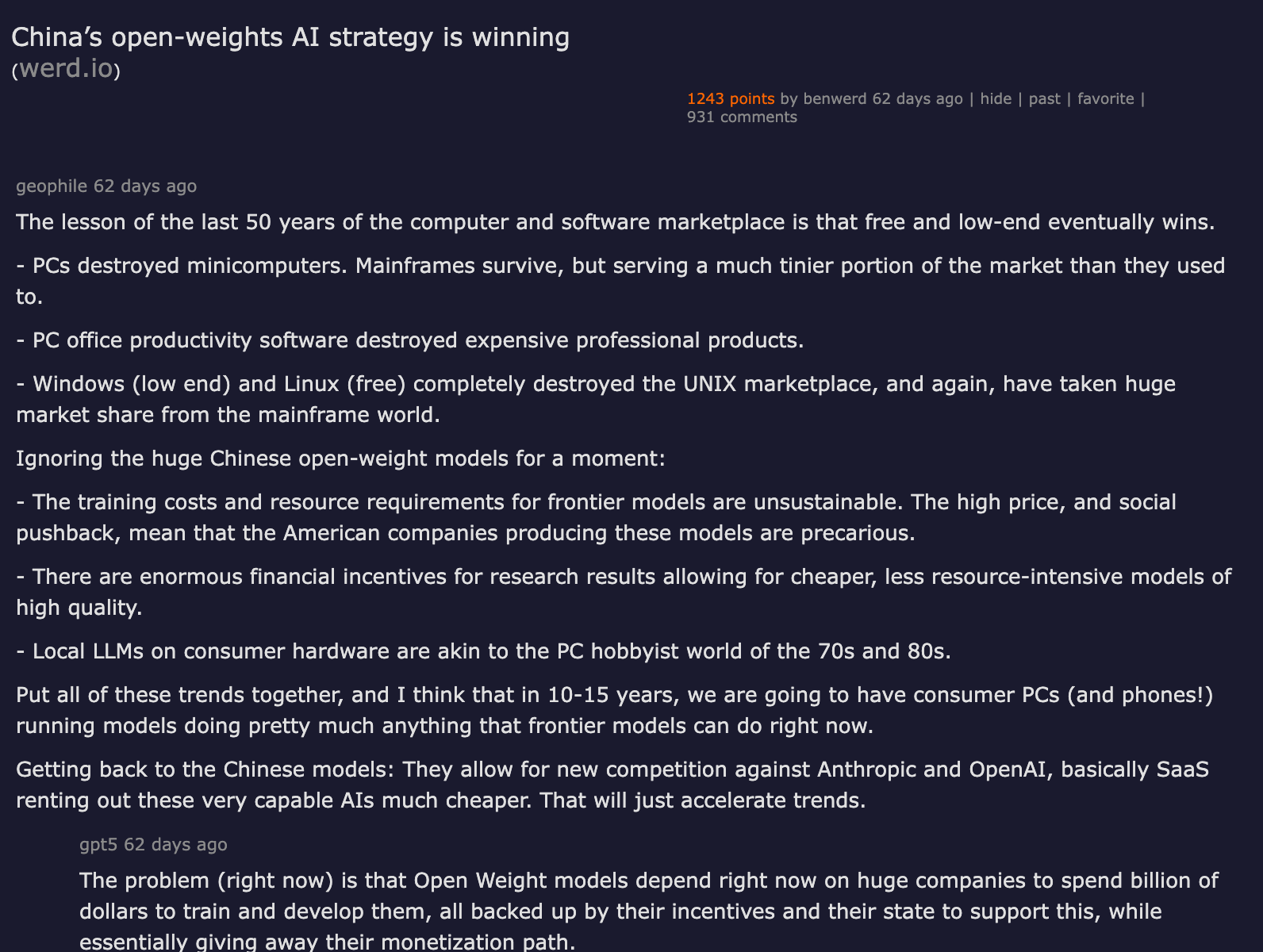
The Hacker News discussion on "China's open-weights AI strategy is winning" — 1,243 points, 931 comments — captures the practitioner mood. The top-voted comment frames the dynamic in terms of economic history: "The lesson of the last 50 years of the computer and software marketplace is that free and low-end eventually wins." Others challenge the timeline — one commenter notes that Qwen 3.6 27B already runs locally and matches frontier models from 15 months prior, suggesting 1-2 years to capability parity rather than the 10-15 years some analysts predict.
View discussion on Hacker News →
The most provocative thread comes from a commenter observing the irony: American companies "closed all that content into a box they charge for," then Chinese competitors "released it into the world for everyone." The competitive reversal — where China plays the role of open-source champion and the US plays the role of proprietary gatekeeper — represents a legitimacy inversion that Washington has not yet internalized.
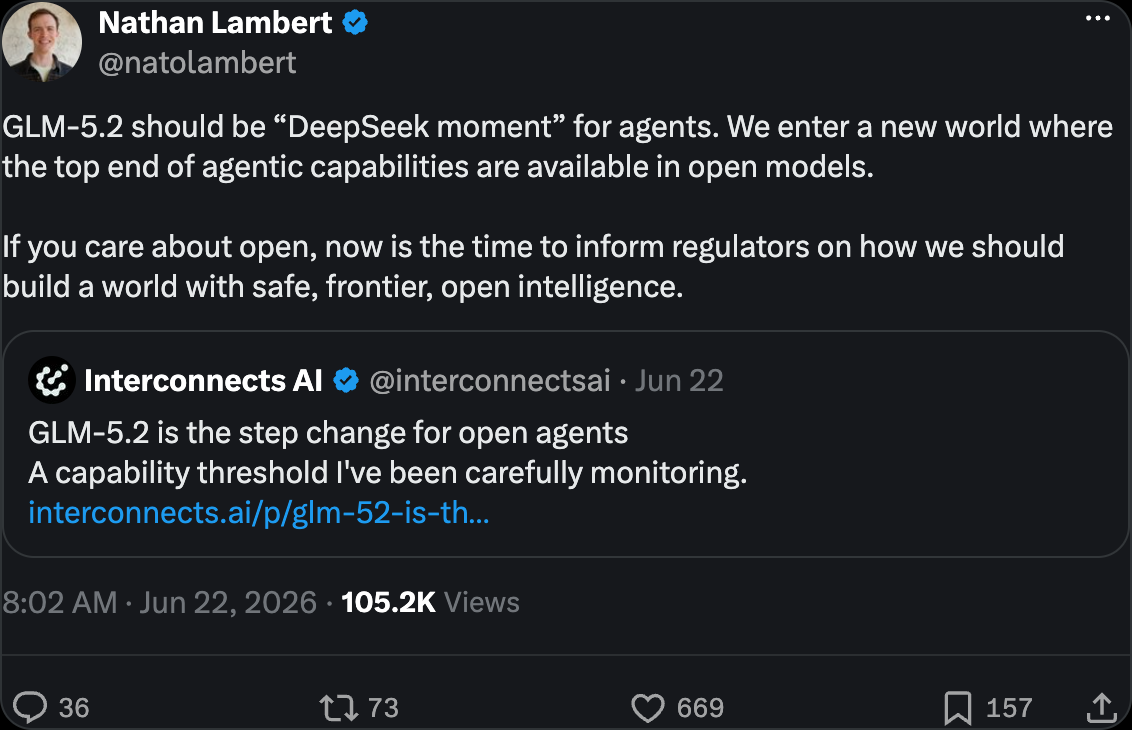
Lambert himself has been blunt on X. He called GLM-5.2 the "DeepSeek moment for agents," arguing that "the top end of agentic capabilities are available in open models" and that "now is the time to inform regulators on how we should build a world with safe, frontier, open intelligence." In a separate post, he offered a darker forecast: "If there's a major step in Chinese open-weight performance, there's a good chance the whole Chinese LLM sphere is banned."
The Release Cadence Is Compressing — Again
One detail buried in the current intelligence: the release cadence of open models on both sides is accelerating. Near-simultaneous stealth tests from Anthropic (Fable 5.2, Opus 5.5) alongside a full slate of Chinese frontier releases — Qwen 4, Kimi K3.1, MiniMax M3.1, Step 5. The signal is not any individual model. It is the pattern: when both sides compress their release cycles, the competitive dynamic shifts from capability to distribution. Whoever ships fastest to the most developers wins not on benchmarks but on ecosystem lock-in.
This is where China's structural advantage compounds. ByteDance, Alibaba, and Tencent are not just model developers — they are distribution platforms with billions of existing users. A new Qwen release reaches developers through the same infrastructure that serves TikTok and Taobao. American open models have no comparable distribution channel. Hugging Face is a hosting platform, not an ecosystem. Meta has distribution through its social networks but has shown limited appetite to use it for model diffusion. Google's Gemma ships under Apache 2.0 — the most permissive license in the space — but lacks the industrial deployment feedback loop that gives Chinese models their compounding advantage.
The USCC report's core insight applies here: distribution is not just a go-to-market strategy. It is a data strategy. Every deployment generates operational data. Every operational dataset makes the next model better. The labs with the widest deployment footprint will train the best models — not because they have more compute, but because they have more signal from the real world.
What Comes Next
Lambert's briefing identifies a window that is closing. American open models need not match Chinese ones on raw performance to matter — they need to be good enough, available enough, and trusted enough that the global AI stack does not default entirely to Chinese architecture. The RAND report argues for three moves: stronger support for a US open-model ecosystem, recalibrated export controls that address the physical loop (not just the digital one), and incentives for permissive licensing that makes American models competitive in global markets.
Whether Washington acts on any of this is an open question. The prediction markets say no. The lobbying letters say "don't regulate." The think tanks say "regulate differently." And every month that passes, the download counts continue to shift.
The uncomfortable truth Lambert delivered to Congress is this: open weights are no longer a technology licensing question. They are an instrument of state power. China understood this first. Whether the US understands it in time is the strategic question of the next two years.
Previously on The Arc of Power: The Open-Weight "Letter" Is a Lobbying War and China's Open-Source Gambit.
The Desk
About The Arc of Power
The Arc of Power editorial desk delivers rigorous analysis of geopolitics, defense, economic statecraft, and intelligence — examining the forces that shape the global order.
Briefing Access
Request Briefing Access
In-depth geopolitical analysis — power dynamics, defense strategy, and economic statecraft — three times a week. No noise.
Request briefing access