Case file · Geopolitics · 12 min read
The Pentagon's Europe Drawdown Is Already Priced In
Pentagon eyes 25-40K troop cuts. Aramco zeroes European crude. Prediction markets diverge on Iran and Russia. The retrenchment is measurable.
The Arc of Power ·

On September 17, NBC News reported that the Pentagon is weighing the withdrawal of 25,000 to 40,000 troops from Europe — planes, ships, weapons, and personnel — in what would be the largest drawdown of American military presence on the continent since the Cold War ended. One day later, Bloomberg reported that Saudi Aramco told European refiners they will receive zero crude oil for October after a drone attack shut the kingdom's East-West pipeline.
These are not two separate stories. They are the same story measured in different units: troops and barrels. And if you know where to look, the prediction markets have been pricing this convergence for weeks.
Our thesis: The United States is conducting a measurable, prediction-market-visible strategic retrenchment from Europe — and the scramble to fill the vacuum has already begun.
The Numbers: What 25,000 Means
The Pentagon currently maintains roughly 80,000 military and civilian personnel across Europe, with around 65,000 permanently based and the rest on rotational deployments. The proposed cut of 25,000 to 40,000 — roughly a third to a half — would be the steepest single reduction since the United States began drawing down forces after the Berlin Wall fell in 1989.
This did not materialize overnight. The drawdown has been a slow-motion sequence:
- October 2025: The US withdrew its rotational Infantry Brigade Combat Team from Romania.
- May 2026: Secretary of State Marco Rubio told NATO foreign ministers in Sweden that there would "eventually be less US troops in Europe than there have historically been." The Pentagon suspended Armored Brigade Combat Team rotations to Poland and Lithuania and withdrew 5,000 troops from Germany.
- May 2026: The US pulled submarines, bombers, fighter jets, and warships from European waters — the hardware drawdown that gets less attention than the headcount.
- July 2026: At the Ankara NATO Summit, Defense Secretary Pete Hegseth announced a formal six-month review of US military posture in Europe. The final recommendation is due November 6.
- September 2026: NBC's report of the 25,000-40,000 figure leaked from inside that review.
The 2026 National Defense Authorization Act contains a statutory floor of 76,000 US troops in Europe, with a 45-day grace period for falling below it before congressional notification is required. Even the lower-bound 25K cut would breach that floor. Congress is already pushing back — even Republicans are calling the pace "absolutely unacceptable".
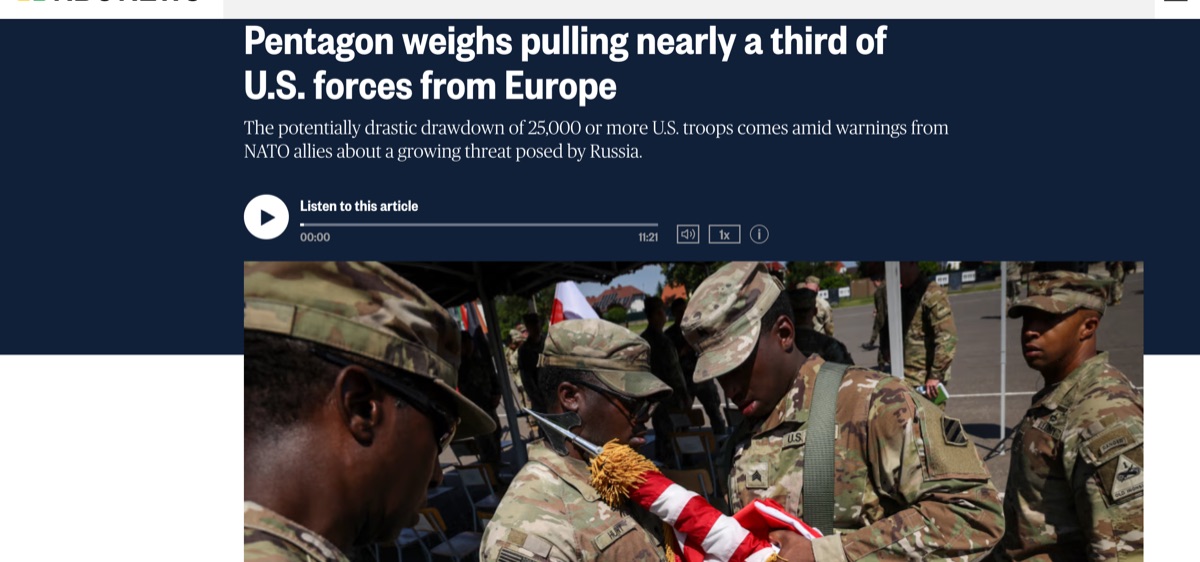
View original article on NBC News →
The story immediately exploded on Reddit, where r/worldnews drove over 11,000 upvotes and 1,200 comments in hours — a signal of how viscerally the drawdown resonates with a global audience watching American power recede.

The Prediction Market Scoreboard
Here is where the retrenchment becomes measurable in real time. Three Polymarket markets, read together, tell a story that no single news headline captures.
Market 1: US-Iran next round of talks — up 9% today. The odds of a new round of US-Iran peace talks spiked 9% in a single day on September 18, with $177,000 in 24-hour volume. The related venue market — where the next talks will be held — rose 10.2% over the month. Something is moving on the Iran diplomatic track.
Market 2: Trump-Putin next meeting — collapsed 29% this month. The odds of a Trump-Putin summit bled out 29 percentage points over the past month — from roughly 91% to 62% — on $22,000 in daily volume and $568,000 in liquidity. The summit trade is unwinding. CIA Director Ratcliffe floated a Trump-Putin-Zelensky trilateral during his Moscow visit in August, but the Kremlin's counteroffer of a November APEC trilateral with Xi went nowhere.
Market 3: Russia-Ukraine peace talks — down 14% this week. Peace talks by December 3 fell to 69%, down 14% in one week. Every near-term Russia-Ukraine diplomacy market softened simultaneously.
Note
Reading the scoreboard together: Washington is pivoting diplomatic resources from a frozen Russia track (down across the board) to a live Iran track (up 9% today on real volume). Europe is the bill-payer for both moves — the drawdown frees forces for the Iran theater, while Russia diplomacy stalls with no American leverage being added to the table. The prediction markets are pricing a portfolio reallocation, not chaos.
The Energy Coincidence That Is Not One
On September 10, a drone strike — attributed to Iran-backed Houthis and Iraqi militias — forced the shutdown of Saudi Arabia's East-West pipeline, a 7-million-barrel-per-day artery that moves crude from eastern oil fields to the Red Sea port of Yanbu, bypassing the Strait of Hormuz.
By September 18, Aramco told European refiners they would receive zero crude under long-term agreements for October. At least three European refinery operators — including Poland's Orlen SA — were scrambling to find replacement crude. The volume normally flowing to Europe via Saudi term contracts: 680,000 barrels per day, zeroed overnight.
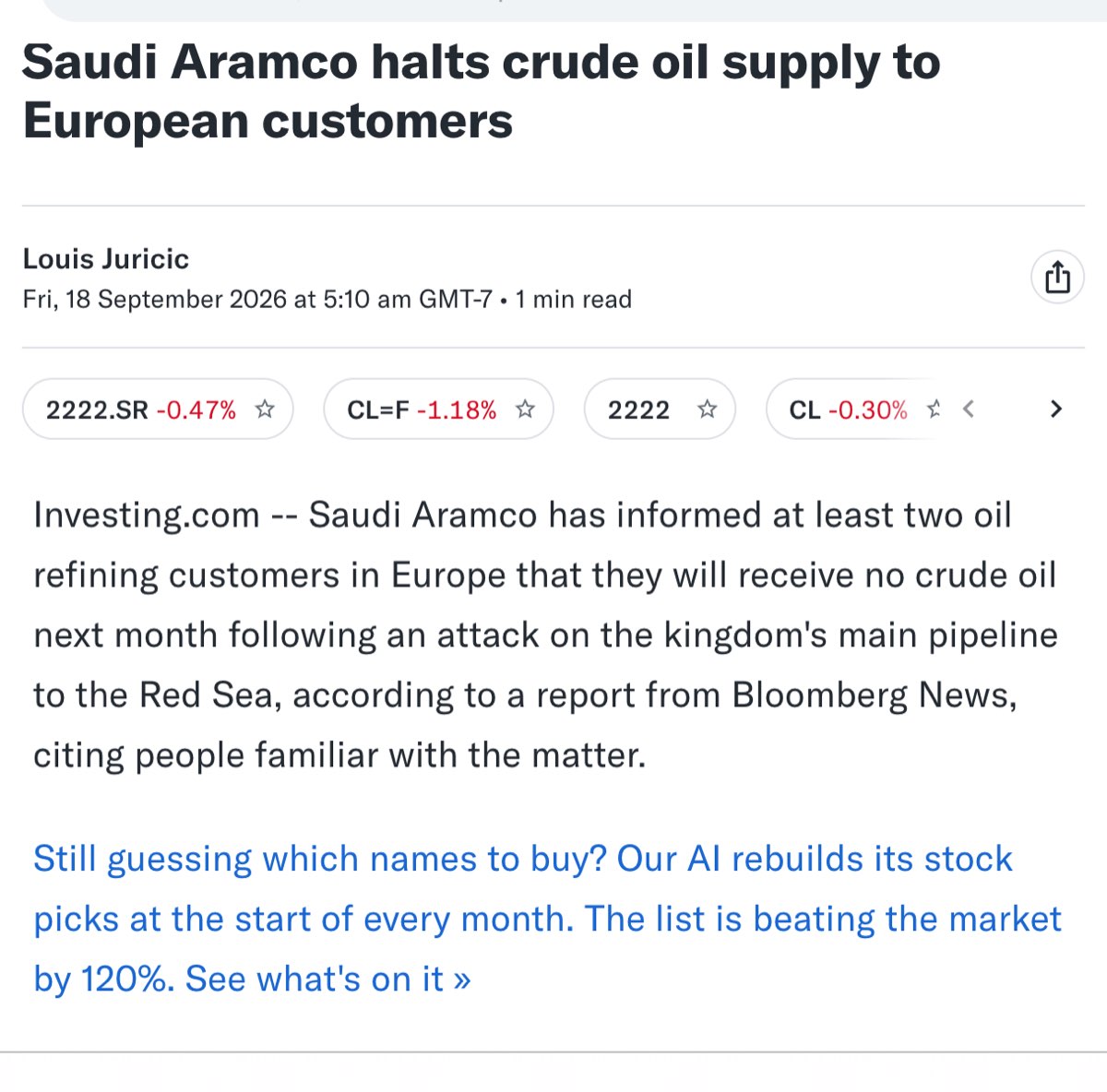
View original article on Yahoo Finance →
The Aramco crude cutoff landed on Reddit with equal force — over 7,100 upvotes and nearly 1,400 comments on r/worldnews, with European commenters reporting immediate price spikes at their local fuel pumps.

The pipeline is expected to partially restart within days and return to full capacity within six weeks. But the damage extends beyond the disruption window. The attack demonstrated three things simultaneously:
-
Europe's energy supply chains are exposed. The continent already lost Russian pipeline gas after 2022. Now its crude diversification to Saudi Arabia has proven vulnerable to the same Iran-axis proxy forces that the US drawdown from Europe is partly funding operations against.
-
The Hormuz bypass is not a bypass. Saudi Arabia built the East-West pipeline specifically to route oil around the Strait of Hormuz chokepoint. A drone attack on Saudi soil proved that the alternative route is just a different chokepoint. As we analyzed during the earlier Hormuz crisis, energy geography and security geography are inseparable.
-
Energy and security vacuums reinforce each other. Europe is simultaneously losing its American security guarantor and its Saudi crude supply — in the same month, for related reasons.
Three Lessons This Drawdown Teaches
Strip away the breaking-news cycle and three structural lessons emerge from the convergence of military drawdown, energy disruption, and prediction market signals.
Lesson 1: Burden-Shifting Has Replaced Burden-Sharing
For sixty years, the transatlantic debate was about burden-sharing — cajoling Europeans into spending more on defense while American forces stayed put. The 2024 switch to a 5% GDP defense spending target at The Hague Summit represented the logical endpoint of that framework.
But the framework has changed. As the OSW Centre for Eastern Studies analyzed in July 2026, NATO is transitioning to "NATO 3.0" — a model where European members assume primary responsibility for conventional defense and deterrence, not a greater share of a jointly managed burden.
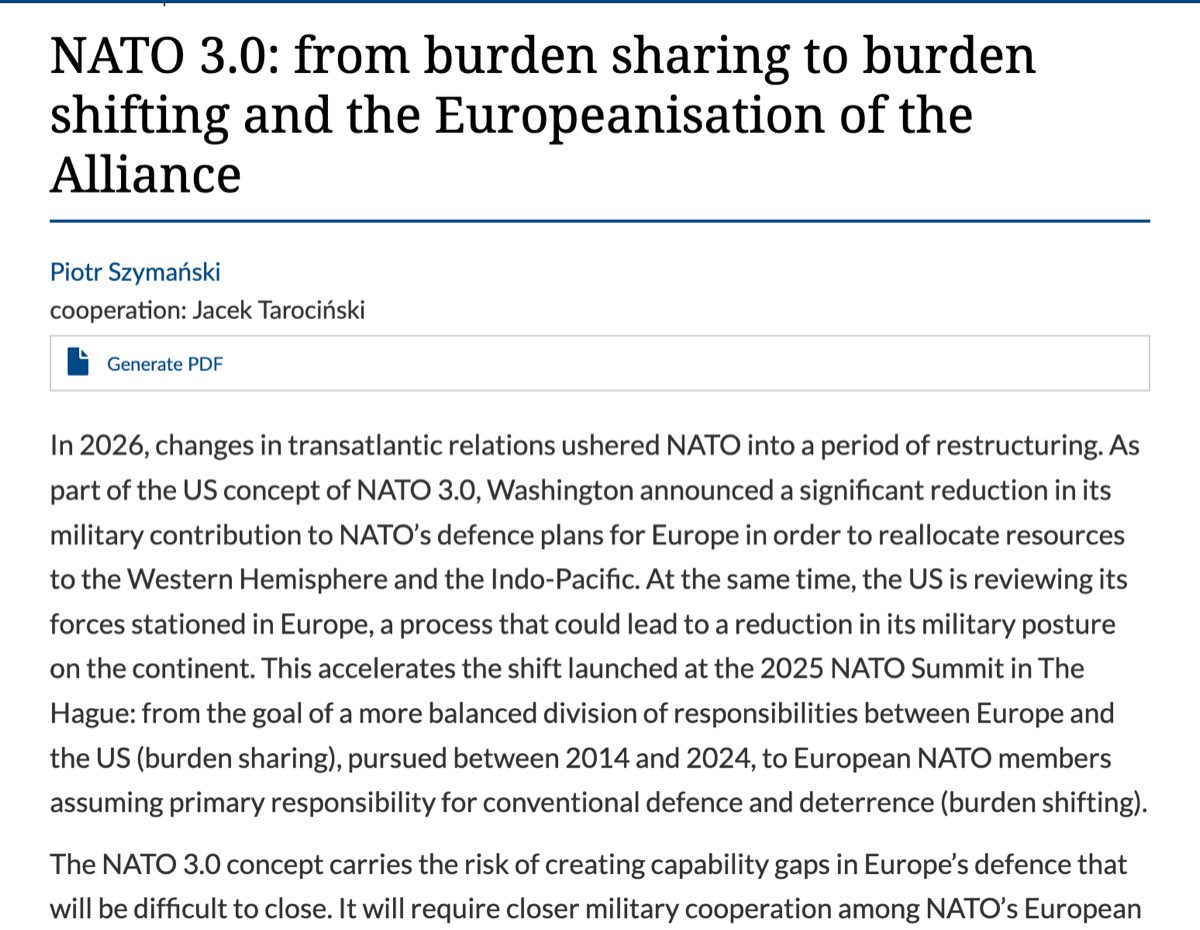
View original analysis on OSW →
The intellectual scaffolding for this shift is now in place. Foreign Affairs published "Leave Europe to the Europeans" in August 2026, arguing that "a clear, written plan for substantial withdrawals would show Europeans that the administration is serious." Defense Priorities went further: "Stop bargaining with Europe, start leaving."
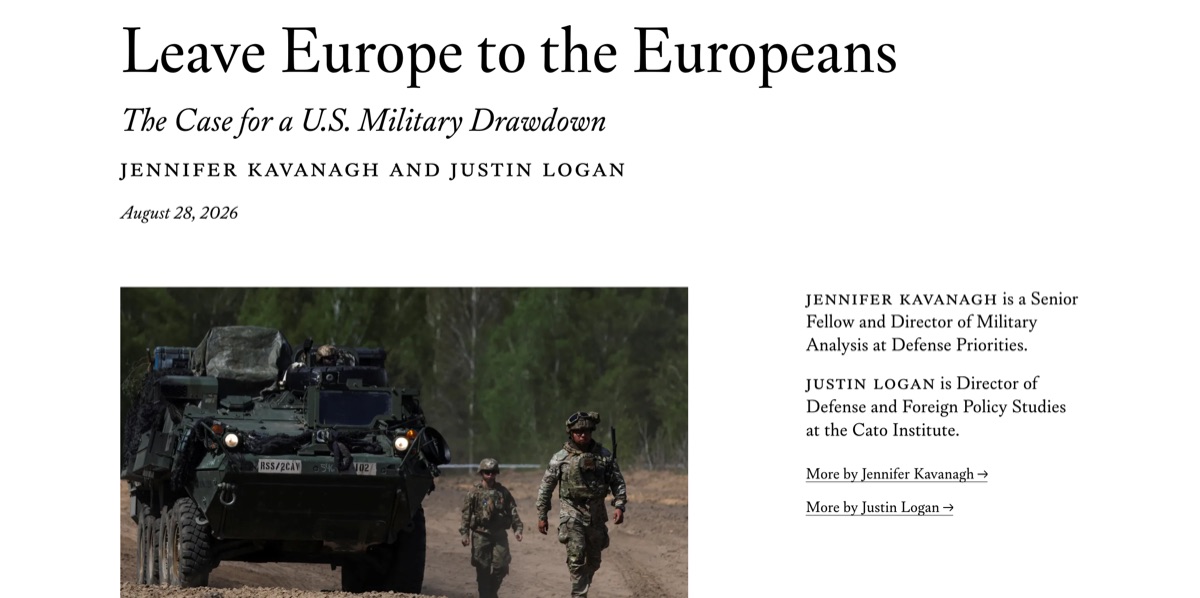
View original article on Foreign Affairs →
This is not punditry — it is policy. The 2026 National Defense Strategy explicitly elevated homeland defense and the Western Hemisphere above forward commitments in Europe and Asia. The Pentagon's posture review due November 6 will translate that doctrine into troop numbers.
As we tracked at the Ankara NATO Summit, the alliance is already operating as a transactional bilateral marketplace. The drawdown is the logical consequence.
Lesson 2: Prediction Markets Are the Retrenchment's Real-Time Audit
Traditional metrics of alliance commitment — troop counts, defense spending percentages, joint exercise schedules — lag reality by months or years. Prediction markets update in real time, with real money at stake.
The US-Iran talks market spiking 9% on the same day as the 25K drawdown report is not coincidence — it is capital flowing to where Washington's attention is going. The Trump-Putin meeting market collapsing 29% in a month is not noise — it is capital exiting positions that assumed diplomatic momentum where none exists.
For anyone tracking American strategic commitment to Europe, prediction markets now provide what troop counts cannot: a forward-looking, continuously-updated probability estimate of how Washington prioritizes its theaters. Polymarket is the alliance's ticker tape.
Lesson 3: The Vacuum Will Be Filled — the Question Is by Whom
Europe's defense spending rose nearly 20% in real terms in 2025 compared to 2024. Norway surpassed the United States in per-capita defense spending — a first in recorded NATO history. Germany's Zeitenwende continues. France is pushing harder for European strategic autonomy than at any point since de Gaulle.
But as GLOBSEC's analysis warned, "developing fully independent operational capabilities will take years, making any rapid reduction of American troops a critical factor in the continent's short-term security calculations."
The gap between spending announcements and operational capability is where the real danger lives. Europe can commit to 5% GDP on defense by 2035. It cannot stand up integrated air defense, heavy logistics, and expeditionary capability by 2027. The interim period — which is now — is where vacuums either get filled by allies building faster or by adversaries probing the gap.
This maps directly onto a pattern we have tracked through the Hormuz crisis: when American commitment wavers, the first response is not enemy aggression but allied defection. The UK refused Hormuz blockade participation. Spain refused Iran-campaign airspace. Each refusal widens the vacuum further.
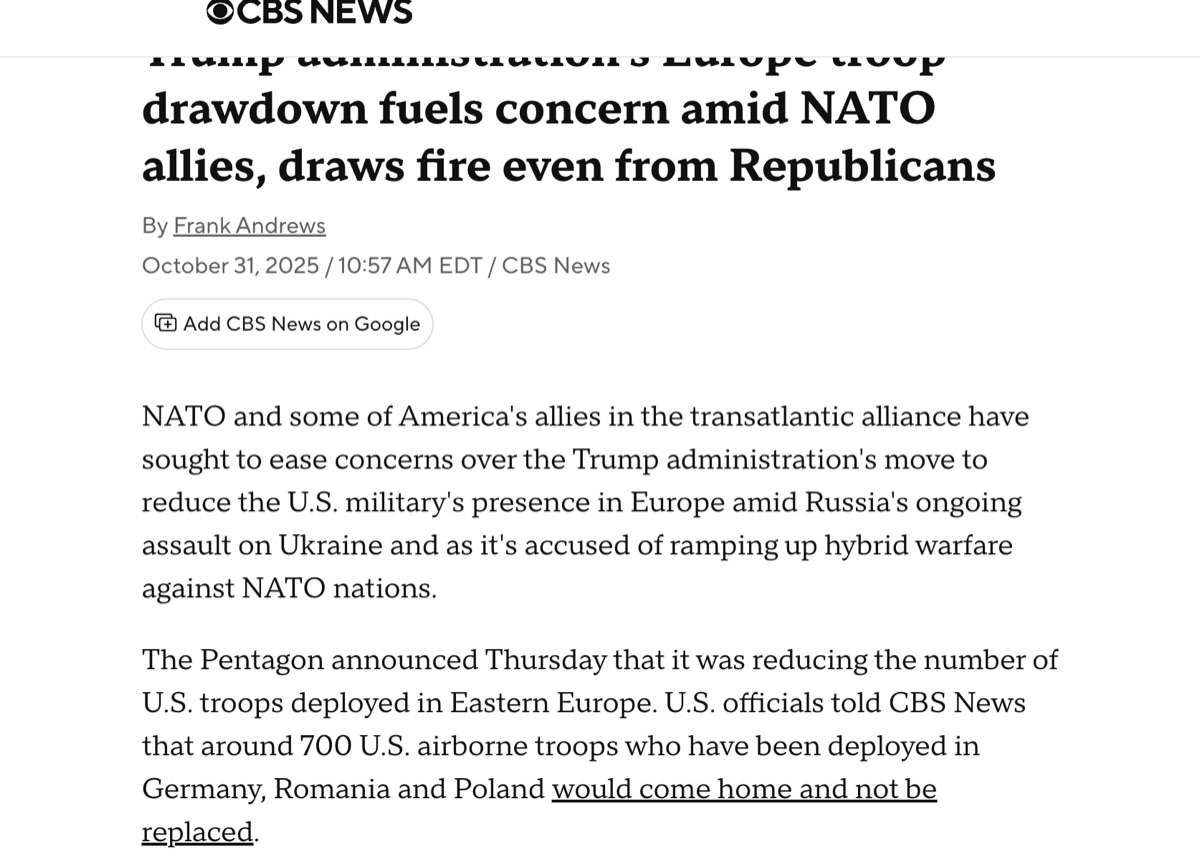
View original article on CBS News →
Critical
The contrarian take: The drawdown may accelerate European strategic autonomy faster than sixty years of burden-sharing pleas ever did. NATO's 5% GDP commitment at The Hague — five times the old 2% target — emerged precisely because Europeans believed the American guarantee was ending. The vacuum, paradoxically, may be the catalyst that the alliance always needed. The risk is timing: if the autonomy builds slower than the vacuum grows, the gap is not academic — it is geographic, and it runs from the Baltic to the Black Sea.
What Comes Next
The November 6 deadline for the Pentagon's posture review is the next structural catalyst. Between now and then, three threads to watch:
1. The 76,000-troop statutory floor. If the administration recommends a cut below 76K, Congress has 45 days to respond. The bipartisan pushback is already organized. Watch whether the NDAA floor holds or gets revised downward.
2. Aramco pipeline recovery timeline. The East-West pipeline's six-week repair window closes in late October. If it slips, European refiners face a winter with depleted crude allocations — a supply crisis layered on top of a security crisis. The Polymarket oil-price markets have not yet spiked, suggesting the crowd expects recovery on schedule. That is a position worth watching for fragility.
3. US-Iran diplomatic track. The +9% move today is real volume, not noise. If a new round of talks materializes before the November 6 posture review, it would confirm the thesis: Washington is trading European commitment for Middle East progress. The ceasefire we analyzed earlier was built on sand — but sand can be reshaped if the architects are motivated.
The broader pattern is unmistakable. As we explored in the EU sovereign compute analysis, the 2026 through-line is European entities — from militaries to data centers — being forced to build capabilities they outsourced to America for decades. The troop drawdown is the military chapter of a story that spans energy, technology, and finance.
America is not abandoning Europe. It is repricing the relationship. And the prediction markets already have the new quote.
The Desk
About The Arc of Power
The Arc of Power editorial desk delivers rigorous analysis of geopolitics, defense, economic statecraft, and intelligence — examining the forces that shape the global order.
Briefing Access
Request Briefing Access
In-depth geopolitical analysis — power dynamics, defense strategy, and economic statecraft — three times a week. No noise.
Request briefing access