Case file · Geopolitics · 12 min read
Europe Drops Russia Sanctions as Its Airspace Gets Probed
EU drops oligarchs Usmanov and Fridman from sanctions as a Russian Mi-8 enters Polish airspace. Markets price ceasefire at 72%.
The Arc of Power ·
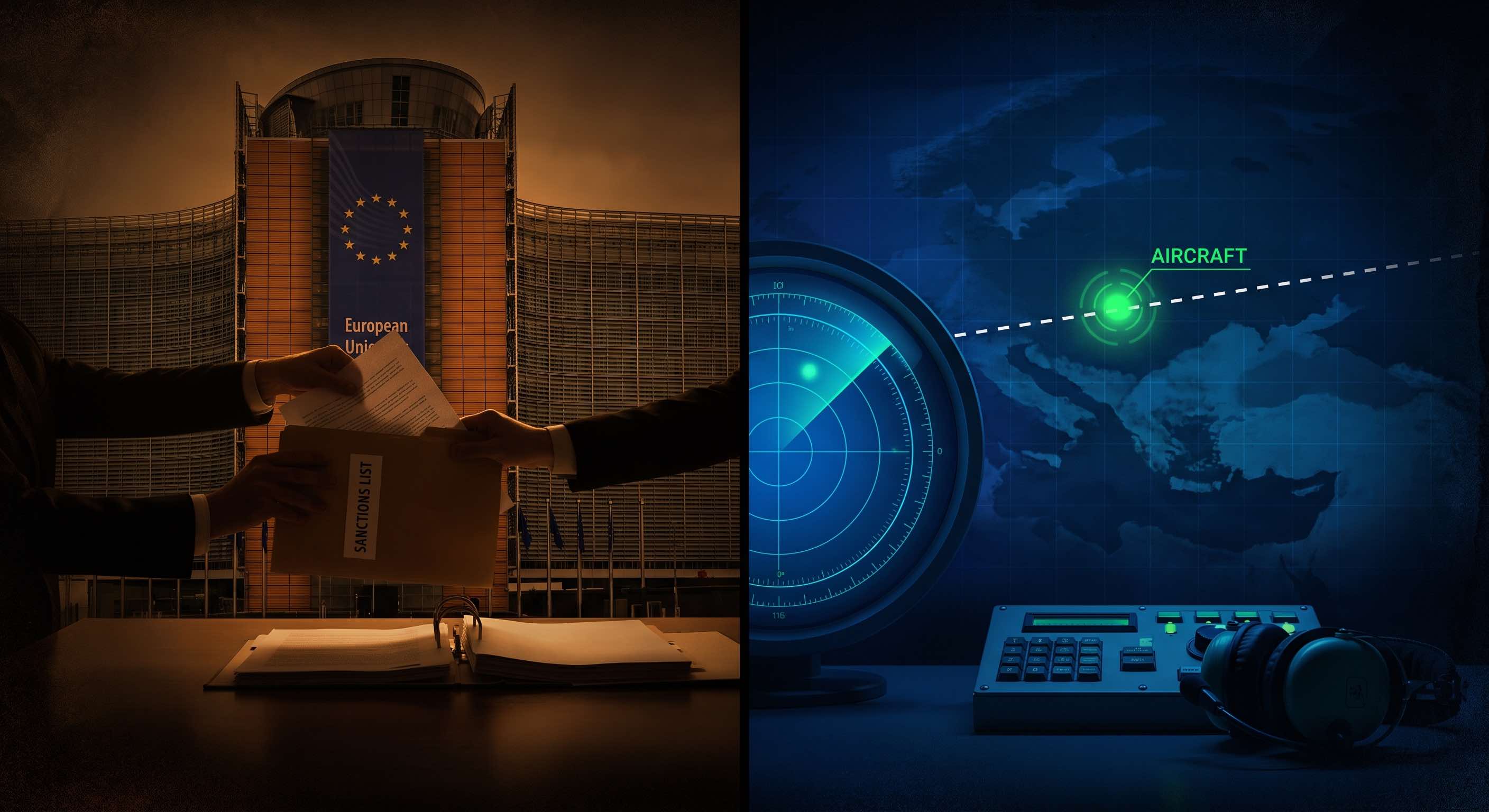
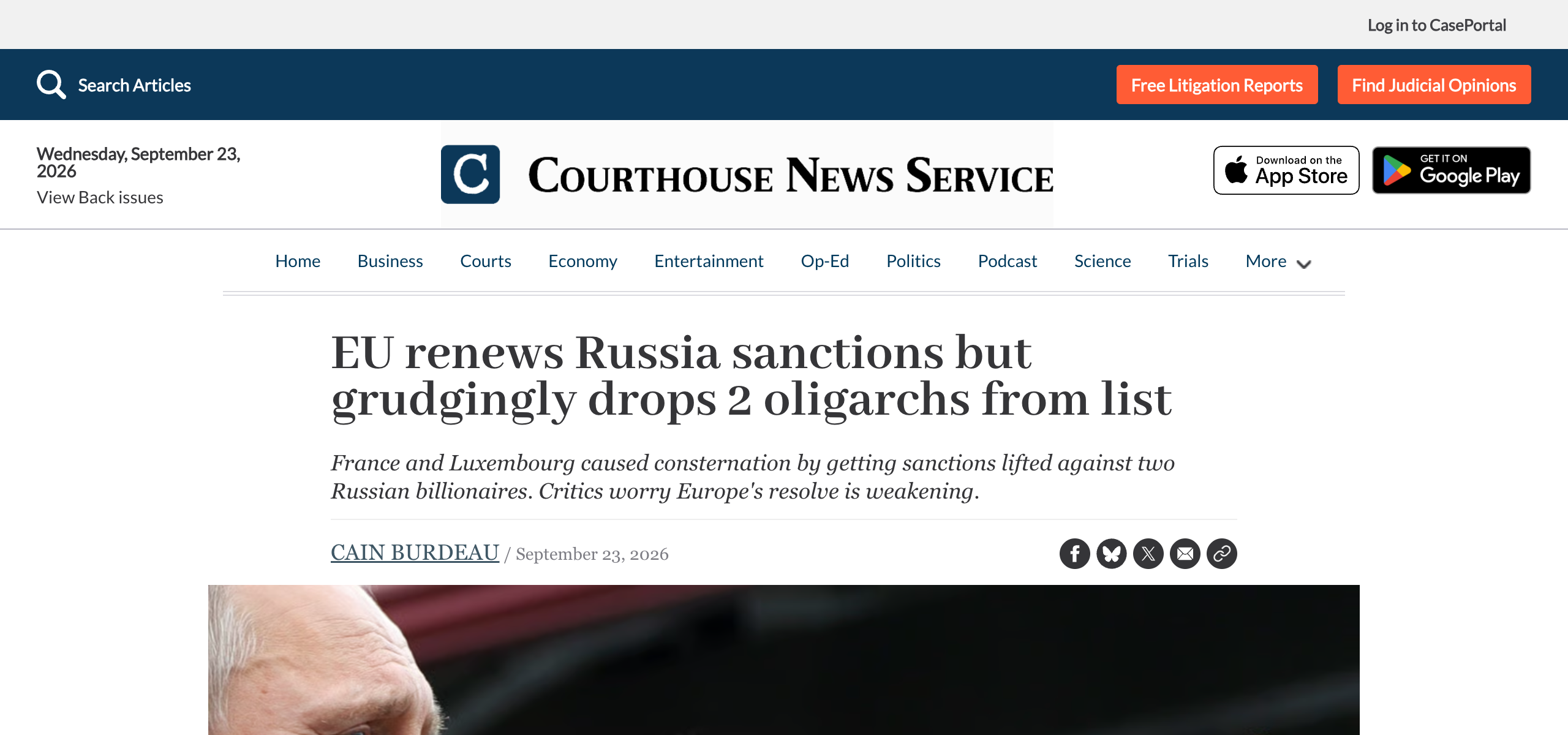
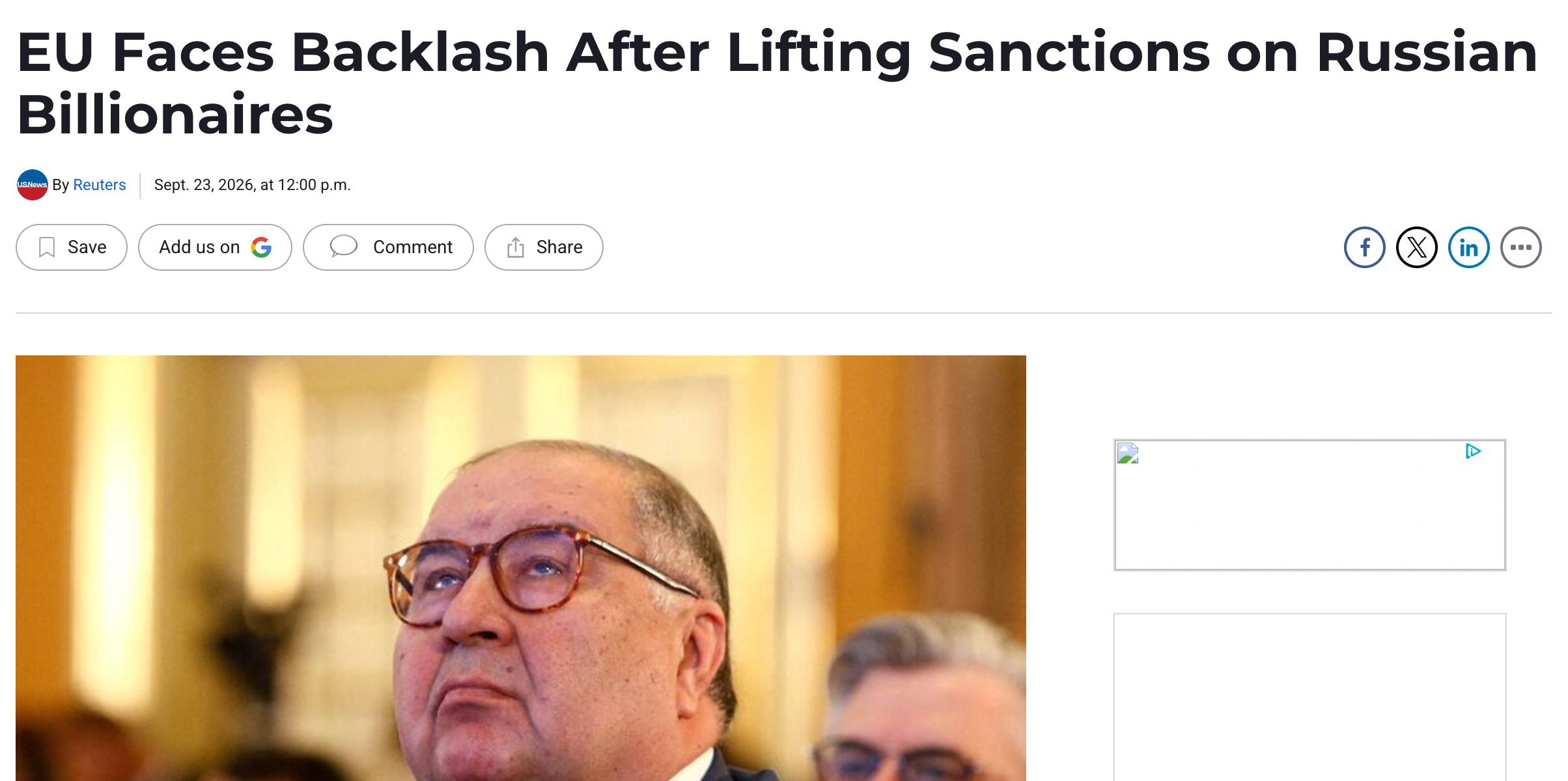
On September 22, the European Union dropped two of Russia's wealthiest oligarchs — Alisher Usmanov (net worth $14.5 billion) and Mikhail Fridman — from its sanctions list. The official framing: a necessary compromise to lock in a three-year renewal of the remaining 3,000 sanctions designations. The unofficial reality: France traded sanctions integrity to free two hostages in Azerbaijan, Luxembourg folded under a $16 billion legal claim, and the EU's consensus architecture did exactly what Moscow's long game is designed to make it do — crack under bilateral pressure.
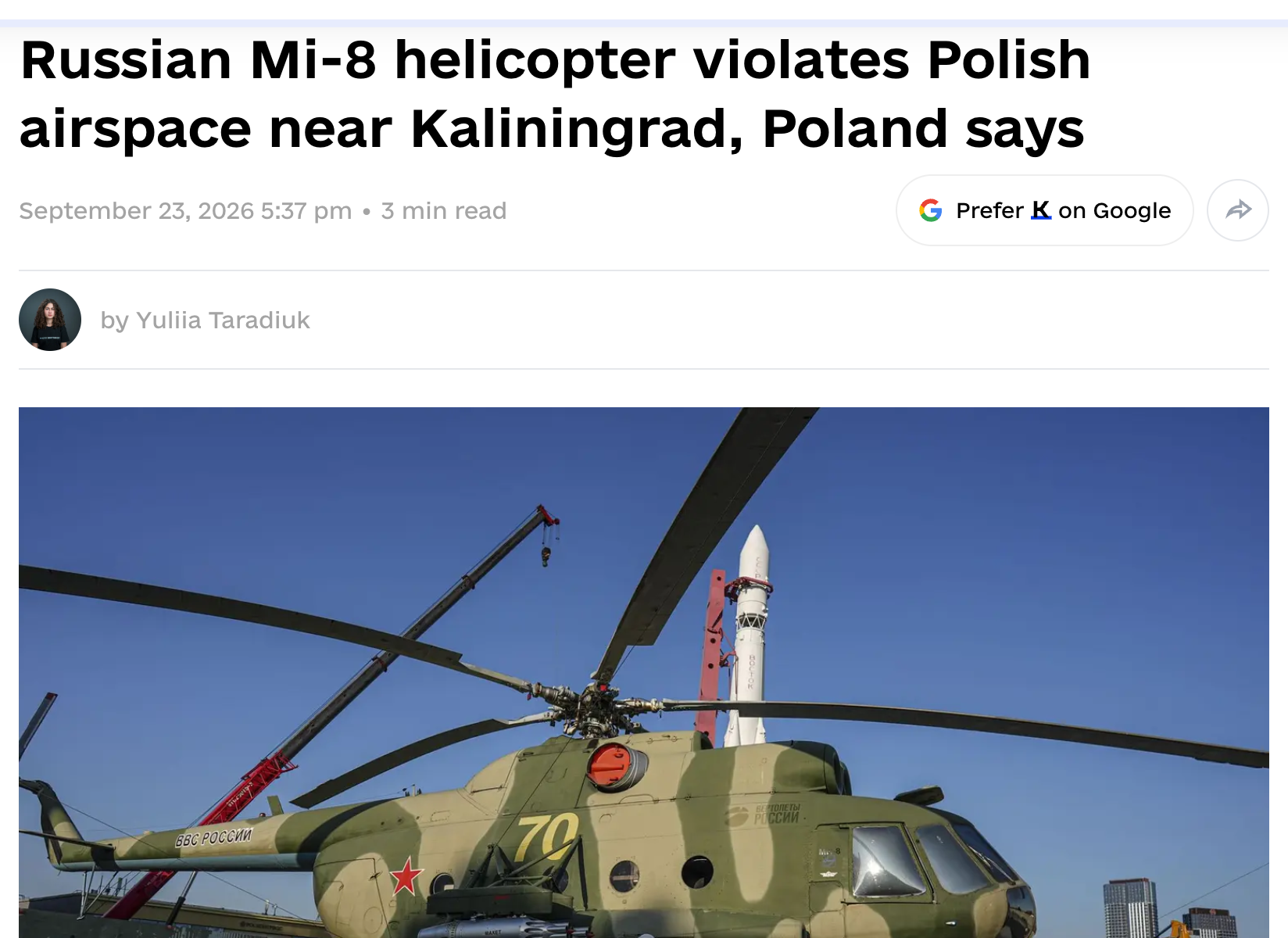
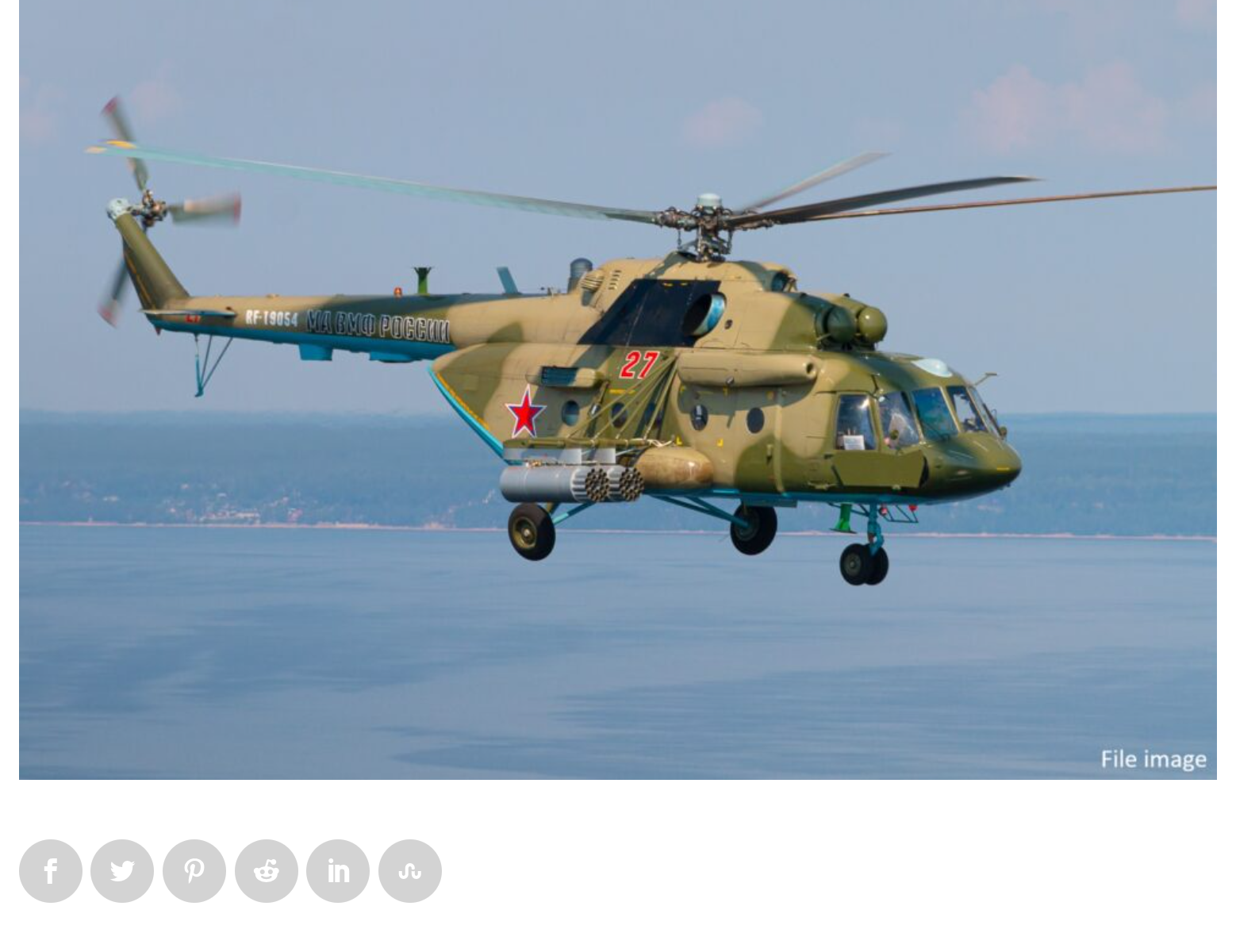
Less than 24 hours later, a Russian Mi-8 military helicopter flew into Polish airspace from Kaliningrad, spent 42 seconds inside NATO territory, penetrated 300 meters past the border, and withdrew. Poland scrambled fighter jets. The Polish military command stated the incident indicates Russia is "once again testing the readiness of our air defense."
Two signals. One week. And they point in exactly opposite directions — unless you understand that they are two sides of the same Russian strategy.
The Sanctions Bargain: What Europe Actually Traded
The mechanics of the deal deserve close examination because they expose how the EU's unanimity requirement functions as a structural vulnerability.
France pushed to remove Usmanov from the sanctions list, citing "national security concerns." In private, French diplomats indicated that Azerbaijan was using Usmanov as leverage to extract concessions over two detained French citizens. Once France broke the seal, Slovakia demanded Usmanov's removal too. Luxembourg then insisted on identical treatment for Fridman, who has launched a $16 billion claim against the country. Latvia held out as the last holdout before capitulating.
The compromise: remove both oligarchs, but extend the remaining sanctions for 36 months instead of the usual six-month rolling renewals. Supporters argue this locks in the broader regime more durably. Critics — including Ukraine — say it signals that pressure and legal threats work.
Read full report on Courthouse News →
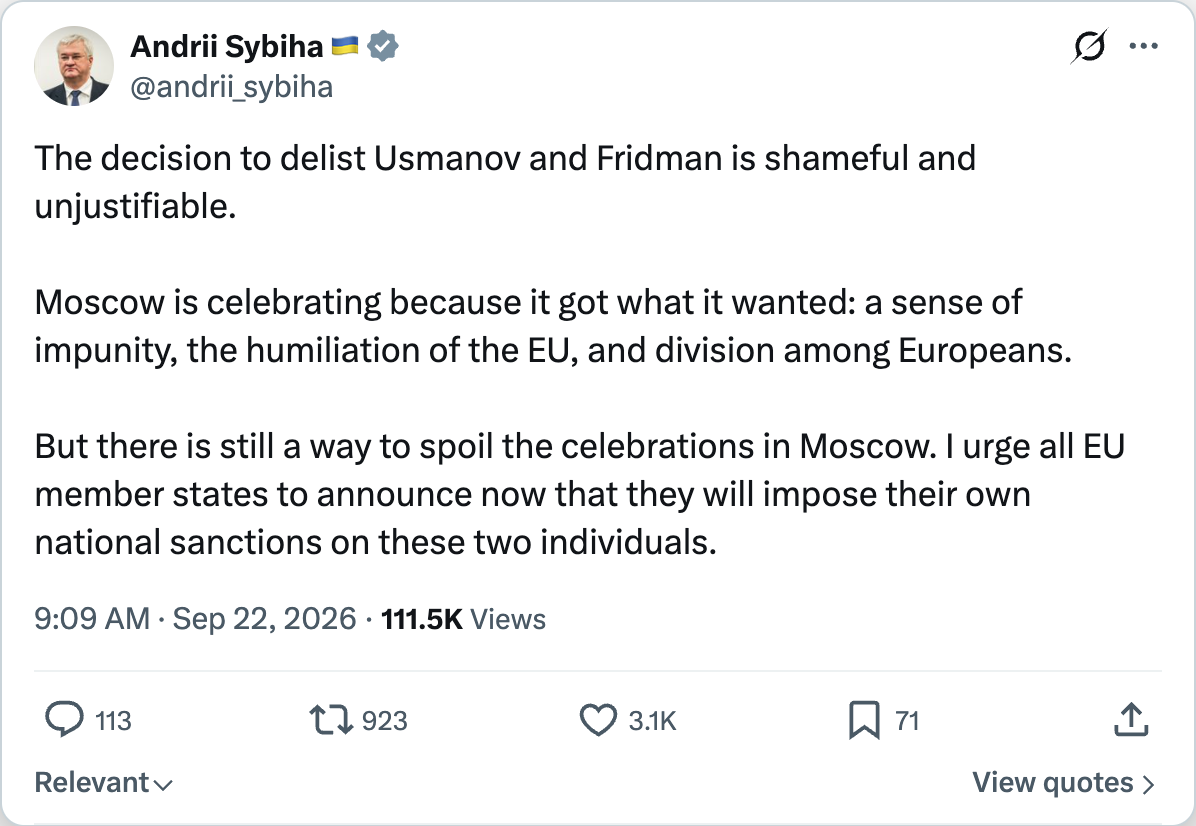
Ukraine's Foreign Minister Andrii Sybiha called the decision "shameful and unjustifiable", writing: "Moscow is celebrating because it got what it wanted: a sense of impunity, the humiliation of the EU, and division among Europeans."
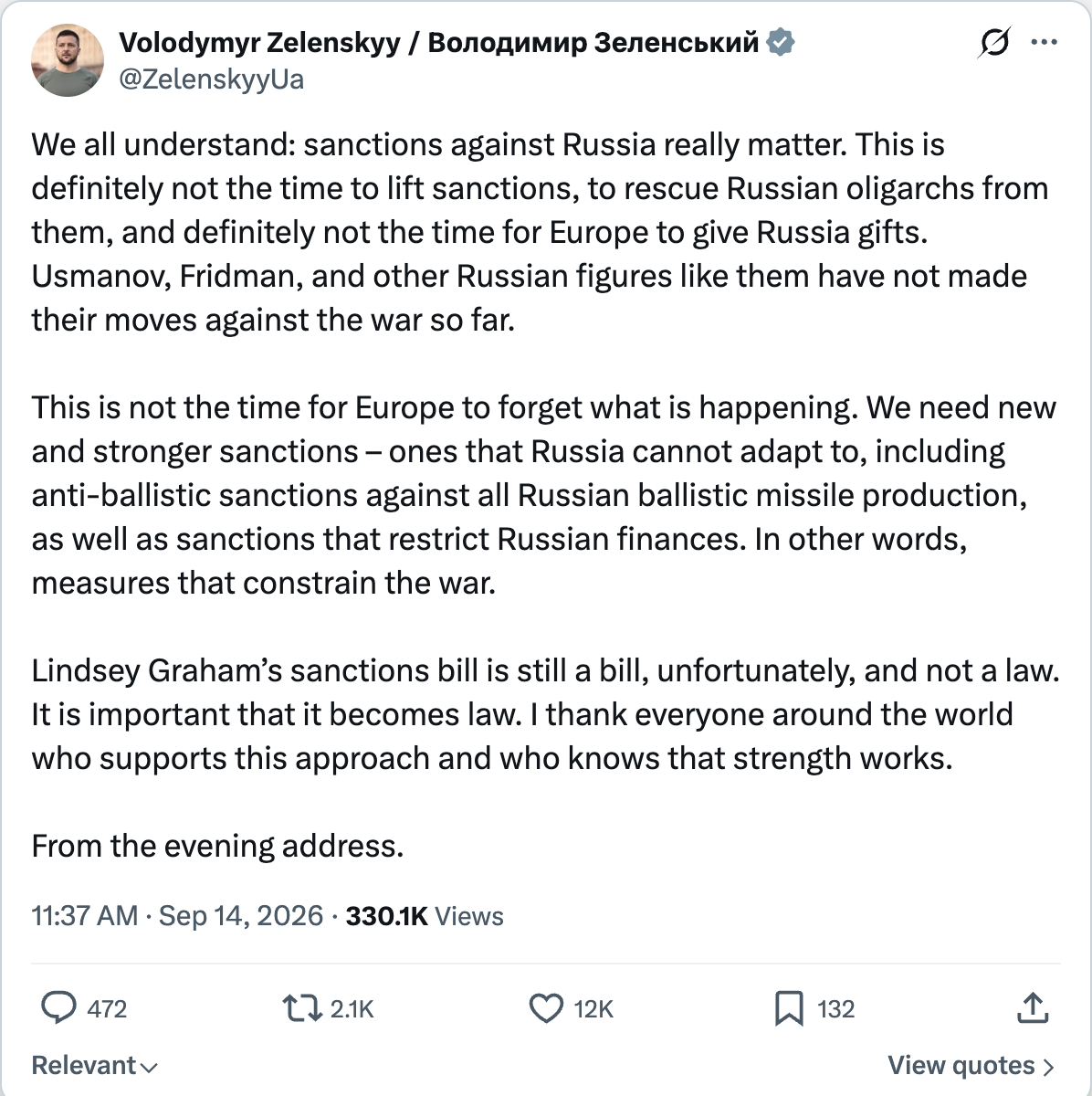
President Zelenskyy was more pointed. Before the vote, he urged the EU to hold the line: "This is definitely not the time to lift sanctions, to rescue Russian oligarchs from them." After the deal was done, he delivered a direct warning to the delisted billionaires: "Perhaps these two oligarchs are happy now. But they don't know us. They don't know me. Yet I will return to the Europeans with these same names."
Guntram Wolff, a senior fellow at the Bruegel think tank, offered the clinical assessment: the move sends "a very negative signal that the EU has been ready to make more or less dubious exemptions at a moment of political pressure."
The Airspace Test: 42 Seconds That Tell You Everything
The timing demands scrutiny. On the morning of September 23 — the day after the EU finalized its sanctions deal — a Russian Mi-8 helicopter crossed into Polish airspace north of Braniewo, entering from the Kaliningrad exclave at approximately 11:08 local time. It remained for 42 seconds, penetrated 300 meters into NATO territory, and withdrew.
This is not a rogue pilot getting lost. Mi-8 crews flying from Kaliningrad — a militarized exclave surrounded by NATO territory on three sides — know exactly where the border is. The flight path was deliberately close to the maximum plausible-deniability threshold: short enough to claim accident, deep enough to trigger a scramble, precise enough to demonstrate control.
Read full report on Kyiv Independent →
This incident fits a documented pattern. In July 2026, a Russian cruise missile detonated inside Polish territory. In August, NATO allies formally condemned Russian airspace violations after multiple incidents involving Poland and Romania. NATO fighter jet scrambles have increased 250% year-over-year. The alliance confirmed it has conducted over 570 intercept missions — nearly triple the 2023 figure.
Poland's response has been to accelerate its push for a permanent U.S. military presence. President Karol Nawrocki — within hours of the helicopter incursion — revived the "Fort Trump" proposal: a permanent base housing 3,000 to 5,000 American troops, with Warsaw seeking a total U.S. military presence of around 15,000. Trump announced "major progress" on the base via Truth Social.
Read full analysis on Notes From Poland →
Three Lessons from the Contradiction
The escalation-meets-appeasement divergence is not accidental. It is structural. Here is what it teaches.
1. The Unanimity Trap Is Russia's Best Weapon Against EU Sanctions
The EU requires unanimous agreement to renew sanctions every six months (now every 36 months under the new deal). This means any single member state can hold the entire regime hostage. Hungary has done this repeatedly. Now France and Luxembourg have demonstrated that even Western European founding members will trade sanctions designations for bilateral interests.
The implication is severe: every sanctioned Russian oligarch with enough money and the right lawyer can now study this playbook. Find a member state with a bilateral vulnerability — hostages, legal exposure, energy dependence, political leverage — and apply pressure through intermediaries. The EU has demonstrated that the price of a delisting is one good reason and enough stubbornness.
This is not hypothetical. Hungary has already demanded the removal of additional oligarchs — Dmitry Mazepin, Pyotr Aven, Musa Bazhaev, and Albert Avdolyan. The 36-month renewal may delay the next fight, but it does not solve the structural problem.
2. Airspace Probes Are Calibrated to the Diplomatic Clock
The temporal correlation between the sanctions decision and the helicopter incursion is unlikely to be coincidental. Russia has consistently timed provocations to moments of Western diplomatic vulnerability — not to escalate toward war, but to underline a message: while you debate our oligarchs' bank accounts, we are reminding you that we can reach your territory whenever we choose.
The 42-second incursion is calibrated. It is too short to trigger Article 5 invocation. It is long enough to force a scramble, generate headlines, and remind every NATO capital that the eastern flank is a physical frontier, not an abstract policy question. Polish Prime Minister Donald Tusk warned just five days earlier that Russia was planning "provocations" to test NATO's cohesion — and then it happened.
The deeper lesson: Russia reads European institutional dynamics with precision. The Mi-8 probe was not aimed at Polish air defenses. It was aimed at the gap between European diplomatic signaling (sanctions softening) and security reality (border probing).
3. Prediction Markets Are Pricing Process, Not Peace
Polymarket's ceasefire-agreement market currently prices at 72% for some form of agreement at some point. But drill into the tranches and the optimism evaporates. An actual ceasefire by October 31: 4%. By December 3: 15%. A peace deal before 2027: 8%.
Note
Polymarket snapshot (September 23, 2026): Ceasefire agreement probability sits at 72% ($84K daily volume, $1M+ liquidity) — but actual ceasefire by December is only 15%, and a peace deal before 2027 is 8%. Peace talks by December 3 trade at 69%. The crowd is pricing diplomatic theater, not resolution. The gap between agreement probability (72%) and actual ceasefire probability (15%) is the single most important number in this conflict right now.
The 72% headline number reflects the probability of any agreement at any point — a broad enough definition to include partial measures, energy ceasefires, prisoner exchanges, or diplomatic frameworks that fall far short of ending the war. The tight tranches tell the truth: nobody with real money believes this war ends in 2026, and less than one in ten thinks a peace deal arrives before 2027.
This matters because the sanctions decision and the airspace provocation both feed into the same market psychology. Sanctions softening signals Western fatigue — bullish for ceasefire agreement theater. Airspace testing signals Russian assertiveness — bearish for actual peace. The prediction market reflects this contradiction by pricing process high and outcomes low.
As we analyzed in our earlier breakdown of Russia's frozen-war dynamics, the market has been consistently pricing a conflict that is neither resolving nor escalating — just enduring. This week's events reinforce that pattern with a new twist: Europe is now actively weakening its own leverage while Russia probes the physical boundaries of the alliance.
The Contrarian Corner: Was This Actually Smart?
Critical
The counter-argument deserves a serious hearing. By sacrificing two names, the EU secured a 36-month renewal — eliminating six potential veto crises over the next three years. Previous six-month cycles had become diplomatic hostage situations, with Hungary blocking or threatening to block at every renewal. The three-year lock-in removes this leverage until 2029. If you weight the stability of 3,000 sanctions over three years against the symbolic cost of two delistings, the math arguably works in Europe's favor. And the helicopter? A 42-second, 300-meter incursion is a probe, not an escalation. Treating every border test as a casus belli risks the boy-who-cried-wolf problem and plays into Russia's strategy of maintaining permanent tension.
This argument has surface-level merit but misses the dynamic effects. The 36-month extension removes the renewal vulnerability but creates a new one: individual member states have now demonstrated they can extract delistings as a price of consensus. The precedent is the weapon. Hungary, which has been the most persistent obstructionist on Russia sanctions, will study this episode carefully. So will any future government that finds bilateral accommodation with Moscow more useful than collective pressure.
On the airspace question: yes, individual 42-second incursions are probes, not provocations warranting kinetic response. But the pattern — drones in 2025, cruise missiles in July 2026, repeated incursions in August, a helicopter probe in September — is a classic escalation ladder, each step testing the floor that becomes the next step's ceiling. The danger is not any single incident; it is the normalization of a boundary that was once considered inviolable.
Read full report on U.S. News →
What Comes Next
Three developments will determine whether this week marks a blip or a turning point.
First, watch the Baltic states. Latvia and Estonia have signaled they may impose national sanctions on Usmanov and Fridman. If they do, it creates a two-tier sanctions regime within the EU — some members freezing assets that others have unfrozen. This would be administratively messy but politically significant: a coalition of the willing within a framework that demands unanimity.
Second, watch Kaliningrad. The helicopter probe from the exclave is a different category than the drone and missile incidents during Ukrainian strikes. Those could be attributed to operational spillover. An Mi-8 departing Kaliningrad is a deliberate military action with no plausible connection to Ukrainian operations. If the pattern shifts from strike-related incursions to deliberate Kaliningrad-based probing, the security calculus for Poland — and for the "Fort Trump" proposal — changes substantially.
Third, watch the Polymarket tranches. If the ceasefire-agreement market stays elevated (72%) while the actual-ceasefire tranches remain depressed (15% by December), the market is telling you that diplomacy is decorative. The moment those tight tranches start rising — especially if they converge with the agreement number — that is the signal that something real is happening. Until then, the smart money says this war endures, the sanctions slowly erode, and the airspace probes become a permanent feature of Europe's eastern frontier.
Europe's eastern flank is no longer a policy abstraction. As the NATO drone pact and the America's quiet retreat analysis both warned, the alliance's deterrence posture depends on credibility — the credibility of economic pressure and the credibility of territorial defense. This week, Europe compromised on the first. Russia tested the second. And the prediction markets priced in more of the same.
The Arc of Power tracks the intersection of geopolitics, defense strategy, and prediction markets. Follow our analysis of the Russia-Ukraine frozen war and NATO alliance dynamics.
The Desk
About The Arc of Power
The Arc of Power editorial desk delivers rigorous analysis of geopolitics, defense, economic statecraft, and intelligence — examining the forces that shape the global order.
Briefing Access
Request Briefing Access
In-depth geopolitical analysis — power dynamics, defense strategy, and economic statecraft — three times a week. No noise.
Request briefing access