Case file · Geopolitics · 12 min read
Ukraine's Peace Track Masks an Escalating Shadow War
Polymarket prices Ukraine peace at 74%. Spoofed nuclear alerts, a 23TB Rosstat breach, and Iran's cyber war tell a different story.
The Arc of Power ·

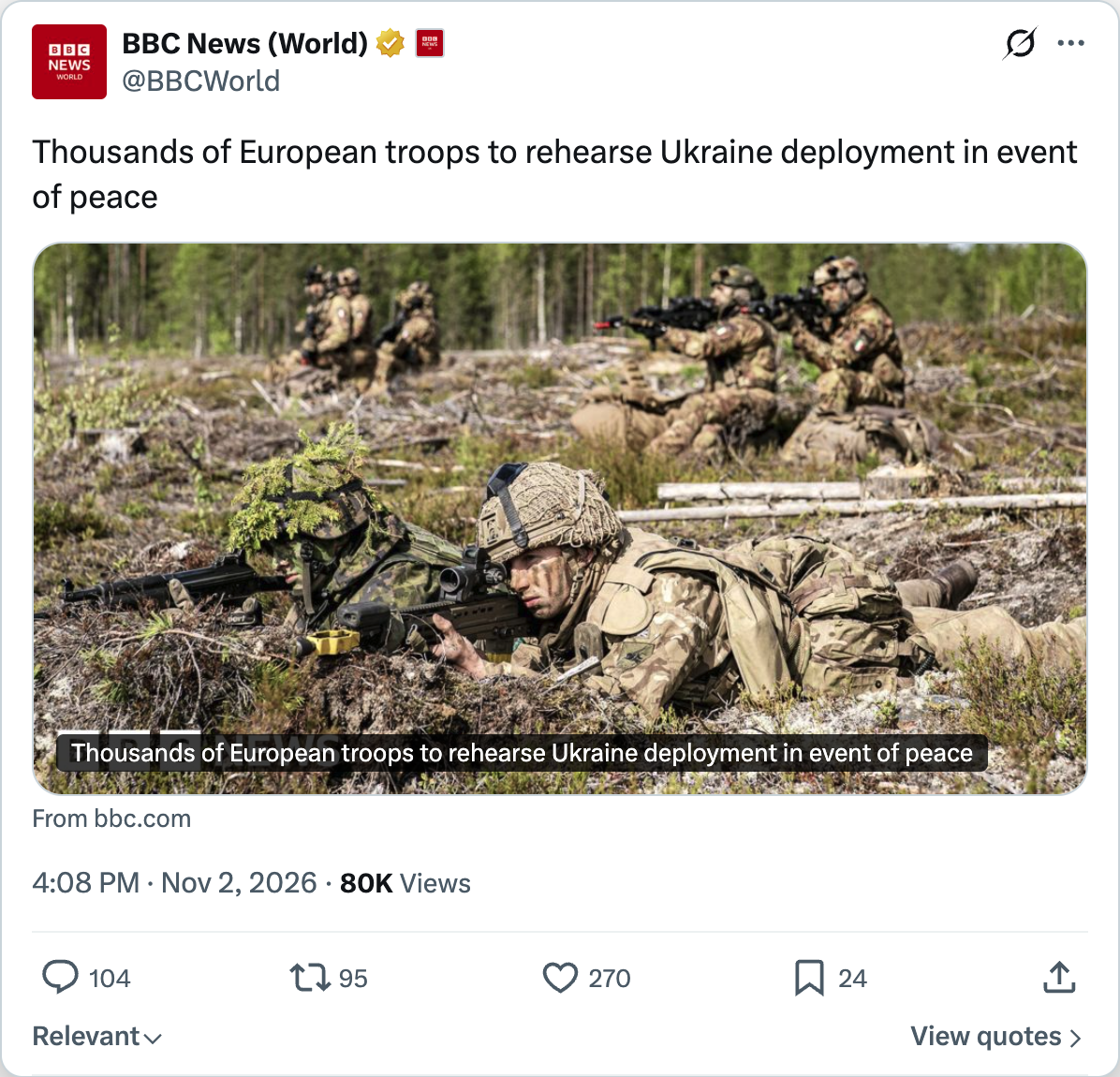
On November 2, 2026, Polymarket's Russia-Ukraine peace talks contract hit 74% for talks by December 3 — up 20 percentage points this month. The ceasefire agreement market prices a deal at 70%. Zelensky told reporters he is ready to meet Putin in Turkey, and 1,500 European troops from the UK, France, and Germany are rehearsing deployment to Ukraine in Polish exercises — the kind of operational planning that only happens when governments believe a settlement is near.
Read those signals and you get a clean narrative: the war is winding down.
Now look at what happened in the same 48 hours. Hackers breached Ukraine's official Air Alert app, sending false warnings of nuclear and radiological threats across the country. Hours later, Russia's Emergency Situations Ministry app was compromised, pushing fake notifications that nuclear warheads had been launched at every Russian region. Separately, a hacker group claimed to have stolen 23 terabytes from Rosstat, Russia's federal statistics agency — including Ukraine war casualty figures that Moscow has guarded as a state secret. And in the background, Iran's state-sponsored cyber groups continue to treat the kinetic ceasefire as irrelevant to their operations, running a 17-country espionage campaign even as Polymarket prices the US-Iran ceasefire at 92% through November.
Two tracks are running simultaneously. The prediction markets are pricing one of them. The other has no market at all — and it may be the one that defines what comes next.
The Peace Track: Real Momentum, Genuine Signals
The diplomatic acceleration is not theater. Multiple converging indicators suggest Ukraine peace negotiations have crossed from speculative to operationally probable.
Zelensky's offer to meet Putin face-to-face in Turkey — while rejecting Donbas handover and Crimea recognition — represents a significant shift from Kyiv's previous position that talks required a full Russian withdrawal. The conditions he attached are maximalist enough to serve as a negotiating floor, but the willingness to sit across from Putin at all marks a departure. Reddit's r/worldnews gave it 9,186 upvotes and 632 comments, reflecting the scale of public attention.
The European troop exercises are the strongest signal. When the UK, France, and Germany rehearse deploying a combined contingent to Ukraine in a "coalition of the willing" exercise, they are not signaling contingency planning — they are signaling to Russia that a settlement would come with security guarantees backed by European boots on the ground. UK Defence Secretary John Healey described the scope as "thousands of troops." The January 2026 UK-France-Ukraine declaration of intent, combined with Zelensky's claim of 5,000 committed troops each from London and Paris, puts this in the realm of operational preparation, not political posturing.
Polymarket reflects this with volume, not just price. The peace-talks contract has $115,765 in liquidity; the ceasefire-agreement contract holds $1.17 million. These are not toy markets. When prediction markets move this decisively on geopolitical contracts — 20 points in one month — the information aggregation is real. The crowd has seen enough converging signals to price settlement as the base case.
But as we have tracked extensively on this site, Polymarket is excellent at pricing binary diplomatic outcomes and systematically poor at pricing the operational landscape that surrounds them. A ceasefire is a legal state. A shadow war is an operational reality. The two can coexist indefinitely.
The Shadow War: Three Vectors in 48 Hours
Vector 1: Spoofed Nuclear Alerts — Information Warfare at Scale
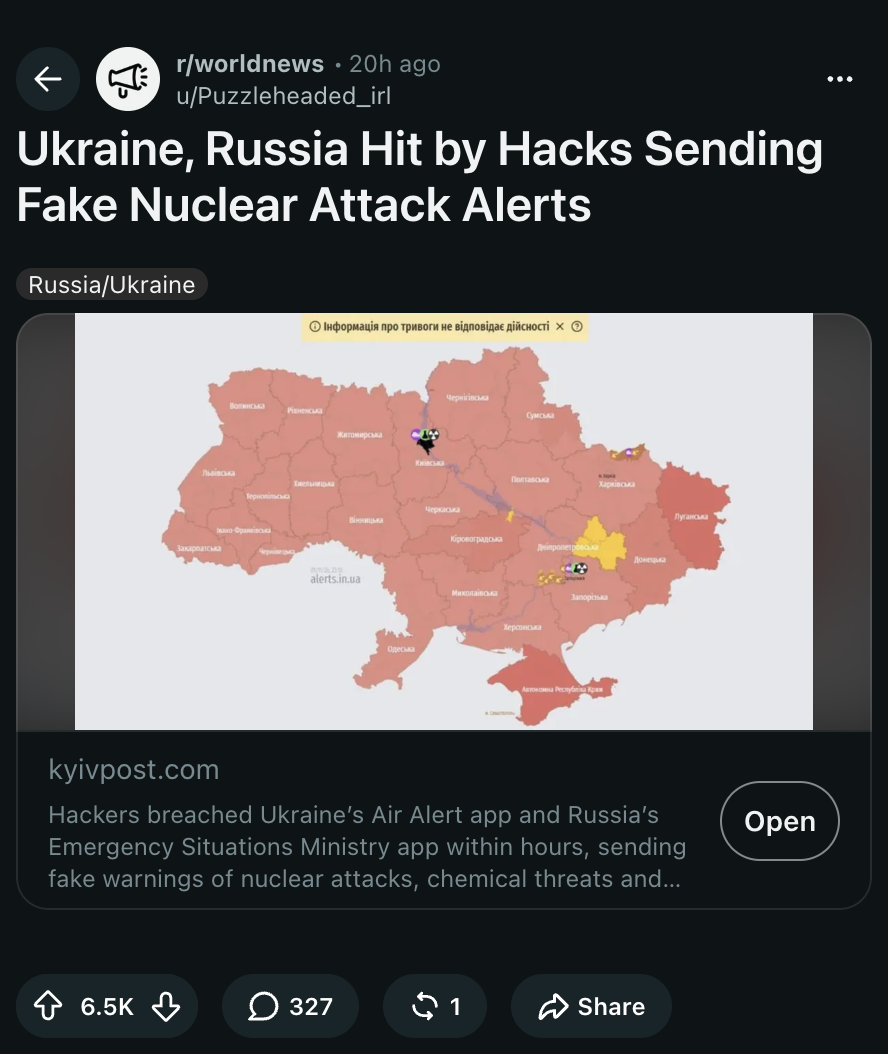
On the evening of November 1, Ukrainian users of the Air Alert app — the official system that warns of incoming Russian strikes — received push notifications claiming radiological and chemical hazards were imminent, including a Russian-language alert referencing the Oreshnik missile and claiming a nuclear alert was underway. The app went temporarily dark. Ukraine's Air Force acknowledged "hostile interference."
Hours later, on November 2, Russia's Emergency Situations Ministry app was similarly compromised. Users across St. Petersburg, Moscow, Belgorod, Nizhny Novgorod, Sverdlovsk, and Tyumen received notifications stating that nuclear warheads had been launched at every region. The fake alerts specified the delivery system — P1-SUN, described as a Ukrainian-made FPV interceptor drone by the defense company SkyFall. Users were told to stockpile three weeks of food and shelter in basements. The warnings spread to regional ministry channels on the Max messaging platform and Belgorod's Telegram operational headquarters channel before the ministry called it a "massive attack" and acknowledged a "vulnerability in the mobile application."
Critical
Contrarian Corner: The shadow war IS the peace process. The standard reading says spoofed nuclear alerts are escalatory. The contrarian reading: these operations are bargaining chips being established before settlement talks. Intelligence gathered now determines leverage at the table. Countries hack harder precisely when diplomacy is closest — because the information asymmetry you create today is the hand you play tomorrow. The rising peace probability and the rising cyber tempo are not contradictions; they may be causally linked.
No one has claimed responsibility for either attack. The symmetry is notable: both sides were hit, both through official emergency notification infrastructure, both with nuclear-themed messaging designed to maximize panic. This is not sabotage in the traditional sense — no physical infrastructure was damaged. It is information warfare aimed at eroding trust in the emergency systems that populations depend on during an actual crisis. The strategic logic is simple: if citizens cannot trust an alert, they cannot respond to one.
Vector 2: The 23TB Rosstat Breach — Data as a Weapon
In a separate operation, hackers claimed to have exfiltrated approximately 23 terabytes of data from Rosstat, Russia's Federal State Statistics Service. Rosstat itself acknowledged that its servers were hit by "coordinated cyberattacks." The claimed haul includes demographic data and — critically — Ukraine war casualty figures that the Kremlin has classified and suppressed since the invasion began.
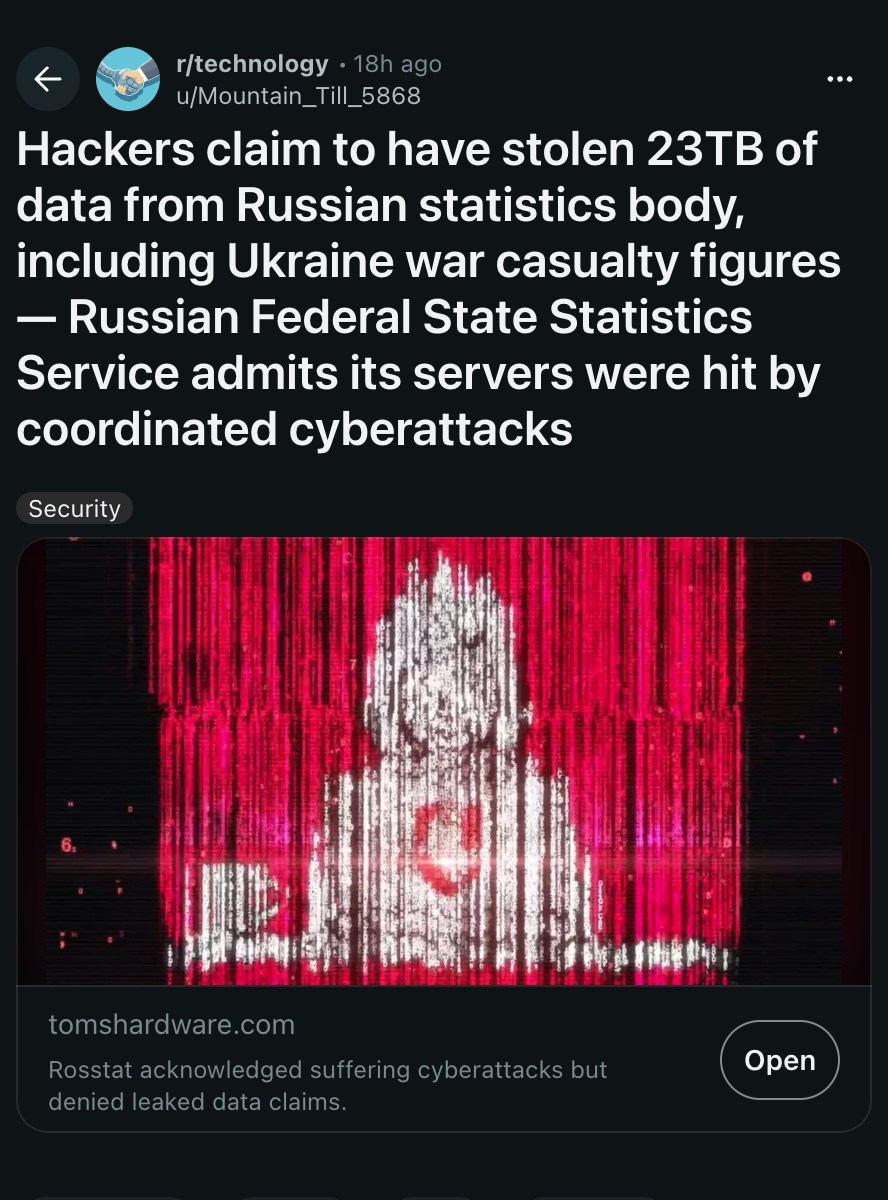
The significance is not the breach itself — Russia's government agencies have been hit repeatedly since February 2022, with Ukrainian hackers claiming 667 million personal records stolen in the past year and groups like UA25 reporting access to over 100 Russian sites. What makes the Rosstat breach different is the type of data. War casualty figures are the single most politically sensitive category of information the Russian government holds. Bloomberg reported this week that Russian forces suffered record losses even as territorial gains slowed — a narrative the Kremlin cannot afford to have substantiated with its own internal numbers.
If the Rosstat data proves authentic and enters public circulation before settlement talks begin, it fundamentally alters Moscow's negotiating position. A government that has told its population the war costs are manageable cannot easily negotiate from a position of strength when the numbers say otherwise.
Vector 3: Infrastructure Attacks — The European Freezer Precedent
The information and cyber warfare is not confined to the Russia-Ukraine theater. In October, hackers compromised the Danfoss refrigeration control systems used by 150 to 400 European supermarkets, raising freezer temperatures to 50 degrees Celsius, destroying food stocks, and sparking fires in some locations. The attacks spread across France, Belgium, the Netherlands, and other countries. Reddit's r/technology thread drew 13,465 upvotes and 2,518 comments — more engagement than any other geopolitics story this week.
Note
Why supermarket freezers matter for geopolitics: The Danfoss hack demonstrates that IoT-connected infrastructure — refrigeration, power grids, water systems — can be weaponized remotely at scale. Many of the freezers were running with default passwords. No group has claimed responsibility. The French public prosecutor opened an investigation, and one retail executive suggested a ransom motive "but did not rule out political destabilization." This is the template for post-settlement asymmetric warfare: you do not need to strike a military target to impose costs.
Iran: The Second Front No Ceasefire Covers
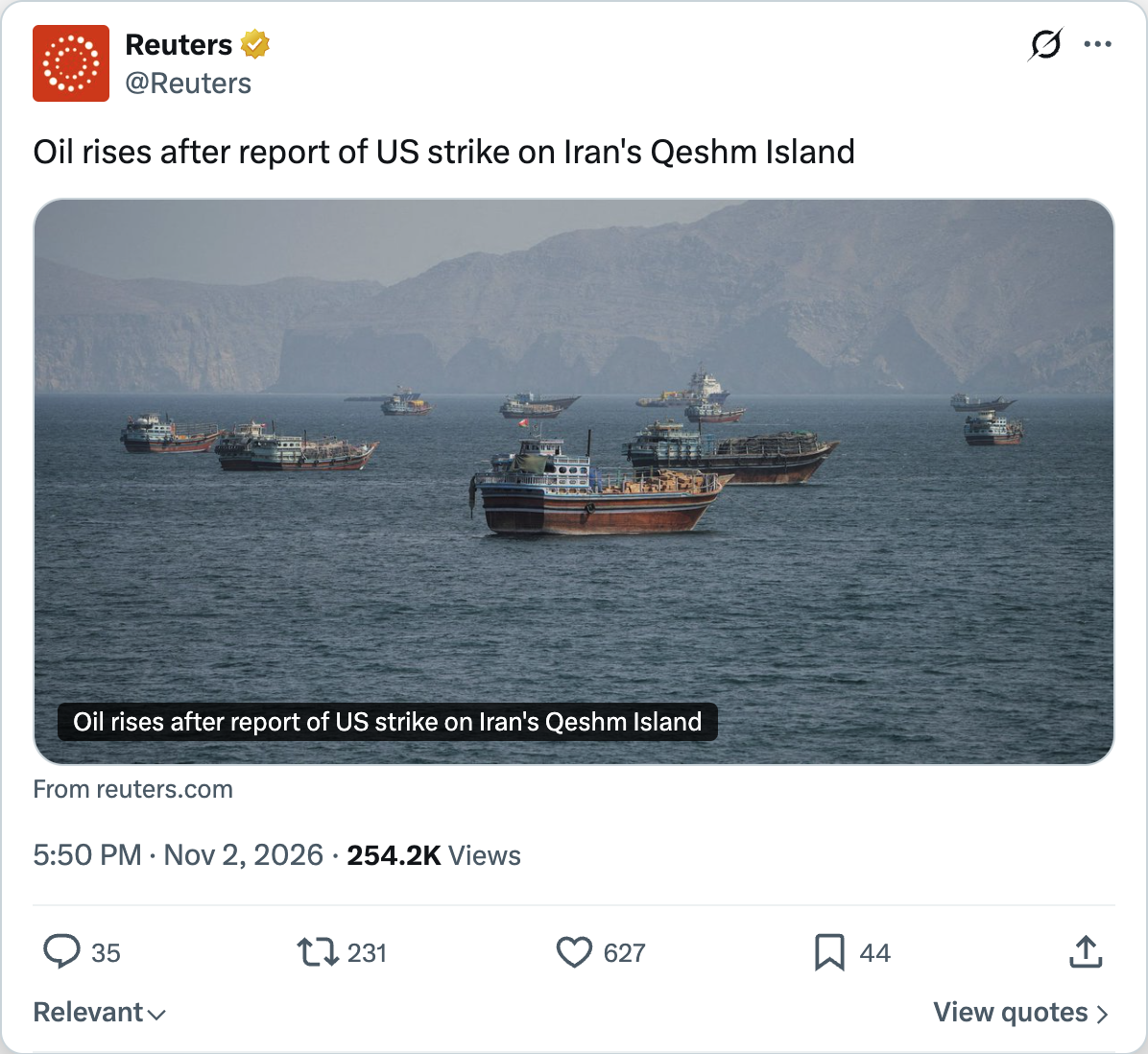
The Iran dimension compounds everything. Polymarket prices the US-Iran ceasefire continuation at 92% through November 30, with $782,715 in daily volume and $604,885 in liquidity. This is the most liquid geopolitical contract on the platform. Meanwhile, Reuters reported that oil prices rose on reports of a US strike near Iran's Qeshm Island.
The contradiction is structural, not accidental. As the CSIS documented in its analysis of Tehran's cyber doctrine, Iran considers the information domain to be the key battlespace — not an adjunct to kinetic operations but the primary theater. The April ceasefire explicitly excluded cyber operations. Anomali's threat intelligence documented three confirmed Iranian exploitation campaigns active during the ceasefire period, a 17-country espionage campaign targeting energy, government, and telecom infrastructure, and continued development of ICS malware targeting US water utility PLCs.
The Economist's analysts warn of a "very high risk" of escalation immediately after the US midterms. Former Human Rights Watch director Ken Roth openly asked whether Senator Chris Murphy was referring to Trump contemplating a tactical nuclear strike on Iran — a question that would have been unthinkable six months ago.
What the Israel-Iran ceasefire contract captures — a 24% drop in confidence this month — is the recognition that the Iran front is diverging from the Ukraine front. As we analyzed in our earlier piece on Iran's ceasefire as a divergence signal, the crowd sees war while the market sees peace. The gap is widening, and the operational reality — Qeshm strikes, cyber campaigns, infrastructure vulnerability — sits firmly on the crowd's side.
Three Lessons from the Two-Track World
1. Ceasefires are narrowing, not broadening. The 2026 US-Iran ceasefire is the template: it explicitly carved out cyber operations. The Ukraine settlement, if it comes, will do the same — because neither side has an incentive to constrain its information and cyber capabilities during negotiations. This means every future "peace" comes with a built-in shadow war. Prediction markets that price ceasefire probability are pricing a legal state, not an operational one.
2. Emergency notification systems are the new frontier of information warfare. The simultaneous compromise of Ukrainian and Russian emergency apps represents an escalation in information warfare that has no kinetic equivalent. You cannot bomb a population into distrusting its own government's emergency alerts — but you can hack them. The long-term effect is corrosive: populations that do not trust alerts cannot be mobilized, evacuated, or informed. This capability will outlast any ceasefire.
3. Data breaches are becoming diplomatic weapons. The Rosstat breach is not cybercrime; it is intelligence warfare. Casualty data stolen from a federal statistics agency and released before negotiations would serve the same function as a decisive battlefield victory: it changes the terms. Expect more of this as settlement talks accelerate. The 23TB figure is not just a technical milestone — it represents a potential shift in the information balance of power between Moscow and Kyiv.
Tip
What to watch next: The November drills in Poland will reveal whether European troop commitments are symbolic or operational. If the exercises include logistics and sustainment rehearsals — fuel delivery, medical infrastructure, communications integration — that signals a deployment timeline, not a political gesture. On the Iran front, the 72 hours after the US midterms on November 3 are the highest-risk window, per The Economist's assessment. Polymarket's Iran ceasefire contract will be the fastest indicator.
The Market's Blind Spot
Polymarket is doing what prediction markets do best: aggregating dispersed information about binary outcomes. Will there be peace talks by December 3? Will the ceasefire hold through November? These are questions markets can answer.
But the questions that matter most right now do not have Polymarket contracts: Will the shadow war intensify during settlement negotiations? Will spoofed nuclear alerts become a recurring tool? Will the Rosstat casualty data enter circulation before talks begin? Will the Iran ceasefire's cyber carve-out become the standard template for future agreements?
These are the questions shaping the post-settlement landscape. And they have no market — which means they have no price signal, no aggregated crowd intelligence, no discipline of real-money betting to separate signal from noise. The shadow war is escalating in a domain that prediction markets structurally cannot reach.
For analysts, the implication is simple: do not let the 74% fool you. The peace track is real. But so is everything underneath it — and the shadow war will outlast whatever agreement the diplomats sign. As we have tracked through every divergence this year, the gap between what markets price and what operators experience is the space where the next phase of this conflict is already being fought.
The markets see peace. The operators see something else entirely.
The Desk
About The Arc of Power
The Arc of Power editorial desk delivers rigorous analysis of geopolitics, defense, economic statecraft, and intelligence — examining the forces that shape the global order.
Briefing Access
Request Briefing Access
In-depth geopolitical analysis — power dynamics, defense strategy, and economic statecraft — three times a week. No noise.
Request briefing access