Case file · Geopolitics · 10 min read
Netanyahu Lost His Majority and Called It Stolen
Polymarket prices a succession fight at 42/34 before the media frames one. What $70M in bets knows about Israel's next PM.
The Arc of Power ·
Polymarket's Israel next-PM market — $70 million in total volume, the platform's most-traded geopolitics contract — settled into a quiet verdict on Wednesday night: Netanyahu 42%, Gadi Eizenkot 34%, everyone else in single digits.
That 8-point gap looks comfortable until you remember where it was 48 hours earlier. Before exit polls dropped on election night, Eizenkot was the favorite at 56%. Netanyahu sat at 27.5%. The exit polls swung the line 15 points in Netanyahu's favor overnight — and then it stopped. The market priced in the partial count, absorbed the "stolen election" rhetoric, and landed on 42%.
Not a coronation. Not a collapse. A succession fight — priced in real time by capital that does not care about ideology.
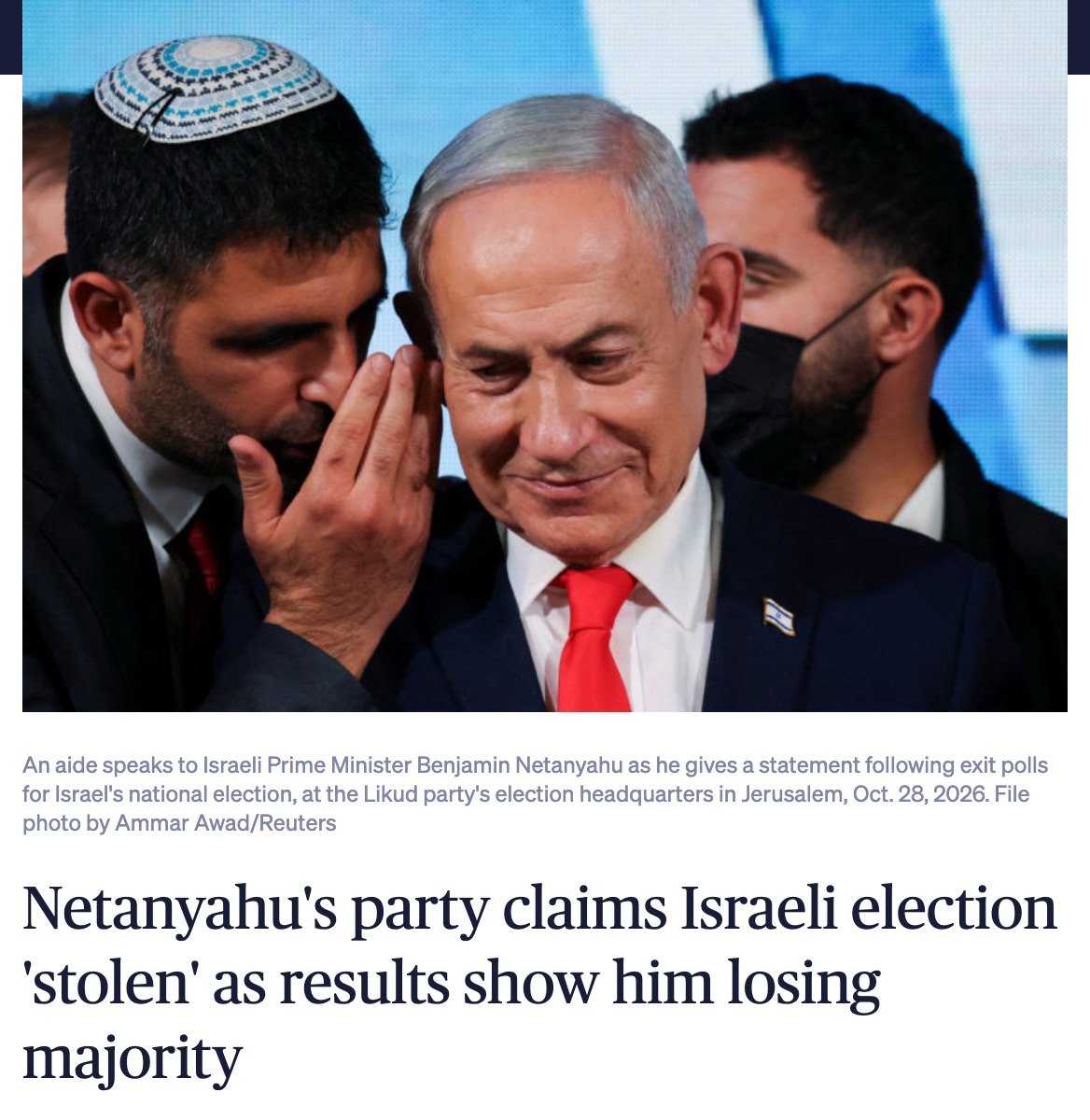
View source article on PBS NewsHour →
The Reddit post that broke this story into the global conversation hit 32,800 upvotes on r/worldnews with a 96% approval ratio and 1,520 comments. That is not a partisan signal. That is the internet collectively recognizing a pattern it has seen before.
The Numbers That Don't Lie
Israel's Central Elections Committee, with over 4 million votes counted, put Netanyahu's right-religious bloc at 54 seats — seven short of the 61 needed to govern. Eizenkot's opposition coalition held roughly 48, with Arab-led parties accounting for the remaining 18-19 seats. Neither bloc has a majority. Neither can form a government alone.
The Polymarket read is more precise than any poll because it prices coalition probability, not vote share. At 42%, the market says Netanyahu is the most likely individual to end up as PM — but the probability that someone other than Netanyahu becomes PM is 58%. That is the story the headline misses.
Note
How to read a prediction market: This is not a poll. These are traders putting real money at risk on the outcome. When $756,000 moves through the Israel PM contract in a single day, the price reflects information — coalition signals, backroom deals, party defections — that polls cannot capture. The Polymarket Israel market is now higher-resolution than any Israeli polling outfit.
Since our last analysis of this market in July — when we covered Netanyahu's 18-point collapse to a 38-38 dead heat with Eizenkot — the line has moved through three distinct phases: a summer of Eizenkot dominance (peaking at 56%), a pre-election Netanyahu rally, and a post-election settlement that prices uncertainty rather than victory.
The "Stolen" Playbook
Within hours of partial results showing his bloc short of a majority, Likud released a statement alleging that Arab parties had "stolen" the election through "bribery, forged ballots, voter intimidation, and illegal software use across multiple polling stations." The party said it was handing evidence to three separate bodies: the Israeli Police, the Shin Bet, and the Central Elections Committee.
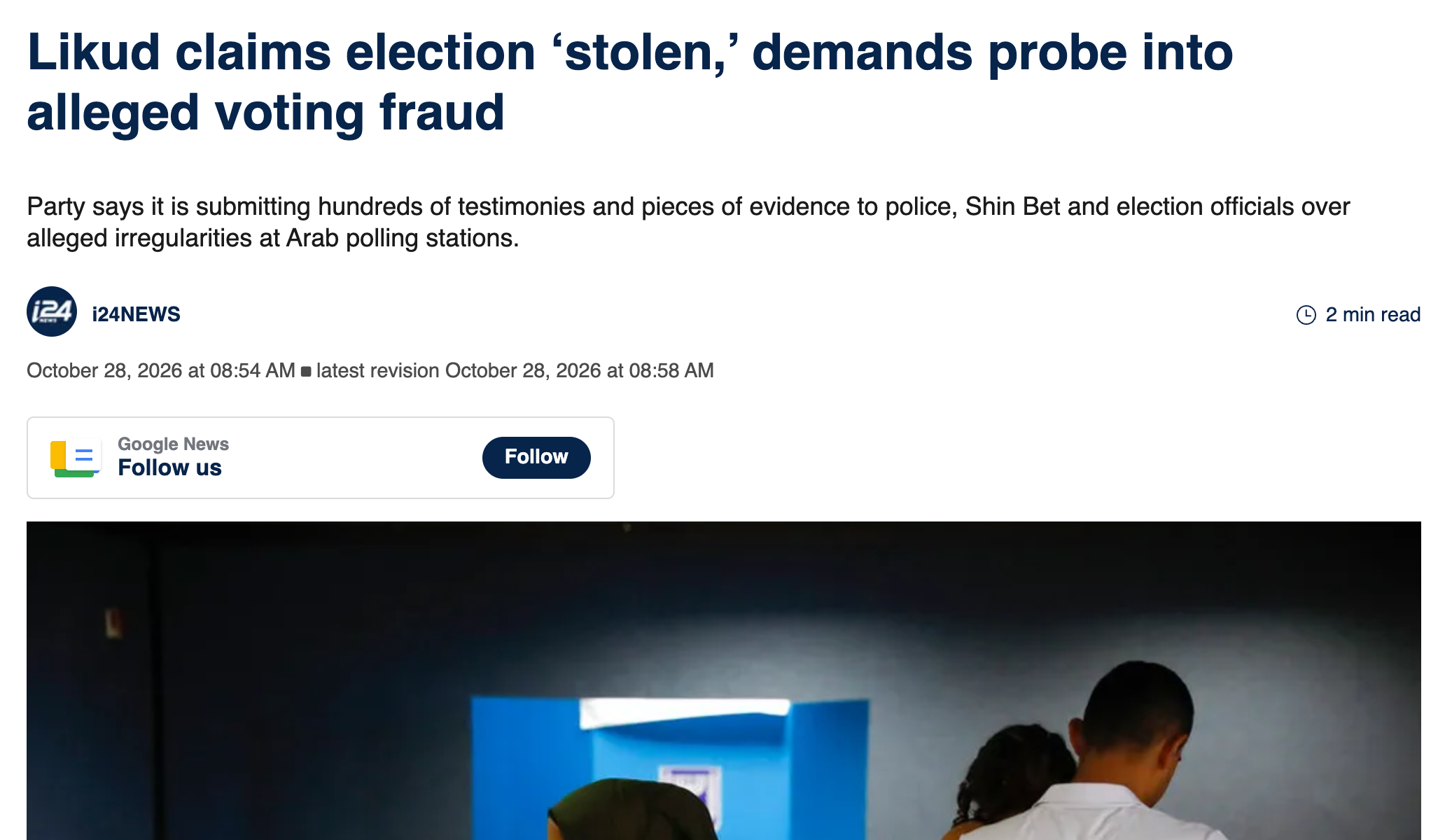
View source article on i24 News →
The Central Elections Committee dismissed the claims. Eizenkot's Yashar party called it "panicking and making up stories." The Daily Beast ran the headline: "Bibi's Trumpian Election Freakout Has Experts Worried."
View source article on Daily Beast →
The parallel is not subtle, and it is not accidental. This is a playbook with a precise tactical purpose:
1. Delegitimize the count. By targeting Arab voting stations specifically, Likud frames any opposition majority that depends on Arab parties as structurally illegitimate. This is not about proving fraud — it is about poisoning the well of coalition math.
2. Buy time. Official results are due November 4. The longer the count is contested, the more time Netanyahu has to negotiate with potential coalition partners — or to pressure wavering members of the religious right to stay loyal.
3. Set up the snap-election option. If no coalition forms within the mandated timeline, Israel goes back to the polls. Netanyahu has survived six elections. A seventh is not a threat to him — it is a feature. The "stolen" narrative ensures his base stays mobilized for the next round.
What $70 Million Sees That Headlines Don't
Ynet reported that Israel's election "sent $70 million in Polymarket bets into turmoil." That number deserves unpacking.
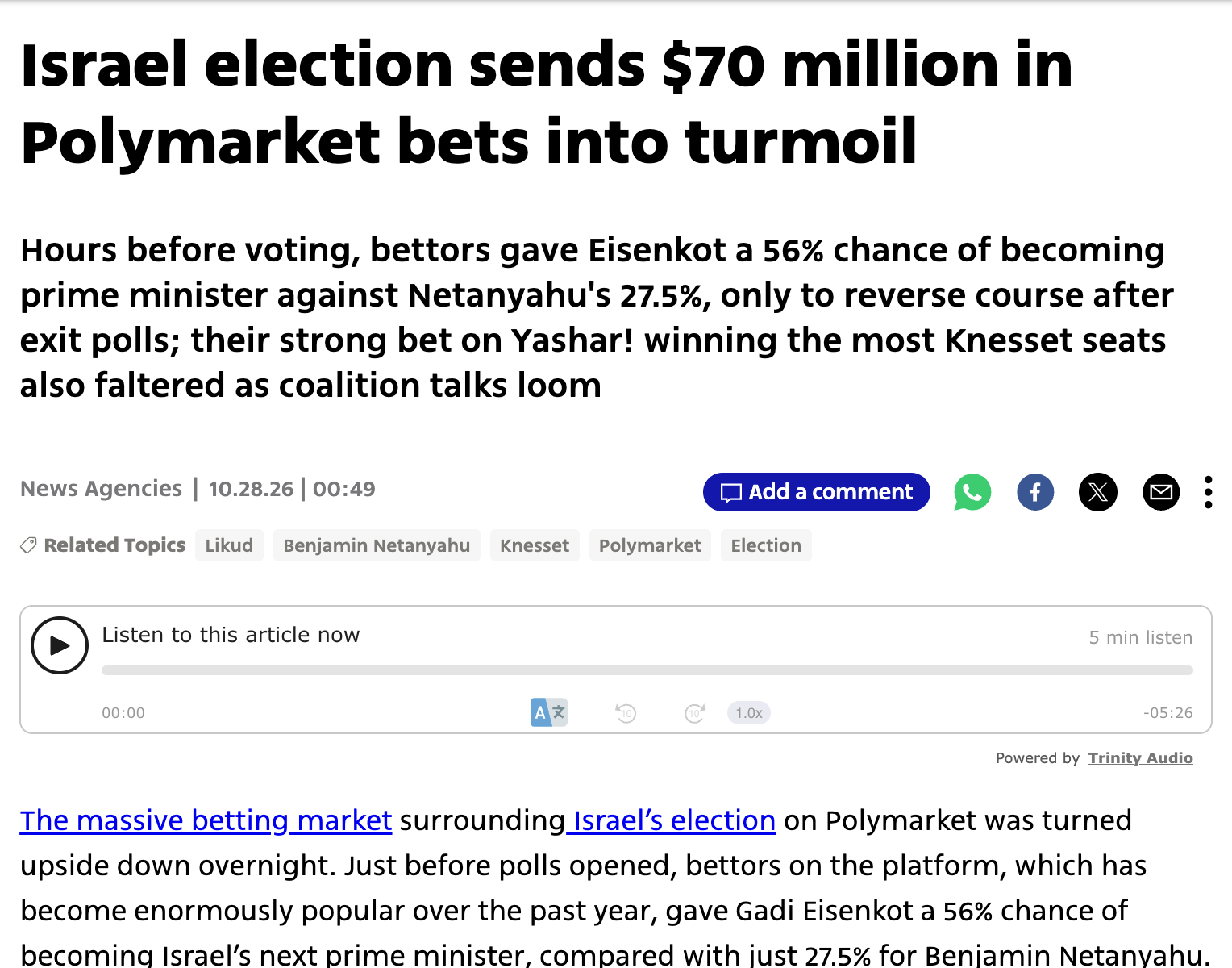
Before the election, Polymarket traders had priced Eizenkot as the clear favorite (56% to Netanyahu's 27.5%). Exit polls showing a near-tie wiped out millions in positioned bets overnight. i24 News reported "a turnaround at Polymarket after exit polls" as Netanyahu's odds surged.
But the market did not swing all the way. It settled at 42/34 — not the 55/30 that a Netanyahu-wins narrative would produce, and not the 30/56 that a clean opposition victory would show. The market is pricing a specific scenario: a prolonged succession fight with no clean resolution.
Here is what the 42/34 split encodes:
- Netanyahu remains the most probable individual PM — but at less than coin-flip odds
- The probability of a non-Netanyahu government is 58% — the market sees his era as more likely ending than continuing
- The gap is closing — in our July analysis, the market was 38-38; the election moved it to 42-34; Netanyahu gained ground but not enough to exit the danger zone
- Katz at 2% confirms the race is binary — this is Netanyahu vs. Eizenkot, with no third candidate viable
Tip
The Polymarket edge over polls: Israeli polls measure vote intention. Polymarket measures coalition-formation probability. A voter can prefer Eizenkot but doubt he can assemble 61 seats. That doubt — rooted in the Arab-coalition dilemma — is what keeps Netanyahu at 42% despite his bloc falling short. Traditional polling cannot capture this layer of strategic reasoning.
The Eisenkot Dilemma: Arab Votes Without Arab Partners
The Arab Center DC published a crucial analysis this week on Israel's election and Eisenkot's Arab coalition dilemma. The problem is arithmetic.
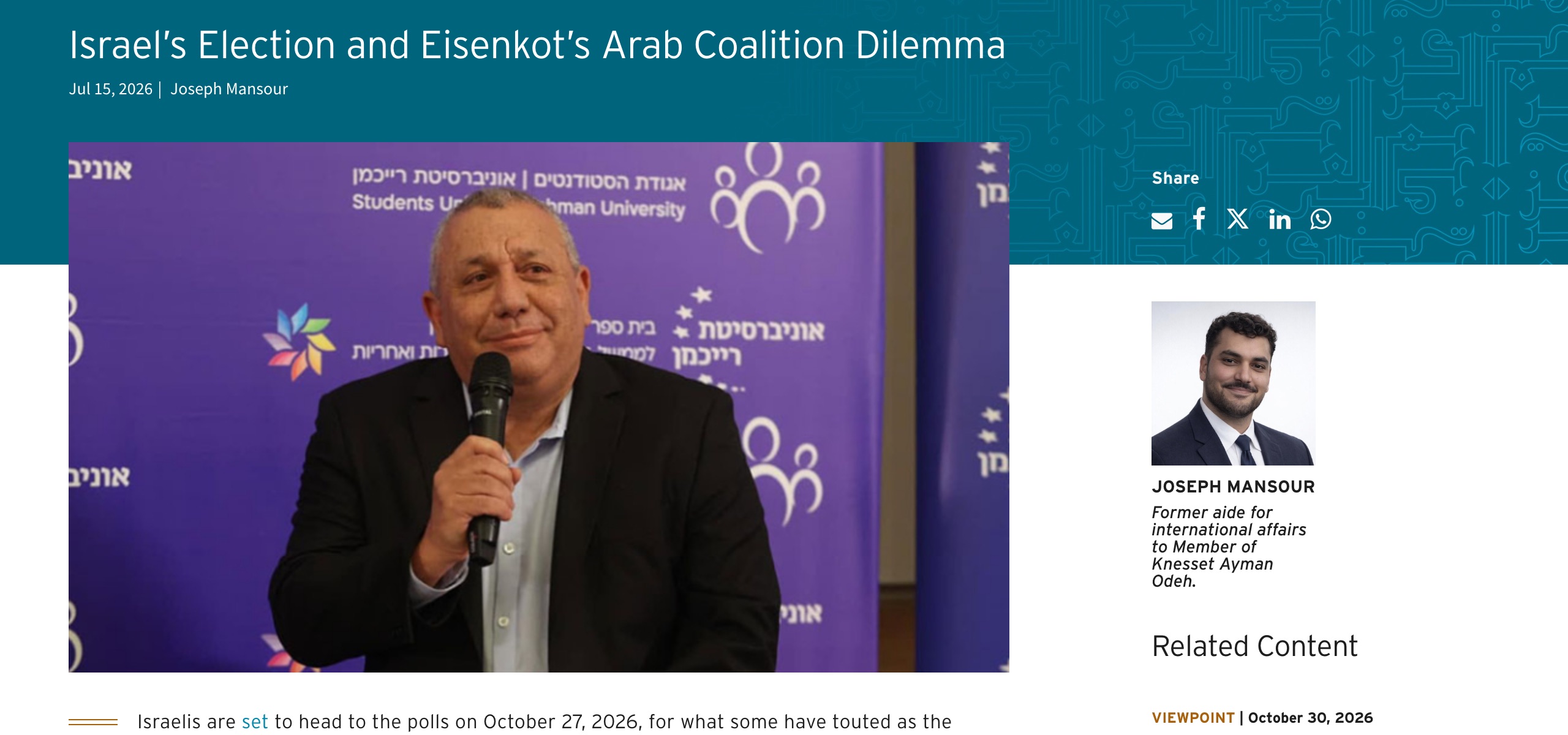
View source article on Arab Center DC →
Eizenkot's opposition bloc holds roughly 48 seats. To reach 61, he needs Arab-led parties — who control 18-19 seats and could comfortably deliver a majority. But Eizenkot has publicly ruled out a formal coalition with Arab parties. The political cost in Israeli Jewish politics would be terminal.
The workaround is a minority government sustained by external Arab support — Arab lawmakers vote confidence but do not join the cabinet. It has historical precedent (Rabin's government in the 1990s relied on similar arrangements). But it is inherently unstable. Any withdrawal of Arab support collapses the government.
This is the variable the prediction market is pricing. At 34%, Eizenkot is priced not as unlikely-to-win but as likely-to-face-a-fragile-arrangement. The market is saying: he can probably assemble a government, but it might not survive its first crisis.
Netanyahu's counterplay is patience. If Eizenkot cannot form a stable coalition within the mandated period, the mandate passes back — potentially to Netanyahu, or to a new election where the "stolen" narrative has had weeks to marinate in his base.
Critical
Contrarian Corner: Netanyahu has survived every political obituary written about him for 15 years. His 54-seat bloc is still the single largest coalition. Markets underpriced him in July at 27%, and he rallied 15 points on election night alone. The opposition's Arab-coalition dilemma — Eizenkot needs Arab votes but will not formally include Arab parties — is a structural weakness that a patient operator like Netanyahu is designed to exploit. The "stolen" rhetoric may look desperate. It may also be working.
Three Lessons This Succession Fight Teaches
Lesson 1: Prediction markets lead media on political transitions by days, sometimes weeks.
In July, when Israeli media was still framing the election as "Netanyahu vs. Bennett," Polymarket had already priced Eizenkot as the co-favorite. The 38-38 dead heat we reported appeared in Israeli polling only weeks later. Today, the market prices a succession fight while most English-language coverage still frames the story as "Netanyahu claims fraud." The market has moved past the noise to the structural question: who assembles 61 seats?
Lesson 2: "Stolen election" rhetoric is a position, not a belief.
Netanyahu does not need to prove fraud. He needs to delay resolution, energize his base, and delegitimize any coalition that includes Arab support. The rhetoric tracks precisely with Trump's 2020 playbook — not because Netanyahu copied it, but because it solves the same problem: how does a powerful leader who lost an election avoid a clean transfer of power? The answer, in both cases, is to make the transfer messy enough that the alternative looks unstable. The Times of Israel asked directly: "Does that add up?" The answer from the Central Elections Committee: no.
View source article on Times of Israel →
Lesson 3: The Arab vote is the actual variable, and everyone is pretending it is not.
Every analysis of Israeli coalition math eventually arrives at the same conclusion: the Arab parties hold the balance of power. Eizenkot needs them. Netanyahu needs to prevent them from being counted. The "stolen election" rhetoric targeting Arab polling stations is not random — it is strategically aimed at the exact parties whose support would make an Eizenkot government viable. If Likud can frame Arab participation as fraudulent, it raises the political cost of any arrangement that depends on Arab votes.
The Road from Here
Official results arrive November 4. The president will then begin consultations, asking each party to recommend a candidate for prime minister. The candidate who receives the most recommendations gets 28 days to form a coalition, extendable by 14.
If that candidate fails, the president can offer the mandate to someone else. If no one succeeds, Israel goes to its seventh election in eight years.
The Polymarket odds will update in real time through every stage. Watch the Eizenkot line: if it crosses 40%, the market is pricing a successful coalition formation. If Netanyahu climbs above 50%, the market sees either a coalition breakthrough or a snap election where he is favored.
At 42/34, the market's current message is clear: this is not over. The succession fight the media has not yet framed is already priced.
This is the second in The Arc of Power's series tracking Israel's leadership transition through prediction-market data. Read the first installment: Netanyahu's 18-Point Collapse.
The Desk
About The Arc of Power
The Arc of Power editorial desk delivers rigorous analysis of geopolitics, defense, economic statecraft, and intelligence — examining the forces that shape the global order.
Briefing Access
Request Briefing Access
In-depth geopolitical analysis — power dynamics, defense strategy, and economic statecraft — three times a week. No noise.
Request briefing access