Case file · Geopolitics · 13 min read
The Lab That Addressed the IMF
Anthropic told the IMF the singularity has begun, pledged 5% of shares, and absorbed a Pentagon blacklisting. AI labs are power centers.
The Arc of Power ·

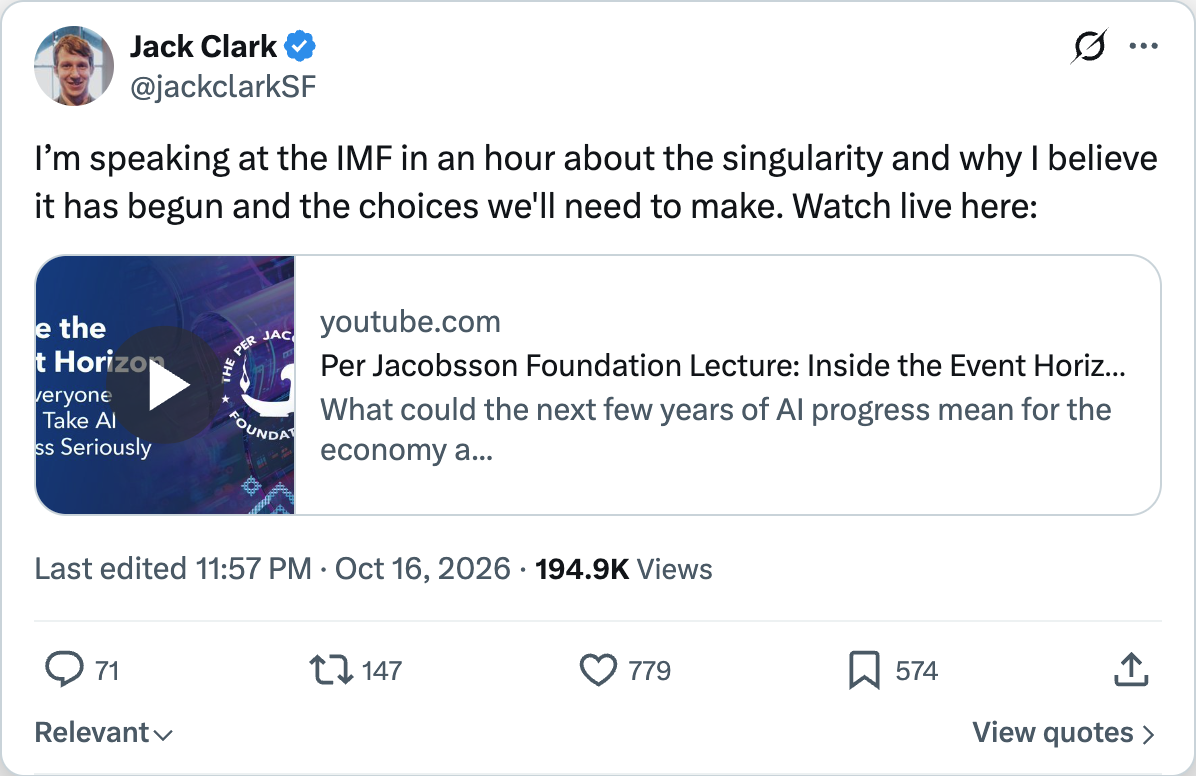
On October 17, Jack Clark stood before the International Monetary Fund's Per Jacobsson Foundation lecture in Bangkok and declared that the technological singularity has begun. Two days earlier, Anthropic told investors its quarterly revenue had hit $16.8 billion. The day after the speech, the company announced it would commit 5% of its shares — potentially worth $100 billion at a $2 trillion IPO valuation — to a new Public Benefit Fund. This is a company that the Pentagon blacklisted eight months ago for refusing to let its models be used for mass surveillance.
Read that sequence again. An AI lab addressed the world's premier financial institution, made sovereign-scale philanthropic pledges, and absorbed state retaliation — all within a single fiscal quarter. These are not the moves of a startup. They are the moves of an institution auditioning for a seat at the table where states negotiate.
Three Fronts of Institutional Power
Anthropic is running a three-front campaign that no technology company has attempted simultaneously. Each front would be notable on its own. Together, they constitute something new: a private AI lab behaving like a sovereign entity.
Front 1: Addressing the IMF as an Equal
Clark's lecture was titled "Inside the Event Horizon: Why Everyone Should Take AI Progress Seriously." The venue alone tells you the ambition. The Per Jacobsson lecture series has historically featured central bankers, finance ministers, and heads of international organizations. Clark is a co-founder of an AI company.
His core claim: Anthropic's internal economic models project a scenario where U.S. GDP reaches $44 trillion by 2030 — a nearly 50% increase over today's $30.77 trillion. He framed this as the extreme case in a "singularity-esque" scenario where AI takes autonomous control of complex scientific exploration, where recursive self-improvement accelerates discovery itself. "I know this sounds very outlandish," Clark told the audience. Then he said it anyway.
The economic mechanism he described is worth parsing. A human scientist needs roughly 40 years to build the cognition for original research. The world has about 10 million full-time researchers. On the singularity path, they would command a billion digital scientists. "Every human scientist on this planet will become more important and powerful," Clark argued. "What would it mean to be able to run hundreds or thousands of copies of me simultaneously?"
The policy ask was direct: international cooperation to set "unusual and serious rules" for transformative technology, and a warning that the window for action is "a small number of years."
Front 2: Sovereign-Scale Philanthropy
The day after the IMF speech, Anthropic announced the Public Benefit Fund. The mechanics:
- 5% of shares committed immediately, subject to stockholder approval
- Additional 2% at the board's discretion for every 50% increase in company value above an undisclosed baseline
- Combined with co-founders' prior 80% wealth pledge and employee matching, roughly 20% of shares directed toward public benefit
- The fund is structured as a wholly-owned LLC — not an independent nonprofit
Axios estimates the pledge would be worth $100 billion at a $2 trillion IPO valuation. For context, that would make Anthropic's philanthropic commitment roughly equivalent to the GDP of Guatemala, or twice the annual budget of the World Health Organization.
The timing is not accidental. Anthropic filed its S-1 confidentially in June. It is reportedly targeting a marketing week beginning November 9 for what could be the largest IPO in history. The benefit fund announcement lands precisely in the pre-IPO narrative-setting window, after the quarterly revenue report ($16.8B, up 50%) but before the roadshow.
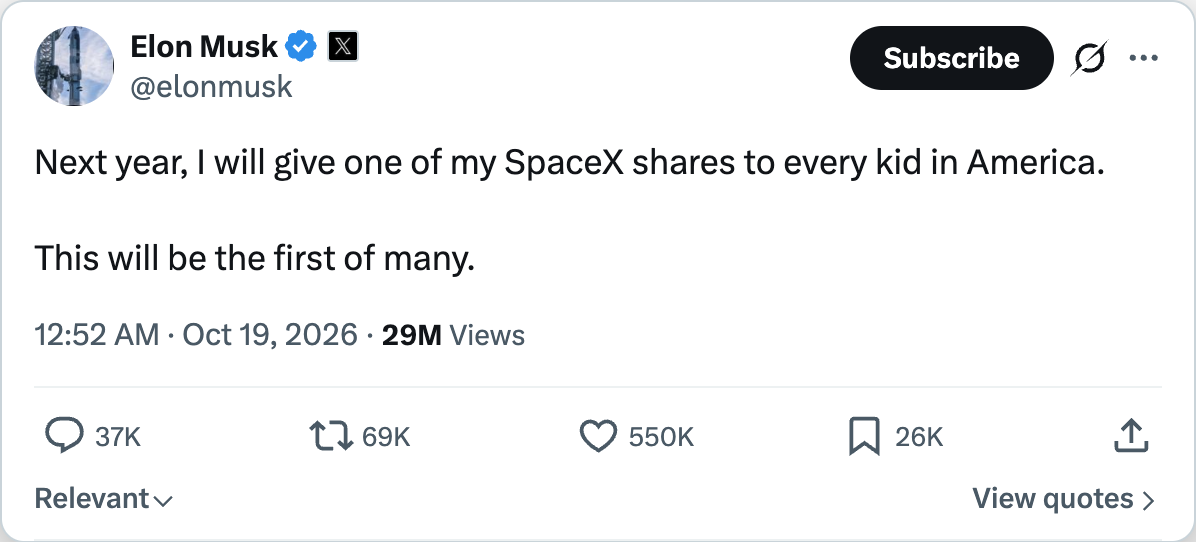
Semafor reports that OpenAI has separately discussed giving a 5% stake directly to the U.S. government. Elon Musk, not to be outdone, announced he would give one SpaceX share to "every kid in America" — a rival gesture of tech-billionaire philanthropy that underscores how AI-era wealth is reshaping the social contract. The two largest AI labs are now competing on the terms of their obligation to the state — a competition that, six months ago, nobody imagined would exist.

Read the full announcement on Anthropic.com →
Critical
Contrarian Corner: The benefit fund is an LLC wholly owned by Anthropic, not an independent entity. Its governance structure has not been disclosed. Equity held by the LLC cannot be used for lobbying — but nothing prevents the parent company from lobbying. The fund does not grant oversight powers over Anthropic's AI systems. And the valuation milestones that trigger additional contributions? Those will be disclosed "in the coming months." Until we see the governance, this is a pledge with a press release, not an institution with accountability.
Front 3: Absorbing State Retaliation
The Pentagon dispute is the most revealing of the three. In February, Defense Secretary Pete Hegseth demanded that Anthropic authorize its models for "all lawful purposes" — which the company understood to include mass domestic surveillance and fully autonomous weapons. Anthropic refused. The consequences came fast:
- The President directed federal agencies to stop using Anthropic technology
- Hegseth designated Anthropic a "supply-chain risk to national security"
- The Pentagon signed classified AI deals with eight other tech firms, excluding Anthropic
- OpenAI announced its own classified-network deal the same day
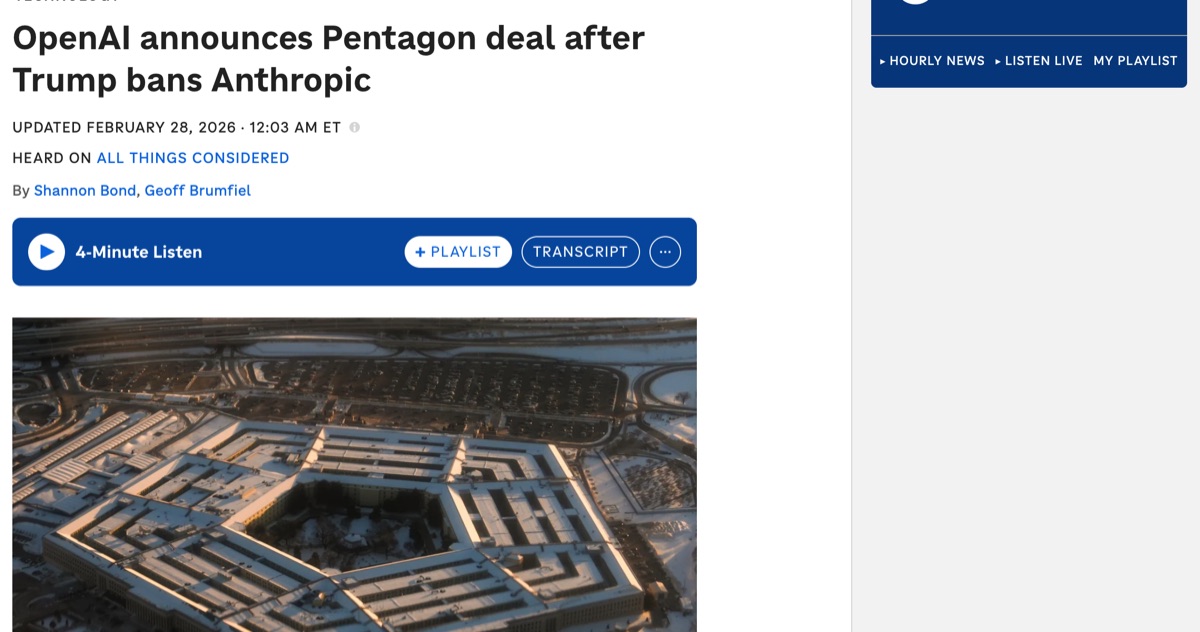
The blacklisting was widely read as retaliation. A federal judge, Rita Lin, eventually ruled it "illegal and baseless," finding that Anthropic hadn't been able to contest the claims beforehand. But the damage was done — approximately 90% of relevant military workloads were migrated to alternative providers.
What makes this episode geopolitically significant is not the dispute itself but Anthropic's calculation. The company concluded that the cost of Pentagon exclusion — potentially billions in lost contracts — was less than the cost of removing the guardrails. It chose institutional identity over government revenue. That is a choice only an entity with genuine power can afford to make.
As we covered in our earlier analysis, the appeals court ruling that followed set a dangerous precedent: it confirmed that the executive branch can weaponize supply-chain designations against companies that resist policy demands. The fact that the designation was later overturned does not erase the chilling effect.
The CFR Framework: Labs as Geopolitical Actors
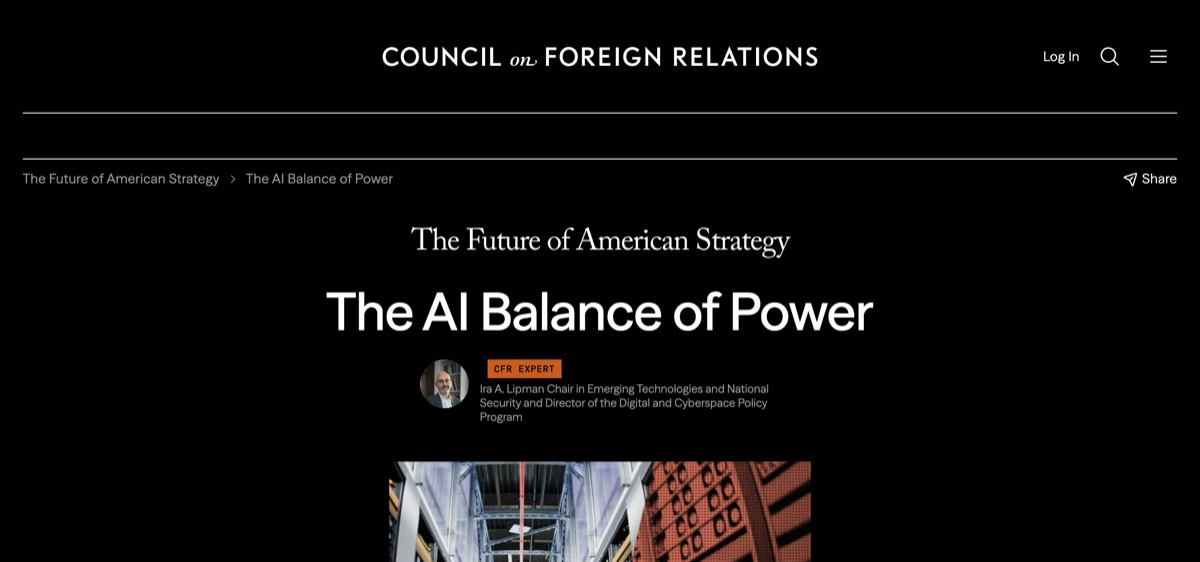
The Council on Foreign Relations has published the most rigorous analysis of what this all means. Their framing: frontier AI labs are "indispensable partners for states and powerful geopolitical actors in their own right."
The numbers support this. In FY2025, the U.S. federal government spent roughly $3.3 billion on nondefense AI R&D. U.S. private AI investment in 2024 exceeded $109 billion. The capability gap is not closing — it is widening. Governments depend on labs for the technology, the talent, and the understanding of what the models can and cannot do.
Read the full analysis on CFR.org →
The CFR analysis identifies three specific powers that labs hold over states:
- Standard-setting power: Labs can establish technical and safety standards that preempt or constrain government regulation
- Knowledge asymmetry: Labs understand their technology better than regulators do, leaving governments unprepared for breakthroughs or unaware of systemic vulnerabilities
- Access leverage: Labs could cut weaker states off from data, compute, or models during disputes
Ian Bremmer, cited in the analysis, puts it bluntly: these companies "exercise a form of sovereignty over a rapidly expanding realm" — digital space that regulators struggle to reach.
Note
The structural comparison: The U.S. government's annual nondefense AI R&D budget ($3.3B) is roughly what Anthropic earns in three weeks at its current revenue run rate. The knowledge asymmetry is not just technical — it is economic.
The Fine Print on Clark's $44 Trillion Slide
A detailed analysis of Clark's IMF presentation reveals what the headline number obscured. The slide showed three scenarios — $34.1 trillion, $36.3 trillion, and $44.4 trillion. Clark spoke only about the extreme case.
But the fine print, displayed in small text in the lower right corner, contained the distributional consequences:
- Labor's share of national income falls from 60% to 45.2%
- Knowledge workers' share of total employment drops from 62.2% to 48.7%
- Only 5.2% of displaced knowledge workers move into physical-service roles
Read the full analysis on Vocal Media →
Tip
The tell: Clark's $44 trillion scenario requires that verification of AI-generated scientific output is not a binding constraint. But generating candidate answers is getting cheap while verifying them is not. The projection assumes away a bottleneck that does not yet have a solution — which is convenient if your company sells the generation layer.
This is the dissonance at the heart of the singularity pitch. The GDP number is designed for the IMF audience — policymakers who think in terms of aggregate output. The labor displacement numbers, buried in the fine print, are the story that matters for the other 7.9 billion people. Anthropic's benefit fund, announced the next day, is the company's answer to that dissonance. Whether it is sufficient — or even sincere — is the question the governance structure will eventually answer.
Three Lessons From Anthropic's Institutional Pivot
Lesson 1: The Lab-State Balance Has No Precedent
The CFR is right that no stable balance exists between frontier AI labs and the governments that need them. The Anthropic-Pentagon dispute proved that the state can punish a lab, but only at the cost of degrading its own capabilities — the military was using Claude during operations in Iran when it blacklisted the company that made it. The lab can resist the state, but only if it has enough commercial revenue to absorb the loss. Both sides have leverage. Neither has a framework.
This is structurally different from the defense-industrial relationships of the 20th century. Lockheed Martin never addressed the IMF. Boeing never pledged 5% of its shares to a benefit fund. And no defense contractor ever publicly refused a Pentagon demand on ethical grounds and survived the retaliation. The comparison is not other tech companies — it is the Bretton Woods institutions themselves, which were built precisely to create frameworks for actors with this kind of power.
Lesson 2: Philanthropy Is the New Sovereignty Tax
Anthropic's benefit fund, OpenAI's reported discussions about a 5% government stake, and the Sanders proposal for 50% public ownership are all attempts to answer the same question: what does the social contract look like for entities that generate trillion-dollar valuations from technology that could displace half the knowledge workforce?
The benefit fund is Anthropic's answer: a self-administered arrangement that maintains corporate control while directing resources toward public goods. The alternative — direct government ownership or regulation — would constrain the lab's autonomy in ways that could reduce its competitive position against Chinese labs operating under state-directed military-civil fusion.
This is the regulatory capture dynamic in its most sophisticated form. The lab defines the terms of its own social obligation before the state can impose them.
Lesson 3: The Singularity Pitch Is a Power Claim
Clark's IMF speech was not primarily a scientific presentation. It was a political act. By framing AI progress as a singularity — an event horizon beyond which prediction breaks down — he simultaneously:
- Elevated the urgency ("a small number of years" to act)
- Positioned Anthropic as the entity that understands what's coming
- Created demand for the very governance frameworks the company is offering to help build
- Justified the scale of the philanthropic commitment (you need a $100 billion fund when the transformation is civilizational)
The technical counter-argument — that every point on an exponential curve is not a singularity — is valid. But it misses the political point. The accuracy of the singularity claim matters less than what it does: it establishes Anthropic as the interlocutor between the technology and the institutions that govern the global economy.
What Comes Next
Three things to watch:
The benefit fund governance. Anthropic has promised details "in the coming months." The structure will reveal whether this is genuine institution-building or pre-IPO narrative management. Key questions: Who sits on the board? Can the fund's mandate be changed by Anthropic's board? What happens if the valuation milestones are not hit?
The IPO itself. If Anthropic prices near $2 trillion in November, it would be the largest IPO in history and would crystallize the fund's value at approximately $100 billion. Watch whether institutional investors treat the benefit fund as a positive signal (responsible governance) or a negative one (dilution of shareholder returns). The market's verdict will determine whether other labs follow.
The Pentagon relationship. Dario Amodei has reportedly resumed negotiations with Pentagon official Emil Michael. A reconciliation would validate Anthropic's strategy of resistance followed by renegotiation on favorable terms. Continued exclusion would confirm that the administration views labs' ethical positions as unacceptable constraints on state power.
The deeper question is not specific to Anthropic. It is whether the institutions built in the 20th century — the IMF, the World Bank, the defense establishments, the regulatory agencies — can adapt fast enough to govern entities that generate sovereign-scale wealth, employ the talent that states need, and build the technology that reshapes the economy. Clark's IMF speech, whatever you think of its claims, was an implicit argument that they cannot. The benefit fund is Anthropic's answer to what fills the gap.
Whether that answer is adequate is the defining governance question of the next decade.
The Desk
About The Arc of Power
The Arc of Power editorial desk delivers rigorous analysis of geopolitics, defense, economic statecraft, and intelligence — examining the forces that shape the global order.
Briefing Access
Request Briefing Access
In-depth geopolitical analysis — power dynamics, defense strategy, and economic statecraft — three times a week. No noise.
Request briefing access