Case file · Geopolitics · 12 min read
Nationalize AI? Bernie's 50% Stake vs. Trump's Partnership
Sanders wants half the stock. Trump wants a partnership. Anthropic's founders pledge 80%. The fight over who owns the AI windfall.
The Arc of Power ·
Nationalize AI? Bernie's 50% Stake vs. Trump's Partnership
On June 5, 2026, three things happened within the same news cycle that would have been unthinkable twelve months ago.
Senator Bernie Sanders introduced the American AI Sovereign Wealth Fund Act, demanding a one-time 50% tax on the largest AI companies — payable in stock. President Trump confirmed that his administration is in active discussions with OpenAI, Anthropic, and xAI about the government taking direct equity stakes. And Anthropic's seven co-founders had already pre-empted both by pledging to donate 80% of their combined $37.8 billion in wealth.
Three ownership models. Three different theories of who should control the AI windfall. All live policy positions as of this week.
The coverage has mostly framed this as left vs. right — Sanders the socialist vs. Trump the capitalist. That framing misses the structural shift. Both sides now agree that the government should own pieces of AI companies. The debate has moved from should the state have a stake? to on whose terms? The capital tier is racing to define the answer before the political tier does it for them.
The Week Everything Converged
The timing is not coincidental. Each move was a response to the others, even if the principals won't say so publicly.
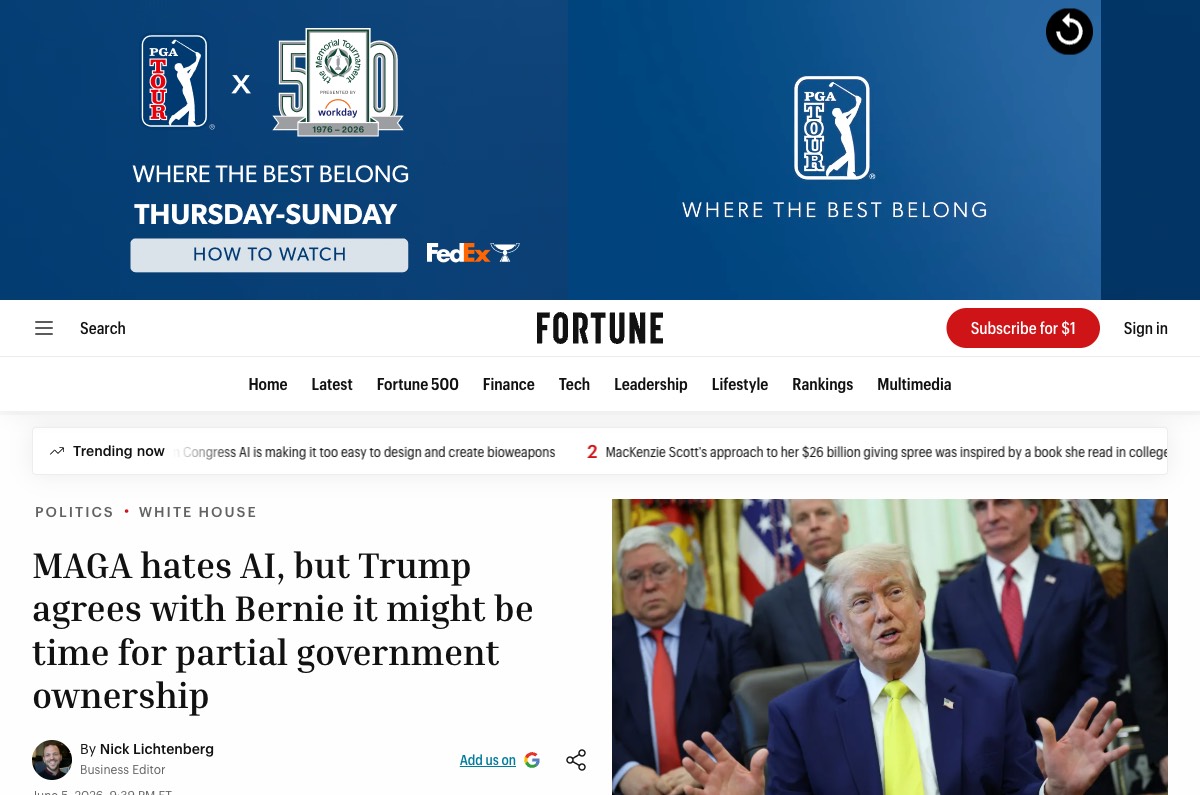
Sanders filed his bill the same day Trump made his equity comments. Fortune captured the convergence with a headline that would have been satirical a year ago: "MAGA hates AI, but Trump agrees with Bernie it might be time for partial government ownership."
The Anthropic wealth pledge preceded both by several months — Dario Amodei published "The Adolescence of Technology," a 38-page essay in February 2026 arguing that AI wealth concentration is unsustainable and proposing that nations create sovereign wealth funds with stakes in AI companies. The essay reads differently in June than it did in February. What looked like philanthropy now looks like a strategic pre-emption of exactly the legislative proposals that followed.
Three days before all of this, Trump signed the "Promoting Advanced Artificial Intelligence Innovation and Security" executive order — a voluntary framework that established the government's right to review frontier AI models without the power to compel compliance. That EO was the appetizer. The equity conversations are the main course.
And underneath it all, AI CEOs are openly worrying that the government will nationalize their companies. The worry is no longer hypothetical.
Sanders: The 50% Seizure
Sanders' American AI Sovereign Wealth Fund Act is the most aggressive ownership proposal ever filed for a technology sector. The mechanics:
One-time 50% tax payable in stock. Not a cash tax — a stock transfer. The government would receive voting shares and equal board representation at each qualifying company. This isn't a revenue play. It's a governance takeover.
Scope: The bill targets companies above a market cap threshold — Sanders' office has indicated it would cover the "Big AI" companies: OpenAI, Anthropic, Google DeepMind, xAI, and Meta's AI division.
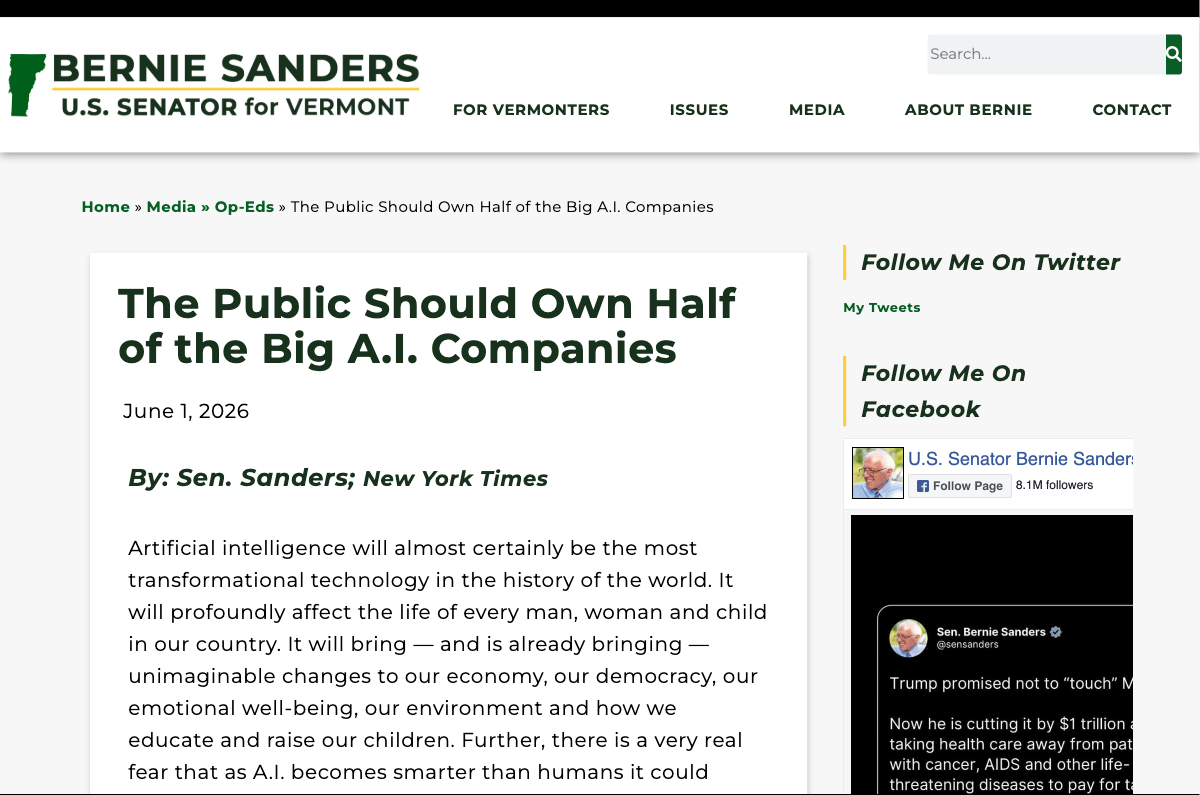
Rationale: Sanders' op-ed states the thesis explicitly: "Since AI is built on the collective knowledge of humanity, the wealth it generates must benefit humanity." AI training data comes from the public internet — publicly generated knowledge — so the public is entitled to ownership of the resulting value.
The bill has zero chance of passing in its current form. Sanders knows this. The purpose isn't legislative — it's to anchor the Overton window. By proposing 50%, Sanders makes Trump's 10-20% equity discussions look moderate by comparison. Every future negotiation over government stakes in AI companies will now be conducted in the range between 0% and 50%, and Sanders has defined the upper bound.
The voting shares provision is the tell — this isn't passive investment. Sanders wants the government sitting at the board table with veto power over deployment decisions, safety protocols, and executive compensation. The sovereign wealth fund would be the largest single shareholder in every company it touches.
Trump: The Partnership Model
Trump's approach is structurally different from Sanders' but arrives at the same destination: government equity in AI companies.
CNBC reported the key detail that most coverage buried: Sam Altman has been pitching this concept to the Trump administration since early 2025. The government equity stake wasn't Trump's idea. It was the industry's idea, offered as a voluntary concession to head off mandatory regulation.
Trump's framing is revealing. He described the arrangement as "making them a partnership in this revolution" — positioning the government as a junior partner in a corporate venture, not a sovereign exercising regulatory authority.
The administration already holds stakes in approximately 20 private companies through various government investment vehicles. AI would be the largest sector addition. The discussions with OpenAI, Anthropic, and xAI are about the terms: stake size, voting rights, board representation, and what the government gives in return.
What does the government give in return? The answer is embedded in the June 2 executive order: regulatory certainty. A voluntary compliance framework. Preferential access to government contracts. The implicit promise that companies who partner with the government won't face the kind of mandatory oversight that Sanders is proposing.
This is the deal: give us a piece of the company, and we'll protect you from the people who want half.
The Fortune article captured the political irony: MAGA populists who elected Trump on anti-corporate rhetoric are watching their president negotiate equity partnerships with the very tech companies they distrust. The donor class wins again — this time by offering to share, on their terms, before they're forced to share on someone else's.
Anthropic: The Voluntary Counter-Move
Anthropic's play is the most sophisticated of the three because it pre-empted the political fight entirely.
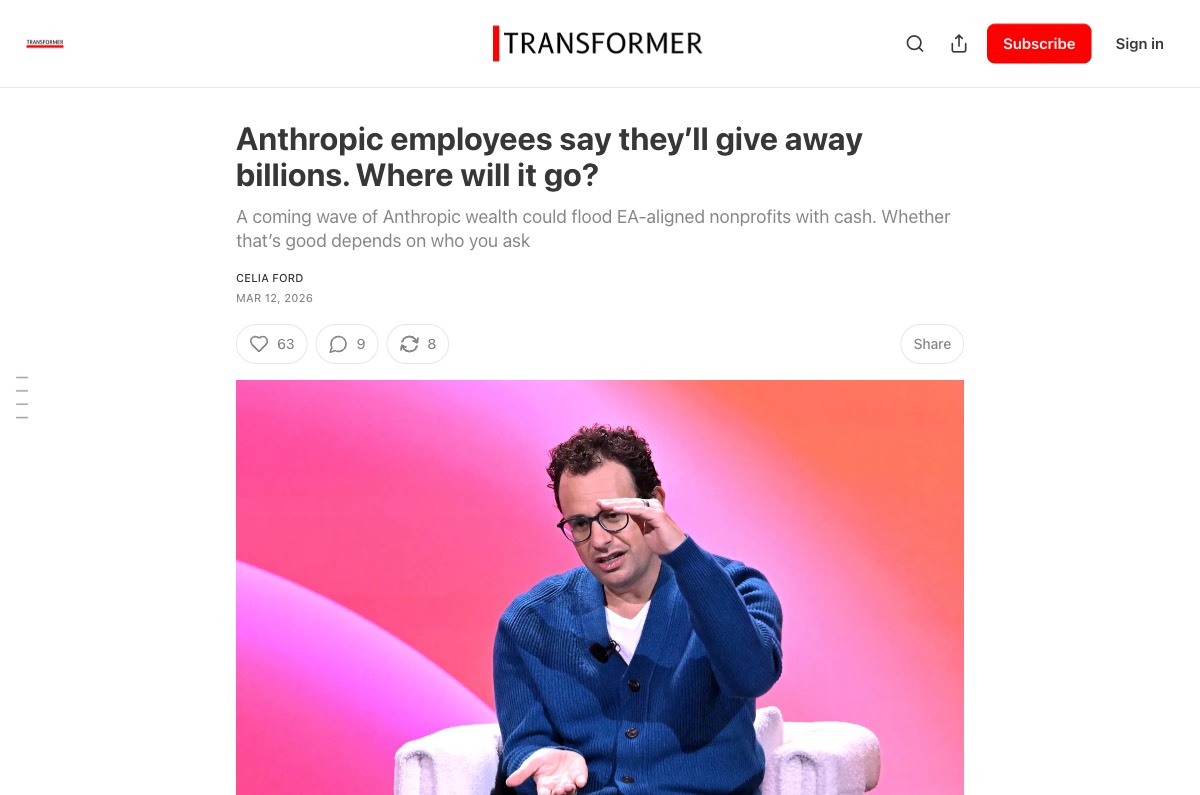
In February 2026, all seven Anthropic co-founders pledged to donate 80% of their wealth — approximately $37.8 billion combined. Dario Amodei's "Adolescence of Technology" essay laid out the philosophical framework: AI will generate unprecedented wealth concentration; that concentration is politically unsustainable; the founders should redistribute voluntarily before governments do it involuntarily.
The essay went further. Amodei explicitly proposed that nations create "national sovereign wealth funds with stakes in AI" — the same mechanism Sanders is now legislating and Trump is now negotiating. Anthropic's founders proposed the policy before the politicians adopted it.
This is the voluntary model: we'll give away the wealth ourselves, on our terms, directed toward the causes we choose, through the philanthropic structures we control. No government board seats. No voting shares transferred. No sovereign wealth fund managing our equity. Just a pledge — legally non-binding — to donate 80% of future gains.
The strategic logic is clear. If AI founders are already redistributing their wealth voluntarily, the political argument for forced redistribution weakens. Sanders can't seize what's already being given away. Trump can't demand a partnership stake in wealth that's been pledged to charity. The voluntary pledge is a shield against both models.
Whether it works depends on whether politicians — and the public — trust billionaires to keep their promises. The history of tech philanthropy pledges is not encouraging. But the Anthropic pledge is different in one respect: the political cost of reneging is existential. If Anthropic's founders break their wealth pledge, they've handed Sanders the best possible argument for mandatory seizure.
The Cyber AI Executive Order
The June 2 executive order — "Promoting Advanced Artificial Intelligence Innovation and Security" — is the regulatory backdrop against which the ownership fight is playing out.
The order establishes a voluntary framework for government access to frontier AI models. Key provisions: AI developers are asked to share models up to 30 days before release; CISA must establish an AI cybersecurity clearinghouse; the order explicitly prohibits mandatory licensing.
We covered this order in detail in our previous analysis of regulatory capture — how Sacks, Altman, and Musk lobbied to weaken it from a 90-day mandatory review to a 30-day voluntary one. The relevant point for the ownership question is this: the EO created a cooperative framework that makes government equity stakes politically viable.
A government that's already reviewing your models and sitting in your security briefings has a natural argument for sitting on your board. The voluntary compliance framework is the on-ramp to government ownership — it establishes the relationship that the equity stake formalizes.
Critical
The order also reveals the administration's true priority. The EO is about security — protecting critical infrastructure from AI-enabled cyber attacks. The equity discussions are about economics — who profits from AI's value creation. By linking the two, the administration can frame government ownership as a national security necessity, not a wealth redistribution scheme. That framing neutralizes both the libertarian objection (government shouldn't own companies) and the populist objection (this benefits billionaires).
Polymarket Reads the Room
The prediction markets are pricing adjacent risks that contextualize the ownership fight.
Polymarket: SpaceX IPO closing market cap above $1T
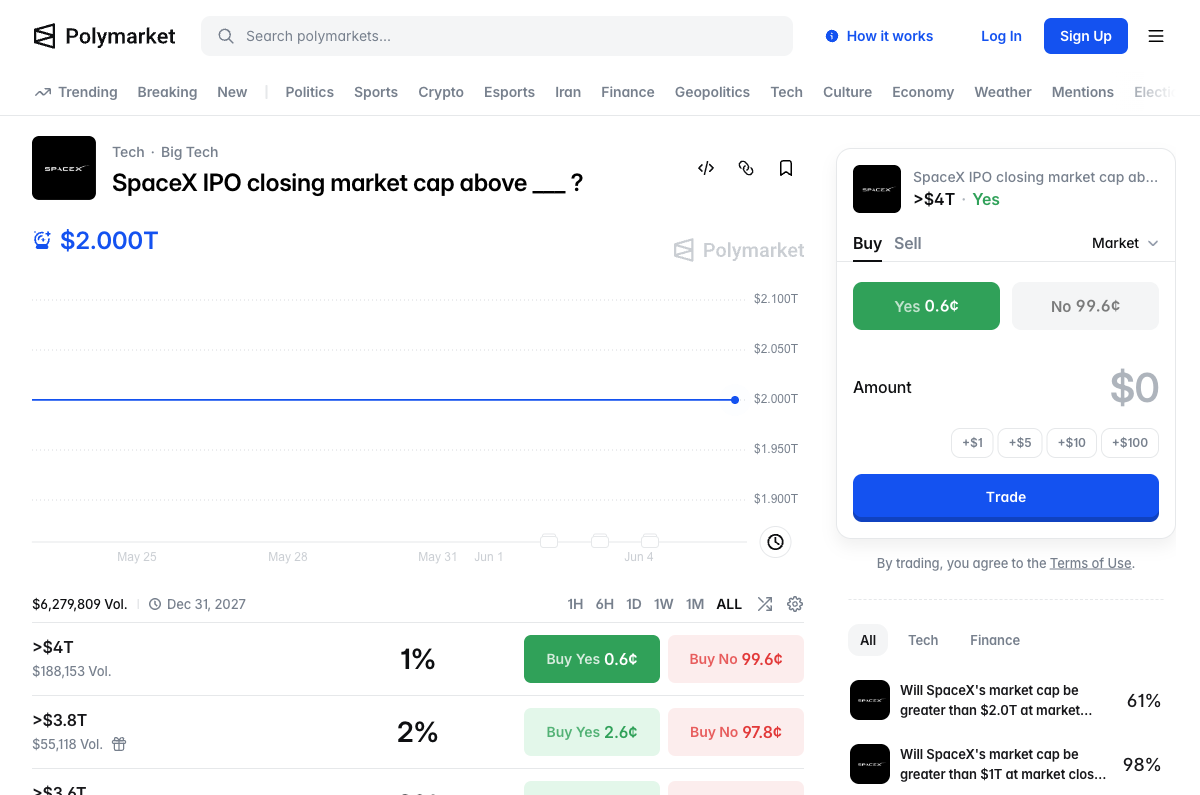
SpaceX IPO closing market cap above $1 trillion: 98% YES. The near-certainty of a trillion-dollar tech IPO underlines the stakes. If SpaceX can IPO at $1T+, the AI companies at the center of the ownership debate — OpenAI, Anthropic, xAI — are potentially worth multiples of that combined. A government 10% stake in companies worth $5-10 trillion is a sovereign wealth fund in itself.
Polymarket: AI data center moratorium passed before 2027
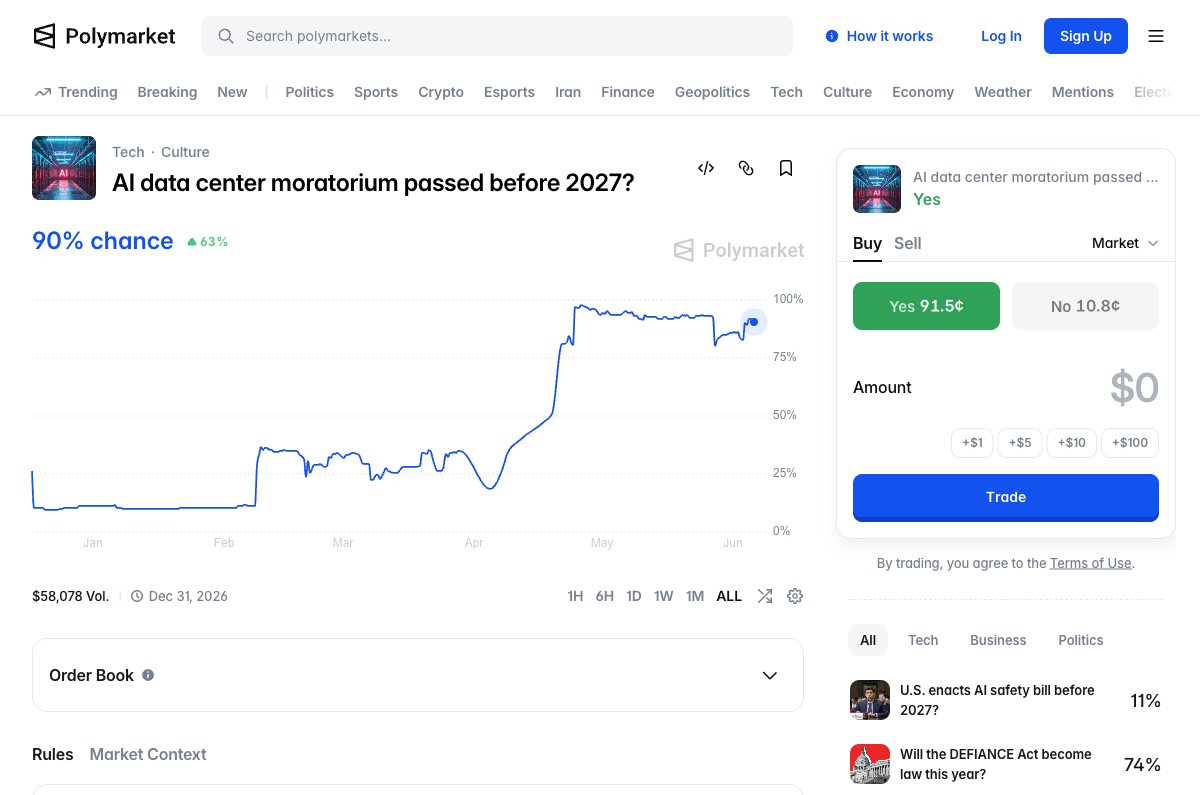
AI data center moratorium passed before 2027: 93% YES. The backlash against AI infrastructure is its own political force. We covered the 69+ jurisdictions that have already moved to restrict data center construction. A federal moratorium would constrain the very infrastructure that makes AI companies valuable — which paradoxically strengthens the argument for government ownership. If the government is going to limit AI growth, it has a political interest in sharing the profits from whatever growth it permits.
The two Polymarket positions together tell a story: AI companies are about to be worth more than ever (SpaceX IPO pricing), while facing more restrictions than ever (data center moratorium pricing). Government ownership is the political resolution of that tension — a way for the state to capture value from an industry it's simultaneously constraining.
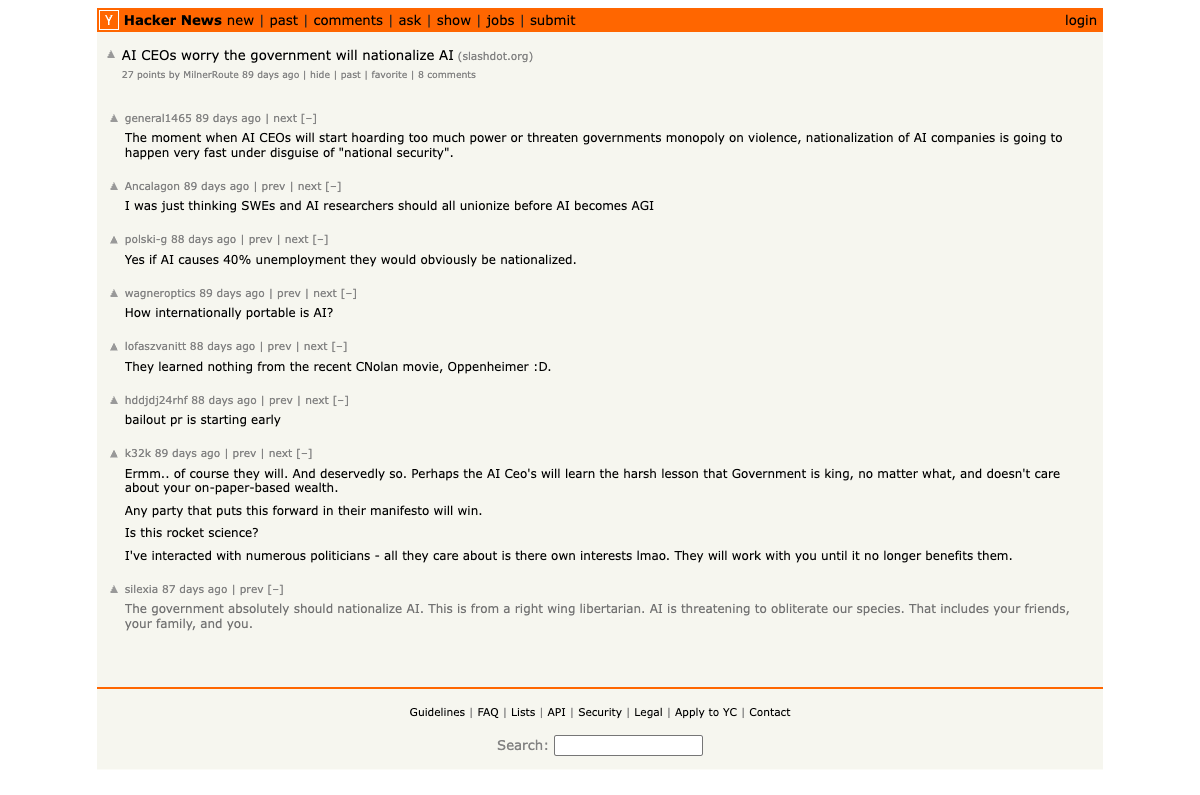
Legal scholars are already debating the constitutional framework. The "should we nationalize AI" discussion has moved from academic exercise to active policy analysis. The Slashdot thread on "AI CEOs Worry the Government Will Nationalize AI" is no longer a hypothetical — it's a description of the current policy debate.
What's Actually Being Decided
Strip away the partisan framing and three ownership models are now competing:
Model 1 — Seizure (Sanders): The government takes 50% of AI companies through mandatory stock transfer. Voting shares, board seats, sovereign wealth fund. Maximum public control, maximum disruption to private markets, maximum flight risk — companies could redomicile offshore. Probability of enactment: near zero. Probability of influencing the final outcome: high.
Model 2 — Partnership (Trump): The government negotiates equity stakes as a willing partner. Companies offer shares in exchange for regulatory certainty and government contracts. Moderate public ownership, structured as investment rather than taxation. Currently the most likely path — it has the advantage of being offered by the industry itself.
Model 3 — Philanthropy (Anthropic): Founders voluntarily redistribute wealth through pledges and donations. No government ownership, no structural change to corporate governance. Depends entirely on voluntary compliance. Strategically, it's a defense against Models 1 and 2 — redistribute enough voluntarily to undermine the political case for mandatory redistribution.
The three models aren't mutually exclusive. The likely outcome is a hybrid: government equity stakes in some form (Trump's partnership model), combined with heightened philanthropic pressure on founders who don't participate (Anthropic's model as social norm), with Sanders' 50% proposal serving as the threat that keeps both other models moving.
Note
What none of the models address is the underlying question: who should control AI deployment decisions? Ownership and control are different things. A government that owns 10% of Anthropic doesn't necessarily have a say in whether a particular model gets released. A founder who's pledged 80% of their wealth still controls 100% of their company's technical decisions until the check clears. The ownership fight is a proxy for the control fight. And the control fight hasn't started yet.
The ownership question has moved from theoretical to operational in a single week. The political tier and the capital tier are now competing to define the terms before the other side locks them in. This is the first article in Arc of Power's coverage of the AI ownership debate — a question that will define the next decade of technology policy.
For our analysis of the regulatory capture dynamics behind the June 2 executive order, see Regulatory Capture in Real Time. For the data center backlash that's constraining AI growth, see 69 Jurisdictions Have Moved to Ban AI Data Centers.
The Desk
About The Arc of Power
The Arc of Power editorial desk delivers rigorous analysis of geopolitics, defense, economic statecraft, and intelligence — examining the forces that shape the global order.
Briefing Access
Request Briefing Access
In-depth geopolitical analysis — power dynamics, defense strategy, and economic statecraft — three times a week. No noise.
Request briefing access