Case file · Geopolitics · 10 min read
AI Data Center Bans: 69 Jurisdictions, Polymarket 93%
Polymarket prices an AI data center moratorium at 93% YES. 69 jurisdictions ban new builds. The political-cost ledger catches up to the capex.
The Arc of Power ·
AI Data Center Bans Hit 69 Jurisdictions — Polymarket: 93% YES
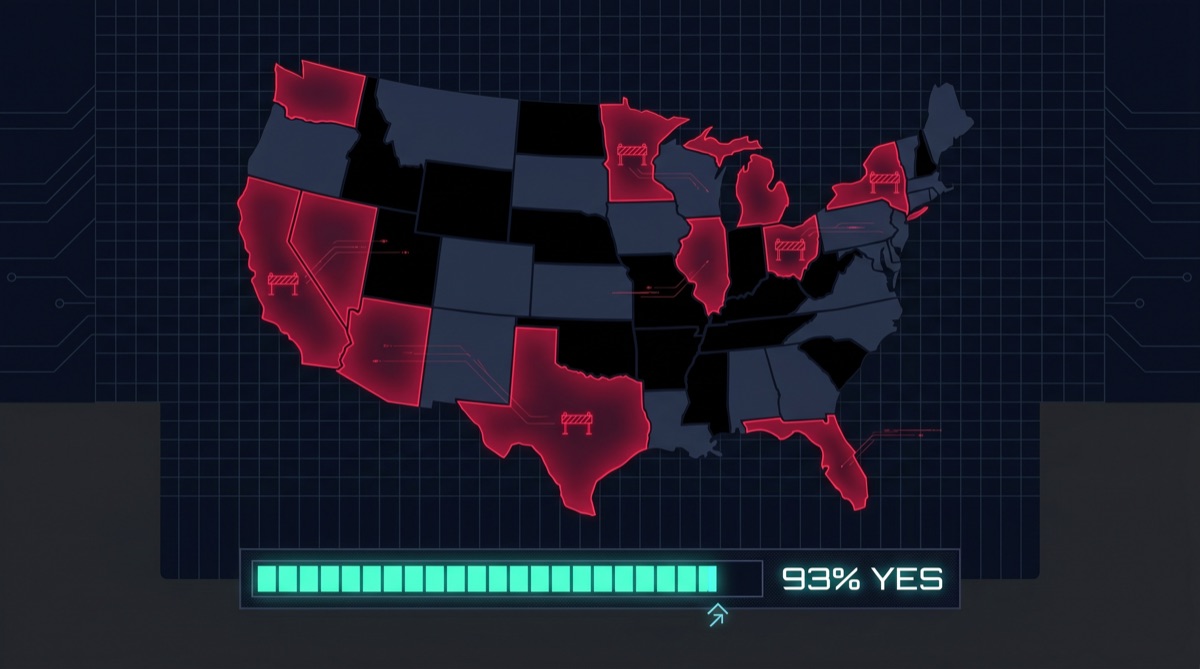
The political-cost side of the AI inference economy formalized this week. In a 24-hour window, three signals converged:
- r/technology #2 of the day: "AI data center bans rapidly multiplying — 69 jurisdictions" — 2,052 points on Reddit, sourced to Tom's Hardware reporting that 69 US local governments have now blocked new AI data-center construction, with four of those moves explicitly permanent.
- HN #1 + r/technology #2: Cloudflare cut roughly 1,100 employees — about 20% of its workforce — on the morning of May 7, framing the cut as a transition to an "agentic AI-first operating model." Stock fell 24%. 1,161 points on HN, 4,649 on r/technology.
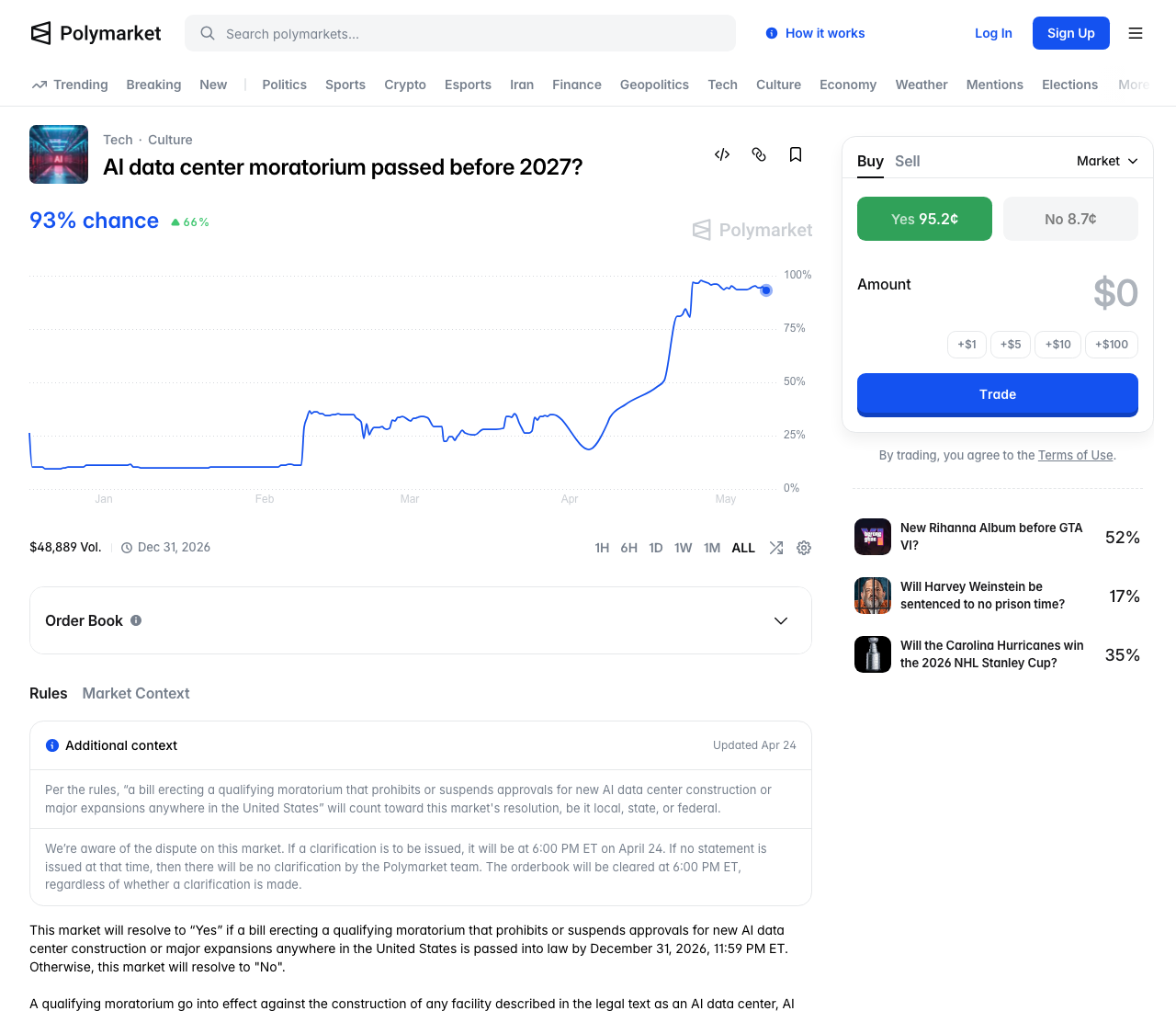
- Polymarket: "AI data center moratorium passed before 2027" sat at 93% YES, up 62.7% in a single month. By Polymarket's own X feed, the implied probability has since climbed further, to 85% on a separate "this year" framing.
Polymarket: AI data center moratorium passed before 2027
Three signals, one trade. The Iran/Hormuz arc that has dominated The Arc of Power for the past month was always about the geographic concentration of compute. This week the political concentration of compute moved into view — and the prediction market is already pricing the political backlash as near-certain.
This piece reads the ledger top-down: the capex deals at the top of the AI infrastructure stack, the layoffs in the middle layer, and the ban moratoria at the bottom. It is a single trade, expressed three ways.
Layer 1: The Capex Top
The upstream story is well-rehearsed in this column. The Anthropic-SpaceX/xAI 300 MW, $5B-per-year Colossus arrangement on its second day on Substack is the flagship. The next round of hyperscaler builds — Stargate, Colossus, and the Anthropic-aligned regional projects — are individually larger than every prior decade of US data-center expansion combined. There is no scenario, on the supply side, in which capex slows.
What changed this week is that the political delta against that capex has now formalized to the point where prediction markets price the political backlash at near-certainty. That is the sentence to internalize. The capex is locked in; the political cost is now also locked in.
Layer 2: The Middle Layer Snaps
Cloudflare's 1,100-person cut is the clearest mid-stack signal of 2026.
 The framing matters: this is not a 2023-style retrench. Cloudflare's Q1 revenue was $640M, up 25% year-over-year. It beat earnings. The company is cutting because AI agents replaced internal workflows, not because revenue softened. Co-founders Matthew Prince and Michelle Zatlyn framed the move as a transition to "an agentic AI-first operating model"; internal AI usage at Cloudflare grew 600% in three months.
The shape of the political problem this creates is what concerns the lower layer of the ledger. A mid-cap AI-coupled platform is shedding 20% of its headcount while AI capex at the top of the stack is accelerating. That juxtaposition is the political dataset that local governments are responding to. They are not seeing "growth"; they are seeing "out-of-state capex with in-state grid load and out-of-state hiring decisions." Two of the three Cloudflare layoff vectors landed on HN and on r/technology the same morning. The story does not stay in the technology press for long. It crosses into local-politics terrain within days.
Layer 3: The Floor — 69 Jurisdictions
The Tom's Hardware count is the floor of the ledger. 69 US jurisdictions have moved to block new AI data-center construction, with four of those moves marked permanent. The DataCenterBans.com tracker — purpose-built to follow this category — pegs the broader number higher still, with 78 active or proposed moratoriums across the country in the May 2026 reading.
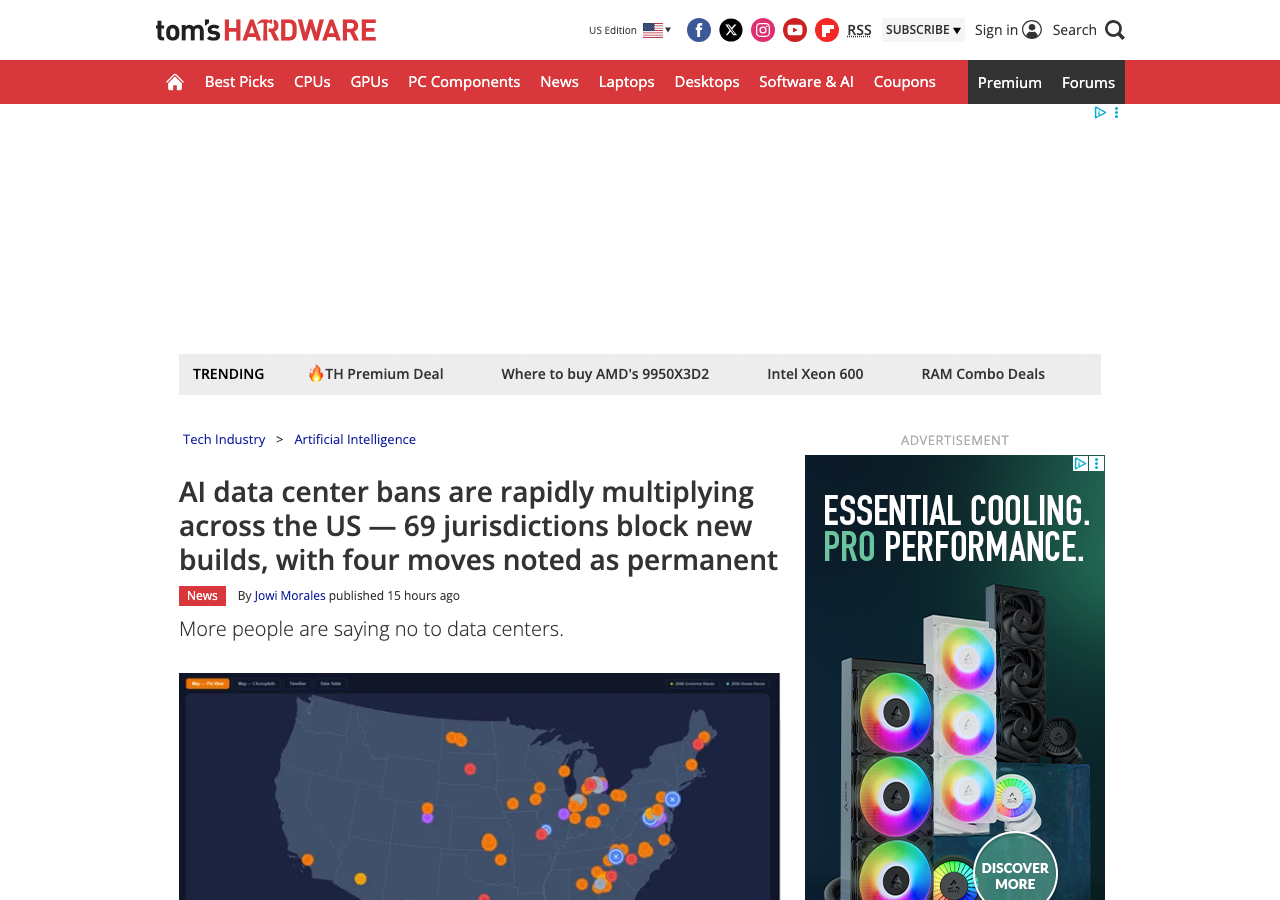
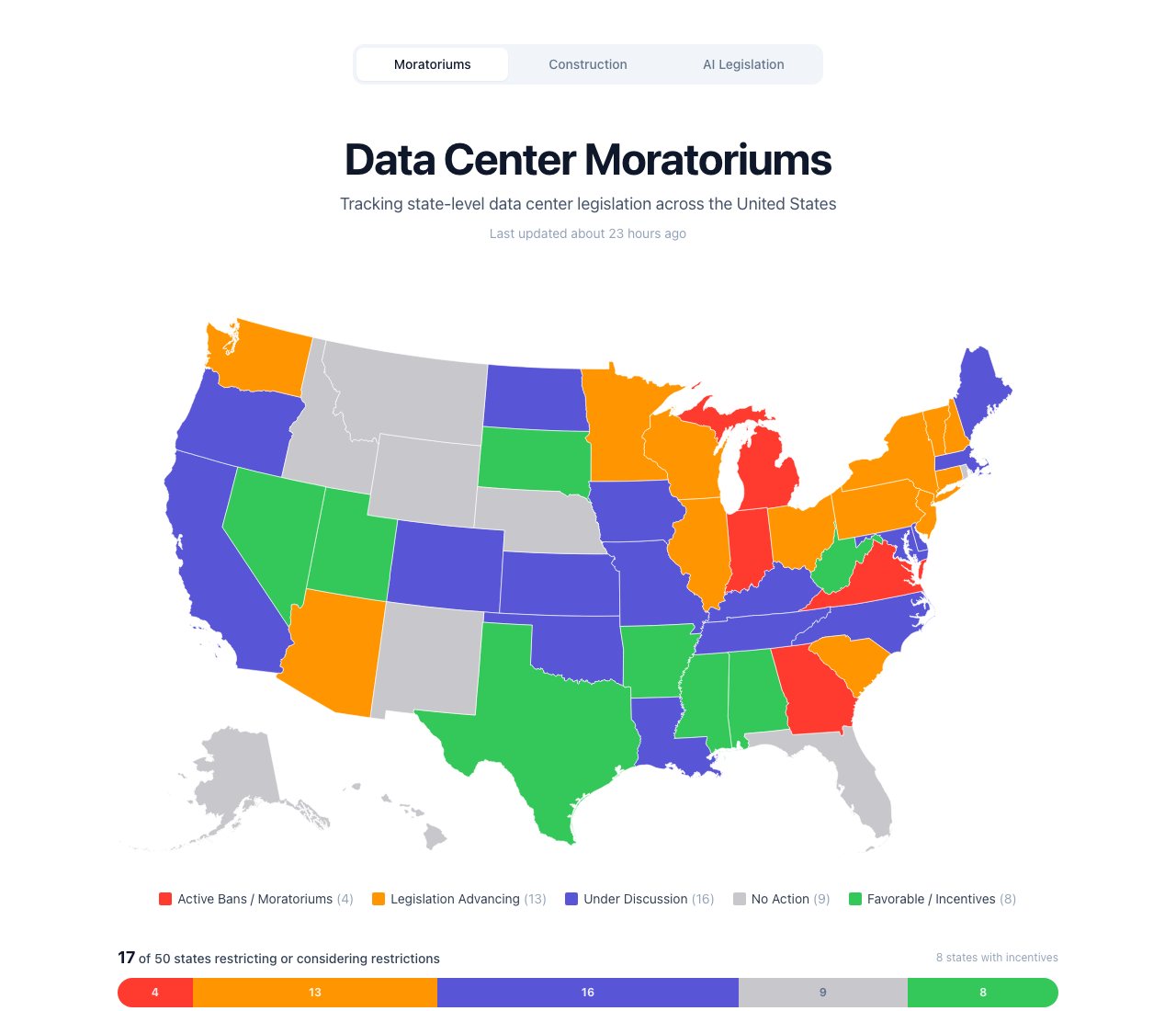
The numbers grew from a baseline of about eight jurisdictions in May 2025 to the current count in twelve months. The acceleration is the story. This is not a steady drift; it is a step-change in the political feasibility of objecting to a data center being sited in your county.
The proximate causes are the same wherever the bans appear:
- Grid strain. A hyperscale AI build can claim 300 MW or more — multiples of what a typical small-city distribution network was provisioned for. Local utilities cannot guarantee residential reliability without preferential capacity for the data center, and the political optics of that tradeoff are unworkable.
- Water use. Cooling at AI-density requires evaporative or potable-water-fed loops at scales that compete with municipal supply.
- Energy cost passthrough. The marginal kWh price under data-center demand affects residential bills directly. The Boston Globe's recent op-ed called the bans "a distraction" — but the political fact is that they are passing.
- Tax-incentive asymmetry. A counties' incentive package brings in fewer permanent jobs than the headline count suggested, and the construction-phase windfall ends within 18 months.
The four permanent bans are the structurally important data point. A temporary moratorium can be lifted; a permanent ban requires legislative reversal. Permanent bans now exist in jurisdictions whose voting demographics are about to be tested in fall 2026 cycles — meaning the political incentive to expand permanent-ban coverage is rising, not falling.
The Maine episode is the precedent operators should keep in mind. On April 29, 2026, Maine's House voted 72–65 and the Senate 20–11 in favor of overriding Governor Janet Mills' veto of what would have been the first statewide data-center moratorium in US history — both falling short of the two-thirds majority needed. The veto held. But the legislative arithmetic is now visible: 72 House members publicly voted to ban AI data centers statewide, in a state with no current AI hyperscale presence, on the basis of the political-cost ledger above.
Layer 4: Polymarket Has Priced It
The market that matters here is Polymarket's "AI data center moratorium passed before 2027". It resolves YES if a qualifying federal moratorium passes into law by December 31, 2026, 11:59 PM ET. The board on May 8 reads 93% YES.
That is not a thinly-traded market. The contract has run through the entire arc of the moratorium debate — Maine veto-override-fail, Oklahoma City's unanimous local moratorium, Senator Sanders' federal AI Data Center Moratorium Act (S.4214) — and it has held above 90% throughout. The +62.7% one-month move is the cumulative repricing.
The structural read is that the prediction market is no longer pricing the political outcome — it is pricing the legislative timing. The question has shifted from "will a federal moratorium pass" to "which session will see the bill cleared." Polymarket's separate "this year" framing is at 85%, meaning the market puts the bill on the floor in the current session at meaningful odds.
The Political-Cost Ledger, Read End-to-End
Stack the three layers and the ledger reads as a single trade:
| Layer | Direction | Magnitude this week | Polymarket equivalent |
|---|---|---|---|
| Capex (Anthropic / SpaceX / xAI Colossus) | Up | $5B/yr, 300 MW deal on Substack day-2 | Implicit in "AI data centers continue to be built" — pricing-relevant only if blocked |
| Mid-stack (Cloudflare 20% cut) | Down on labor, up on revenue | 1,100 jobs cut; revenue +25% YoY | "Cloudflare to outperform" trades available; not flagged as a leading indicator here |
| Floor (69 local bans) | Up | +61 jurisdictions in 12 months; 4 permanent | "AI data center moratorium passed before 2027" — 93% YES |
The dollar-weighted center of the ledger is the top. The political-weighted center of the ledger is the bottom. Polymarket has translated the political weight into a dollar-priced contract. That is the move that locks the read in: when a prediction market with non-trivial liquidity puts a proposition at 93%, the residual uncertainty is no longer about whether, only about when and what shape.
For The Arc of Power's analytic frame — power as a portfolio of constraints, priced by markets that integrate distributed signals — this is a textbook case. The chokepoint here is not geographic (as in Hormuz). It is electoral. But the analytic logic is identical: the resource (compute, energy) flows through a constrained route (siting permission, grid capacity); the constraint is repricing in real time; and the leading indicator is a market — not the press.
What Operators Should Watch Next
Three secondary markets and signals to track over the next 60 days:
- Federal bill movement on S.4214 / equivalent. Sanders' section-by-section reads as a draft positioned to clear committee under the right calendar. Watch for hearings before recess.
- Polymarket movement on "moratorium passed this year." Currently around 85%. Crossing 90% would be the analogous lock-in to the longer-dated contract.
- First non-coastal red-state jurisdiction to enact a permanent ban. The current four permanent bans are clustered geographically. The first time a permanent ban appears outside that cluster — particularly in a state where AI hyperscale capex is currently arriving — the political-cost ledger crosses into investor-thesis territory. Hyperscaler insurance markets reprice from there.
The shape of US AI infrastructure through 2027 is being written this week, and not in San Francisco. It is being written in 69 county clerks' offices, in one Senate bill, and on one Polymarket contract. The capex is locked in. The political cost is locked in. What remains to be priced is the geographic redistribution of the build pipeline — and that pricing will happen on prediction markets first.
Related Coverage
- Hormuz De-Escalation Reprices Energy and Compute Together — the geographic-chokepoint analogue of this week's electoral-chokepoint repricing.
- China–Iran Gambit: Maximum-Pressure Trump and the Hormuz Reprice — the upstream geopolitical context for AI infrastructure siting decisions.
Sources
- Tom's Hardware — 69 jurisdictions block AI data-center builds
- Polymarket — AI data center moratorium passed before 2027
- Polymarket on X — 85% projection for this year
- CNBC — Cloudflare Q1 2026 earnings and 1,100-job cut
- TechCrunch — Cloudflare says AI made 1,100 jobs obsolete
- DataCenterBans.com — Active moratorium tracker
- MarketWise — The Anti-AI Data Center Rebellion is Growing
- Boston Globe — The fight over data centers is a distraction
- Data Center Knowledge — Moratorium: Balancing Energy, Community, Growth
- Senate.gov — S.4214 AI Data Center Moratorium Act, full text
- Senator Sanders — Section-by-Section explainer
The Desk
About The Arc of Power
The Arc of Power editorial desk delivers rigorous analysis of geopolitics, defense, economic statecraft, and intelligence — examining the forces that shape the global order.
Briefing Access
Request Briefing Access
In-depth geopolitical analysis — power dynamics, defense strategy, and economic statecraft — three times a week. No noise.
Request briefing access