Case file · Geopolitics · 12 min read
Amazon Told Towns to Stop Fighting. The Grid Said Otherwise.
Amazon pledged $1B and told towns to stop defying its data centers. Then the grid operator said it can cut them off.
The Arc of Power ·
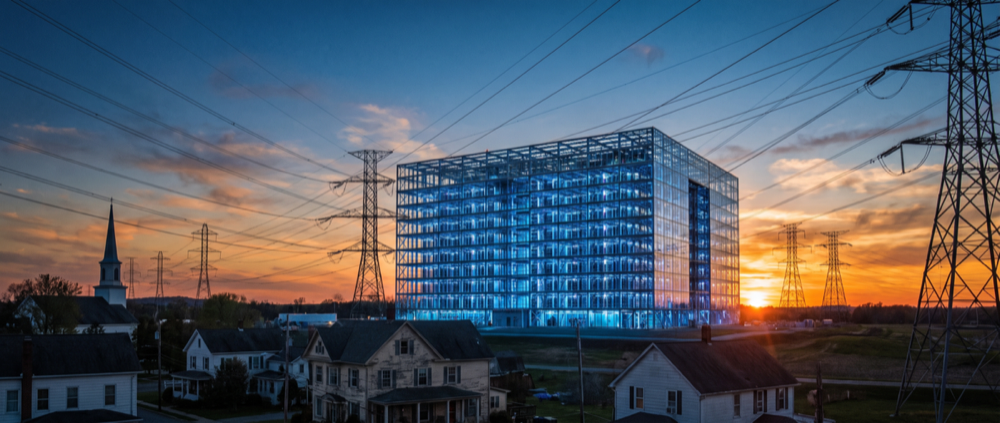
On October 2, 2026, AWS CEO Matt Garman published a 3,100-word memo that mixed concession with threat. Amazon would pledge more than $1 billion over five years to communities hosting its data centers — free community college, job training, home energy upgrades. It would stop using nondisclosure agreements with local officials. It would publish its water and energy use annually. The program is called "Built Together," and it reads like a peace offering.
Then came the other hand. Garman warned that "right now there are over 100 data center moratoriums being considered across the country." He attributed the opposition to "misinformation and outright lies." He framed the backlash as a threat to American competitiveness in the AI race, implying that communities resisting data centers are endangering national security.
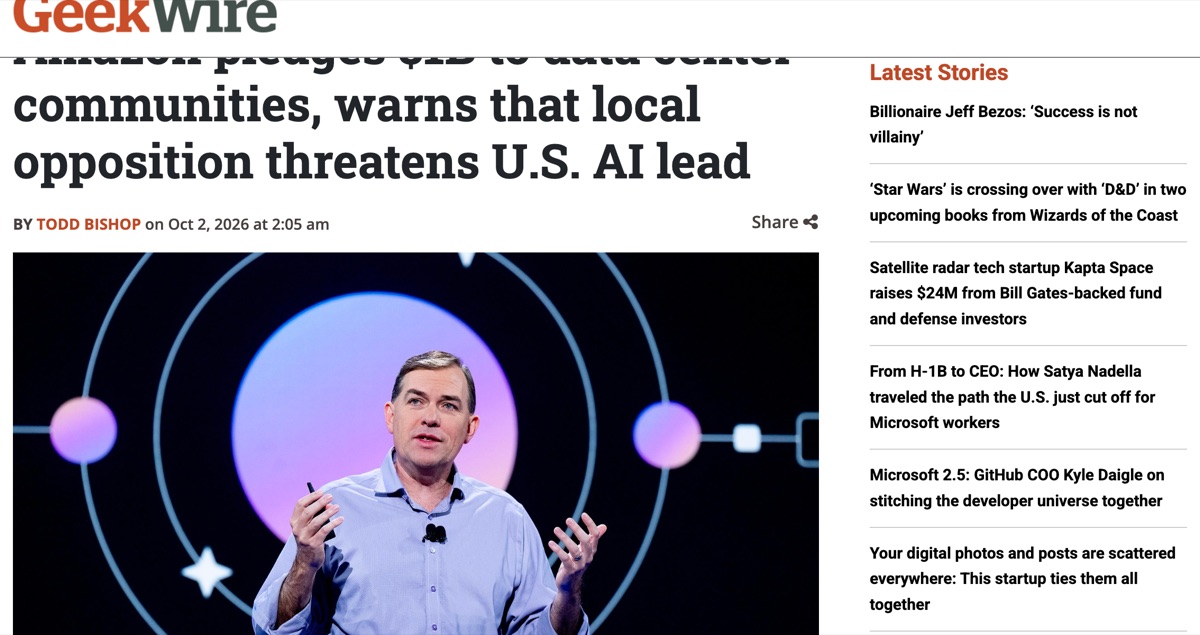
View original article on GeekWire →
The framing is familiar: big capital positions local resistance as parochial and dangerous. But something has changed in 2026. The power dynamics that once favored hyperscalers are inverting — and the inversion is coming from two directions Amazon did not anticipate.
The first is democratic. Voters in Calvert County, Maryland ousted three county commissioners who had supported Amazon's proposed 2.4 million square foot data center campus at the Calvert Cliffs nuclear plant. Amazon withdrew its application. In Falls Township, Pennsylvania, hundreds of residents packed a four-hour town hall demanding answers on electricity bills and pollution. In Walla Walla, Washington, Amazon submitted an incomplete permit application — a tactical retreat disguised as community engagement.
The second is physical. Grid operators — the entities that actually control electron flow — are asserting authority that no amount of capital can override. PJM Interconnection, which manages the grid for 13 states and 65 million people, has proposed cutting power to data centers that fail to secure their own generation capacity during grid emergencies. The Department of Energy has given PJM legal authority to curtail any data center pulling at least 50 MW of peak load. NERC — the continent's grid reliability watchdog — issued its highest-ever alert level in May 2026 after data centers dumped more than a gigawatt of load onto the grid in seconds, leaving operators with no time to respond.
Amazon has capital. What it does not have is guaranteed electrons or democratic consent. That is the power inversion story of 2026.
Three Lessons from the Data Center Rebellion
Lesson 1: Capital Cannot Buy Consent
Amazon's $1 billion pledge amounts to roughly 0.45% of its projected 2026 data center capital expenditure of $220 billion. Stand.Earth called it "a drop in the bucket." The math is instructive: Amazon is offering communities a fraction of a percent of what it plans to spend, while asking them to absorb the full externalities — noise, water consumption, power grid strain, and the aesthetic transformation of rural landscapes into industrial campuses.
Note
Data Center Watch reported that grassroots opposition blocked or delayed 120 data center projects worth nearly $200 billion during the first half of 2026. Active anti-data center groups doubled from 396 at the end of 2025 to 833 by March 2026, spanning 49 states.
The numbers tell a story of deepening resistance. Data Center Watch counted 75 projects worth $130 billion blocked in Q1 2026 alone. By mid-year, the figure had grown to 120 projects worth nearly $200 billion.
Gallup's March 2026 survey found 71% of Americans oppose a data center in their community — more than oppose nearby nuclear power plants. The opposition is bipartisan. Senator Bernie Sanders and Governor Ron DeSantis have both spoken against unchecked data center expansion. This is not a left-right issue. It is a local-versus-distant-capital issue.

View original discussion on Reddit →
The Calvert Cliffs case is the clearest proof that capital cannot override democratic process. Amazon had the money. It had the nuclear power source. It had willing county commissioners. What it did not have was the voters. When the commissioners lost their primaries on June 23, Amazon withdrew its application two weeks before a scheduled moratorium hearing. A Change.org petition against the project collected over 10,000 signatures.
The pattern is repeating. New York imposed the first statewide moratorium on hyperscale data centers in July. Texas Governor Greg Abbott paused new approvals while auditing tax breaks. Seattle's city council voted a one-year moratorium after public outcry — and then Amazon investigated three of its own engineers who testified in favor of the regulations. The engineers filed a civil rights complaint alleging retaliation for protected political speech.

View original article on TechCrunch →
Lesson 2: The Grid Has Its Own Veto
Garman's memo devoted extensive space to debunking what he called myths about data center power consumption. He argued that an aging grid — not data centers — is responsible for rising electricity rates. He pointed to states where rates have fallen despite data center growth.
What Garman did not address is the grid operator's emerging power to physically disconnect his facilities.
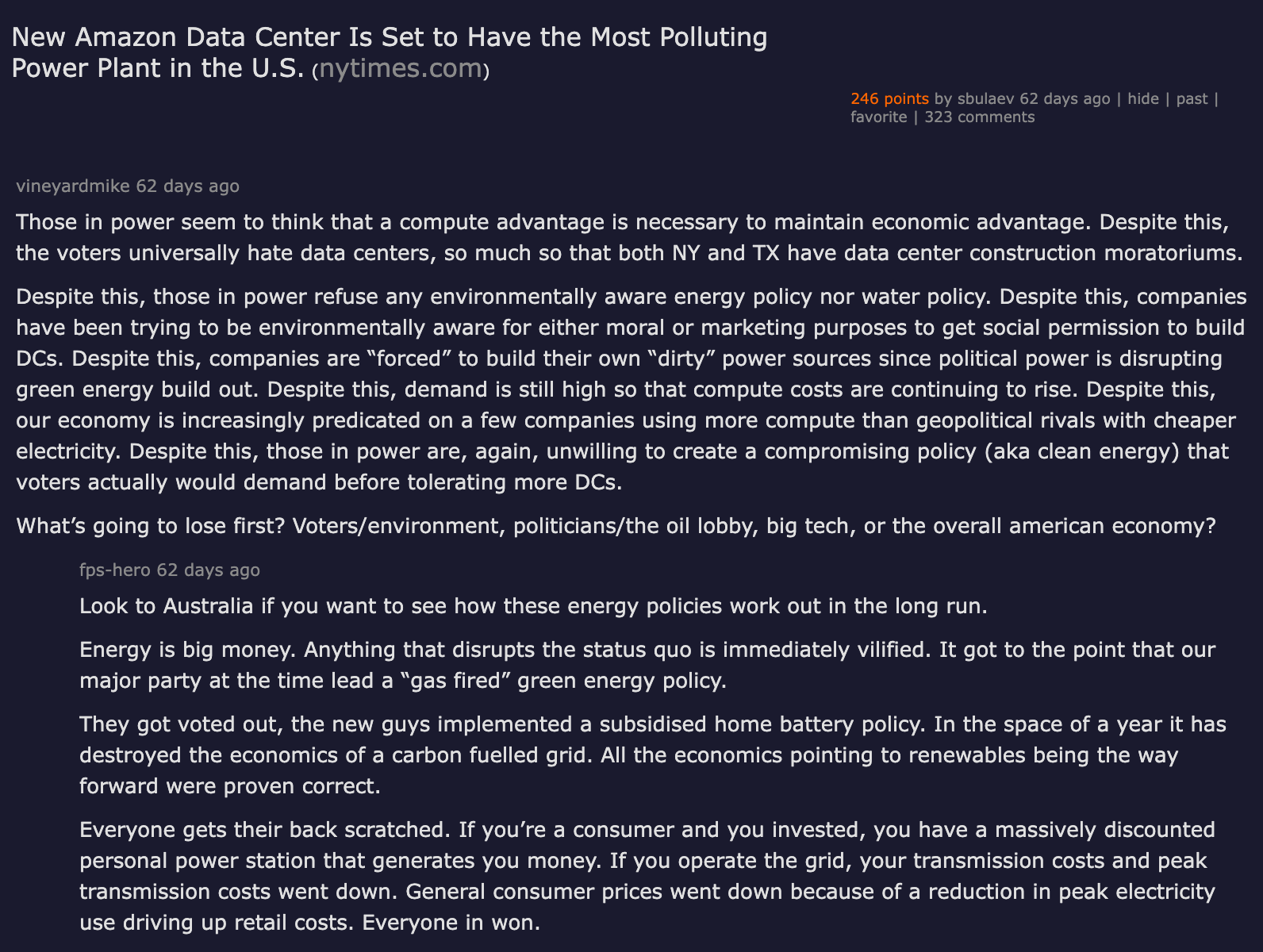
View original discussion on Hacker News →
PJM Interconnection — the grid operator covering data center-dense states from Virginia to Illinois — filed a two-part proposal with FERC in July and August 2026. The first part, a Reliability Backstop Procurement, would spend up to $20 billion on new power plants to serve data center demand. The second, the Interim Resource Adequacy Service (IRAS), would allow PJM to stop power from flowing to data centers that lack their own generation capacity during supply shortages — beginning June 2027.
The context makes the proposal urgent. PJM's July 2026 capacity auction fell 6,831 MW short of its reliability requirement for the 2028/2029 delivery year. Its independent market monitor told CNBC the situation is "at a crisis stage right now. PJM has never been this short."
Note
NERC's Level 3 alert — issued May 4, 2026 — is the highest tier the continent's grid reliability watchdog has ever deployed. It followed incidents where more than 1,000 MW of computational load dropped from the grid in seconds, leaving operators with no time to respond.
In July 2024, a single transmission fault in Northern Virginia caused 1,500 MW of data center load to disappear across 60 interconnection points and 25 substations. In July 2026, more than 3 GW of data center load left PJM after another transmission fault. The grid doesn't care about Amazon's capital expenditure plans. When demand exceeds supply, something gets disconnected.
NERC's response is to treat data centers the way it treats power plants: as entities that must be registered, monitored, and subject to reliability standards. It plans to register computational loads of 20 MW or more — meaning Amazon, Google, and Meta will face the same kind of regulatory oversight as the generators that supply them.
Texas has gone further. The regulator ordered one co-located data center to be capable of curtailing its full load within 30 minutes during grid emergencies, with physical breaker disconnection if necessary. ERCOT cut its demand forecast by 3.7 GW — a 4.6% reduction — specifically because "more data centers can be curtailed."
Amazon knows this is coming. According to The Information, the company developed Project Falcon, an automated system that lets its data centers switch from grid power to backup generators when utilities signal strain — without requiring human intervention. Behind-the-meter power supply is expected to rise from 10-20% of incremental data center demand today to 50-60% by 2030.
But building your own grid is not the same as controlling the public one. And the transition period — while Amazon is still dependent on grid power for most of its facilities — is exactly when the grid operator's veto matters most.
Lesson 3: The Power Triangle Is Unstable
What we are witnessing is the emergence of a three-sided power struggle with no stable equilibrium.
Corporate power (Amazon): $220 billion in planned data center capex. 44 GW of planned capacity. The financial resources to build behind-the-meter generation, lobby legislatures, and offer communities what amounts to a protection payment. The weakness: Amazon needs permission to build, and it needs electrons to operate. It controls neither.
Democratic power (towns and voters): The ballot box and the moratorium. Calvert Cliffs showed that voters can fire the officials who approve data centers. Over 100 moratoriums are under consideration. The opposition is organized, bipartisan, and growing. The weakness: communities also want jobs, tax revenue, and the economic multiplier effects that large employers bring.
Physical power (the grid): The breaker switch. Grid operators have no political constituency and no profit motive in this fight — their mandate is reliability. When NERC says data centers must be curtailable, there is no lobbying or community benefit package that changes the physics. The weakness: the grid itself needs investment, and data center load contracts represent revenue that utilities desperately want.
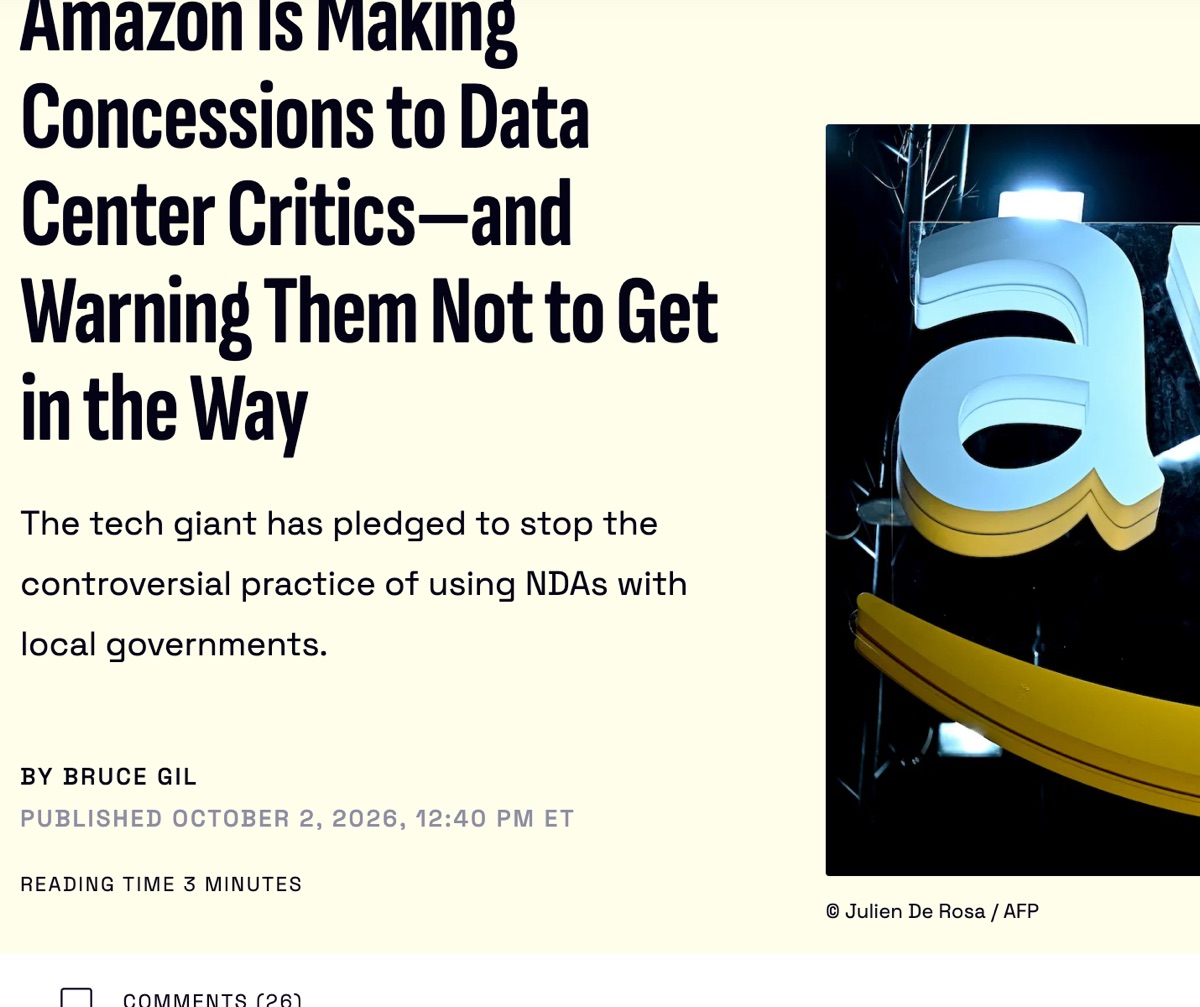
View original article on Gizmodo →
The instability comes from the fact that each actor can block the others but none can compel them. Amazon can offer money but cannot force towns to accept data centers. Towns can impose moratoriums but cannot solve grid reliability. The grid can disconnect data centers but cannot generate the political will to build new transmission lines. Each holds a veto. None holds a majority.
This is fundamentally different from previous corporate-versus-community disputes. When a factory or a mine faces local opposition, the company can often relocate. Data centers are partially location-flexible — but only partially. They need proximity to fiber interconnects, cooling water, and stable power. The places that have all three are precisely the places where opposition is fiercest: Northern Virginia, central Ohio, suburban Texas, the Pacific Northwest.
What the Community Is Saying
The Reddit thread on Amazon's announcement in r/technology drew 8,369 upvotes and 687 comments in under 24 hours. The dominant sentiment was skepticism toward Garman's framing. Top comments noted the gap between Amazon's revenue from these facilities and the $1 billion pledge. Others drew parallels to previous corporate promises to extractive communities.
The Hacker News thread on the NYT investigation into Amazon's Texas power plant — 246 points, 323 comments — focused on the environmental externalities. The facility is permitted to release 33 million tons of CO2 per year, making it potentially the most polluting power plant in the United States. Commenters questioned whether behind-the-meter generation actually solves the grid problem or simply relocates the emissions.
The employee dimension adds another layer. When Seattle's city council held hearings on its data center moratorium, three Amazon engineers testified in favor of the regulations. Amazon subsequently opened investigations into all three, leading to civil rights complaints.
Critical
Contrarian Corner: Amazon's transparency commitments — dropping NDAs, publishing energy and water data, paying to keep local bills flat — are meaningful concessions that no hyperscaler has previously offered. The curtailment threat from grid operators is also largely theoretical: no operator has yet disconnected a hyperscaler during a peak event. The market incentives favor keeping data centers online, since they represent the most reliable and highest-paying load on most grids. The real question is whether Amazon's concessions arrive fast enough to outpace the moratorium movement.
The Road Ahead
NERC's Level 3 alert response deadline was August 3, 2026. PJM's IRAS proposal is pending at FERC. New York's statewide moratorium is in effect. Texas is auditing its tax incentive structure. Amazon's "Built Together" program has not yet distributed any funds.
The next six months will determine whether the three-sided power struggle settles into a workable framework or escalates. The indicators to watch: whether PJM's curtailment authority is approved and exercised; whether Amazon's $1 billion changes any community's vote on moratoriums; and whether behind-the-meter generation actually reduces grid dependence or simply shifts the political fight from electricity to emissions.
The deeper pattern is this: for the first time in the AI infrastructure buildout, the entities with the most capital are not the entities with the most power. Amazon can write a $220 billion check. It cannot make voters approve a rezoning, and it cannot prevent a grid operator from pulling the plug during a heat wave. That is the power inversion. And it is not going away.
This is the fourth in The Arc of Power's series on AI infrastructure politics. Previous coverage: AI Data Center Bans: 69 Jurisdictions, Polymarket 93%, The $965B Bet Needs Power to Run, and When the Grid Says No.
The Desk
About The Arc of Power
The Arc of Power editorial desk delivers rigorous analysis of geopolitics, defense, economic statecraft, and intelligence — examining the forces that shape the global order.
Briefing Access
Request Briefing Access
In-depth geopolitical analysis — power dynamics, defense strategy, and economic statecraft — three times a week. No noise.
Request briefing access