Case file · Geopolitics · 14 min read
The $965B Bet Needs Power to Run
AI's capex supercycle has a chokepoint: local permitting revolts, NDA secrecy, and a grid that can't keep up.
The Arc of Power ·
The $965B Bet Needs Power: Inside the Datacenter Permitting Backlash
The numbers that move capital markets are seductive in their scale. Anthropic's recent S-1 filing implied a $965 billion valuation. The company's compute arrangement with SpaceX reportedly runs at $1.25 billion per month. Microsoft, Google, Meta, and Amazon have collectively committed hundreds of billions to datacenter buildout over the next five years. The prevailing narrative frames this as an unstoppable infrastructure supercycle — sovereign-scale capital deployment chasing an intelligence bottleneck.
What that narrative elides is a chokepoint that no amount of venture conviction can overcome by quarterly deadline: the American power grid, and the communities that live next to it.
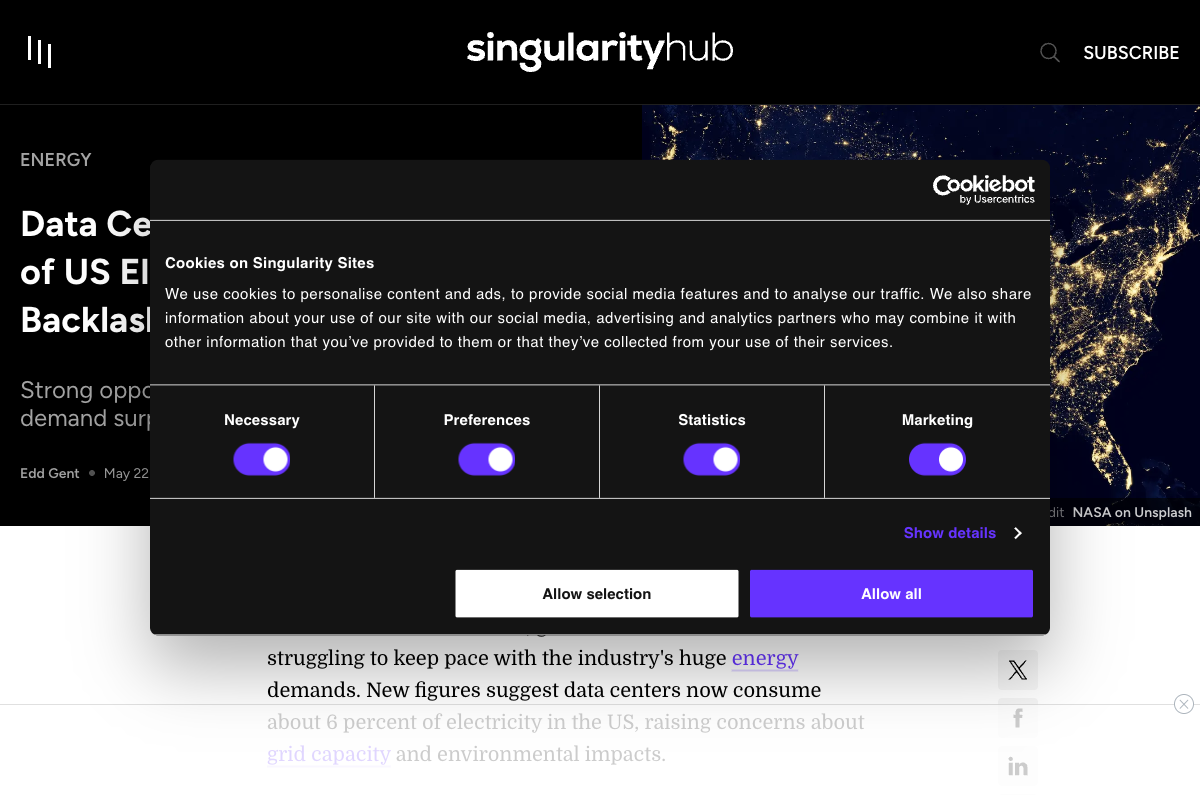
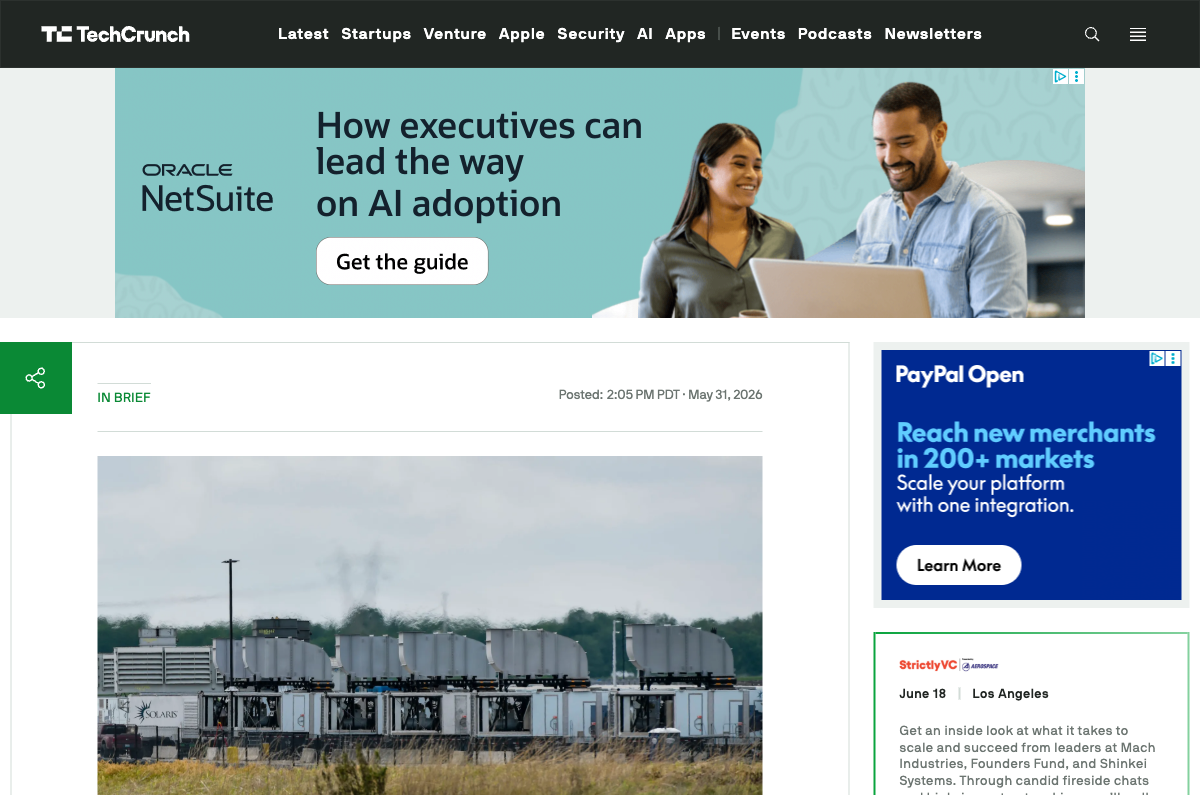
Data centers now consume 6% of all electricity in the United States. That figure, published in May 2026, represents a doubling over five years and a trajectory that the International Energy Agency has called structurally transformative. The IEA's analysis projects that AI workloads alone could add the equivalent of Japan's entire electricity consumption to global demand by 2030. PJM Interconnection — the grid operator covering thirteen states and the District of Columbia — projects a 6 gigawatt supply shortfall by 2027. That is not a rounding error. That is a structural gap between the capital cycle and the physical infrastructure that must support it.
The AI industry has, until recently, treated this as an engineering problem — a matter of interconnection queues, transmission upgrades, and regulatory timelines to be managed at the utility level. What 2026 has revealed is that it is, in fact, a political problem. And political problems have protagonists.
Enter Erin Brockovich
In late May 2026, Erin Brockovich — the environmental activist whose name became synonymous with corporate accountability after the Hinkley groundwater case — launched a public data collection campaign targeting the AI datacenter buildout. The initiative, hosted at brockovichdatacenter.com, invites residents near datacenter sites to submit photographs, complaints, and documentation of what they allege are opaque permitting processes and suppressed community input.
TechCrunch reported that the campaign specifically targets the use of non-disclosure agreements in local permitting deals — arrangements in which municipal governments agree to confidentiality provisions that prevent them from publicly disclosing the terms under which land use approvals, tax abatements, and utility agreements are granted to datacenter developers. Brockovich characterized these arrangements as communities being "steamrolled" by capital interests operating through legal instruments designed to suppress civic deliberation.
Within days, Newsweek reported that more than 6,000 photographs had been submitted to the campaign's interactive map. That is a data point worth dwelling on. Six thousand submissions is not a fringe movement. It is a distributed intelligence network — exactly the kind of organic, decentralized organizing that precedes legislative action.
The symbolism is deliberate and precise. Brockovich is not a random celebrity attaching herself to a cause. She is an icon of the specific story that datacenter opponents want to tell: a corporation with asymmetric legal and financial resources, operating with official sanction, extracting value from a locality while externalizing costs onto residents who lack the tools to resist. Whether or not that framing survives scrutiny in every specific case, it is the framing that shapes legislation. And legislation is already moving.
The Legislative Surge
The scale of state-level legislative activity in 2026 represents one of the more significant regulatory inflection points in the history of American technology infrastructure — and it has received almost no sustained attention in the capex-cycle coverage that dominates the financial press.
MultiState's tracker documents more than 300 datacenter-related bills introduced across more than 30 states in the first quarter of 2026 alone. The bills span a wide range: mandatory environmental impact assessments, water usage disclosure requirements, setback rules from residential zones, grid impact fees, and, in the most aggressive cases, outright construction moratoria.
Maine is the leading edge. A Hacker News thread tracking the Maine legislation documents the state's movement toward becoming the first jurisdiction in the United States to implement an effective construction moratorium on large-scale datacenters — a policy that, if it survives legal challenge, will establish a precedent with national implications. Maine's position is geopolitically significant: the state has surplus hydroelectric capacity and relatively cool ambient temperatures, making it an attractive location for hyperscale operators. The moratorium, if it holds, signals that even favorable physical infrastructure does not guarantee a permissive regulatory environment.
The aggregate effect is not yet a national ban. But researchers tracking the opposition at Harvard's Gazette note that the distributed nature of the resistance — hundreds of local and state campaigns rather than a single federal movement — creates a permitting environment that is structurally more difficult to navigate than a unified regulatory regime. A single federal framework, however onerous, can be litigated, lobbied, and eventually resolved. Three hundred state bills and an unknown number of local zoning disputes cannot be.
Public opposition has been heating up since at least early 2026, with community groups from Virginia's data center alley to rural Georgia organizing against proposed facilities. The Project Sail development in Georgia became a case study in how opposition can coalesce rapidly around concerns about noise, water, and grid impact — even in states with historically permissive development environments.

The Grid Is Not an Abstraction
The energy argument is where the politics connect to the physical reality most directly, and where the capex narrative is most vulnerable.
Consumer Reports published an analysis in 2026 documenting the mechanism by which datacenter load growth translates into higher residential electricity bills. The logic is straightforward: utilities must invest in generation and transmission capacity to serve new large industrial customers. Those investments are capitalized and recovered through rate base — meaning existing ratepayers subsidize the infrastructure buildout required to serve the new load. In markets where utilities operate as regulated monopolies, there is no opt-out mechanism for residential customers.
This is not a theoretical concern. Common Dreams documented utility commission proceedings in multiple states where consumer advocates have intervened to challenge cost allocation proposals that would shift datacenter interconnection costs onto residential ratepayers. The interventions have had mixed success, but they have introduced procedural friction — and procedural friction, in regulated utility markets, translates directly into timeline delays.
The electricity consumption disparity that underlies the politics is stark. A single AI inference task — the kind of computation that generates a paragraph of text or analyzes an image — consumes approximately 1,000 times more electricity than a conventional web search. That figure, widely cited in energy policy discussions, is the physical reality beneath the demand projections. It is also the number that makes community opposition coherent rather than reflexive: the infrastructure being built is not equivalent in its grid impact to previous generations of internet infrastructure.
The Hill's analysis frames the emerging dynamic as a genuine grid crisis — not in the catastrophist sense of imminent blackouts, but in the sense of a structural mismatch between load growth and the policy frameworks designed to manage it. Transmission infrastructure that took decades to build cannot be upgraded in the three-to-five year windows that AI infrastructure investment cycles assume.
The NDA Mechanism as Power Architecture
The non-disclosure agreement dimension of the datacenter permitting backlash is underreported and analytically important.
The use of NDAs in economic development is not new. Municipal governments routinely agree to confidentiality provisions in negotiations with large employers — the logic being that premature disclosure would allow competitors to outbid the locality, or would trigger opposition that would kill a deal before its benefits could be demonstrated. Amazon's HQ2 site selection process, which involved confidential proposals from over 200 cities, normalized this approach at scale.
What the AI datacenter buildout has done is apply this mechanism to a category of infrastructure with significantly different community impact profiles than a corporate headquarters. A headquarters employs thousands of people and generates visible economic activity. A hyperscale datacenter employs dozens of permanent staff, draws enormous amounts of power and water, and generates noise and heat — while the economic benefits flow primarily to the developer and to tax revenues that may or may not offset the externalized costs.
When Brockovich characterizes communities as being "steamrolled" through NDA deals, she is identifying a structural feature of the negotiating environment: municipalities desperate for tax revenue are incentivized to accept confidentiality provisions that prevent them from consulting their own residents. The residents discover the terms of the deal, if at all, through construction permits and utility filings — at a point when opposition requires overturning an already-concluded agreement.
This is a power dynamics story in the precise sense. The NDA mechanism converts what should be a public deliberation about land use and infrastructure into a bilateral negotiation between a well-resourced private actor and a local government operating under information asymmetry and fiscal pressure. The Brockovich campaign is attempting to create a countervailing information infrastructure — a distributed map of grievances that gives the opposition a data asset comparable to what the developers have.
The Utah Signal
CNN's reporting on Kevin O'Leary's datacenter venture in Utah is instructive as a case study in how the opposition has evolved tactically.
O'Leary — the venture capitalist and television personality — positioned the Utah project as a model of responsible AI infrastructure development, emphasizing job creation and tax revenue. Local opposition organized not around categorical anti-technology sentiment but around specific, quantified concerns: water consumption projections, grid interconnection costs, and the adequacy of the environmental review process. The opposition secured legal standing and procedural delays.
The tactical evolution matters. Early datacenter opposition was often characterized by generalized anxiety about technology or property value concerns that were easy to dismiss as NIMBYism. The 2026 opposition is increasingly sophisticated — organized by people who have read the utility filings, engaged engineers to contest the grid impact analyses, and secured legal representation capable of sustaining regulatory proceedings. This is the difference between a protest and a chokepoint.
Hacker News threads tracking datacenter build-out delays document the aggregate effect: an estimated $98 billion in datacenter projects blocked or delayed in 2025. That figure, if accurate, represents a material constraint on the capex cycle — not because any single project was blocked definitively, but because the cumulative friction of permitting delays, litigation, utility proceedings, and legislative uncertainty has extended timelines in ways that compound across a portfolio.

The Capex Narrative's Blind Spot
The financial press coverage of AI infrastructure investment has a consistent structural blind spot: it treats the supply of power and permits as a derived variable — a function of capital deployment and regulatory lobbying — rather than as an independent constraint with its own political dynamics.
This framing made sense in a period when datacenter development was a niche industrial activity with limited community visibility. It no longer maps to reality. The communities adjacent to proposed datacenter sites are now organizing before groundbreaking, not after. State legislators are introducing bills in the first quarter of legislative sessions rather than as reactive measures. Environmental advocates with national profiles and established legal infrastructure are training their attention on the sector.
The $965 billion valuation implied by Anthropic's S-1 is a claim on future compute capacity. That compute capacity requires physical infrastructure. That physical infrastructure requires power, water, land, and permits. All four of those inputs are now subject to political contestation at a scale that the capital cycle did not price in when the commitments were made.
This connects to the broader analysis we've examined in the AI datacenter bans across 69 jurisdictions — a trend that was legible in the data well before it became a mainstream infrastructure story. The permitting backlash is not a temporary friction cost to be modeled as a discount rate adjustment. It is a structural feature of a political economy in which the costs and benefits of AI infrastructure are distributed asymmetrically across geography and income.
Critical
The scorecard: $98 billion in datacenter projects blocked or delayed in 2025. 300+ state bills in 2026. Maine poised for the first construction moratorium. 6,000+ citizen photos mapped. The permitting revolt is no longer a risk factor in a footnote — it is a material constraint on the AI capital cycle.
Who Gains, Who Loses, What Moves
The permitting chokepoint creates a set of second-order dynamics worth tracking.
Geography as strategic asset. States and localities with permissive regulatory environments, surplus renewable power, and water access become disproportionately valuable. The scramble for favorable jurisdictions — already visible in the concentration of datacenter investment in Virginia, Texas, and Iowa — will intensify as the legislative environment in other states tightens. This is a form of regulatory arbitrage that creates winners and losers at the state level.
Utility leverage. The grid operators and regulated utilities that control interconnection access are in an increasingly powerful negotiating position. Their timelines determine project schedules. Their cost allocation decisions determine the political sustainability of individual projects. The utilities that serve the largest datacenter markets are, in effect, chokepoint operators — and they are beginning to act accordingly.
Opposition consolidation. The Brockovich campaign is an early indicator of a trend: the consolidation of dispersed local opposition into national networks with shared data, legal strategy, and public profile. As the Harvard Gazette analysis notes, this consolidation dramatically increases the sophistication and staying power of the opposition.
The federal question. The current administration has signaled support for AI infrastructure investment as a matter of industrial policy. But federal support for development does not override state and local permitting authority in most circumstances. The tension between federal AI policy ambitions and state-level legislative resistance is likely to produce preemption battles — legal and political contests over which level of government controls the decisive regulatory variables.
The Real Constraint
The AI capital cycle is built on an assumption: that the inputs to compute — power, cooling, land, permits — are essentially commodities that can be acquired at scale if the capital is available. The permitting backlash of 2026 is stress-testing that assumption in real time.
What Brockovich's campaign, Maine's moratorium, and 300-plus state bills collectively represent is the emergence of political agency in communities that were previously treated as passive recipients of infrastructure decisions made elsewhere. That political agency is now a variable in the financial model — and it is not trending in a direction that supports the timelines embedded in the $965 billion valuation.
The chokepoint is not the technology. The chokepoint is the permission structure — legal, political, and social — within which the technology must be built. And permission, unlike capital, cannot be manufactured at scale by entities with strong balance sheets. It must be negotiated, community by community, commission by commission, with populations that are increasingly aware of their leverage and increasingly organized to use it.
The $965 billion bet is real. So is the power it needs. The question that the capex narrative has not yet answered is who, exactly, is going to be asked to provide it — and on what terms.
The Desk
About The Arc of Power
The Arc of Power editorial desk delivers rigorous analysis of geopolitics, defense, economic statecraft, and intelligence — examining the forces that shape the global order.
Briefing Access
Request Briefing Access
In-depth geopolitical analysis — power dynamics, defense strategy, and economic statecraft — three times a week. No noise.
Request briefing access