Case file · Geopolitics · 12 min read
US-Iran Talks This Week: What the Money Already Prices
Polymarket prices Iran ceasefire at 96% for September but 56% for October. Oil futures, defense stocks, and prediction markets reveal what headlines miss.
The Arc of Power ·

On Sunday, Trump told Axios he expects US negotiators to resume indirect talks with Iran this week. Qatari mediators will hold separate meetings with Iranian Foreign Minister Abbas Araqchi and the US side on Monday or Tuesday. The headlines frame this as diplomacy in motion. But the prediction markets, oil futures, and defense equities are telling a different and more precise story: this week's talks are a ceasefire maintenance exercise, not a breakthrough event — and the money is pricing a hard cliff just weeks away.
The Polymarket US-Iran ceasefire contract — the most-traded geopolitics market on the platform this week at $341,000 in 24-hour volume — prices the ceasefire holding through September at 96%. Through October: 56%. Through November: 38%. That 40-point drop between September and October is the single most important number in geopolitical risk pricing right now, and almost nobody in the headline press is talking about it.
The Three Markets and What They Say Together
The mistake most analysts make is reading prediction markets, energy futures, and defense equities as separate signals. They are not. They are three instruments pricing the same underlying variable: the probability that the US-Iran ceasefire survives the quarter. Read together, they tell a coherent story that the headline coverage — "talks resuming" versus "Trump rejects proposal" — cannot.
Prediction Markets: The September-October Cliff
Polymarket's ceasefire-continuation contract is the cleanest expression of informed sentiment available. With $4.7 million in total volume and $421,000 in liquidity, it is liquid enough to resist casual manipulation and deep enough to reflect genuine conviction. The numbers as of September 28:
- September: 96% (+9.3% this week)
- October: 56%
- November: 38%
That structure — near-certainty in the present, coin-flip at one month, and minority odds at two months — is the market saying: the ceasefire survives this round of talks but may not survive the next provocation. This is not pessimism. It is a precise pricing of the gap between the current diplomatic infrastructure (fragile, mediated, built on expired memoranda) and the unresolved structural issues (Hormuz, nuclear program, sanctions architecture) that have broken every prior framework.
A second market adds texture. The "Where will the next US-Iran senior diplomatic meeting take place?" contract surged +17% today, with 54% now pricing a specific venue (likely Oman's Salalah, based on reporting from The National). That is the market saying talks will happen — but it sits alongside the October cliff, which says the talks will not produce enough to stabilize the ceasefire beyond the near term.
Note
The prediction-market read: Traders are pricing talks that prevent immediate collapse, not talks that produce a deal. The diplomatic meeting-location market going up while the October ceasefire contract stays flat is the market distinguishing between "they will sit down" and "they will agree on anything."
We have tracked this pattern before. When Reddit was pricing war and Polymarket was pricing peace in August, the market was right — the ceasefire held. But this time the market itself is split: near-term confidence, medium-term doubt. That internal divergence is more informative than any single probability.
Oil Futures: The $105 Warning
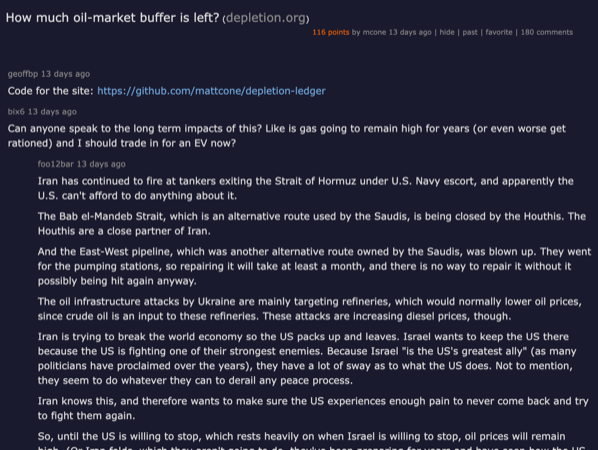
Crude oil moved immediately on Trump's rejection of Iran's seven-day Hormuz proposal. Brent closed at $105.28 after touching $108.83 intraday. WTI settled at $92.60, having spiked to $96.54. These are not panic levels — panic was the $88% spike when the blockade first tightened. But they are significantly above the $85-90 range that prevailed during the brief period when Hormuz partial reopening seemed plausible.
What the oil market is pricing is subtle. The spike from $100 to $105 on the proposal rejection was a risk premium restoration, not a supply disruption. The Strait of Hormuz remains effectively closed, as it has been since the blockade framework tightened. What briefly compressed the risk premium was the possibility that Iran's seven-day offer might lead to partial reopening. Trump's rejection removed that possibility, and the premium returned.
The more important oil signal is what did not happen. Brent did not break $110. It touched $108.83 and retreated. That ceiling tells us the market does not believe the ceasefire is about to collapse — if it did, we would see crude testing the $115-120 range that prevailed during the active-hostility phase earlier this year. The oil market agrees with Polymarket: the ceasefire holds for now, but the underlying risk premium remains structurally elevated because Hormuz stays closed.
Defense Equities: The Stalemate Trade
Defense stocks are the third instrument, and they tell the most nuanced story. On September 22, when reports surfaced that Iran had offered to reopen Hormuz, Lockheed Martin and RTX each dropped 3%. Boeing dipped alongside them. When Trump rejected that offer days later, the stocks recovered.
But zoom out. Lockheed Martin is still up approximately 40% year-to-date, driven by Iran-war demand. RTX carries a record backlog of $289 billion. Northrop Grumman gained 4.1% on the day the war's first major strikes launched. The THAAD interceptor production line has been quadrupled from 96 to 400 units per year at $12.77 million per interceptor.
What defense equities are pricing is not war or peace. They are pricing stalemate — a condition where the ceasefire nominally holds, Hormuz stays closed, and the US military maintains its forward-deployed posture in the Gulf. This is the most expensive state for the defense budget and the most profitable for defense contractors. A genuine peace deal would collapse these valuations. A return to active hostilities would create short-term spikes but long-term supply-chain uncertainty. The current stalemate is the Goldilocks scenario for defense stocks, and the money knows it.
Critical
The contrarian bet: RTX has shed 10% and LMT 7% over the past month as ceasefire optimism crept in. If this week's talks produce even a symbolic Hormuz gesture — a single escorted tanker transit, a 48-hour navigation window — defense stocks drop another 5-8% while the Polymarket October contract reprices upward toward 70%. The midterm political calculus also favors this: Trump cannot afford $105 oil into November elections. The money is underpricing the probability that Trump settles for a cosmetic deal that lets him claim victory while kicking the structural issues past the midterms.
Four Lessons from the Money Flow
1. The Ceasefire Is a Process, Not a State
The biggest misconception in the headline coverage is treating the ceasefire as binary — it either holds or it does not. The prediction markets understand something more sophisticated: the ceasefire is a continuously maintained process that requires regular diplomatic inputs to prevent decay. The June 17 Memorandum of Understanding expired without extension. The April framework collapsed after the Islamabad Talks failed. What is keeping the ceasefire alive right now is not an agreement but a rhythm of engagement — talks in New York last week, talks via Qatari mediators this week, and an expected meeting in Oman within days.
The 96%/56%/38% cliff is the market pricing the probability that this rhythm continues. September is near-certain because the talks are actively happening. October drops because the rhythm depends on follow-through that both sides have historically failed to sustain. November drops further because by then, the window for pre-midterm deal-making will have closed and the domestic political incentives for compromise will evaporate.
2. Hormuz Is the Swing Variable
Every market we are tracking — prediction contracts, oil futures, defense equities — pivots on the same underlying question: does the Strait of Hormuz reopen? Iran's rejected proposal was specifically about Hormuz. The oil risk premium is specifically about Hormuz. Defense stocks dropped specifically on a Hormuz reopening rumor. This is not one factor among many. It is the variable.
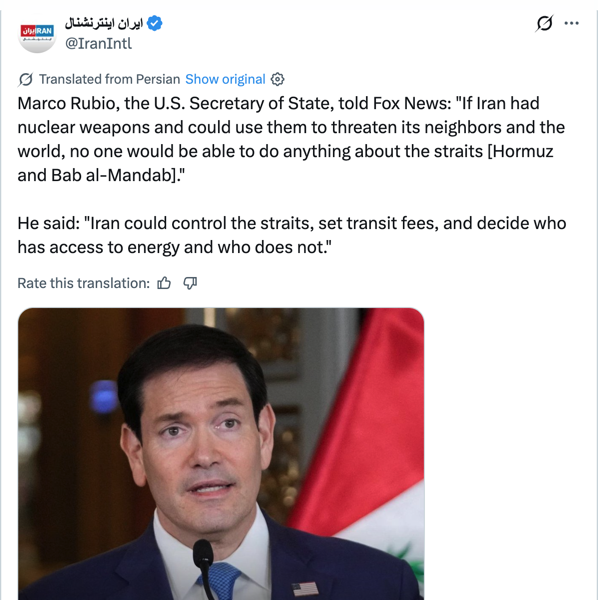
Secretary of State Rubio's framing is revealing: he links Iran's nuclear program directly to Hormuz leverage. The implication is that the US views denuclearization and Hormuz reopening as a package — Iran cannot trade one without conceding the other. This is precisely why the October prediction market is at 56% rather than 80%: the structural issues are too deeply entangled for a single round of indirect talks to resolve.
We have covered this dynamic extensively. The Hormuz toll doctrine analysis showed how the blockade created a new pricing regime for Gulf transit. The ceasefire-built-on-sand analysis documented the structural fragility that persists beneath every diplomatic gesture.
3. The Midterm Clock Is the Hidden Variable
The headline coverage focuses on diplomatic logistics — who meets where, which mediator carries which proposal. The markets are pricing something the diplomatic press mostly ignores: the US midterm elections on November 3.
Al Jazeera's framing captures the tension: Trump is simultaneously threatening to "annihilate" Iran at the UN General Assembly and telling Axios he expects talks this week. This is not incoherence. It is a dual-track strategy driven by the midterm calendar. The threats are for the base. The talks are for the gas price.
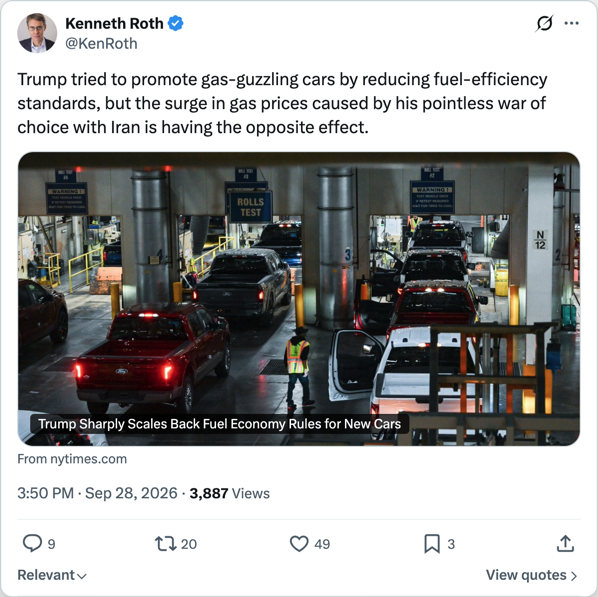
Ken Roth's observation lands the point: the Iran war's domestic cost is showing up at the pump, and voters notice gas prices more than geopolitical strategy. With Republicans already distancing themselves from Trump as private polls signal midterm trouble, the incentive structure for a deal — even a cosmetic one — grows stronger every day oil stays above $100.
This is why the Polymarket ceasefire contract shows such a sharp cliff between September and November. The money understands that Trump's willingness to negotiate is a function of the electoral calendar, and that calendar expires in five weeks.
4. The Insider-Trading Shadow
One signal the prediction markets carry that no other instrument does is the insider-trading footprint. Earlier this year, traders placed over $1 billion in suspiciously well-timed bets on ceasefire outcomes, with newly created accounts winning big on precisely timed positions.
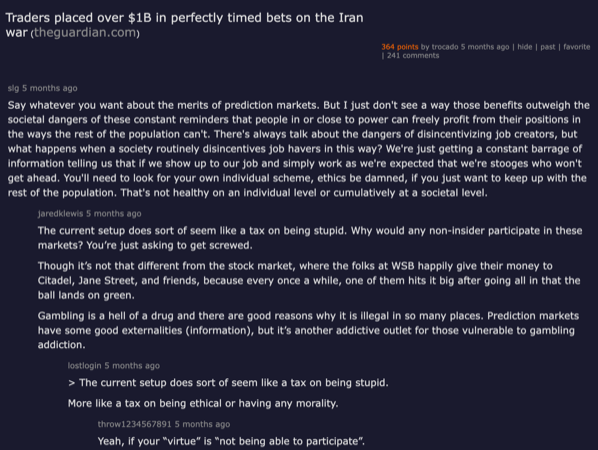
This matters for interpreting this week's market movements. The +9.3% weekly gain in the September ceasefire contract and the +17% daily surge in the diplomatic-meeting-location contract are large moves. If those moves are driven by informed participants who know the talks will proceed, the signal is stronger than if they reflect retail sentiment following the Axios headline. We cannot know for certain, but the pattern — large moves immediately before confirmed diplomatic events — is consistent with the informed-trader hypothesis.
What to Watch This Week
The money has already placed its bets. Here is what to watch to see if it is right:
If the October ceasefire contract rises above 65%: The talks produced a framework — likely a partial Hormuz concession or a timeline for renewed nuclear inspections. This is the bull case for oil consumers and the bear case for defense stocks. Watch for LMT and RTX to drop 3-5% and Brent to test $95.
If the October contract drops below 45%: The talks collapsed or produced nothing. The ceasefire's expiration clock is now audible. Oil tests $110+, defense stocks rally, and the November contract approaches 25%. At that point, the market is pricing ceasefire failure before year-end.
If nothing moves: That is the stalemate scenario the defense stocks are already pricing. The ceasefire continues on inertia without structural progress. Oil stays in the $100-108 band. Defense backlogs grow. And the most expensive outcome — indefinite standoff — becomes the baseline.
The talks are this week. The money has already voted. Now we find out if the diplomats read the same odds the traders do.
For earlier prediction-market analysis on Iran, see our coverage of the crowd-vs-market divergence, the insider-trading footprint, and the ceasefire's structural fragility.
The Desk
About The Arc of Power
The Arc of Power editorial desk delivers rigorous analysis of geopolitics, defense, economic statecraft, and intelligence — examining the forces that shape the global order.
Briefing Access
Request Briefing Access
In-depth geopolitical analysis — power dynamics, defense strategy, and economic statecraft — three times a week. No noise.
Request briefing access