Case file · Geopolitics · 15 min read
AI's Approval Crash Reaches the Ballot Box
A new ABC/Post/Ipsos poll shows 57% call AI bad for society. With 34 ballot measures pending, the backlash is now an election.
The Arc of Power ·
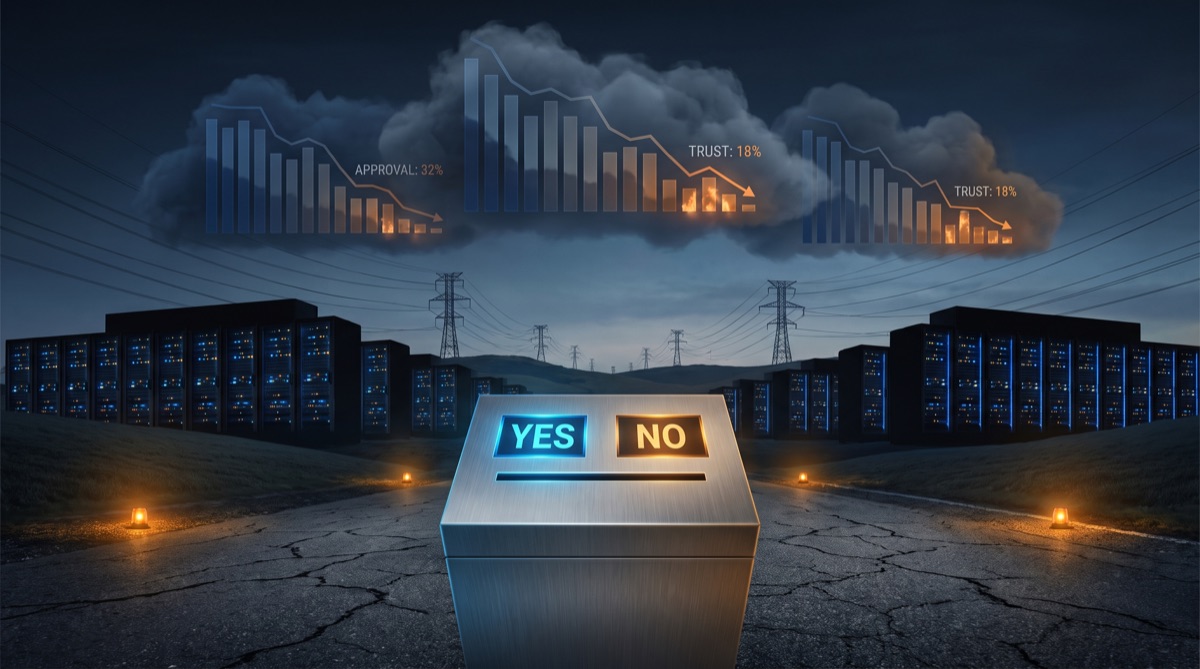
The numbers arrived on the morning of October 21, and they should make every AI infrastructure investor recalculate. An ABC News/Washington Post/Ipsos poll of 2,545 U.S. adults — conducted October 9-13, margin of error plus or minus two points — finds that 57% of Americans now say artificial intelligence is bad for society. Only 42% say it is good. And when asked about the physical infrastructure that makes AI run, the rejection is even sharper: 66% oppose building new data centers nationally, and 72% oppose one in their own community.
This is not a fringe position. It is not a NIMBY footnote to an otherwise bullish AI capex story. It is a majority sentiment, with a bipartisan base, arriving two weeks before an election in which 34 data center ballot measures will be decided by voters. The backlash has left the town hall. It is now on the ballot.
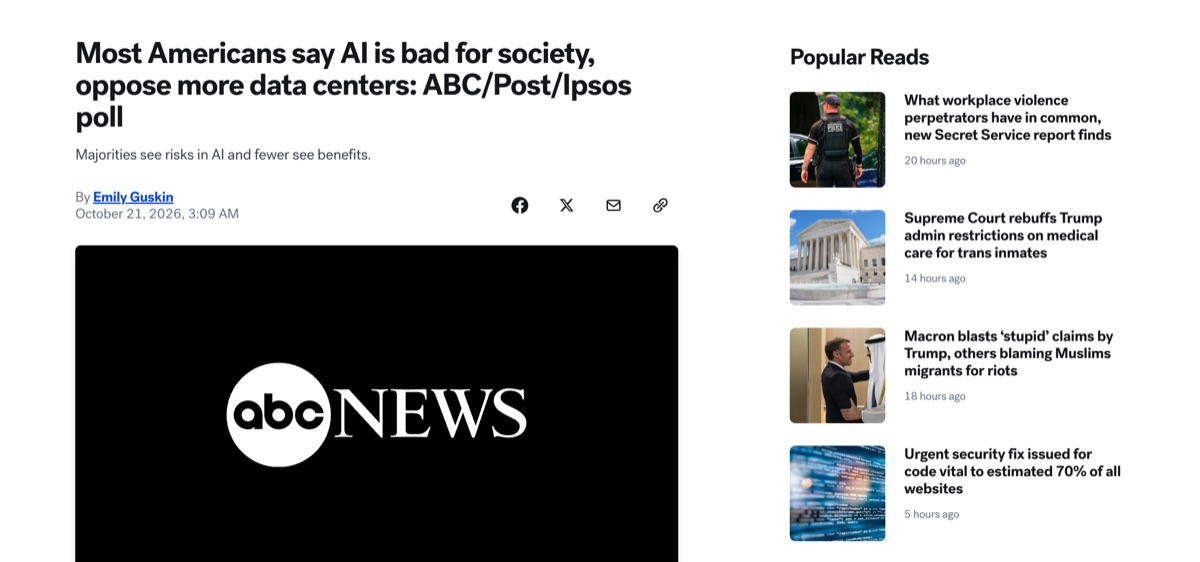
View original article on ABC News →
This column has tracked the data center fight from its early-2026 escalation through the 69-jurisdiction ban count, the grid-strain wall, and the permitting backlash. Today's poll is the first major national survey to link negative AI sentiment directly to opposition to physical infrastructure — and it turns what was a local zoning dispute into a measurable, cross-partisan electoral force.
The Numbers That Matter
The ABC/Post/Ipsos data is the most comprehensive public snapshot of American AI sentiment to date, and its structure reveals something the headline misses: the opposition is not uniform — it is layered, and each layer has different political implications.
Layer 1: The Societal Verdict. Fifty-seven percent say AI is bad for society, versus 42% who say good. The intensity gap is stark: 17% say "extremely bad" while only 2% say "extremely good." Americans who feel strongly about AI overwhelmingly feel strongly against it.
Layer 2: The Personal Split. When asked whether AI is good or bad for them personally, the country is almost exactly divided: 50% good, 49% bad. This is the pivot on which every political campaign will turn. People who think AI is abstractly harmful but personally useful are persuadable. People who think it is both are not.
Layer 3: The Partisan Asymmetry. Democrats (63%) and independents (58%) are solidly negative on AI's societal impact. Republicans are nearly evenly split — 51% good, 47% bad. But here is the line that should alarm Republican strategists: on data centers specifically, 58% of Republicans oppose local construction. Among Democrats, it is 81%. Among independents, 76%. The GOP has a base that is narrowly pro-AI but broadly anti-data-center. That is an extremely difficult position to campaign on.
Layer 4: The Generational Inversion. Eighty percent of adults under 30 oppose a data center in their community — the highest of any demographic group. Among those 65 and older, it is 69%. The usual pattern in technology adoption, where youth embraces and age resists, is inverted. The generation that grew up with AI is the most hostile to its physical footprint.
Note
The ABC/Post/Ipsos poll is not an outlier. A PBS/NPR/Marist poll from September found 65% oppose local data centers. A Gallup survey in May put it at 71%. An NYT/Siena poll recorded 61% opposition to new facilities. Five major polls in six months have converged on the same conclusion: roughly two-thirds of the country does not want a data center nearby.
Three Lessons the Polls Teach
Lesson 1: Opposition Is a National Sentiment, Not a Local Reaction
The standard industry narrative frames data center resistance as hyperlocal: residents near a proposed site oppose it because of noise, water, or electricity costs. The polls destroy this reading. Opposition is equally high in cities (69%), suburbs (72%), and rural areas (78%), according to the ABC/Post/Ipsos data. A PBS NewsHour segment noted that only 8% of opponents say they know of a data center near their home. Americans are opposing data centers they have never seen.
This is not NIMBYism. It is a nationwide judgment about AI's trajectory — expressed through the most tangible thing voters can point to. As Tom Wheeler argued in a Brookings commentary, data centers have become "a stand-in for public anxiety about jobs and daily life" under AI. They are the physical face of a technology most people cannot otherwise confront. You cannot vote against a language model. You can vote against a zoning permit.
Lesson 2: The Partisan Truce Is Real — and Exploitable
The bipartisan nature of data center opposition is the most politically significant finding in the polls. When 58% of Republicans and 81% of Democrats agree on anything in 2026, it is worth pausing on.
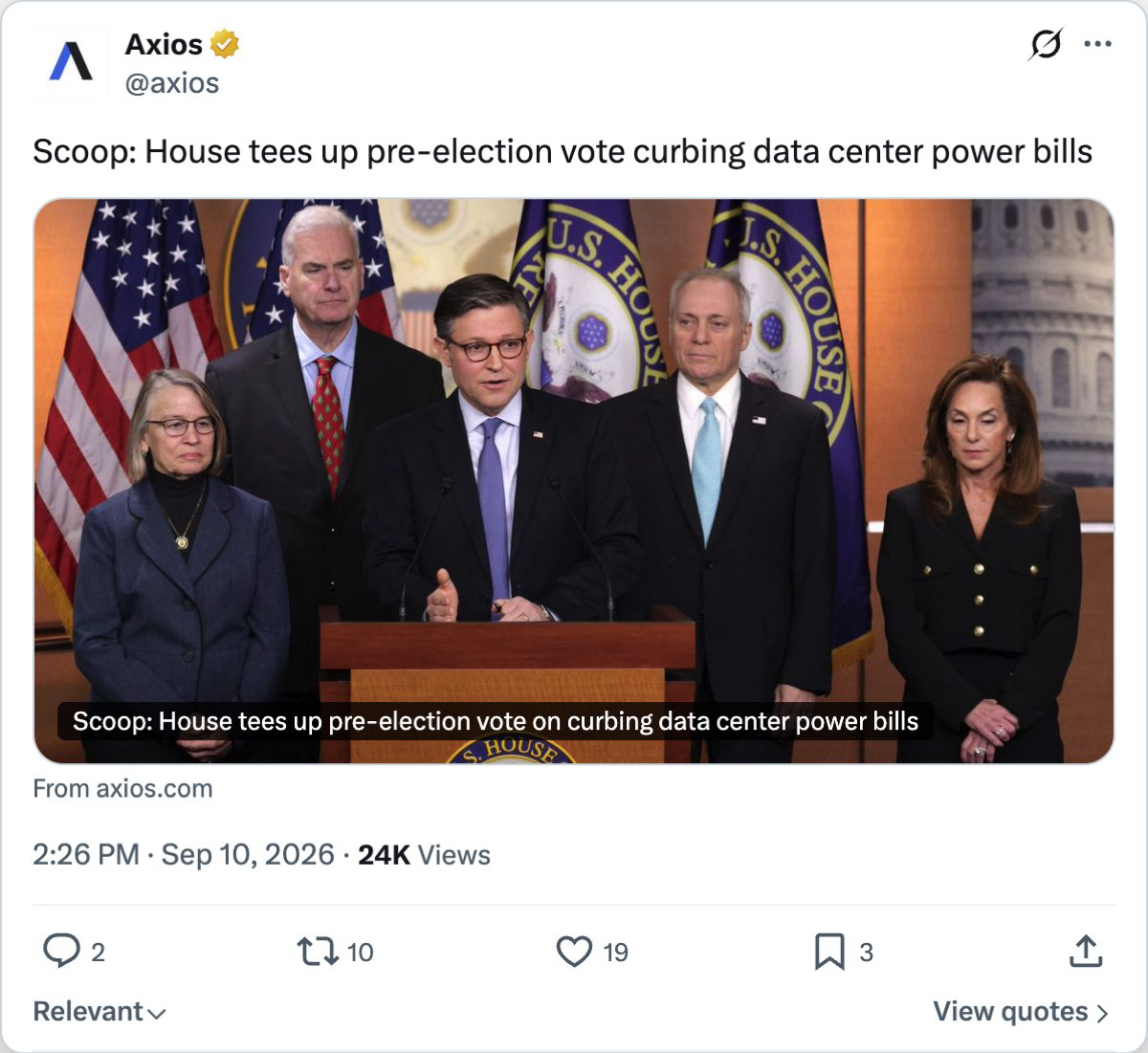
Both parties are already exploiting it. In Ohio, Democrat Sherrod Brown is running ads tying Republican Senator Jon Husted to the data center industry. The NRSC reportedly warned in an August memo that data centers were becoming a "sleeper issue for the entire cycle." In Michigan, Democratic Senate nominee Abdul El-Sayed has called for moratoriums. In Pennsylvania, Republican candidates have attacked Governor Shapiro for fast-tracking Amazon data center permits.
View original article on Axios →
The political geometry is unusual. Democrats see data centers as a rare issue where they can split the Republican coalition — MAGA voters are narrowly pro-data-center (53% support nationally, per the ABC poll), but mainstream Republicans are not. Republicans, meanwhile, face a president who has told communities opposing data centers they will end up "backwards and poor", while their own voters in swing districts oppose the facilities.
Lesson 3: The Administration Is Scrambling, and It Shows
President Trump's response to the backlash has shifted three times in four months, and each pivot has made the previous position harder to defend.
Phase 1: Dismissal (August). Trump posted on Truth Social that communities opposing data centers would be "backwards and poor," framing opposition as economic ignorance. This galvanized opponents without persuading skeptics.
Phase 2: Dividends (September-October). After meeting with tech leaders, Trump floated the idea of a "community dividend" — direct payments to residents of data center communities, alongside teacher bonuses. Critics immediately called it a bribe. A Pennsylvania resident told the Wall Street Journal that "$10,000 would not offset a drop in property value." The proposal lacks any legislative vehicle or funding mechanism.
Phase 3: Legislative Retreat (October). The House overwhelmingly passed bipartisan legislation requiring state energy regulators to consider making data centers pay for local electrical upgrades. This is a concession to the opposition, dressed as infrastructure policy. It signals that even data center allies in Congress have concluded the political cost of pure defense is too high.
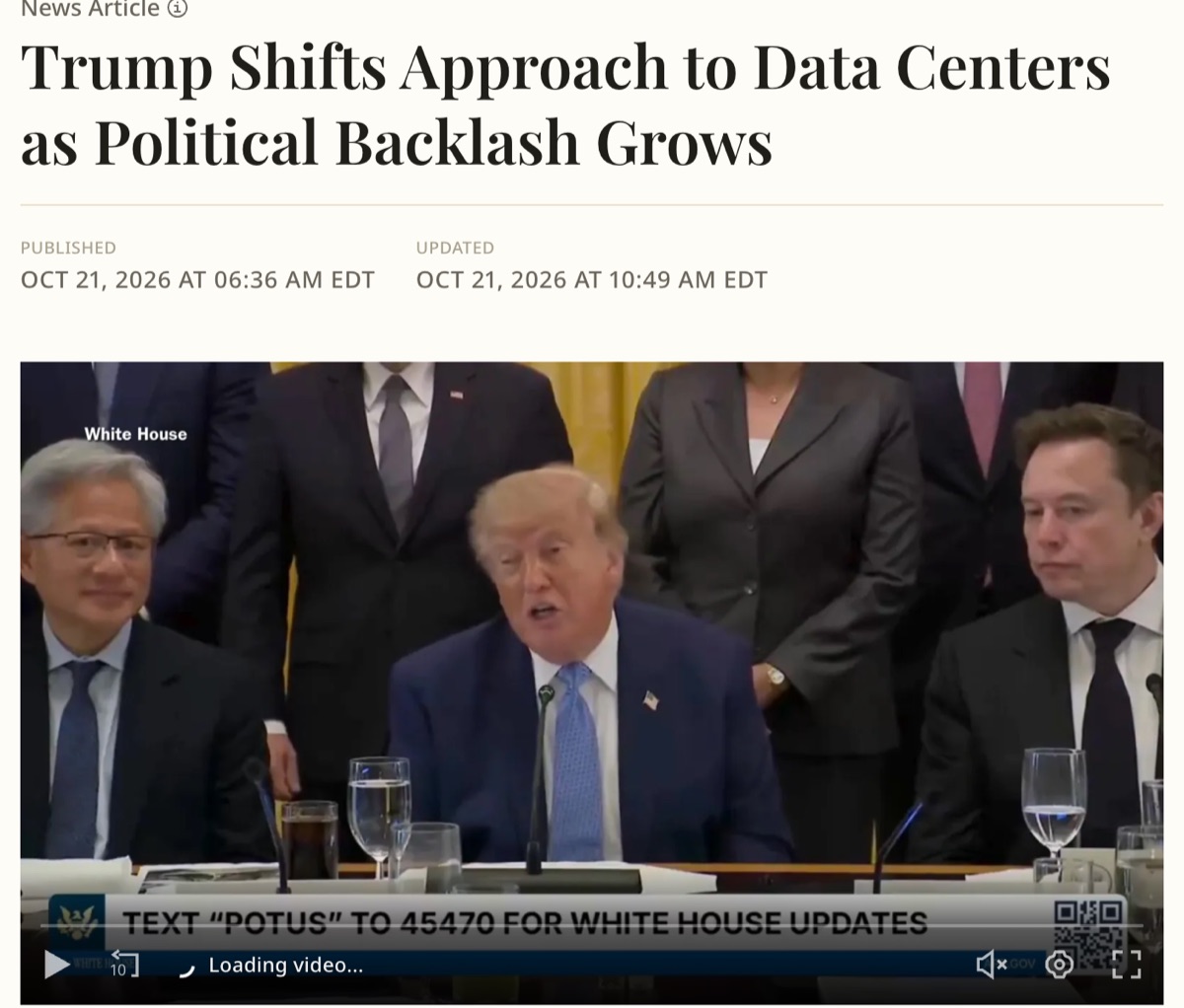
View original article on Newsweek →
The administration's approval numbers on AI reinforce the trajectory. The ABC/Post/Ipsos poll finds only 30% approve of Trump's handling of AI, with roughly two-thirds disapproving. Among non-MAGA Republicans, approval is just 49%. The president owns a position that his own coalition does not share.
Critical
Contrarian Corner: The Capex Holds Up Anyway. Morgan Stanley's July analysis argues that data center investment is not slowing despite the backlash — and that supply constraints from permitting delays could actually accelerate AI capital spending as demand outpaces the shrinking pipeline of approved sites. The firm estimates $870 billion in total AI capex for 2026. If Morgan Stanley is right, the political backlash makes the completed facilities more valuable, not less. The question is whether political risk eventually translates into regulatory risk that even deep-pocketed hyperscalers cannot outspend.
The Electoral Map
The midterm ballot tells the story in miniature.
According to Ballotpedia, 34 data center-related measures will appear on November ballots across the country. Ohio leads with 20 local initiatives — not coincidentally, the same state where the Senate race has become a referendum on data center politics. Programs.com counted 294 moratoriums and bans adopted by local governments from January through July 2026 alone.
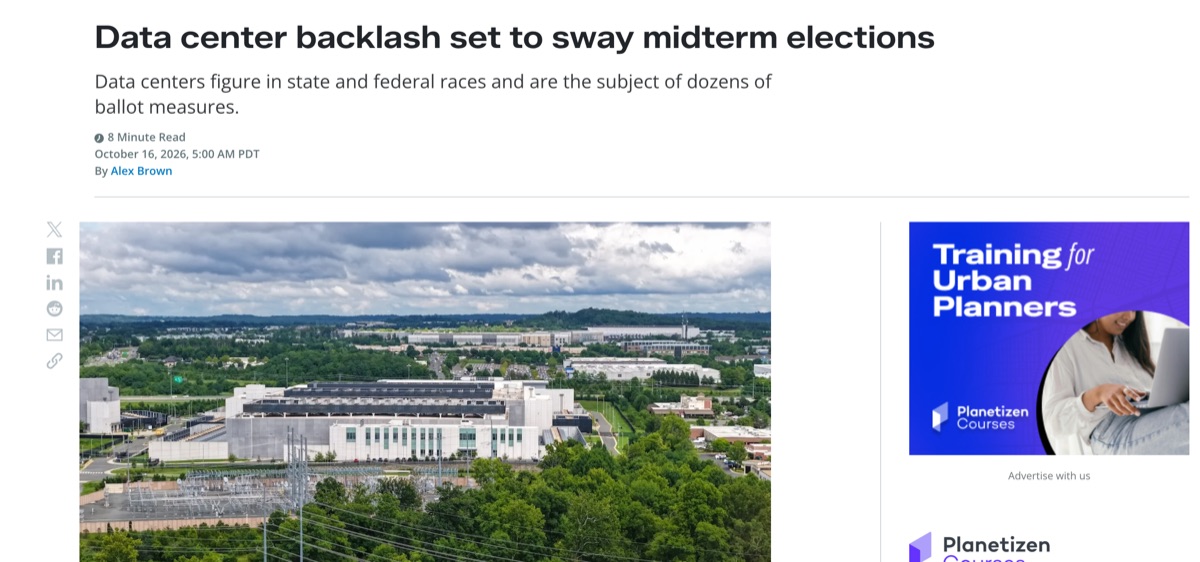
View original article on Planetizen →
The math of blocked projects is equally telling. Data Center Watch, a project of 10a Labs, counted 75 projects worth $130 billion blocked or delayed in Q1 2026 — roughly matching the total for all twelve months of 2025. Morgan Stanley's broader estimate puts delayed or canceled projects at $286 billion from 2025 through Q1 2026.
And the scale of organized opposition has outpaced every projection. What started as scattered town meetings has become a network of over 800 groups across 49 states, according to reporting by Grist. In July 2026, 142 protests were held across 42 states in a single coordinated action. The infrastructure of resistance now rivals the infrastructure it opposes.
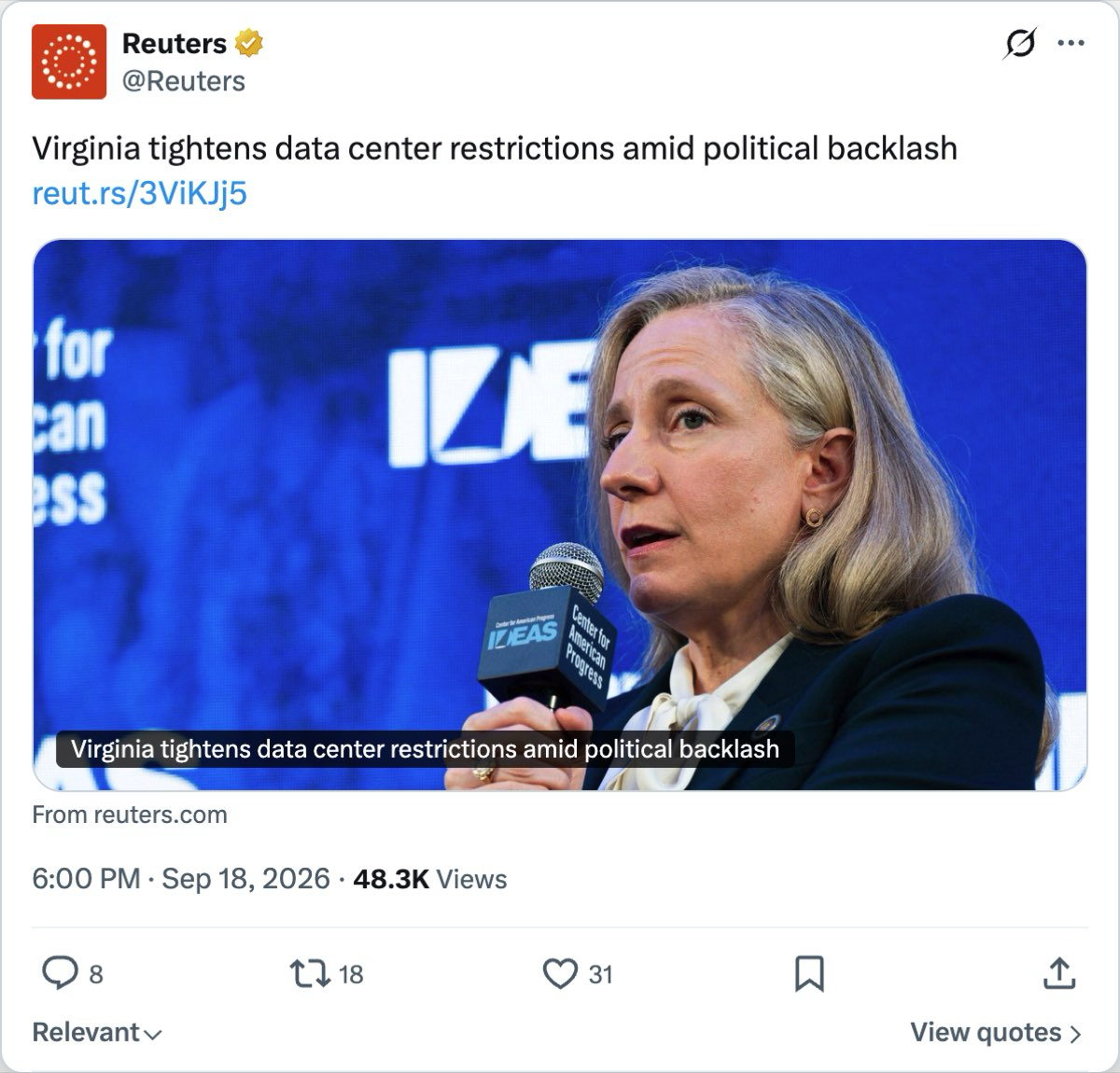
State-level action reflects the same acceleration. New York enacted a statewide moratorium on hyperscale data centers. Texas effectively froze new approvals. Virginia — home to "Data Center Alley" in Loudoun County, which hosts the highest concentration of data centers on Earth — tightened restrictions in September amid fierce local opposition. Pennsylvania's governor issued an executive order barring data center projects from fast-track permitting and requiring developers to fund their own electricity connections. As Bloomberg Government reported, the issue moved from "niche local" to "defining midterm topic" in under twelve months.
View original article on Bloomberg Government →
The Deeper Current: Power, Not Technology
The polls measure something the AI industry has been slow to recognize: the backlash is not really about data centers. It is about power.
Tom Wheeler's Brookings analysis frames it cleanly: data centers have become "a stand-in for public anxiety about jobs and daily life" — and the core question is "whether AI will be governed by democratic institutions or by the few companies that control its infrastructure." The ABC/Post/Ipsos poll provides the supporting data. Sixty-five percent see AI as posing a "high risk" of eliminating many jobs. Sixty-two percent say it poses a high risk of people losing the ability to make decisions without AI. Seventy-three percent say it poses a high risk of hacking secure computer systems.
These are not concerns about noise or water usage. They are existential anxieties, channeled through the most concrete policy lever available to ordinary voters: land use and permitting decisions at the local level.
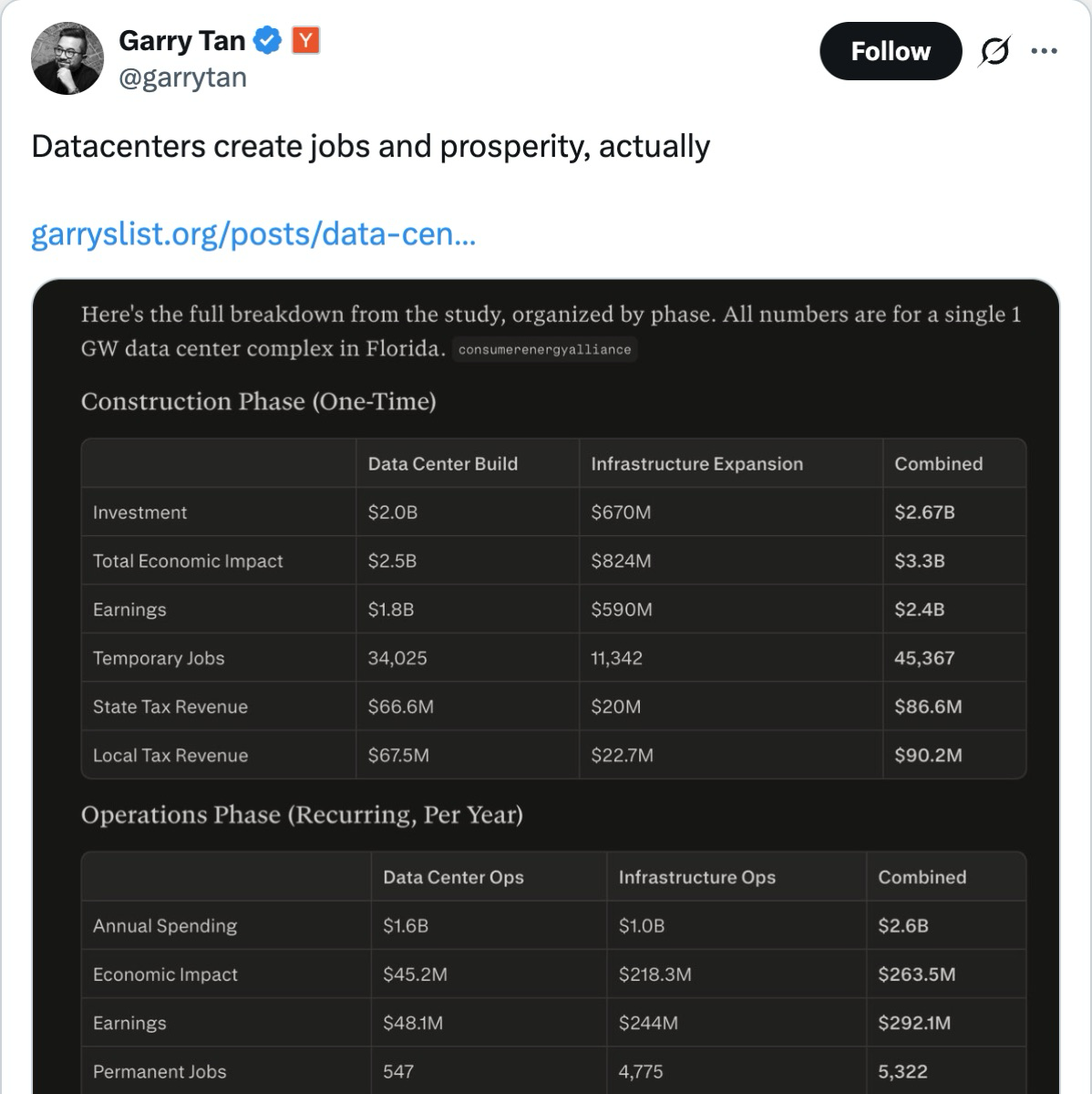
The money flowing into AI politics underscores the stakes. The Leading the Future super PAC launched with $140 million — $50 million each from Andreessen Horowitz and OpenAI president Greg Brockman — to back "pro-AI candidates." On the other side, the Guardrails Alliance, organized by employees at major AI companies themselves, relies on small-dollar donations to advocate for oversight. The asymmetry is the point. As Wheeler notes, "tech-industry leaders are pouring tens of millions of dollars into super PACs to shape AI policy, while employee-led groups with far smaller budgets push back."
What Comes Next
The 2026 midterms will not resolve the data center fight. But they will establish the political parameters for everything that follows. Three outcomes are now in play:
Scenario 1: Federal Preemption. If pro-data-center candidates hold enough seats, Congress could pass legislation overriding local moratoriums — similar to how the Telecommunications Act of 1996 preempted local zoning for cell towers. The political cost would be enormous, but the AI industry has the PAC money to make the case. This is the industry's preferred outcome, and the least likely one given current polling.
Scenario 2: The Dividend Model. Trump's community dividend concept, if formalized, could create a framework for negotiated coexistence — data centers pay a fee to host communities, offset utility costs, and fund local infrastructure. This is the path of least resistance, but it requires legislation, and no bill currently exists. It also assumes communities can be bought, an assumption the Pennsylvania homeowner's $10,000 response challenges.
Scenario 3: Managed Scarcity. If opposition continues to outpace accommodation, the US will build fewer data centers than demand requires. The bottleneck moves from silicon to politics. This is the scenario Morgan Stanley's analysts are pricing: fewer approved sites means higher rents, longer wait times, and a pull-forward of investment into the facilities that do get approved. It is also the scenario that advantages jurisdictions willing to host — turning data center permitting into a form of competitive advantage that reshapes the geography of AI compute.
Note
The Grid Math. Lawrence Berkeley National Laboratory estimates data centers could consume 9.5% to 15.3% of US electricity by 2030, up from about 4.7% in 2024. Every percentage point of that growth requires grid investment that local ratepayers will be asked to subsidize. The energy cost is not a technical problem — it is a political one, and the polls confirm that voters know it. For more on the grid constraint, see our earlier analysis: When the Grid Says No.
The Arc of Power Read
Every major poll this year points in the same direction: the American public has turned against AI infrastructure before AI itself has delivered on its central economic promises. That is a historically unusual pattern. The backlash against nuclear power came after Three Mile Island; the backlash against social media came after a decade of use. The backlash against AI data centers is arriving in advance of the transformation it is supposed to enable.
This matters for geopolitics because the United States' AI advantage rests on its ability to build compute at scale. China's data center construction faces no equivalent democratic constraint. The political risk premium on US AI infrastructure is not priced into the capex forecasts, the supply-chain analyses, or the geopolitical assessments that assume American AI dominance is a function of capital allocation alone. It is also a function of democratic consent — and democratic consent, as of October 21, 2026, is withdrawing.
The AI capex subsidy fight we analyzed earlier this year has evolved into something larger: a legitimacy fight. The ballot box does not care about token-per-second benchmarks. It cares about electricity bills, water tables, and whether the enormous wealth being created by AI is shared or extracted. Until the industry answers those questions — not with PAC money but with tangible benefits that voters can feel — the political cost of AI capex will keep rising. And unlike compute costs, political costs do not follow Moore's Law downward.
The Desk
About The Arc of Power
The Arc of Power editorial desk delivers rigorous analysis of geopolitics, defense, economic statecraft, and intelligence — examining the forces that shape the global order.
Briefing Access
Request Briefing Access
In-depth geopolitical analysis — power dynamics, defense strategy, and economic statecraft — three times a week. No noise.
Request briefing access