Case file · Economics · 12 min read
AI Capex Is Now a Subsidy Fight
Warren's $96B probe meets Eisman's short thesis. The AI buildout depends on taxpayer backstops — who bears the risk?
The Arc of Power ·
On September 28, Senator Elizabeth Warren and her Democratic colleagues sent letters to the CEOs of Meta, Amazon, Alphabet, and Microsoft demanding a full accounting of the AI-related tax deductions they have claimed under the One Big Beautiful Bill Act. Warren's office put a number on what the public is subsidizing: $96 billion in lost federal revenue. The companies have until October 11 to respond.
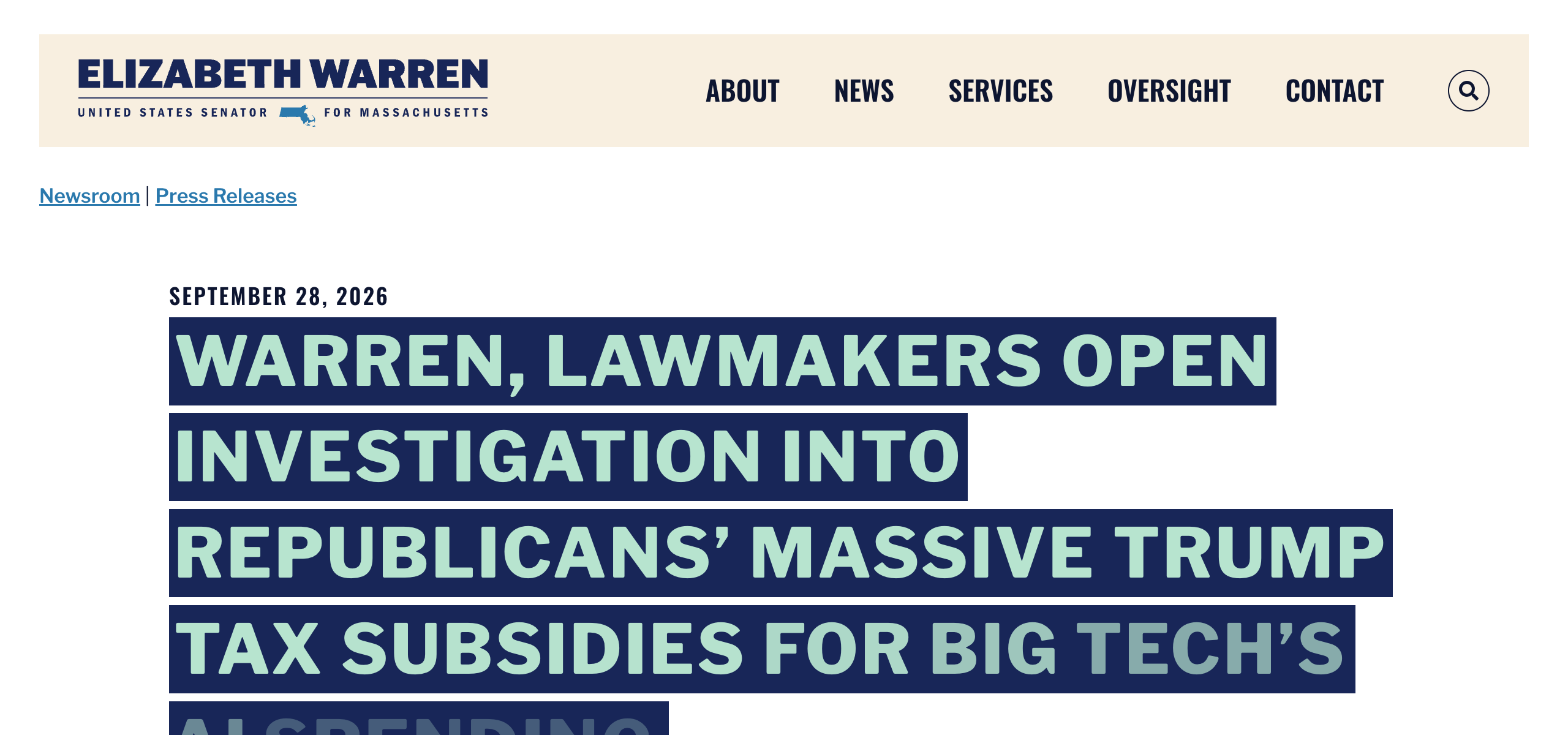
View the full press release on Warren.senate.gov →
Six weeks earlier, Steve Eisman — the investor whose subprime mortgage short made him one of the central figures of The Big Short — sat down with David Lin and laid out a thesis that should unsettle anyone watching the AI capex supercycle. The entire AI revenue chain, Eisman argued, flows through two companies — OpenAI and Anthropic — that together account for roughly 70% of AI-related revenue at the hyperscalers and 25-35% of their cloud revenue. Both are deeply unprofitable. And both are heading toward IPOs that will, for the first time, force them to open their books.
Warren and Eisman are asking the same question from opposite ends of the power spectrum: who bears the downside risk when $725 billion a year in capital expenditure meets a revenue base that cannot yet justify it?
The Scale of the Subsidy
The numbers in Warren's probe are staggering, but they require unpacking. The One Big Beautiful Bill Act, signed by President Trump in July 2025, made 100% first-year bonus depreciation permanent for qualifying business investments. For AI companies, that means every dollar spent on data-center servers, networking hardware, and related equipment can be fully deducted in the year it is placed in service — not depreciated over five or six years as accounting standards would normally require.
The effect has been immediate and massive:
- Microsoft's federal income tax expense dropped $11 billion from fiscal year 2025 to 2026, even as pre-tax income rose by $42.3 billion.
- Meta paid $2.8 billion in federal tax in 2025, down from $9.6 billion in 2024 — a 71% collapse — while earning roughly the same profit.
- Amazon's federal tax payments fell nearly $8 billion from FY2024 to FY2025.
- Alphabet's combined federal and state tax expenses shrank by over $7 billion.
The Joint Committee on Taxation estimates that $67 billion in retroactive tax breaks flowed to corporations in 2026 alone, with the total cost of the bonus depreciation extension projected at $362.7 billion over ten years.
Note
The tax breaks are not grants or subsidies in the traditional sense. Bonus depreciation accelerates deductions — it does not eliminate them. The companies will eventually pay taxes on those earnings. But in an environment where hyperscalers are spending $725 billion a year, the timing shift is enormous: billions in tax revenue that would have arrived this decade will now arrive in the 2030s — if the underlying investments remain profitable at all.
And this is only the federal layer. At the state level, the subsidy stack runs deeper.
The State-Level Rollback
While Washington debates the federal tax code, a revolt is underway in state capitals. Bloomberg Law reports that more than a dozen states are curtailing or rewriting laws that let data centers avoid sales taxes on materials, servers, and equipment. In 2026 alone, eight states enacted legislation rolling back data center tax subsidies, with another seventeen considering similar measures.
The scale of the giveaways has strained credulity:
- Georgia's data center sales-tax exemptions cost $2.5 billion in FY2026 — 664% more than previous estimates.
- In New York, a JPMorgan Chase data center received $77 million in tax breaks to create one job.
- Meta is set to receive $3.3 billion in tax breaks for its $10 billion Louisiana data center.
- Texas Governor Abbott directed regulators to ensure data centers pay for their own grid infrastructure, and pledged to phase out data center sales-tax exemptions.
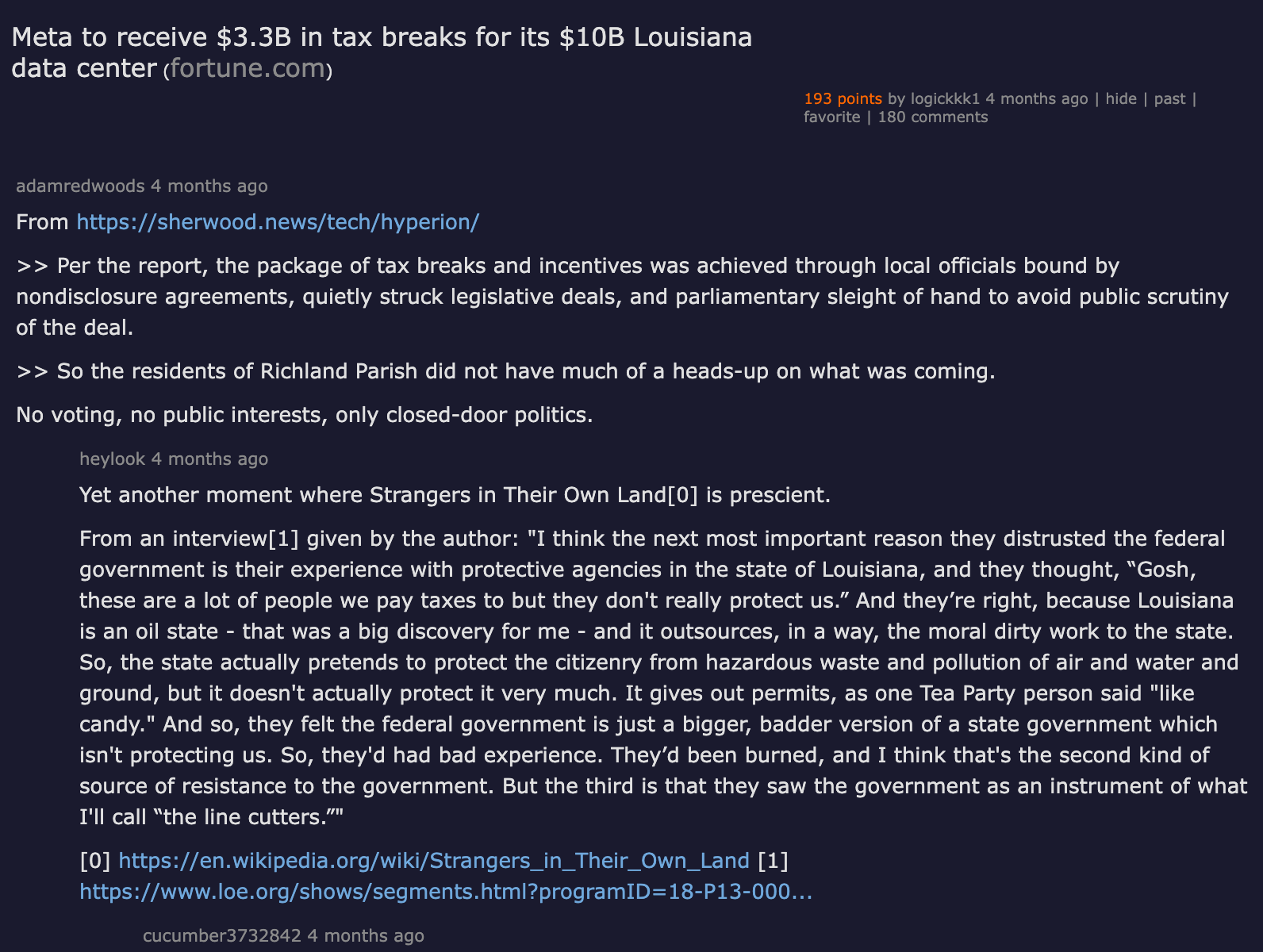
View discussion on Hacker News →
The political math has shifted. Polling now shows 71% of Americans oppose new data centers near their homes. More than 500 localities across 39 states have imposed restrictions on new construction. In the first quarter of 2026 alone, 75 data center projects worth $130 billion were blocked or delayed.
This is not a fringe movement. It is a bipartisan tax revolt that has caught the AI buildout in a vise between federal generosity and local refusal.
Eisman's Achilles Heel
If Warren's probe is the political front of the subsidy fight, Eisman's thesis is the financial front. His argument, laid out on CNBC and in subsequent interviews, is structural:
The entire AI revenue chain — the $725 billion in annual capex, the cloud computing margins, the chip orders — depends on two companies that lose billions of dollars a year.
OpenAI and Anthropic together generate approximately 70% of AI-related revenue at Microsoft, Amazon, Alphabet, and Oracle. That concentration means the hyperscalers' AI bets are not diversified across thousands of enterprise customers. They are dependent on two startups whose unit economics remain unproven at scale.
Eisman's specific concerns:
-
No moats. Unlike the software giants of the 2000s, AI labs have no durable competitive advantage. The technology is converging, and open-source alternatives — particularly Chinese models like Moonshot AI's Kimi K3, which charges $3 per million tokens versus $10 for Anthropic's Claude Fable — are eroding pricing power.
-
IPO will reveal the truth. Eisman told Fortune he "would be petrified" to run an IPO for either company. When OpenAI and Anthropic file, the market will finally see whether the revenue justifies the capital chain built on top of it.
-
Systemic risk. "If OpenAI failed tomorrow," Eisman warned, "the U.S. economy would likely face an immediate recession along with a massive market correction." This is not a technology bet — it is a macroeconomic dependency.

Read the full analysis on Substack →
The financial data supports the anxiety. As the detailed Anomaly Investments analysis documents: hyperscalers committed approximately $1.6 trillion between 2023 and 2026. Amazon's free cash flow has turned negative. Alphabet raised $80 billion in equity — a signal that operating cash flow can no longer fund the buildout. Sequoia Capital identified a $600 billion gap between actual AI revenues and the revenue expectations implied by infrastructure investment. And an MIT study found that 95% of businesses investing in AI have not yet made a profit.
Critical
Eisman is not shorting AI — yet. He says he lacks evidence that the breakdown has begun, and until "trouble at OpenAI and Anthropic begins to metastasize," the trade can keep running. But he has sold his Alphabet stake and reduced his AI exposure. The man who called the subprime crisis is watching the same structural pattern: private gains built on socialized risk, with the bill deferred until the music stops.
Three Lessons This Fight Teaches
Lesson 1: The Subsidy Stack Is the Real Moat
Forget network effects and proprietary data. The AI industry's actual competitive advantage in 2026 is its ability to extract public money at every level of government. Federal bonus depreciation. State sales-tax exemptions. Local property-tax abatements. Utility-rate subsidies. The One Big Beautiful Bill Act did not create this dynamic — it supercharged it.
When Meta's $72 billion in annual capex is "immediately deductible," the practical effect is that American taxpayers are financing the buildout of infrastructure that may or may not generate proportional economic returns. This is not a market failure — it is market design. The companies lobbied for these provisions, each donating $1 million to the presidential inauguration, and they got what they paid for.
The Arc of Power has tracked this dynamic before — the grid pushback that began in Texas and spread to New York. But the subsidy fight is the upstream cause. Without the tax architecture, the buildout could not sustain its current pace.
Lesson 2: The Revenue Gap Is a Political Vulnerability
The strongest argument against AI subsidies is not ideological — it is mathematical. The Anomaly Investments analysis calculates that justifying current hyperscaler valuations requires $320 billion in new annual AI-attributable profit. That approaches the entire combined net operating profit of all four companies from their existing businesses.
This gap creates political exposure. When Warren's staff can point to a company that cut its tax bill by $11 billion while spending $85 billion on infrastructure that generates uncertain returns, the populist argument writes itself: you subsidized a speculation.
This is the same structural vulnerability we analyzed in The Billionaire-Tax Illusion — the math that makes wealth-tax politics emotionally compelling even when the revenue arithmetic does not add up. But the AI subsidy case is different in one critical respect: the tax breaks are not hypothetical. They are flowing right now, at a pace of $67 billion per year.
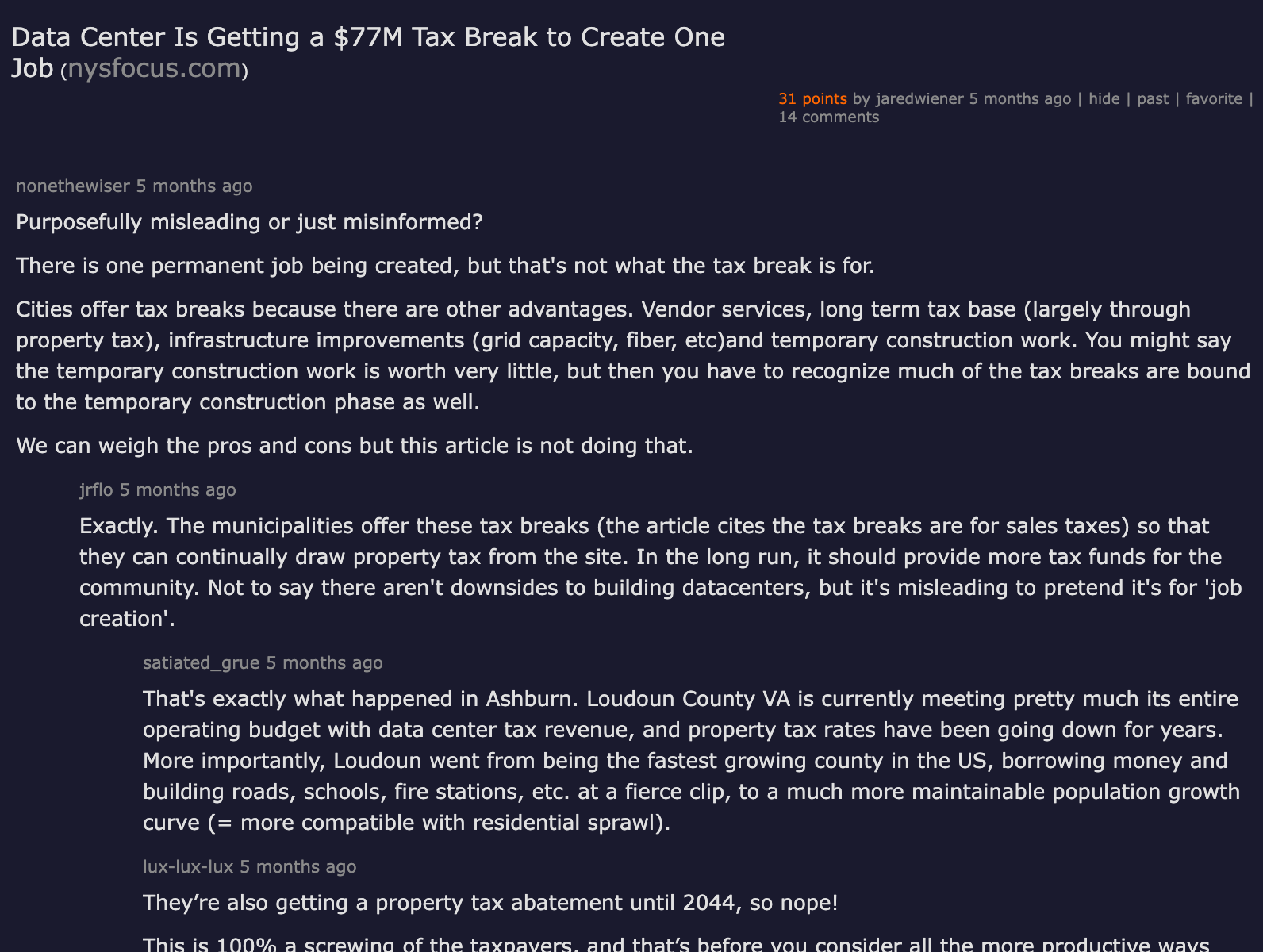
View discussion on Hacker News →
Lesson 3: The IPO Moment Will Be the Reckoning
Eisman's sharpest insight is that the AI trade has operated in an information vacuum. OpenAI and Anthropic are private companies. Their losses are estimated, not disclosed. Their customer concentration is inferred, not audited. The entire capital chain — from Nvidia's chip orders to Microsoft's Azure revenue to Amazon's AWS margins — has been priced on narratives rather than filings.
When those companies IPO — and OpenAI is reportedly seeking a $1+ trillion valuation with a $14 billion operating loss — the market will have real numbers for the first time. If the revenue does not justify the chain, the correction will not be limited to two startups. It will ripple through the hyperscalers, the chip makers, the utility companies, the construction firms, and the state and local governments that bet their budgets on data-center tax revenue that may never materialize.
As we noted in Nationalize AI?, the fight over who owns the AI windfall has been running since Sanders proposed a 50% public stake. But the subsidy fight is the mirror image: not who captures the upside, but who absorbs the downside.
The Contrarian Case
Critical
The subsidy critics may be misreading the mechanics. Bonus depreciation accelerates deductions — it does not eliminate tax liability. The revenue shows up later. State tax breaks compete for data-center jobs the same way factory incentives compete for manufacturing plants. And the infrastructure being built — the grid upgrades, the fiber runs, the construction employment — creates real economic value in communities that desperately need it. Pulling incentives mid-buildout risks pushing investment to the Gulf states and Southeast Asia, exactly where US national-security doctrine says compute should not go. The AI buildout may be a gamble, but it is a gamble the US cannot afford to lose to China.
There is force to this argument. The data-center permitting revolt we covered in June showed that the same communities rejecting data centers often lack alternative paths to economic development. And the national-security case for domestic compute capacity is real — the CHIPS Act was built on exactly this logic.
But the contrarian case has a hole: it assumes the investment will generate returns. If the revenue gap persists — if 95% of enterprise AI deployments remain unprofitable, if Chinese open-source models collapse pricing power, if OpenAI's IPO reveals a business that burns $14 billion a year with no path to profitability — then the subsidy stack did not attract productive investment. It subsidized a bubble.
What to Watch
October 11: The Big Four's response deadline to Warren's letters. Whatever they disclose sets the floor for the 2027 legislative fight over the One Big Beautiful Bill Act's renewal provisions.
OpenAI's IPO filing: Expected in the second half of 2026. The first public look at the revenue, costs, and customer concentration that the entire AI capital chain depends on. Eisman has said this is the data that will determine whether he shorts the trade.
State subsidy rollbacks: Eight states have already clawed back data-center tax breaks. If that number hits fifteen, hyperscalers will face a site-selection crisis — and the capex trajectory that Wall Street has priced in may prove unsustainable.
Polymarket: The AI bubble-burst contract sits at roughly 20% probability through year-end 2026, with $2.5+ million in volume. That is low enough to dismiss — or high enough to take seriously.
Note
The $96 billion question is not whether AI is valuable. It is whether the American public agreed to finance the buildout — and whether anyone asked them before the bill arrived.
The Arc of Power tracks how technology, capital, and political power intersect. For more on the AI infrastructure fight, see When the Grid Says No and The $965B Bet Needs Power to Run.
The Desk
About The Arc of Power
The Arc of Power editorial desk delivers rigorous analysis of geopolitics, defense, economic statecraft, and intelligence — examining the forces that shape the global order.
Briefing Access
Request Briefing Access
In-depth geopolitical analysis — power dynamics, defense strategy, and economic statecraft — three times a week. No noise.
Request briefing access