Case file · Economics · 13 min read
The 50% Wall
Washington slapped 50% tariffs on Canada. Ottawa matched dollar-for-dollar. Who actually holds leverage when your largest trading partner hits back?
The Arc of Power ·

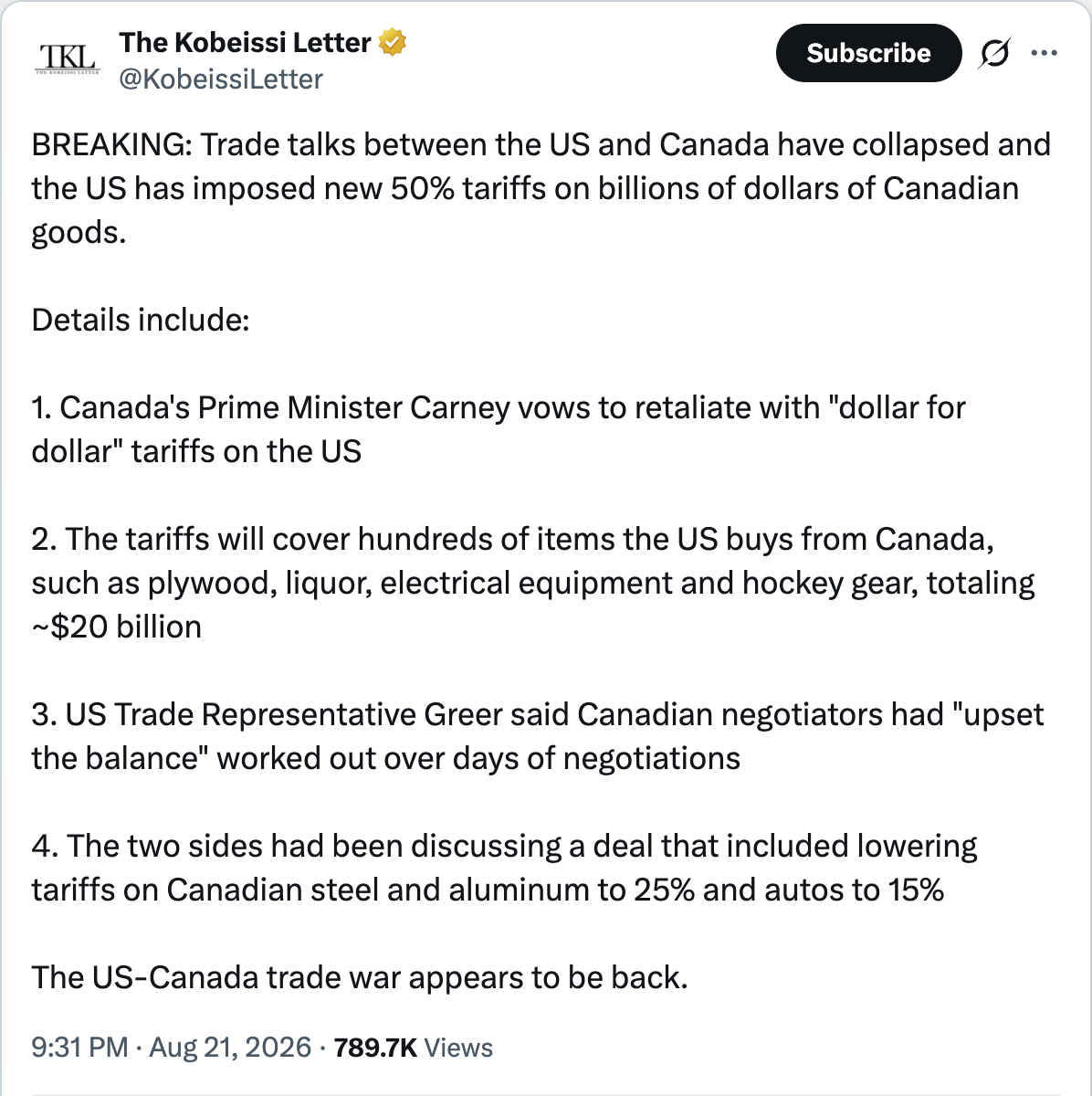
At 12:01 a.m. Eastern on August 22, 2026, the United States imposed 50% tariffs on roughly $20 billion in Canadian goods — dairy, alcohol, building materials, electronics, hockey equipment, and more than 500 other product categories. Trade negotiations had collapsed hours earlier. Within minutes, Canadian Prime Minister Mark Carney stepped to a microphone and said what no allied leader has said to Washington since the postwar order was built: "You're at war when you get attacked. We got attacked."
This is not a tariff dispute. It is the largest trade confrontation between the United States and its closest economic partner in modern history — and it arrives in the same week America's national debt crossed $40 trillion, a milestone the Congressional Budget Office didn't expect until 2028. Washington is waging economic war on two fronts simultaneously: outward against Canada, and inward against its own balance sheet.
What Just Happened — and What Didn't
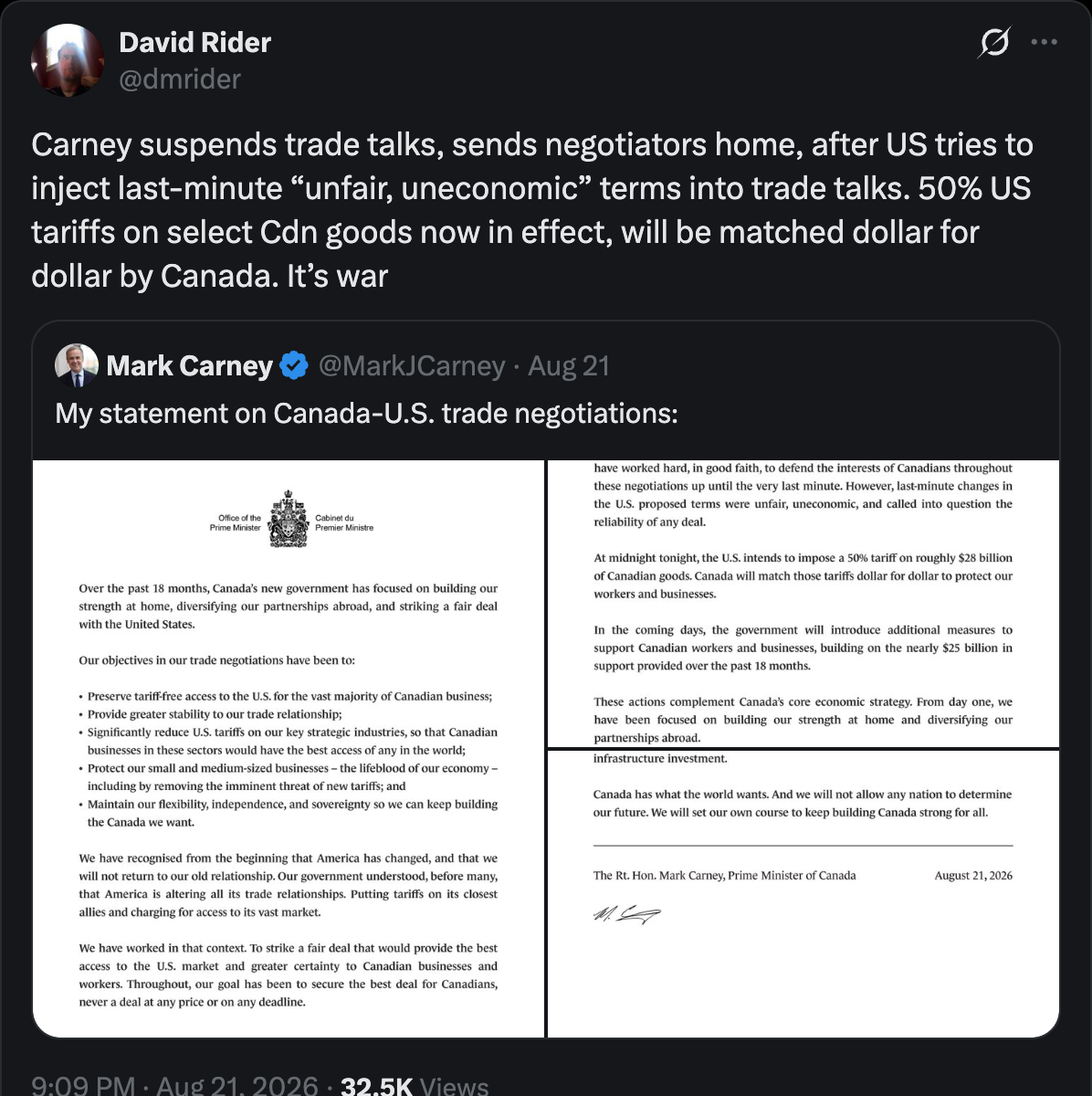
The 50% tariffs are not new terrain for the US-Canada relationship — they are the steepest escalation in an 18-month trade war that began on February 1, 2025, when President Trump imposed 25% tariffs on most Canadian imports and 10% on energy. What makes August 22 different is the context: these tariffs came after negotiations, not before them. Both sides sat at the table, exchanged proposals, and walked away. Carney called the last-minute American demands "unfair" and "uneconomic." The White House called Canada's position "foolish."
The breakdown matters more than the tariff rate. A 50% wall imposed after talks collapse signals something qualitatively different from a 25% opening bid designed to bring the other side to the table. It says: we are not negotiating anymore.
Canada's response was immediate and symmetrical. Ottawa announced retaliatory tariffs on more than 700 U.S. goods — steel, dairy, appliances, agricultural equipment, electronics — ranging from 15% to 50%, effective September 8. The value: approximately $20 billion, matching Washington dollar-for-dollar. Trump, in turn, announced auto tariffs would rise to 50% by January 2027.
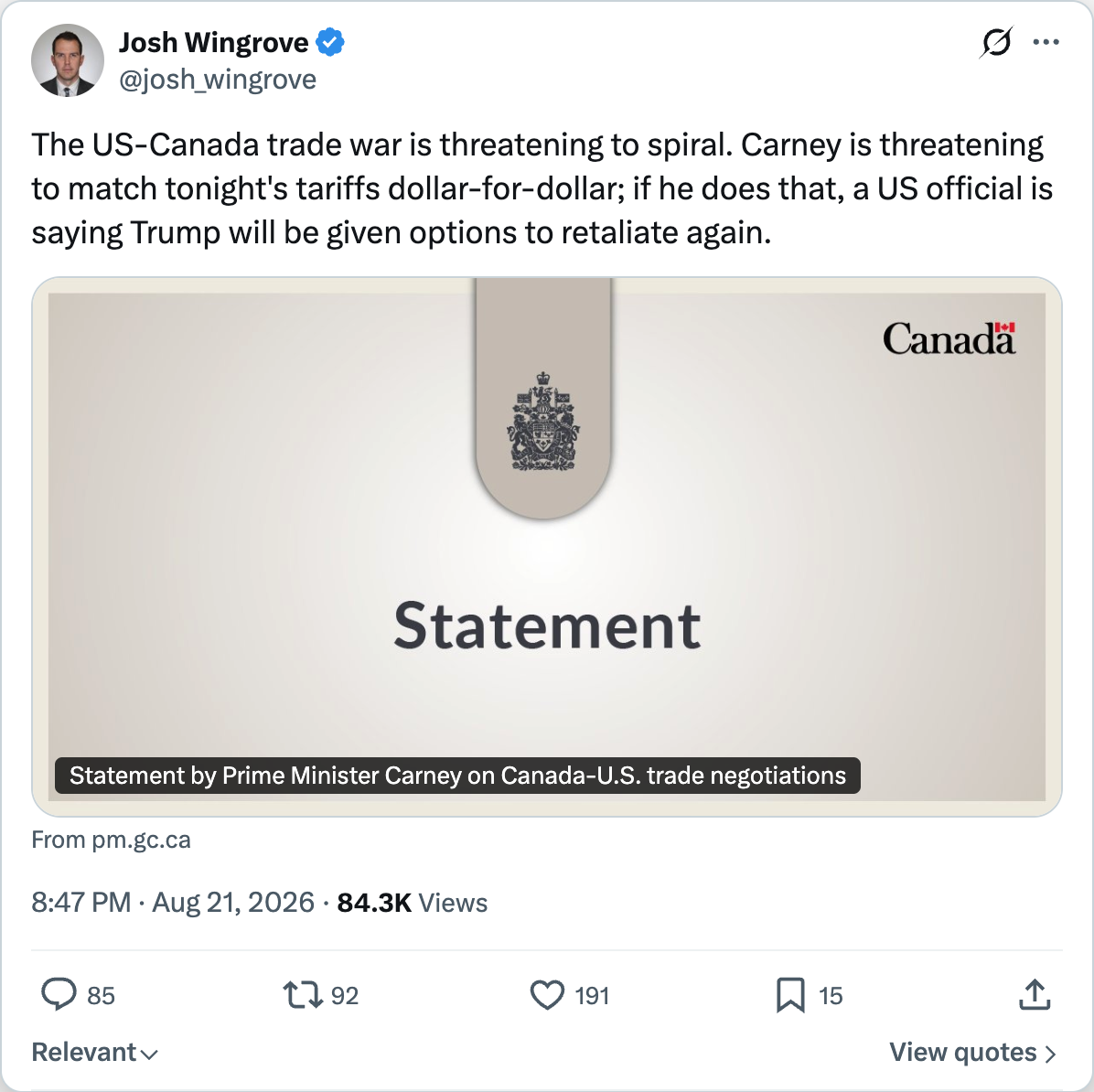
Bloomberg's Josh Wingrove captured the escalation logic plainly: Carney matches dollar-for-dollar, then a U.S. official says Trump will be given options to retaliate again. This is not a tariff schedule. It is a ratchet.
Three Lessons the 50% Wall Teaches
Lesson 1: You Cannot Weaponize an Integrated Supply Chain Without Shooting Yourself
The United States and Canada do not trade with each other the way the US trades with China — at arm's length, across an ocean, with separable supply chains. North American manufacturing is a single organism. Auto parts cross the US-Canada border multiple times before a vehicle is assembled. Canada supplies 60% of US crude oil imports, 85% of electricity imports, and 99% of natural gas imports. The two countries are connected by more than 35 major electricity transmission lines and 70 oil and gas pipelines.
A 50% tariff on this system does not block Canadian goods at the border. It taxes American production.
Critical
The reflexive cost: US construction inflation is now forecast at 4.5-5.5% for 2026, revised upward from earlier projections. Canadian tariffs on US steel, wood, and aluminum are expected to raise total project costs by 8-12% depending on material mix. Both countries are taxing their own builders.
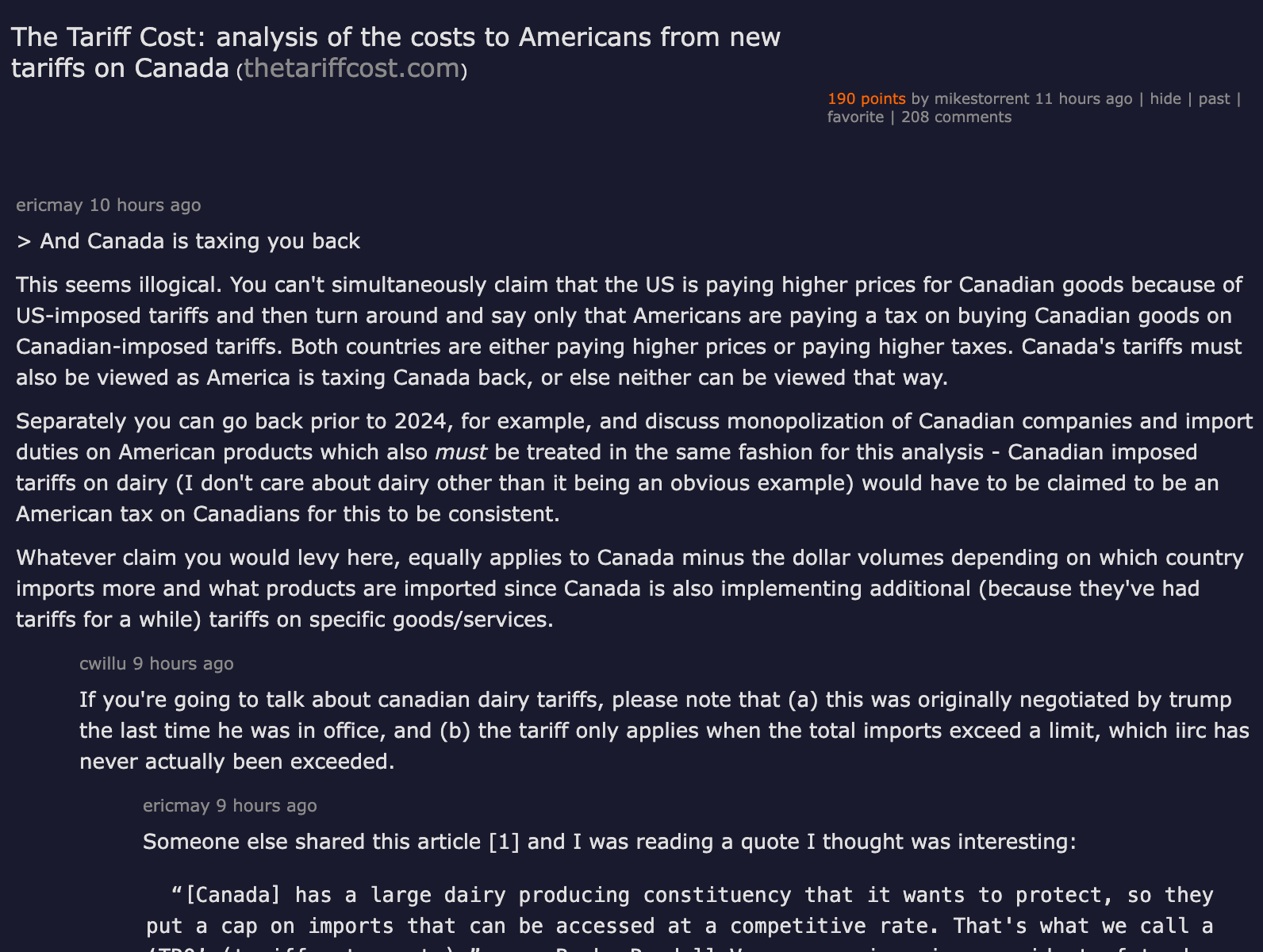
The Hacker News discussion on "The Tariff Cost" — a site analyzing the direct cost to Americans — drew 190 points and 208 comments, with the sharpest observation being how tariffs compound across integrated production: US tariffs hit Canadian inputs, then Canadian retaliatory tariffs hit the US-made components that used those inputs, and the final consumer absorbs the cumulative cost regardless of which flag it carries. As one commenter put it: both countries' tariffs ultimately tax their own citizens, not each other's.
This is the fundamental difference between tariffing an adversary and tariffing an ally embedded in your own production system. When Washington sanctioned Iranian oil or restricted Chinese rare earths, the pain was directional — it flowed outward. When Washington tariffs Canadian lumber, cement, and aluminum, the pain is reflexive — it flows back into American construction sites, homebuilding costs, and consumer prices. This is the supply-chain equivalent of punching your conjoined twin.
Lesson 2: The Asymmetry Is Real — but It Cuts Both Ways
The conventional wisdom says Canada loses this fight on the numbers. Roughly 75% of Canadian exports go to the United States, while Canada accounts for only about 17% of US exports. The $20 billion in tariffed goods represents 5.5% of Canadian exports to the US — painful, but not existential. If this escalates to the full bilateral trade relationship ($409 billion annually), Canada's economic exposure is categorically larger.
Note
The trade math: 73% of Canadian exports go south. Only 17% of US exports go north. In absolute terms, Canada is more dependent on the US than vice versa. But dependence is not the same as leverage.
But raw trade volumes obscure the leverage map. Canada holds three cards that the trade-balance framing ignores:
The energy card. Canada's energy minister has indicated that non-tariff measures — restricting oil exports or levying export duties on energy and minerals — are on the table if the dispute escalates further. Given that the US cannot quickly replace 60% of its crude imports or 99% of its natural gas imports from Canada, this is a credible threat. It is also a mutual-destruction weapon: Canadian producers would scramble for buyers, and the price they receive would collapse. Energy is the "biggest arrow in the quiver" — but firing it means losing the quiver.
The auto card. Trump's announcement of 50% auto tariffs by January 2027 is aimed at the most tightly integrated bilateral industry on Earth. 95% of Canadian motor vehicle and parts exports go to the US — but those exports are components in American-assembled vehicles. Tariffing them raises the sticker price of cars built in Michigan and Ohio by American workers for American buyers. This is not leverage against Canada. It is leverage against American automakers.
The pharmaceutical card. The US imports 400 different ready-for-use medications from Canada, 28 of which have no alternative supplier. A 50% tariff on pharmaceutical inputs is a 50% tariff on American healthcare costs.
Lesson 3: The Debt Backdrop Changes the Calculus
The timing is not coincidental. The same week Washington imposed the 50% wall, the national debt crossed $40 trillion — a milestone that arrived years ahead of CBO projections. The debt has doubled since 2017. Interest payments alone now exceed $1 trillion per year. As we noted in our analysis of the billionaire-tax arithmetic, the federal government burns $20.3 billion every 24 hours — and there is no revenue source, no confiscation, no tariff regime that closes that gap.
This matters for the trade war because tariffs are inflationary, and inflation raises borrowing costs. The CBO projects a $1.9 trillion deficit for FY2026, widening to $3.1 trillion by 2036. Every basis point of inflation driven by tariff-induced price increases makes that deficit marginally harder to finance. Washington is simultaneously waging a trade war that raises domestic prices and carrying a debt load that makes those price increases more expensive to service.
Critical
The debt trap: At $40 trillion in debt with >$1 trillion in annual interest, every tariff-driven price increase feeds back into higher borrowing costs. Washington is fighting a trade war on a credit card.
The question is whether anyone in the administration is running this feedback loop. Tariffs raise prices. Higher prices push inflation expectations. Higher inflation expectations push up Treasury yields. Higher yields increase the cost of servicing a $40 trillion debt. That debt service crowds out other spending — or requires more borrowing, which pushes yields higher still. This is not theoretical. It is happening in real time, and the 50% wall accelerates it.
The Contrarian Case: Washington Knows the Math
Note
The opposite read: What if Washington is right? Canada's 75/17 export asymmetry means Ottawa absorbs more absolute pain from a trade war than Washington does. If the US can tolerate higher construction costs and energy prices longer than Canada can tolerate losing 75% of its export market, the 50% wall is a calculated bet — not a miscalculation.
There is a case — a cold one — that the White House is playing this correctly. The asymmetry in trade dependence is real. Canada needs the American market more than America needs Canadian goods, even Canadian energy. In a game of chicken, the bigger car usually wins. If Trump believes that Carney's "dollar-for-dollar" retaliation is politically unsustainable — that Canadian voters and businesses will feel the pain faster than American ones — then the 50% wall is not a blunder. It is a squeeze.
The evidence for this read: Canada's exports to the US fell 3.7% in 2025, the first year of the trade war, while rising 11% to the rest of the world. Canada is diversifying — but slowly, and from a small base. Replacing the American market takes years.
The evidence against: Trump's own base is concentrated in states — Michigan, Ohio, Pennsylvania — where auto parts and construction materials cross the border multiple times. The political cost of a $10,000 increase in the average new car price may be harder for a Republican administration to absorb than the abstract number "17% of exports." Voters do not feel trade deficits. They feel sticker prices.
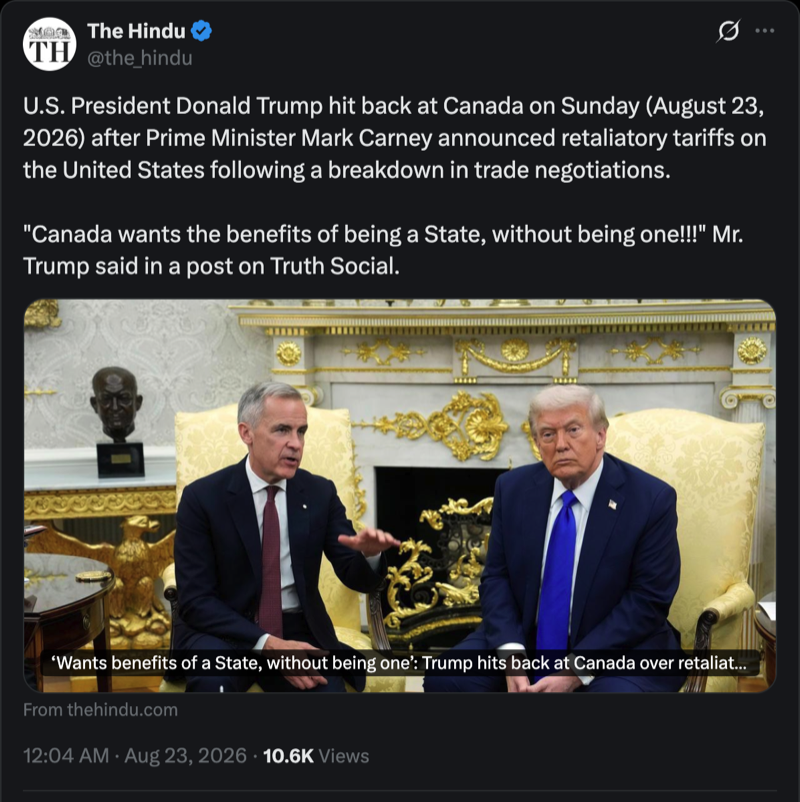
Trump's own framing — "Canada wants the benefits of being a State, without being one" — reveals the power logic beneath the economic surface. This is not about trade balances. It is about subordination. The 50% wall is a sovereignty test dressed in tariff codes.
What to Watch
September 8. Canada's retaliatory tariffs take effect. The question is not whether they will be imposed — Carney has staked his political credibility on "dollar-for-dollar" — but whether Washington escalates again. Bloomberg reported that if Canada matches, Trump will be given options to hit back harder. A second ratchet turns this from a trade war into a spiral.
The energy card. If Canada restricts oil or electricity exports, the trade war enters a different phase entirely. This is the escalation that would register on global energy markets and force third parties — the EU, Mexico, Asian buyers — to choose sides or exploit the opening.
Third-party repositioning. Mexico, the EU, and China are all watching this rift for opportunities. North American supply chains that become uneconomic at 50% tariff rates may relocate — not back to the US, but to Mexico (still inside USMCA for some goods) or overseas. The 50% wall may not protect American industry. It may redirect it.
The midterm connection. With 2026 midterms approaching, rising construction costs and car prices in swing states could turn the tariff war into a domestic political liability. The administration's bet is that voters blame Canada, not Washington. History suggests they blame whoever is in the White House.
The Bottom Line
The 50% wall is the most consequential economic act between the United States and Canada since Confederation — and possibly the most self-destructive tariff action Washington has taken since Smoot-Hawley. It arrives at the worst possible moment: a $40 trillion debt, a federal government spending $7.4 trillion per year, and an integrated continental economy where every tariff on Canadian inputs is also a tariff on American output.
Mark Carney called it war. That framing is not hyperbole — it is diagnostic. Wars of this kind have no clean winners. They have costs, escalation ladders, and exit ramps that both sides are currently ignoring. The question is not who holds more leverage. It is how much wreckage both capitals are willing to create before someone builds an off-ramp.
And the $40 trillion clock is ticking while they figure it out.
The Desk
About The Arc of Power
The Arc of Power editorial desk delivers rigorous analysis of geopolitics, defense, economic statecraft, and intelligence — examining the forces that shape the global order.
Briefing Access
Request Briefing Access
In-depth geopolitical analysis — power dynamics, defense strategy, and economic statecraft — three times a week. No noise.
Request briefing access