Case file · Economics · 12 min read
The Billionaire-Tax Illusion
Musk's $1.4T covers 77 days of federal spending. The math exposes what both sides of the wealth-tax debate refuse to say.
The Arc of Power ·

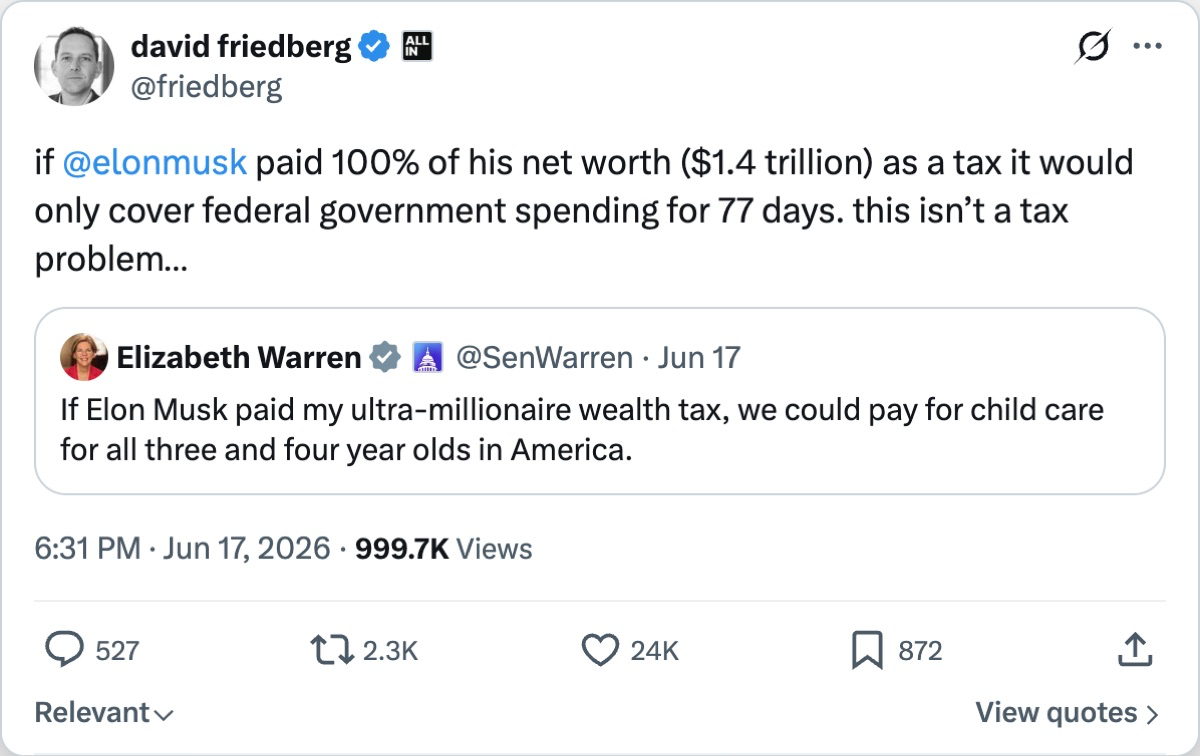
David Friedberg posted seven words that should end the wealth-tax debate — and won't. "This isn't a tax problem," the Ohalo Genetics founder and All-In Podcast co-host wrote on X, after calculating that confiscating 100% of Elon Musk's $1.4 trillion net worth would fund the federal government for exactly 77 days. The post pulled 24,600 likes, 2,400 retweets, and nearly a million views. It also pulled the pin on a grenade both parties have been juggling since Musk became the first trillionaire in June.
The math is correct. The framing is incomplete. And the incompleteness is the point.
The Arithmetic Nobody Wants to Finish
Friedberg's calculation is straightforward. The Congressional Budget Office projects federal outlays of $7.4 trillion in fiscal year 2026 — roughly $20.3 billion per day. Divide Musk's $1.4 trillion by $20.3 billion, and you get 69 days. Friedberg rounds to 77, likely using a slightly lower daily-spend figure or a different net-worth snapshot. Either way, the order of magnitude holds: the richest human who has ever lived could bankroll the United States government for about two and a half months.
But Friedberg stops where the analysis gets interesting. Here is the arithmetic he left on the table:
The Forbes 400 test. America's 400 richest people hold a combined $6.6 trillion in wealth. Seize every dollar — not tax it, seize it — and you fund the government through roughly November of a single calendar year. Then you have no billionaires, no capital to seize next year, and the same $7.4 trillion bill due in January.
The all-billionaires test. The United States has 989 billionaires worth a combined $8.4 trillion. Full confiscation buys you 13.6 months. Then what?
The deficit test. Forget spending; just close the deficit. The CBO projects a $1.9 trillion shortfall for FY2026, widening to $3.1 trillion by 2036. Musk's entire fortune covers 73% of one year's deficit. One year.
The point is not that billionaires shouldn't pay more in taxes. The point is that individual wealth — even at historically unprecedented, civilization-warping scale — is structurally irrelevant to a spending apparatus that burns $20.3 billion every 24 hours. This is a category error dressed up as a policy debate.
Three Lessons the 77-Day Number Teaches
Lesson 1: The Spending Machine Has No Off Switch
The federal government now spends $7.4 trillion annually. To put that in perspective, U.S. GDP is roughly $31.8 trillion. The federal government consumes 23.3% of everything the American economy produces — the highest sustained peacetime share since World War II.
Where does it go? Three categories eat 70% of the budget before Congress votes on a single discretionary dollar: Social Security ($1.5T), Medicare and Medicaid ($1.7T combined), and net interest on the debt ($1.04T). Interest alone now exceeds the entire defense budget. That is the trajectory Friedberg's tweet gestures at without naming: the spending is not discretionary. It is structural. It compounds. And no president, no Congress, no DOGE initiative has demonstrated the ability to meaningfully bend the curve.
Speaking of DOGE: Elon Musk promised $2 trillion in spending cuts. Then he revised to $1 trillion. Then $150 billion. A GAO audit in August 2026 found that 96% of DOGE's claimed $110 billion in savings could not be verified. Independent trackers could confirm just $5.02 billion — or 0.07% of the annual budget. The man whose personal fortune funds 77 days of government couldn't cut 77 hours' worth of spending when given the keys to the machine.
Critical
The irony nobody is noting: Friedberg's tweet implicitly defends Musk against wealth-tax advocates. But the same math indicts DOGE. If $1.4 trillion is a rounding error against $7.4 trillion in spending, then $5 billion in verified cuts is a rounding error's rounding error.
Lesson 2: Wealth Taxes Fail on Physics, Not Fairness
Senator Elizabeth Warren's Ultra-Millionaire Tax Act would impose a 2% annual levy on wealth above $50 million, with an additional 1% on billionaires and a 40% exit tax for those who renounce citizenship. Senator Bernie Sanders and Representative Ro Khanna have pushed a 5% annual wealth tax estimated to raise $368.5 billion per year — roughly $4.4 trillion over a decade.
Run the Friedberg test on the Sanders plan. $368.5 billion per year against $7.4 trillion in annual spending: that buys 18.2 additional days of government per year. A 5% annual wealth tax on every American billionaire — the most aggressive proposal on the table — extends Friedberg's 77 days to about 95. Still doesn't get you to Christmas.
This is not an argument against progressive taxation. It is an observation about scale. The federal spending apparatus has grown to a size where even confiscatory taxation of the ultra-wealthy moves the needle by single-digit percentages. Warren and Sanders are not wrong that billionaires should contribute more. They are wrong — or at least incomplete — in suggesting that doing so materially addresses the fiscal trajectory. The Cato Institute's analysis of European wealth taxes found that most countries abandoned them, not because of ideology, but because of capital flight, administrative costs, and revenue shortfalls against projections.
Note
The scale gap in one sentence: Sanders' 5% wealth tax raises in ten years what the federal government spends in seven months.
But here is where the fairness argument cuts the other way. The top 1% of American households currently pay roughly 55% of all federal income taxes. The effective tax rate on the wealthy has been cut roughly in half since the mid-20th century. Both things are true simultaneously: the rich pay the majority of taxes, and they pay at historically low rates relative to their wealth. Friedberg's framing selects the first fact and ignores the second. The wealth-tax advocates do the reverse.
Lesson 3: California Is the Real Laboratory
The most consequential wealth-tax fight in 2026 is not happening in Washington. It is happening in Sacramento.
California's Proposition 40 — a one-time 5% wealth tax on the state's approximately 200 billionaires — is locked on the November ballot after collecting 1.6 million signatures. It would raise an estimated $100 billion over five years for healthcare, education, and food assistance.
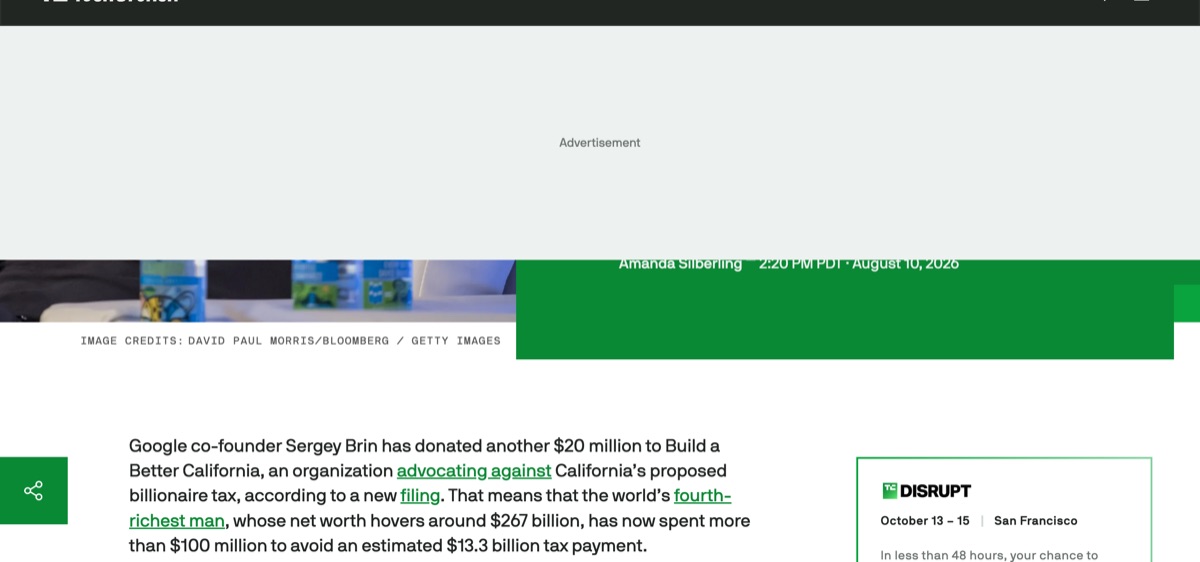
The counterattack is extraordinary. Google co-founder Sergey Brin has personally spent $102 million bankrolling two counter-propositions (Props 41 and 42) designed to nullify Prop 40. Brin's calculus is transparent: he could owe $13.3 billion if the tax passes. Spending $102 million to block a $13.3 billion liability is a 130:1 return on investment — the kind of bet any rational economic actor would make.

Friedberg himself, speaking on the All-In Podcast, called California's billionaire tax a "Trojan Horse" — arguing that establishing the principle of wealth taxation at the state level creates the constitutional precedent for a federal version. He is probably right, and that is exactly why the fight matters. Prop 40 is not primarily about $100 billion in revenue. It is a constitutional test case. If a state can levy a one-time tax on accumulated wealth without running afoul of the Takings Clause or due process, the legal architecture for a federal wealth tax changes overnight.
The Contrarian Corner: What Friedberg Gets Wrong
Critical
The argument Friedberg's framing suppresses: Wealth taxation is not meant to fund the government alone. It is a tool for reducing concentration of economic power that distorts democratic governance. Framing it purely as a revenue question — "does it close the gap?" — is like asking whether antitrust law increases GDP. That is not the point. The point is structural.
Consider the incentive architecture. Musk's $1.4 trillion in net worth is overwhelmingly composed of unrealized capital gains in Tesla and SpaceX stock. Under current tax law, those gains are never taxed if held until death — the step-up in basis means heirs inherit the assets at current market value, erasing the entire tax liability. This is the "buy, borrow, die" strategy that allows billionaires to access their wealth through low-interest margin loans while reporting minimal taxable income.
Friedberg's framing treats Musk's $1.4 trillion as a pool of liquid capital that could theoretically be taxed. But the same framing reveals why the current system is structurally broken: that $1.4 trillion generates enormous economic power — Musk controls the largest EV manufacturer, the dominant launch provider, a major social media platform, and now DOGE itself — while contributing a fraction of its value to the tax base.
The real question is not whether confiscating $1.4 trillion would fund the government for 77 days or 69 days. The question is whether a system that allows one person to accumulate $1.4 trillion while the national debt crosses $40 trillion is structurally sustainable — politically, economically, or democratically.
What the Community Is Saying
The debate playing out across platforms reveals a genuine philosophical split that the Friedberg tweet crystallized but did not resolve.
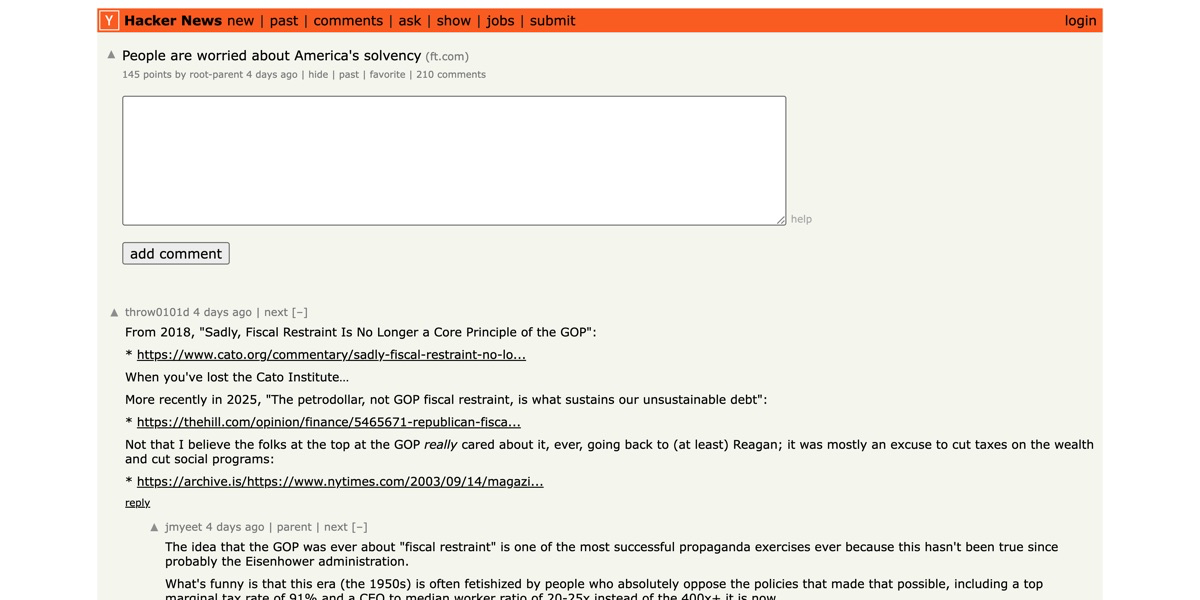
On Hacker News, the thread on Sergey Brin's $100 million anti-tax campaign drew dozens of comments debating whether wealth taxes are constitutionally viable and whether Brin's spending proves the tax is worth implementing ("if billionaires fight this hard against it, it must be hitting the right nerve"). A parallel thread on America's solvency focused on the structural deficit, with commenters noting that neither tax increases nor spending cuts alone can close a $1.9 trillion annual gap.
On X, responses to Friedberg split predictably: fiscal conservatives amplified the "spending problem, not a tax problem" frame, while progressives countered that Friedberg — a venture capitalist and member of the tech elite — has a personal financial interest in delegitimizing wealth taxation. Both are correct. It is a spending problem AND the people making that argument have $1.4 trillion reasons to make it.
The Yahoo Finance coverage connected Friedberg's tweet to the broader context of Trump's One Big Beautiful Bill Act, which could increase deficits by $3.4 to $4 trillion over the next decade — making the "it's a spending problem" argument more urgent and the "tax the rich" counterargument more acute at the same time.

The Power Question
Here is what both sides of this debate refuse to say clearly.
The wealth-tax advocates will not admit that their proposals are arithmetically insufficient to address the fiscal trajectory. Sanders' plan raises $4.4 trillion over a decade. The cumulative deficit over that same decade, per CBO projections, will exceed $25 trillion. The tax closes less than 18% of the gap.
The anti-tax side will not admit that "it's a spending problem" is a statement about reality, not a plan. Federal spending is dominated by entitlements and interest — programs that are both enormously popular and legally locked in. No elected official in either party has proposed a credible plan to reduce Social Security, Medicare, or debt service. When Musk himself tried through DOGE, the verified savings amounted to $5 billion against a $7.4 trillion budget.
The 77-day number is a mirror. It shows the wealth-tax camp their proposals are too small. It shows the anti-tax camp their spending-cut promises are too empty. And it shows the rest of us something more unsettling: the United States is running a $1.9 trillion annual deficit, the national debt has crossed $40 trillion, interest payments now exceed the defense budget, and nobody — not the taxers, not the cutters, not the trillionaire — has a plan that survives contact with the arithmetic.
As we wrote when Musk first crossed the trillionaire threshold: the fight over who pays is always louder than the fight over what gets spent. And that imbalance is itself a form of power — the kind that $1.4 trillion buys without writing a single check.
The Desk
About The Arc of Power
The Arc of Power editorial desk delivers rigorous analysis of geopolitics, defense, economic statecraft, and intelligence — examining the forces that shape the global order.
Briefing Access
Request Briefing Access
In-depth geopolitical analysis — power dynamics, defense strategy, and economic statecraft — three times a week. No noise.
Request briefing access