Case file · Defense · 13 min read
NATO's Quiet Turn to Autonomous War
Canada's 100-year drone pact with Ukraine signals a deeper shift: NATO is rebuilding its industrial base around autonomous systems.
The Arc of Power ·
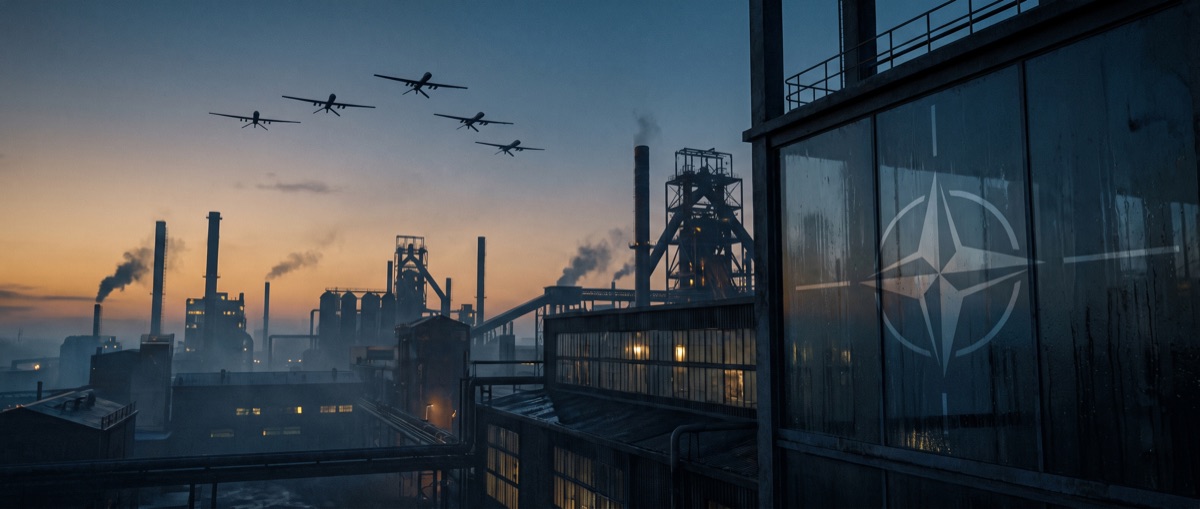
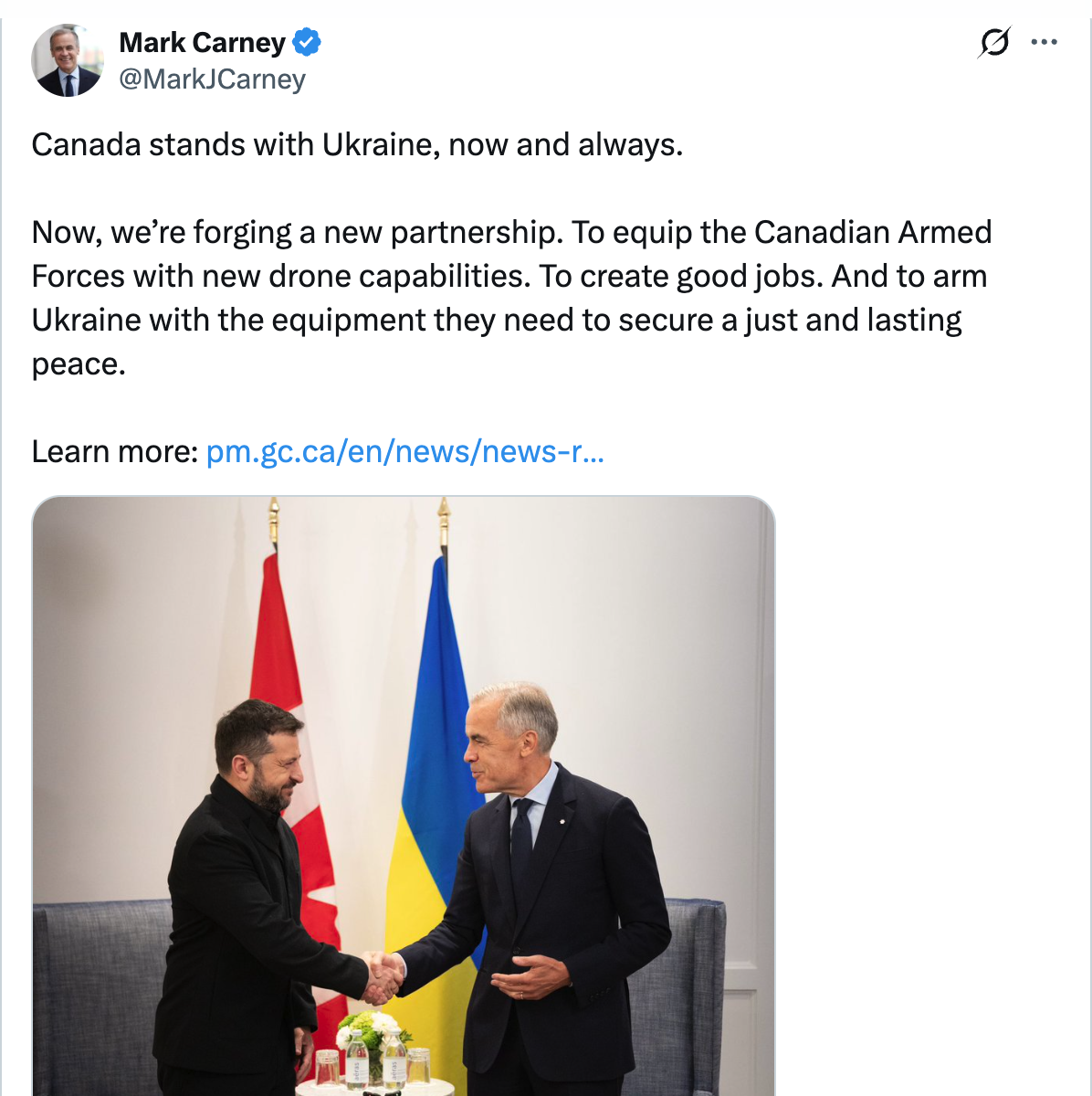
On September 10, 2026, Canadian Prime Minister Mark Carney and Ukrainian President Volodymyr Zelenskyy signed a document with a timeline that outlasts both of them by decades: a 100-year partnership declaration built on drones, counter-drone technology, and joint munitions production. The headline number — $700 million in immediate military aid — is the part designed to make news. The part designed to make history is the procurement model underneath it.
Canada is adopting Ukraine's Brave1 defense-tech marketplace wholesale: a government-run platform connecting 400 trusted suppliers directly to military end-users, bypassing the glacial Request-for-Proposal cycles that define Western defense acquisition. The new Defence Drone Initiative Marketplace will increase Canadian Armed Forces drone deployments tenfold, with initial contracts worth C$50 million awarded to six domestic manufacturers. One-third of all production goes to Ukraine. Carney described Ukrainian developers as "the most battle-tested developers on Earth." He is not wrong — and that framing matters, because it signals something larger than a bilateral deal.
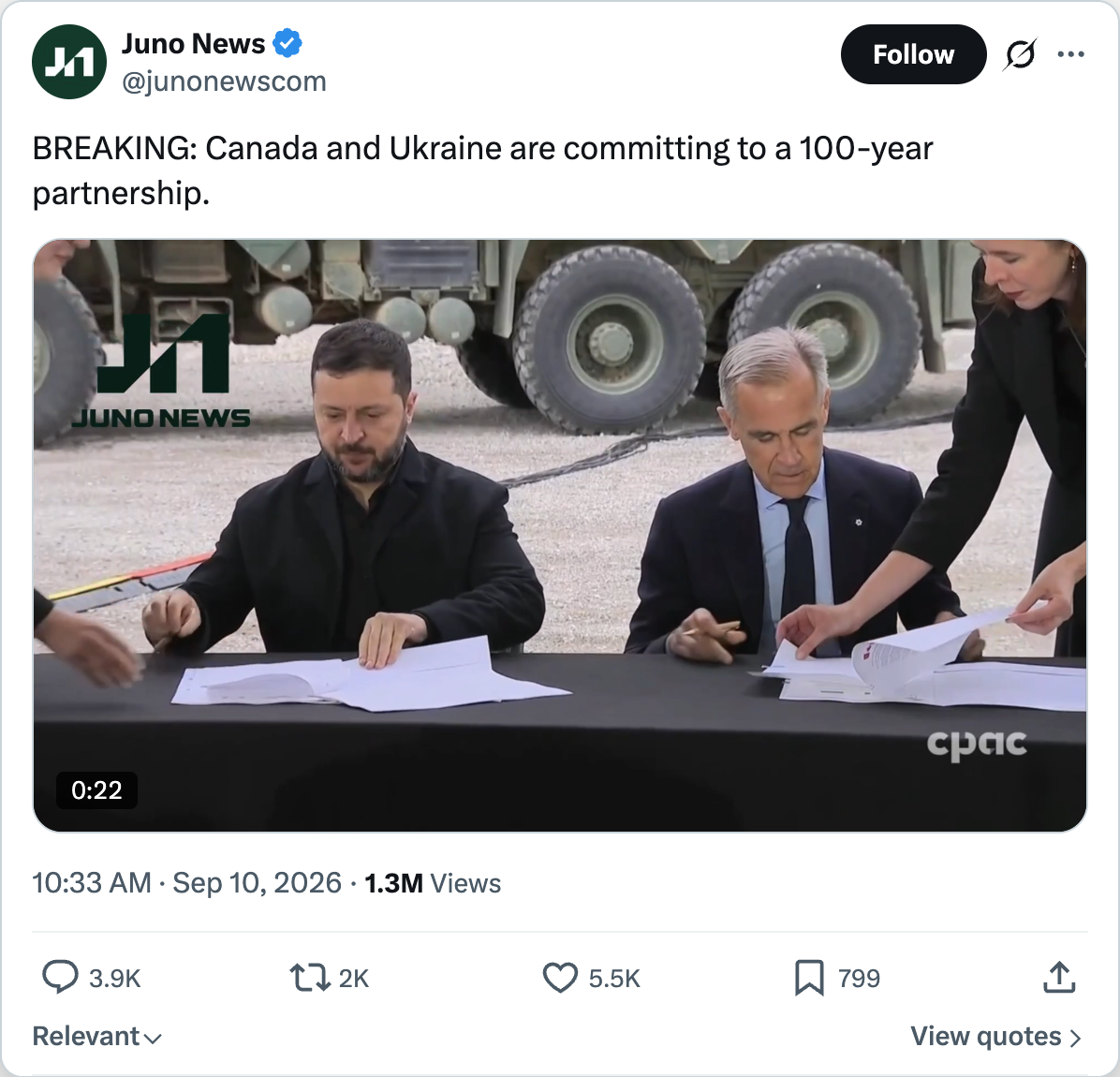
This is not generosity. This is NATO rebuilding its industrial base around autonomous systems, and Ukraine is the template.

The post announcing the pact hit 20,663 upvotes on r/worldnews — front-page-of-the-internet territory. Defense procurement stories do not trend unless the public senses something structural shifting. They are right to sense it.
The Brave1 Model: Inverting the Defense Pyramid
Traditional NATO procurement works like this: a ministry of defense issues requirements, prime contractors (Lockheed Martin, BAE Systems, Rheinmetall) bid over years, subcontractors feed upward, and a platform enters service a decade after the threat it was designed to counter. The F-35 program is the archetype — 23 years from contract to full-rate production, $1.7 trillion lifetime cost.
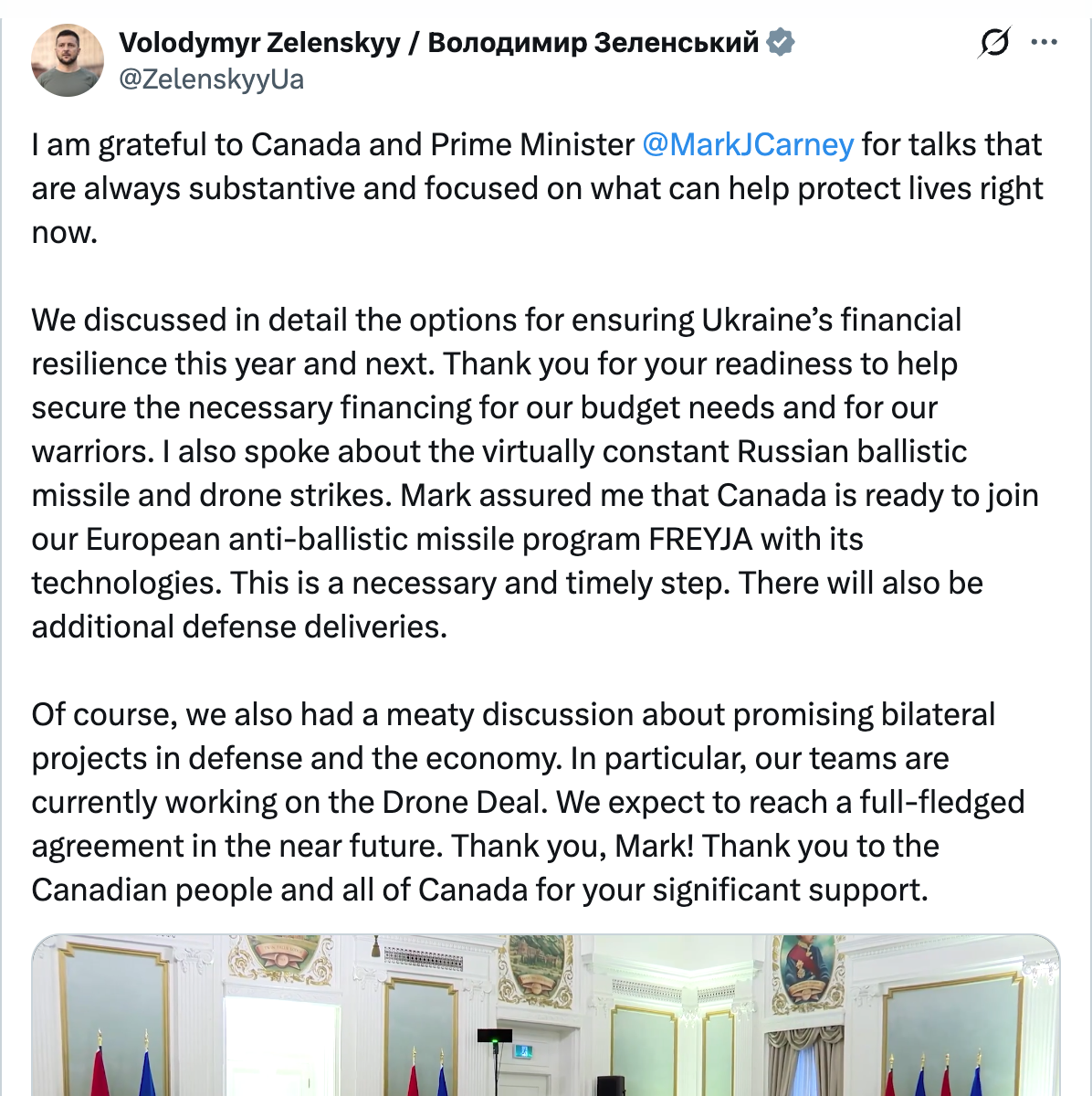
Ukraine's Brave1 inverts this pyramid. Launched in 2023, the platform functions as a government-backed defense-tech accelerator connecting over 1,500 technology companies to the battlefield through $30 million in grants and rapid prototyping cycles measured in weeks, not years. By 2024, Ukraine had received over one million drones. The ecosystem is not a procurement system — it is a production-line war economy that treats operational data as shared resources rather than classified assets.
Canada's Defence Drone Initiative Marketplace is the first NATO-member government to copy this model at national scale. The official announcement frames it as connecting "operators and end-users with Canada's defence ecosystem" — language that would have been heretical in Ottawa five years ago, when procurement meant a single vendor and a fifteen-year contract.
The implications ripple outward. If Brave1-style marketplaces work in Canada — a peacetime democracy with union rules, environmental reviews, and cabinet oversight — they work anywhere in the alliance. And that changes who builds NATO's weapons.
The $40 Billion Signal: NATO's Drone Edge Initiative
Canada's pact did not emerge in isolation. Two months earlier, at the NATO summit in Ankara, Secretary General Mark Rutte launched the Drone Edge Initiative: a $40 billion commitment over five years spanning counter-drone defense, drone procurement, and a fivefold expansion of operator training by end of 2027. Twenty allied nations signed on. The NATO Support and Procurement Agency — the alliance's central buying authority — will route surveillance-drone acquisitions. A new counter-drone marketplace will certify systems as NATO-tested and NATO-compatible.
The initiative also spawned the LEAP program (Low-Cost Effectors & Autonomous Platforms), a joint effort by France, Germany, Italy, Poland, and the UK to manufacture low-cost autonomous drones using Ukrainian expertise. LEAP is the European answer to a question Ukraine settled empirically: a $500 FPV drone that destroys a $2 million armored vehicle is not a gimmick. It is a new cost curve for warfare.
But the headline number obscures a structural problem. Drone Intelligence's analysis of the initiative identified more than forty vendors spanning detection, jamming, kinetic intercept, directed energy, and command systems — with no single vendor covering the full detect-track-defeat chain and no common command-and-control standard binding them. The marketplace "accelerates purchasing but does not impose a common command-and-control layer," risking 32 member states fielding 40+ incompatible systems along Europe's eastern border.
Critical
Contrarian Corner: The Integration Gap. The $40 billion buys hardware. It does not buy interoperability. NATO's counter-drone marketplace and the parallel EU "European Drone Defence Initiative" operate under different procurement rules covering identical members and identical threats — creating competing standards at the moment standardization matters most. The winners of this cycle will not be decided by the budget headline. They will be decided in the integration layer. If NATO cannot solve the C2 problem, it will have spent $40 billion on forty incompatible alarm systems.
The Budget Nobody Is Talking About
The Canada-Ukraine pact and NATO's Drone Edge Initiative are visible. What is less visible — and arguably more consequential — is the budget line buried in the Pentagon's FY 2027 request.
The US Defense Autonomous Warfare Group (DAWG) requested $54.6 billion for fiscal year 2027. The prior year's allocation was $225.9 million. That is a 24,070% increase — not a rounding error, not an incremental step, but a wholesale institutional bet that autonomous systems are the future of American warfighting.
Tip
The number: 24,070%. That is the year-over-year increase in the US autonomous warfare budget — from $225.9 million (FY 2026) to $54.6 billion (FY 2027). For context, the entire Pentagon FY 2027 budget is $1.5 trillion. Autonomous systems just went from a line item to a pillar.
This is not abstract. In July 2026, the Pentagon awarded $500 million to Perennial Autonomy for Ukraine-proven counter-drone interceptors and another $500 million to AeroVironment under the Domestic Shield program. Both awards went to companies that proved their systems in Ukrainian combat, not in Pentagon test ranges. The traditional prime contractors — the companies that have defined American defense for seventy years — were not in the room.
The global AI-in-defense market is projected to grow from $4.2 billion in 2026 to $42.8 billion by 2036, a 26.4% compound annual growth rate. The autonomous defense platforms market is forecast to reach $198.87 billion by 2034. These are not projections from optimistic startups. They are the numbers defense ministries are using to write procurement plans.
Polymarket Reads the Room: Paper, Not Peace
If the procurement numbers tell you where the money is going, the prediction markets tell you why.
On Polymarket, the Russia-Ukraine ceasefire-agreement market tells a story we have tracked before: the crowd believes in paper, not peace. As of September 11, 2026, the probability of a ceasefire by December 2026 sits at 13% — down from 40% the prior day. The October tranche is at 7%. Even the late-2027 tranches can only muster ~70%.
The ceasefire-agreement odds (will anyone sign anything?) hold far higher than actual ceasefire odds — the market prices a diplomatic document eventually, but not actual silence on the front line. Over $6.3 million has traded on the agreement market since May. This is not noise. It is informed capital pricing in a frozen conflict that nobody expects to thaw soon.
Note
Polymarket divergence (September 11, 2026): Ceasefire by December 2026 at 13%. Ceasefire agreement by late 2027 at ~70%. The spread is the signal — the crowd expects paperwork, not peace. NATO's procurement timeline (five-year Drone Edge, two-year Canadian drone capacity) is calibrated to the same assumption: this war, in some form, is the new baseline.
Recent US diplomatic efforts — envoys Steve Witkoff and Jared Kushner met Putin in Moscow and Zelenskyy in Kyiv on September 5-6 — produced agreement to resume trilateral negotiations. No ceasefire emerged. Zelenskyy expects the war to continue into winter. The diplomatic meeting odds are cooling: near-term meeting probabilities fell 20.5% this week.
Read the procurement timelines alongside the prediction markets and the message is clear: NATO is not arming for peace negotiations. NATO is arming for the next decade.
Three Theses This Pact Teaches
1. The Production Treaty Is the New Alliance Treaty
The 100-year partnership is not a security guarantee in the Article 5 sense. It is a production-line agreement: shared IP, shared manufacturing, shared battlefield data. This is a fundamentally different kind of alliance — one built on industrial integration rather than mutual defense promises. Canada gets Ukrainian combat data and drone designs. Ukraine gets Canadian manufacturing scale, AI capability, and raw materials (Canada is a top-five critical minerals producer). The 100-year timeline is aspirational theater, but the industrial entanglement it creates is real and immediate.
Compare this to the sovereign compute thesis: the same logic that drives nations to build domestic AI chip capacity now drives them to build domestic drone production. Sovereignty is no longer just about borders and armies. It is about production lines and software stacks.
2. Ukraine Is Exporting Its War Economy, Not Just Its War
Brave1 is no longer a Ukrainian program. It is a procurement template that Canada has adopted, NATO is studying, and the LEAP consortium is adapting. Ukrainian defense startups raised $105 million in venture funding in 2025 alone. The ecosystem that grew under existential pressure — where iteration cycles are measured in days because the enemy adapts in days — is now being transplanted into peacetime procurement structures.
The speed differential is the core advantage. As the Foreign Affairs Forum analysis put it, "the rhythm of modern defense competition now operates in weeks, not years." A Ukrainian FPV drone unit can identify a vulnerability on Monday, prototype a counter on Wednesday, and deploy it by Friday. Traditional Western procurement takes longer to draft the requirements document. The Canada-Ukraine joint production agreement explicitly couples these two speeds: Ukrainian battlefield iteration with Canadian manufacturing depth. General Dynamics Mission Systems Canada and Green Tech Harvest Ukraine have already signed a memorandum of understanding for drone co-production — the industrial integration is not theoretical.
This is the under-reported dimension. Ukraine's most durable export may not be grain or steel. It may be a defense-acquisition methodology that makes traditional procurement look like what it is: a jobs program for incumbents dressed up as national security.
3. The Autonomy Governance Gap Is Now a Strategic Vulnerability
The US Marine Corps Bullfrog system already fires at aerial threats without human intervention. Britain's Global Combat Air Programme encodes human-in-the-loop at the design stage. NATO has no binding standard on where the line is. UN Secretary General Guterres has warned of "sophisticated and increasingly autonomous" weaponry lacking adequate legal frameworks.
This gap is not an ethical footnote. It is a strategic vulnerability. As Dr. Antonio Bhardwaj argued in Foreign Affairs Forum, the governance deficit creates "a race-to-the-bottom dynamic in which operational military pressure consistently overrides ethical and legal restraint." NATO is spending $40 billion on autonomous systems while its member states cannot agree on what "autonomous" means in a targeting context.
What Comes Next
The next twelve months will determine whether NATO's autonomous pivot produces a coherent capability or an expensive mess. The initial EU capability target is end-2026; full capability by end-2027. Canada's drone marketplace must demonstrate that Brave1's wartime speed translates to peacetime procurement. The integration gap — forty vendors, no common C2 — must close before the hardware hits operational units.
Russia's response has been predictable. Moscow called Canada a "warmonger" and vowed to "mark every drone factory." This is diplomatic noise. The structural shift is already past the point where rhetoric changes outcomes. NATO has committed the budgets, signed the production treaties, and launched the procurement platforms. The question is no longer whether the alliance pivots to autonomous warfare. The question is whether it can do so coherently — or whether $40 billion buys thirty-two incompatible drone armies pretending to be one.
The crowd, as usual, has already priced it in. Thirteen percent says no ceasefire this year. Seventy percent says somebody signs something by late 2027. The spread between those numbers is where the autonomous war economy lives — long enough to justify procurement, uncertain enough to sustain it.
NATO's turn to autonomous war is not loud. It is not dramatic. It is a procurement form signed in Calgary and a budget line in Washington and a marketplace launched in Ankara. But it is, by the numbers, the largest structural shift in Western defense acquisition since the Cold War. And it is already underway.
The 100-year pact will be remembered — if it is remembered at all — not for the diplomatic ceremony in Calgary or the aid package that funded it. It will be remembered as the moment a NATO member looked at Ukraine's wartime production model and said: that is how we should build weapons in peacetime, too. That decision, multiplied across twenty allied nations and backed by $40 billion in committed capital, is the real story. Everything else is commentary.
The Desk
About The Arc of Power
The Arc of Power editorial desk delivers rigorous analysis of geopolitics, defense, economic statecraft, and intelligence — examining the forces that shape the global order.
Briefing Access
Request Briefing Access
In-depth geopolitical analysis — power dynamics, defense strategy, and economic statecraft — three times a week. No noise.
Request briefing access