Case file · Geopolitics · 13 min read
Russia's Frozen War Is Cracking at the Table
Ceasefire holds at 98%, but agreement odds just cratered 17%. What the prediction-market divergence reveals about the power balance.
The Arc of Power ·
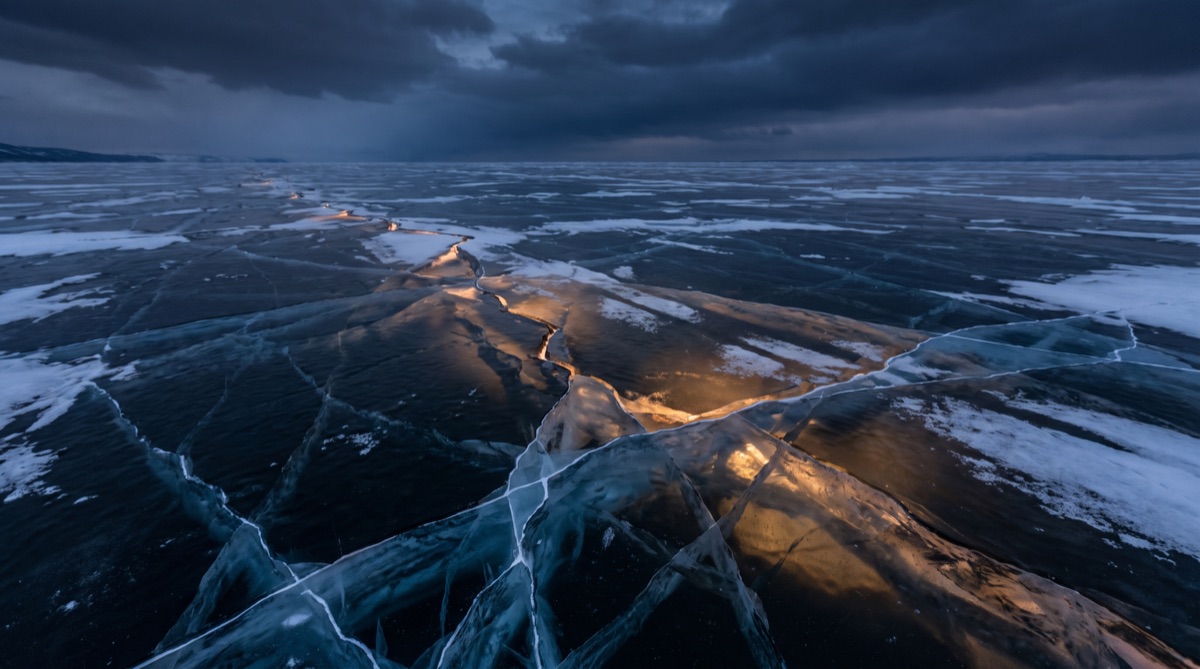
Two numbers tell you everything about where this war really stands.
On Polymarket, every ceasefire-continues market for the Russia-Ukraine conflict is pinned between 98% and 99%. The guns are quiet. The operational pause holds. But the Russia-Ukraine ceasefire-agreement market — the one that asks whether anyone will actually sign anything — just dropped 17% in a single month. The October 2026 tranche sits at 8%. December 2026 at 19%. Even June 2027 can only muster 51%.
Note
Polymarket divergence snapshot (August 29, 2026): every ceasefire-continues tranche pinned at 98-99%, while ceasefire-agreement odds fell 17% this month. The crowd is pricing an indefinite frozen war — guns quiet, paper unsigned. Over $6.3 million has traded on the agreement market since May. This is conviction, not noise.
That divergence is the story the headlines miss. This is not a war winding down toward peace. It is a frozen war that is cracking — not at the front line, but at the negotiating table. And what the crowd is pricing in, from draft rumors to doomsday radio bursts to a CIA director's midnight visit to Moscow, paints a picture of a conflict entering its most unstable phase since the 2022 invasion.
The Divergence: What the Crowd Is Actually Pricing
The distinction between "ceasefire continues" and "ceasefire agreement" is not semantic. It is the entire analytical frame.
A ceasefire continuing means the status quo persists: no major offensive, no formal collapse of the truce arrangements that have held since the May 2026 Victory Day pause. The crowd prices this near certainty because both sides have tactical reasons to maintain it. Russia needs time to reconstitute forces depleted by its grinding Donetsk offensive. Ukraine needs time to integrate Western systems and train reserves. Neither side benefits from a dramatic escalation right now.
A ceasefire agreement is something entirely different. It requires both parties to sign a document, agree on terms, accept territorial realities, and commit to enforcement mechanisms. It requires diplomacy to succeed. And diplomacy is precisely what is failing.
The 17% monthly decline on the agreement line is not noise. Over $6.3 million has traded on this market since its May 2026 launch — enough liquidity to reflect genuine conviction, not thin-market randomness. The money is making a precise, cold-eyed bet: the shooting stays paused, but nobody signs anything. Frozen, not resolved.
We identified this same pattern in April when Russia's reserve wall was cracking but Polymarket wouldn't move. The difference now is that the market is moving — in the wrong direction.
Three Cracks the Crowd Sees
1. The Diplomatic Stall
On August 28, Kremlin spokesman Dmitry Peskov declared negotiations were on a "deep pause" — language that, in Moscow's diplomatic lexicon, means "we are winning on the ground and see no reason to concede at the table." The same day, Russian Foreign Minister Sergei Lavrov rejected even limited proposals for a Black Sea maritime strike moratorium offered by Turkey and Ukraine, underscoring that Russia is systematically refusing even the most modest confidence-building measures.
The one glimmer — Ukrainian Presidential Office head Kyrylo Budanov's August 27 statement that trilateral talks with Russia and the U.S. "could resume in September" — was immediately undercut by Maria Zakharova, who denied receiving any official proposal. Budanov himself warned that combat operations will continue through winter and that freezing the front line is "impossible due to Russia's categorical refusal."
This is talks-about-talks theater. The prediction market is pricing it correctly: diplomatic-meeting odds rose 19.5% even as deal odds fell 17%. More meetings, less progress. The signature pattern of a frozen conflict crystallizing into permanence.
2. The Draft Exodus
If the diplomatic stall is the visible crack, the draft exodus is the internal one — and it's the one that matters more for the power balance.
Over 113,000 Russians entered Georgia in a single week in mid-August, with 20,000 crossing on August 20 alone. Georgian real estate portals report Tbilisi apartment demand up 30% year-over-year. The trigger: persistent rumors of a new mobilization wave, fed by Ukrainian intelligence assessments claiming Russia plans to call up 600,000 additional personnel across 2026-2027, and a Wall Street Journal report that the Russian military was "testing its readiness" to process a new wave of recruits.
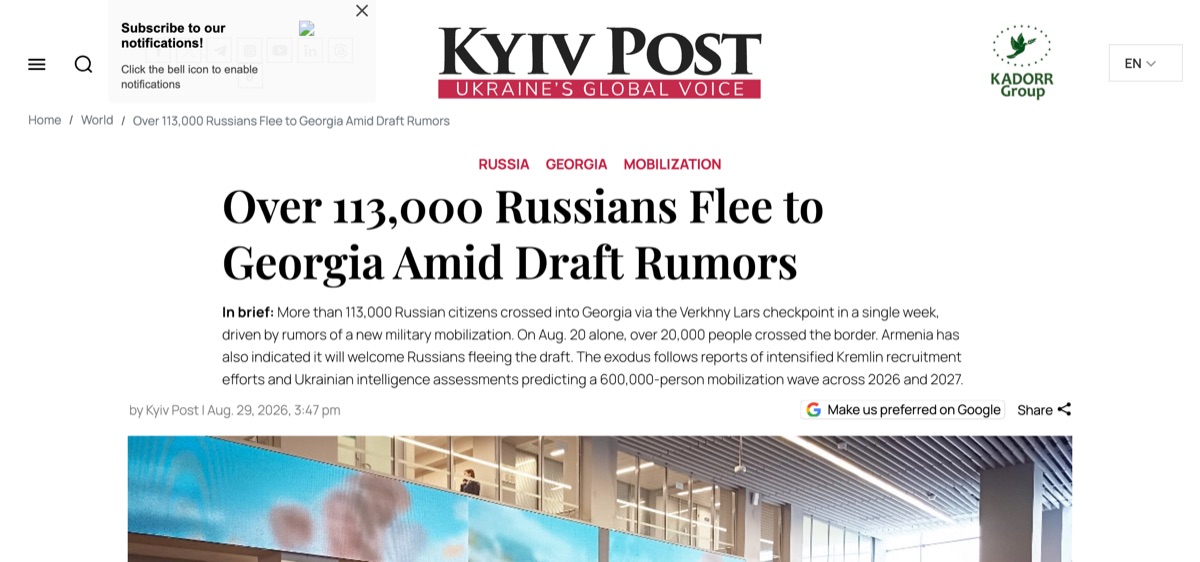
Read the full Kyiv Post report on the draft exodus →
The Kremlin's response? Peskov dismissed the rumors as "information ducks" — deliberate fabrications. It is worth noting that Peskov used nearly identical language in September 2022, calling mobilization reports "nonsense." Putin announced a "partial mobilization" of 300,000 reservists days later.
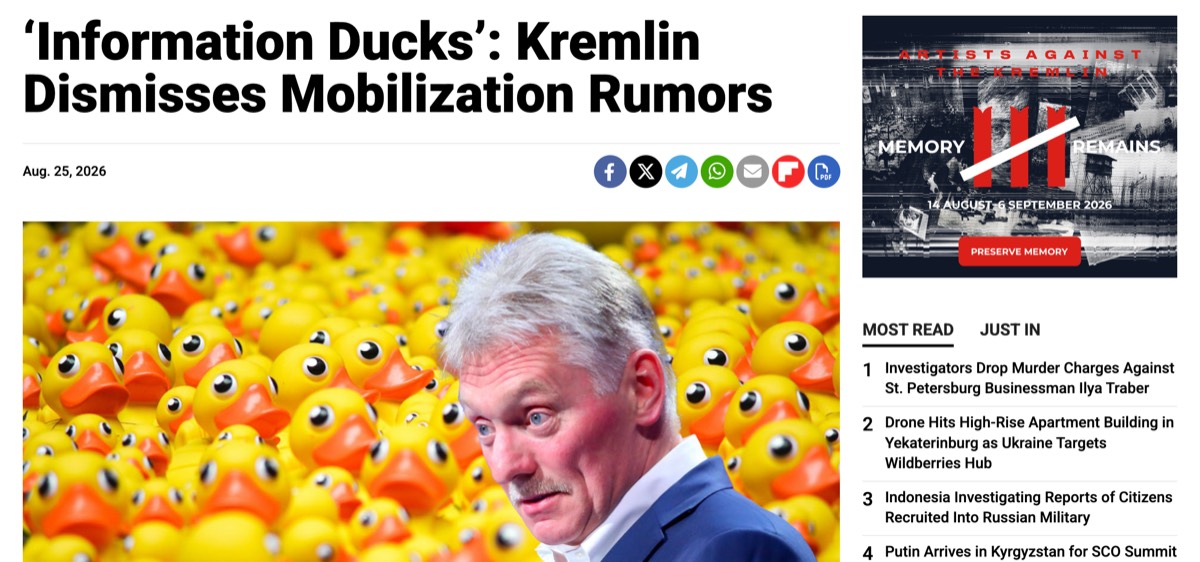
Read the Moscow Times report →
The crowd remembers. The draft-flight pattern — young men voting with their feet before Moscow votes with its pens — is not speculation. It is a behavioral signal with a proven track record from 2022. And unlike diplomatic communiques, it cannot be stage-managed.
3. The Doomsday Buzzer
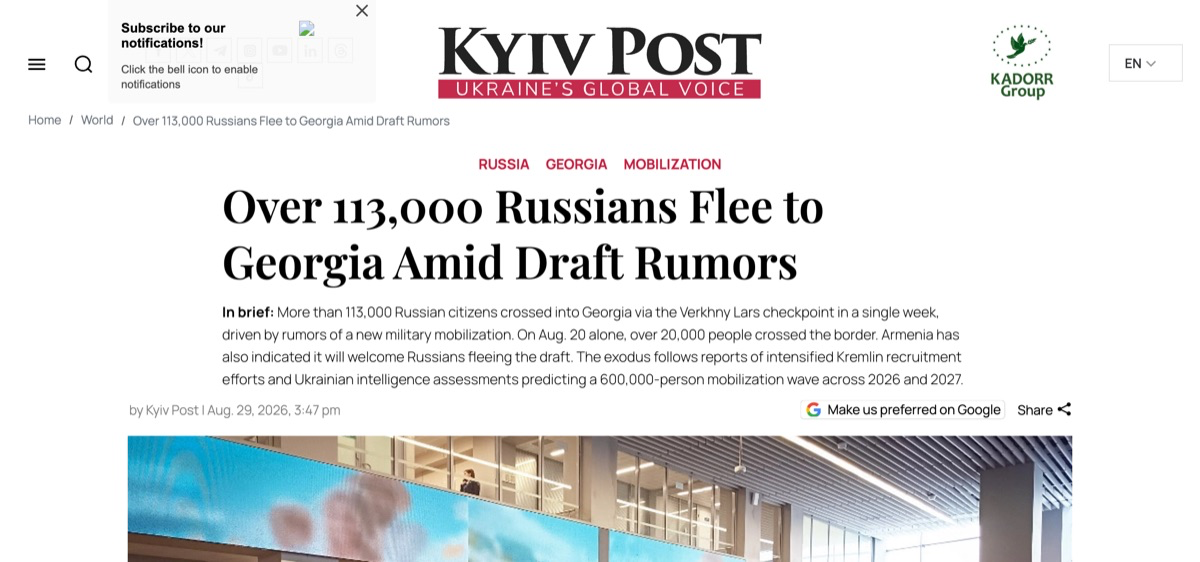
On August 27, two days after CIA Director John Ratcliffe made an unannounced visit to Moscow, Russia's UVB-76 shortwave station — the so-called "Doomsday Radio" that has buzzed monotonously on 4625 kHz since the 1970s — erupted with approximately 25 coded messages in a single day. The station, widely believed to be a military communications channel, had been largely silent since August 20.
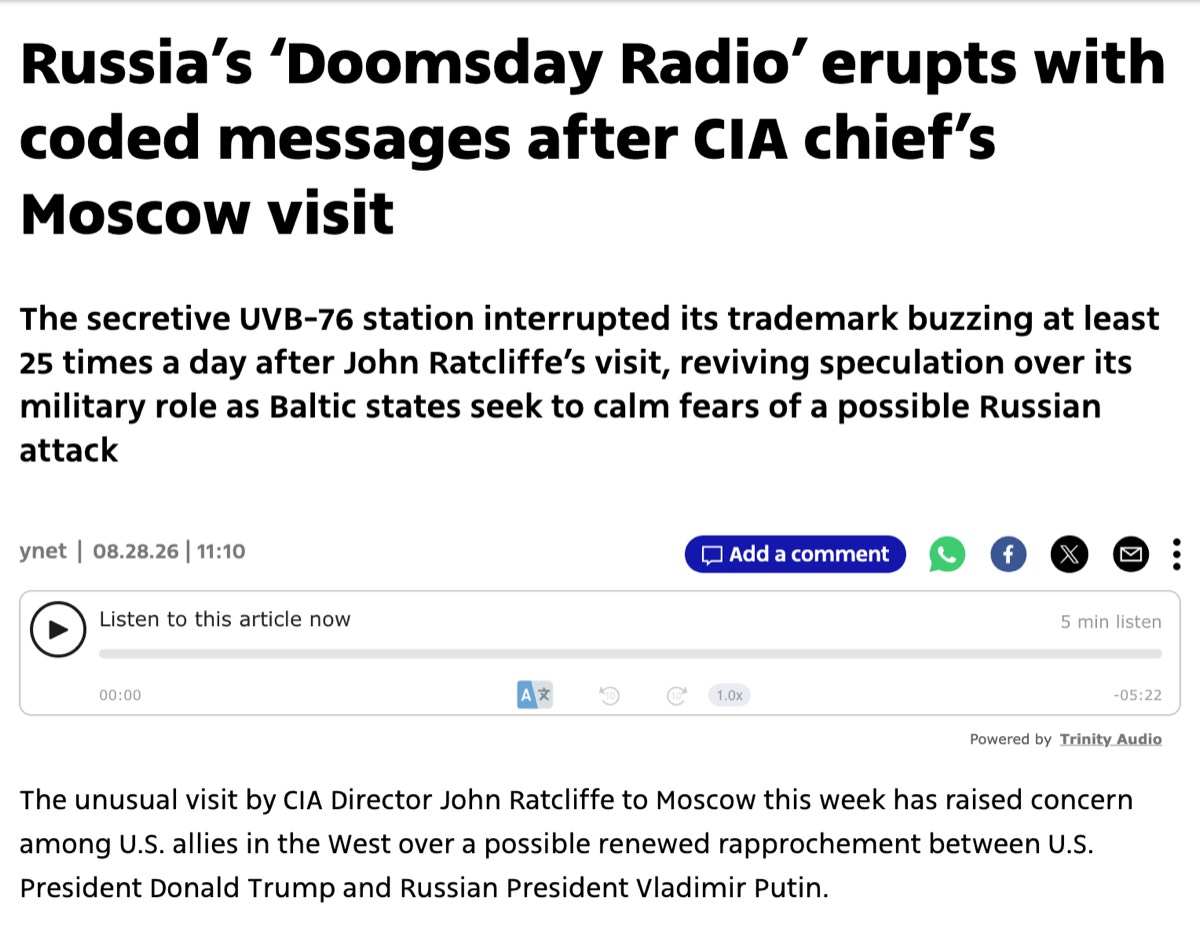
Read the YnetNews report on UVB-76 →
The timing was exquisite, even if coincidental. Ratcliffe's visit had three purposes, according to reporting from CNBC, CNN, and Axios: warn Russia against attacking NATO members, pressure Moscow to help isolate Iran, and float a Trump-Putin-Zelensky trilateral summit.
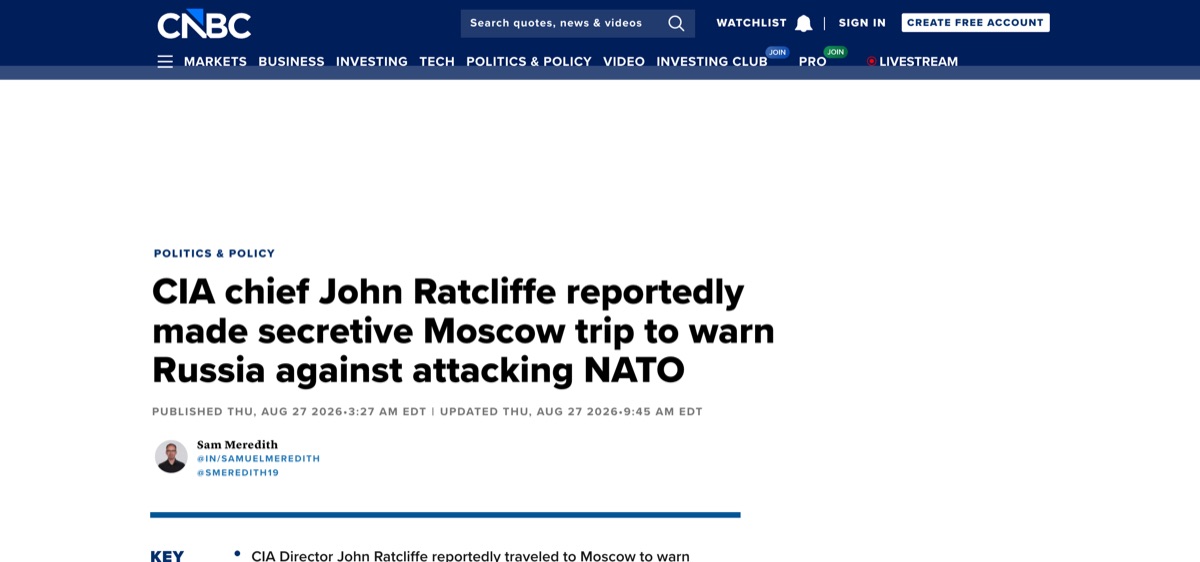
Read the CNBC report on Ratcliffe's Moscow visit →
Is there a direct link between the CIA visit and the radio burst? Almost certainly not. UVB-76's transmissions follow their own operational logic, and the station has a long history of periodic coded broadcasts unrelated to any specific geopolitical event. But in a conflict environment saturated with ambiguity, the perception of linkage matters. The r/worldnews thread treating UVB-76 as a crisis signal — 9,262 upvotes, 784 comments — is itself a data point: it tells you how primed the public information space is for escalation narratives, even when the operational ceasefire holds.
This is the paradox of the frozen war: the front line is static, but the information environment is febrile. And febrile information environments produce real-world effects — like 113,000 Russians crossing a border.
The Internal Rot: Russia's Soviet-Era Pessimism
The prediction market sees the diplomatic surface. What it may be underpricing is the internal pressure building beneath Russia's frozen exterior.
A state-run VTsIOM poll conducted in July 2026 found that 66% of Russians believe "difficult times" lie ahead — a 16-percentage-point increase since January. For historical context, the last time Russian public sentiment hit this level was 1991, months before the Soviet Union collapsed, and 1992, when the population faced mass impoverishment and 2,500% hyperinflation.
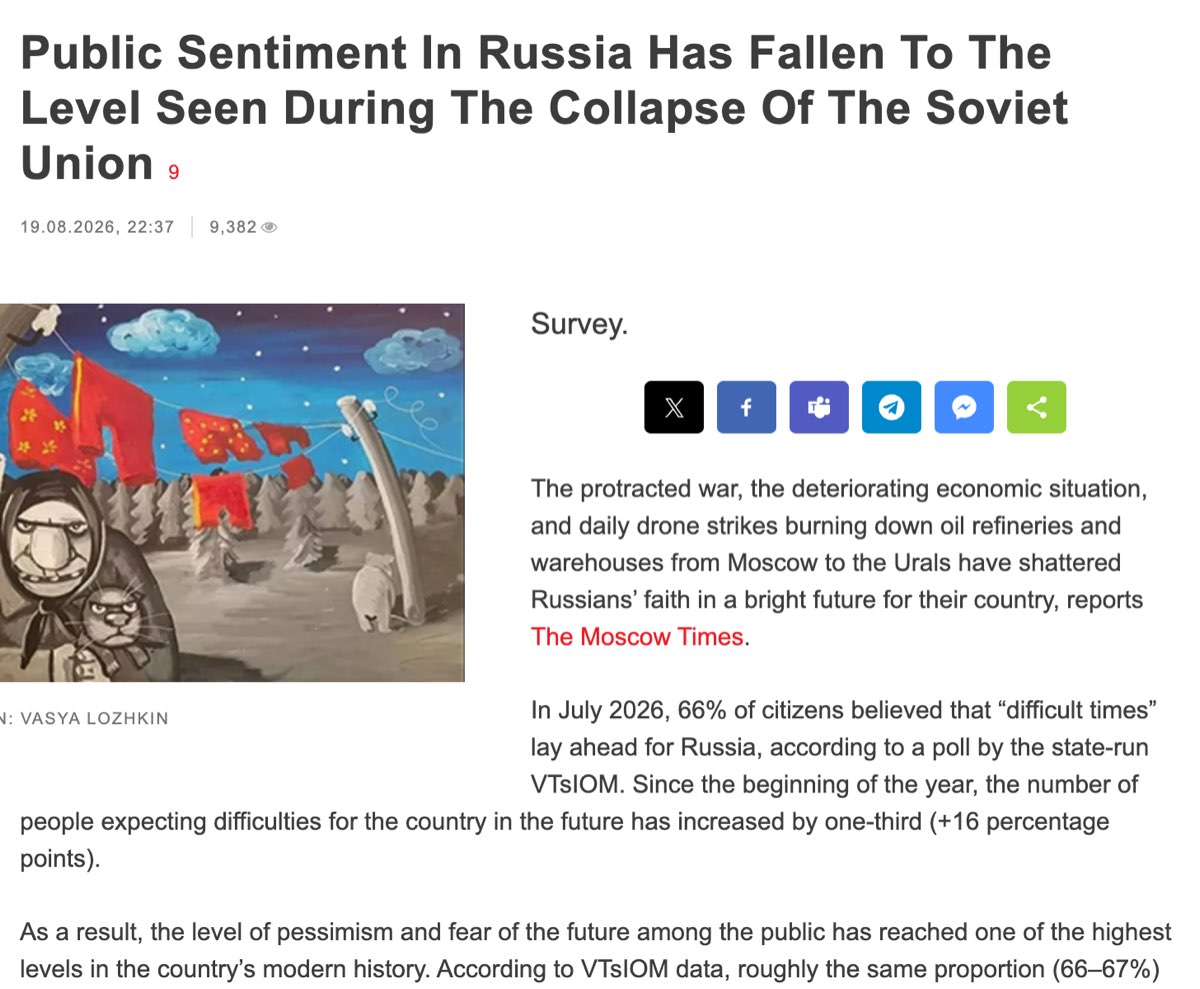
Putin's own approval rating tells a parallel story. VTsIOM recorded the sharpest weekly drop since the 2022 invasion in late June, with approval sliding from 70.4% to 66.9% in a single week. The independent Levada Center recorded a slide from 79% to 74% in the same period. Both pollsters show a consistent downward trajectory through 2026, driven by fuel shortages, internet blackouts, Telegram restrictions, and the quiet accumulation of war fatigue.
The frozen front masks these pressures. Russia captured 1,548 square kilometers across June, July, and August — more than double the equivalent 2024 period — but has suffered a net loss of 233 square kilometers for the year, according to Ukrainian mapping group Deep State. The tactical gains in Donetsk come at enormous human cost, and the reserves question hangs over everything: Russia's contract-soldier recruitment, fueled by signing bonuses that now exceed annual median incomes in many regions, is approaching its ceiling.
Contrarian Corner: Is the 17% Drop Just a Bubble Popping?
Critical
Before reading too much into the agreement-odds decline, consider the alternative: the 17% drop may represent rational recalibration rather than a genuine deterioration in peace prospects.
Early 2026 deal odds were inflated by Trump-summit hype — the May ceasefire, the prisoner swap, the "Art of the Deal" rhetoric. None of it had diplomatic substance. The market may simply be correcting a speculative bubble, not signaling a new crisis.
The strongest version of this argument: look at what hasn't moved. The ceasefire-continues line is rock-solid at 98%. If the crowd genuinely believed the conflict was entering a dangerous new phase, that line would be trending down too. It isn't. The market sees a stable, indefinite stalemate — not a collapse.
This is the "priced in" read, and it deserves serious weight. The question is whether a stable stalemate is actually stable — or whether it's the kind of stability that compounds internal pressure until something breaks.
What the Community Is Saying
The Reddit response to this week's Russia-Ukraine developments reveals a public information environment that has moved well past the "ceasefire optimism" phase of early 2026.
The UVB-76 thread on r/worldnews drew 9,262 upvotes and 784 comments, with the top-voted threads debating whether the radio burst constituted a genuine military signal or "just the internet being the internet." The split itself is informative: a year ago, UVB-76 activity barely registered outside hobbyist shortwave forums. Now it trends on a mainstream news subreddit. The Overton window for "things that might indicate escalation" has widened dramatically.
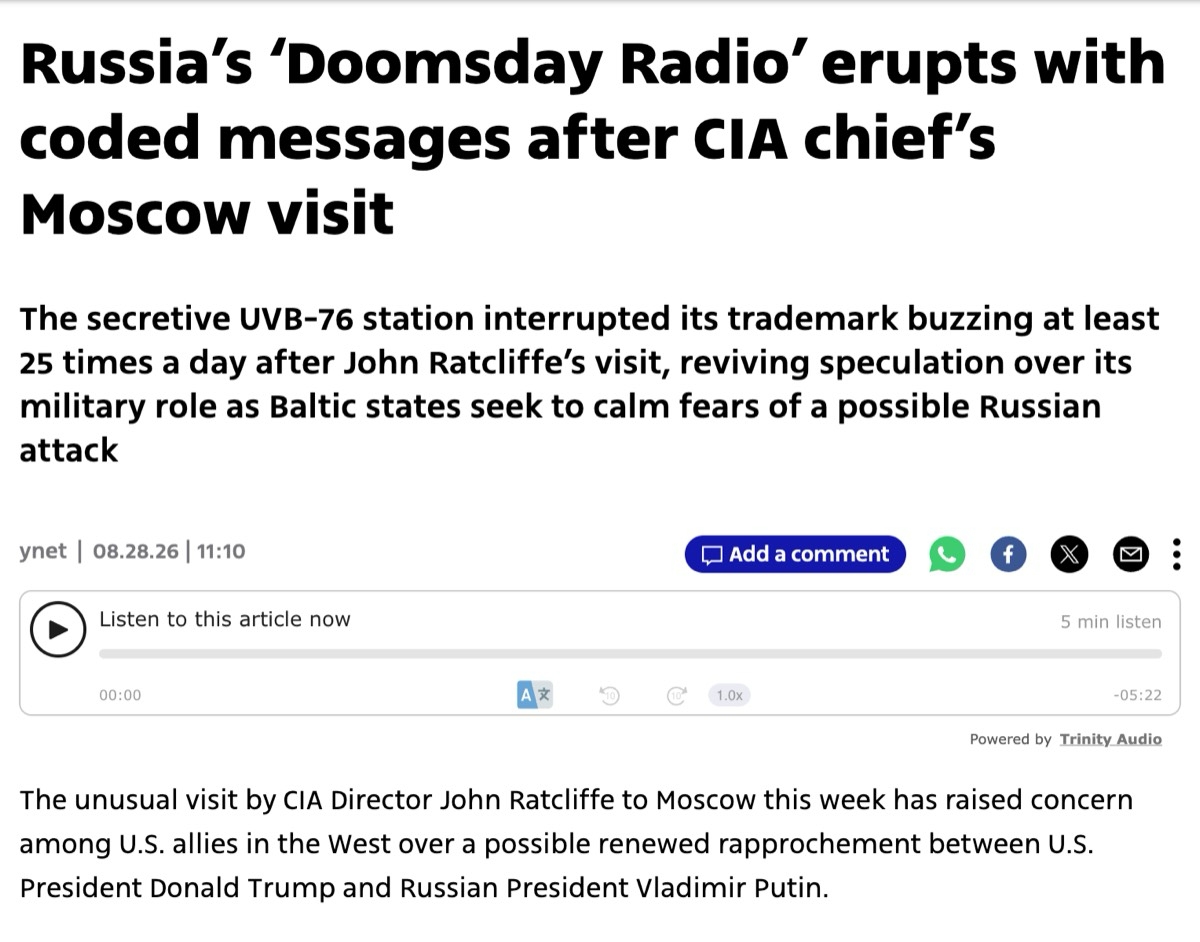
The draft-exodus thread (1,548 upvotes, 116 comments) generated comparisons to the September 2022 mobilization panic, with multiple commenters noting Peskov's identical "information ducks" language from four years ago. The community memory is long, and the pattern-matching is correct: the behavioral signal (mass border crossings) preceded the policy announcement (mobilization decree) by days in 2022.
Meanwhile, European leaders rallied in Kyiv for Independence Day — a solidarity display that reads differently when the agreement odds are cratering. The show of support reinforces the ceasefire-continues line (Ukraine's backers are committed to the status quo) while doing nothing for the agreement line (nobody at those ceremonies was discussing terms).
Three Lessons from the Divergence
Lesson 1: Frozen wars have a shelf life, and the clock is internal. The front-line freeze rewards patience for Ukraine's backers but creates compounding pressure inside Russia. Draft rumors, capital flight, approval ratings at Soviet-collapse levels, and a VTsIOM poll showing 66% pessimism — these are not stable-equilibrium indicators. They are the kind of internal pressures that, in historical precedent, force autocratic leaders toward either dramatic concession or dramatic escalation. The prediction market prices neither outcome, defaulting to an indefinite status quo. That may be the biggest mispricing of all.
Lesson 2: The asymmetry of visible vs. invisible pain determines the edge. Ukraine's suffering is on camera every night — missile strikes on Kyiv, frontline losses in Donetsk, the grinding attrition of a war fought on its own soil. Russia's pain is internal, statistical, and actively suppressed: polling data, recruitment ceilings, reserve depletion, demographic strain. Prediction markets, like all crowds, overweight visible information and underweight hidden structural decay. The edge for analysts is in the structural data. We identified this asymmetry in our analysis of Russia's Oreshnik strike calculus, and it has only sharpened since.
Lesson 3: The prediction-market divergence template applies across conflicts. We saw the same ceasefire-continues-vs.-agreement-drops pattern on the Iran-Israel markets, where Reddit saw war while Polymarket saw peace. The Russia-Ukraine version is more advanced — the divergence is wider, the data richer, and the internal-pressure indicators more alarming. When every "continues" market pins near 100% while every "agreement" market falls, the crowd is telling you something specific: the world has entered an era of frozen conflicts that nobody knows how to unfreeze.
What to Watch
Three indicators will tell you whether the frozen war stays frozen or starts to thaw — in either direction:
-
The ceasefire-continues line. As long as it holds above 95%, the operational status quo is intact. A drop below 90% is the genuine crisis signal. Everything else is noise.
-
September talks. If Budanov's trilateral meeting actually materializes, watch the agreement-tranche reaction in the first 48 hours. A sharp move up on the March 2027 line (currently 40%) would signal the crowd sees genuine diplomatic momentum, not theater. No movement = priced as theater.
-
Russian Duma elections. Parliamentary elections in September create a brief window where mobilization is politically costly for the Kremlin. If the draft rumors subside through election day, the prediction market will likely stabilize. If they intensify afterward — particularly if Peskov's "information ducks" language resurfaces — the 2022 playbook is repeating.
The frozen war is the default state of the 2026 international order. But frozen is not stable, and the cracks at the negotiating table are widening while the cracks inside Russia deepen. The crowd has priced the surface. The edge is in the structure.
The Desk
About The Arc of Power
The Arc of Power editorial desk delivers rigorous analysis of geopolitics, defense, economic statecraft, and intelligence — examining the forces that shape the global order.
Briefing Access
Request Briefing Access
In-depth geopolitical analysis — power dynamics, defense strategy, and economic statecraft — three times a week. No noise.
Request briefing access