Case file · Geopolitics · 11 min read
How Taiwan Risk Is Repricing the Chip Supply Chain
Nvidia's $3.5B MediaTek bet is a board-level hedge on a Taiwan scenario. The chip supply chain is being quietly repriced.
The Arc of Power ·

On August 31, Nvidia announced a $3.5 billion investment in MediaTek — its largest direct investment outside the United States. The deal was structured as convertible bonds, not equity. MediaTek's stock jumped 10%, adding $20 billion in market value overnight. The official framing was ecosystem expansion: NVLink Fusion adoption, AI PCs, autonomous vehicles.
That framing is correct — and incomplete.
Read the structure, not the press release. Nvidia bought convertible bonds — an instrument that gives upside exposure with downside protection. It took 90% of MediaTek's $3.9 billion offering, the largest overseas convertible-bond issuance in Taiwan's capital-market history. Alphabet participated in the remaining slice. When the two most valuable companies on Earth quietly take near-total allocation on a Taiwanese chip designer's debt offering, the signal is not about product roadmaps. It is about positioning.
This piece argues that the Nvidia-MediaTek deal is one data point in a broader pattern: the semiconductor supply chain is being quietly repriced for a Taiwan scenario that corporate boards treat as non-trivial but that nobody — not Jensen Huang, not Morris Chang's successors, not the Pentagon — wants to say out loud.
The Pattern: Three Moves That Converge
The MediaTek deal does not exist in isolation. Read it alongside two other recent signals and a structural thesis emerges.
First signal: Diamandis and the vulnerability thesis. In March, Peter Diamandis published "From Hyperabundance to Terafab" on his Metatrends Substack. The piece centers on Musk's planned mega-fab, but its analytical core is a blunt assessment of TSMC's strategic position. Diamandis writes that if independent US semiconductor production scales, "Elon is single-handedly de-risking World War III," because "a Chinese invasion of Taiwan becomes far less catastrophic if we're not completely dependent on TSMC for advanced chips." The framing is unambiguous: TSMC's concentration of advanced manufacturing is not a competitive advantage to be preserved — it is a vulnerability to be engineered out of existence.

View original post on Substack →
Second signal: Sequoia's sovereign AI playbook. In August, Sequoia Capital partner Sonya Huang published "Own Your Intelligence: A How-to Guide for Sovereign AI". The argument reframes AI strategy around ownership of the intelligence layer itself — not just models, but the compute substrate and training infrastructure that produces them. Huang's four-part case (cost protection, speed, data sovereignty, strategic control) reads as a corporate governance manual for reducing dependency on concentrated supply chains. The word "Taiwan" does not appear in the piece. It does not need to.
Days later, Hugging Face developer advocate Merve Noyan posted on X: "here's my take on consequences of chip bans and potential regulations, own your intelligence friends." The phrasing — own your intelligence — has crossed from venture capital thesis to practitioner imperative in under two weeks.

Third signal: TSMC's own $165 billion answer. TSMC's Arizona GigaFab cluster — up to 12 fabs totaling $165 billion — is the company's own acknowledgment that concentration risk has become existential. Fab 21 Phase 1 began 4nm production in the first half of 2025, manufacturing chips for both Apple and Nvidia's Blackwell AI processors. It is the first time TSMC has produced cutting-edge AI silicon outside of Taiwan. Phase 2 targets 3nm production in 2027. The pace is unprecedented, the cost premium is 30-50% above Asian operations, and the strategic imperative is obvious: TSMC is building its own hedge because its customers are demanding one.
Three Theses on What the Money Is Saying
Thesis 1: Convertible Bonds Are Options on Catastrophe
The choice of instrument matters more than the dollar amount. Nvidia did not buy MediaTek equity — it bought convertible bonds. In financial mechanics, a convertible bond is a debt instrument with an embedded call option: if MediaTek's stock rises, the bonds convert to equity at a profit; if the stock falls (or a geopolitical event destroys value), Nvidia holds senior debt with priority claims over equity holders.
This is the instrument you choose when you want exposure to a partner's upside while protecting against tail risk. It is the instrument sovereign wealth funds use when investing in politically unstable regions. It is the instrument a board approves when the risk committee has flagged the geography.
Jensen Huang is not a geopolitical commentator. He does not need to be. The instrument speaks.
Thesis 2: The "Silicon Shield" Is Being Repriced as a Liability
For two decades, the dominant geopolitical frame around Taiwan's chip industry has been the "Silicon Shield" — the theory that Taiwan's indispensability to global technology supply chains deters Chinese military action. Destroy the fabs, and you destroy the global economy. Rational actors do not do this.
Ben Thompson's February 2026 Stratechery analysis challenges this frame directly. His core argument: AI, unlike nuclear weapons, has a physical dependency in Taiwan "that can be easily destroyed by Chinese missiles, even without an invasion." The shield works only if the attacker's own interests are bound to it. As China's domestic semiconductor capacity grows — however slowly — and as US-allied nations build alternative supply chains, the shield's deterrent value degrades.
View discussion on Hacker News →
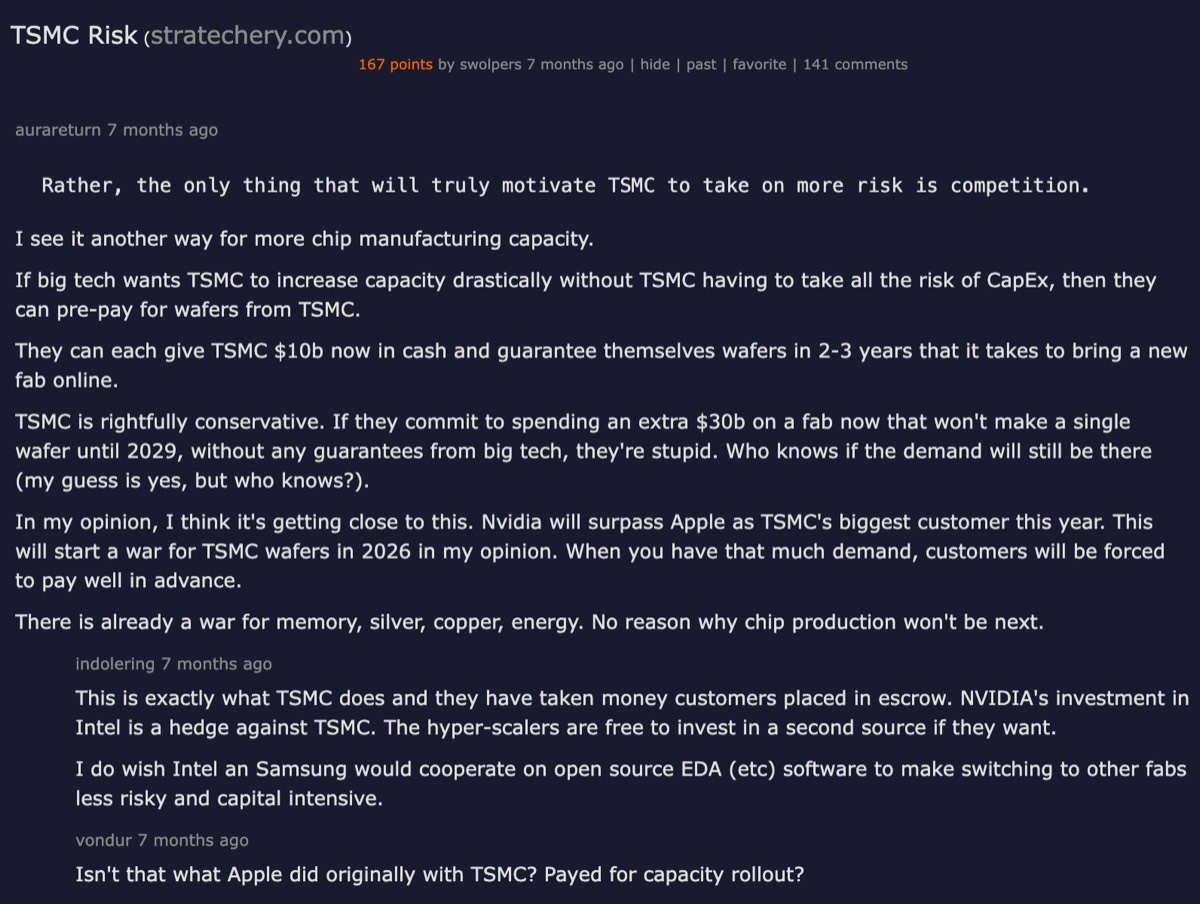
The Hacker News discussion on Thompson's piece drew 167 points and 141 comments. The top-voted comments are revealing: practitioners debating whether tech companies should pre-pay TSMC billions to secure future wafer capacity, whether hyperscalers should invest in alternative fabs as hedges, and whether the "most expensive fab is the empty one." These are not theoretical discussions. They are procurement strategy conversations conducted in public.
In May, Chamath Palihapitiya argued that Taiwan's strategic importance would diminish within 18 months as US-domiciled advanced manufacturing scales. That prediction drew heavy criticism from semiconductor analysts who called it naive. But the directional bet — that the shield is depreciating — is shared by every major participant's capital allocation, if not their public statements.
Thesis 3: "Own Your Intelligence" Is the New "Own Your Data"
Sequoia's framing deserves a closer read because it connects the semiconductor supply chain to the AI application layer in a way that makes the Taiwan risk thesis actionable for corporate strategists.
The argument: as AI models become the core competitive asset, companies that rent intelligence from frontier model providers (OpenAI, Anthropic, Google) face the same concentration risk that companies renting compute from a single cloud provider faced a decade ago. The solution is vertical integration — build your own models, own your training loops, control your inference infrastructure.
But the chain does not stop at models. Inference runs on chips. Chips are manufactured in fabs. Over 90% of the world's most advanced fabs are in Taiwan. "Own your intelligence" is a supply-chain thesis masquerading as an AI strategy thesis.
This is what makes the Nvidia-MediaTek deal legible as geopolitics. MediaTek designs chips. It does not manufacture them — TSMC does. But MediaTek's design capabilities, combined with Nvidia's NVLink Fusion architecture, create a pathway for custom silicon that could theoretically be manufactured at TSMC-Arizona, Samsung, or Intel Foundry Services. The investment buys Nvidia optionality on the design layer while the manufacturing layer diversifies.
View full analysis on Sourceability →
The Numbers That Matter
The semiconductor supply chain's Taiwan concentration is not an abstraction. The numbers are specific and alarming:
- TSMC produces over 90% of the world's most advanced chips (7nm and below), per Professor Hung-Yi Chen's 2026 analysis.
- Nvidia has secured 70% of TSMC's 3-nanometer production capacity, per Diamandis.
- TSMC's Arizona investment of $165 billion across up to 12 fabs is the largest foreign direct investment in US manufacturing history.
- The cost premium for US-based manufacturing is 30-50% above Asian operations — a premium the industry is now willing to pay.
- MediaTek's $3.9 billion convertible bond offering is the largest overseas convertible-bond issuance in Taiwan's capital-market history.
Each number is a price signal. The 30-50% premium is the market's implicit valuation of Taiwan risk. The $165 billion commitment is TSMC's own probability-weighted assessment of disruption. The convertible-bond structure is Nvidia's risk committee speaking in financial instruments.
Critical
The Contrarian Read: The $3.5B MediaTek investment deepens Taiwan exposure rather than hedging it. MediaTek is a Taiwanese company. The convertible bonds are dollar-denominated but the underlying equity is Taiwan-listed. If the strait scenario materializes, Nvidia's $3.5B is as exposed as TSMC's fabs. The "hedge" narrative may be a convenient post-hoc framing of what is simply an ecosystem play dressed in geopolitical clothing. Watch whether Nvidia's next large investment goes to a non-Taiwan chip designer — that would confirm the hedge thesis. If it does not, the ecosystem reading wins.
What This Repricing Means
Three implications follow from the pattern:
For defense planners: The corporate sector is pricing Taiwan risk faster than government contingency planning. When Nvidia's treasury team structures a $3.5 billion deal as convertible bonds rather than equity, they are making an implicit probability assessment that the Pentagon's public posture does not reflect. Policy should follow capital allocation, not the other way around.
For investors: The geographic concentration premium in semiconductor stocks has not yet been repriced by public markets. TSMC trades at roughly 25x forward earnings — a premium that reflects AI demand growth but does not adequately discount the tail risk that multiple analysts have flagged. The smart money is moving in private structures: convertible bonds, fab facility commitments, sovereign AI infrastructure funds. The repricing has begun in private capital; public markets will follow, likely discontinuously.
For technology strategists: "Own your intelligence" is becoming the supply-chain equivalent of "own your data." A decade ago, enterprises learned that putting all their data in a single cloud provider created leverage risk. The same logic now applies to the AI stack: companies that depend on a single geographic bottleneck for the chips that run their models are accepting concentration risk that boards are increasingly unwilling to carry. Sequoia's playbook makes the case for vertical integration at the model layer. The semiconductor layer is next.
The Quiet Part
Nobody at Nvidia, MediaTek, TSMC, or Sequoia is publicly framing their moves as Taiwan contingency planning. Jensen Huang told Bloomberg the deal is about "transforming every computing platform." MediaTek CEO Rick Tsai talked about NVLink Fusion as a technology partnership. Sonya Huang wrote about competitive strategy, not geopolitics.
This is exactly what you would expect. No CEO in a publicly traded company can say "we are hedging against the possibility that China disrupts the Taiwan Strait" without creating the market panic they are trying to avoid. The language of corporate strategy — ecosystem, platform, partnership — is doing double duty as the language of geopolitical hedging.
The money is saying what the words cannot. A $3.5 billion convertible-bond position in a Taiwanese chip designer, a $165 billion fab buildout on American soil, a venture capital manifesto about owning your own intelligence stack, a Hugging Face developer advocate telling her followers to "own your intelligence, friends" — these are not coincidences. They are the supply chain repricing itself, one instrument at a time.
Follow the money. The money has already decided what it thinks about the Taiwan Strait.
The Desk
About The Arc of Power
The Arc of Power editorial desk delivers rigorous analysis of geopolitics, defense, economic statecraft, and intelligence — examining the forces that shape the global order.
Briefing Access
Request Briefing Access
In-depth geopolitical analysis — power dynamics, defense strategy, and economic statecraft — three times a week. No noise.
Request briefing access