Case file · Geopolitics · 13 min read
UAE Quits OPEC: How the Hormuz War Cracked the Cartel
UAE's May 1 OPEC exit ends 59 years of cartel discipline. The Hormuz war, the Habshan-Fujairah pipeline, and who replaces the cartel.
The Arc of Power ·

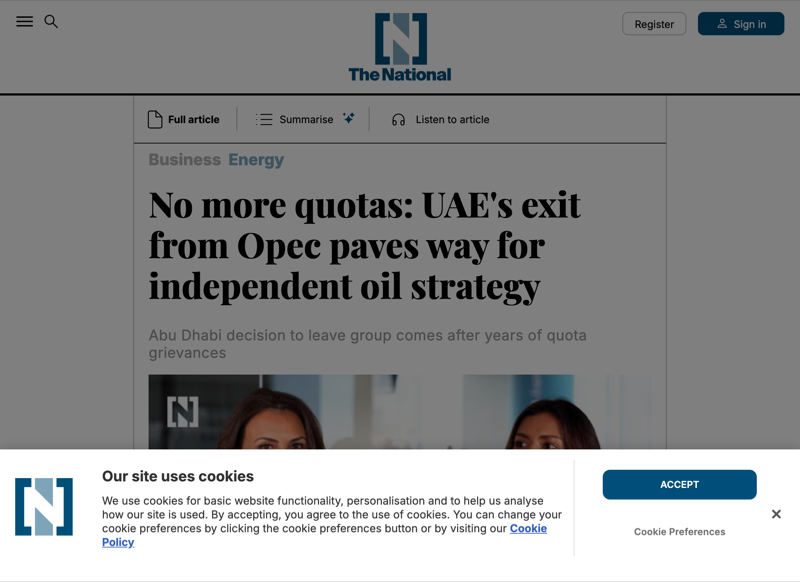
On May 1, 2026, after 59 years of membership, the United Arab Emirates officially left OPEC. Abu Dhabi removed all production quotas the same day. The UAE Energy Ministry's framing was bureaucratic; the substance is not. A founding modern producer just walked off the cartel's discipline floor in the middle of a Gulf war, and the cartel cannot punish them — because the only retaliatory tool OPEC has ever possessed is a coordinated production cut, and the UAE has already opted out of that arithmetic.
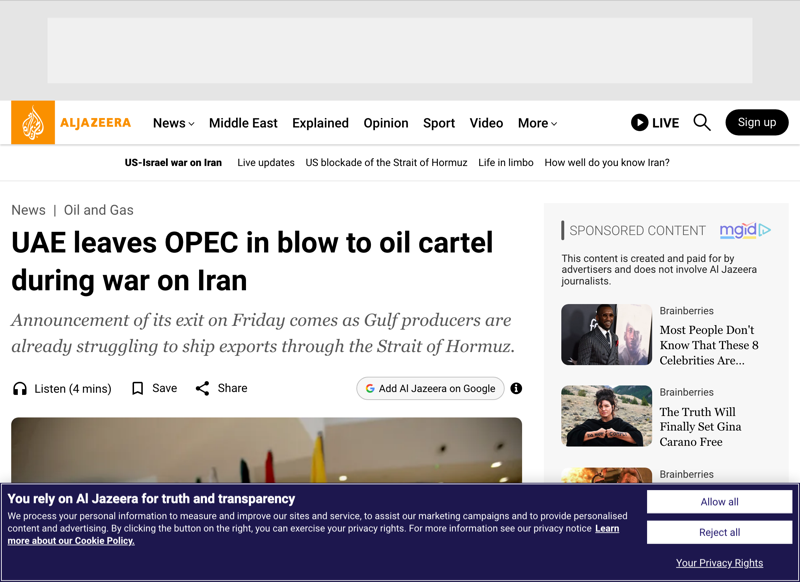
This is not a single-news-cycle story. It is the second-order consequence of the Iran war converging with a long-running production-quota grievance — a grievance the war turned into a once-in-a-generation exit ramp. Read this article alongside our prior pieces on the UAE's yuan warning to Washington and the US Hormuz blockade and UK refusal: three threads, one shape.
The shape is this: the post-1973 oil order — OPEC discipline, dollar settlement, Strait-of-Hormuz transit as the supply chokepoint — is being unbundled in real time. Each piece is being separately repriced. The UAE's exit is the price-discovery event for the cartel layer. This piece walks through what it actually means, who replaces OPEC's pricing power, and the second-order effect on the dollar/yuan tug-of-war.
Note
The Quota Grievance — and Why the Iran War Detonated It
The UAE's frustration with OPEC quotas is not new. Inside the cartel, capacity-vs-quota disputes have been a recurring fight since 2021. Saudi Arabia anchors the OPEC+ framework on the principle that all members hold back proportionally; the UAE — which spent $150 billion building production capacity 40% faster than the rest of the bloc — has been the structural loser of that arithmetic for half a decade.
What changed in 2026 is leverage. Three forces compounded:
- The Iran war disrupted Hormuz transit, not UAE production. The UAE's capacity is unscathed; what's strained is the export channel that runs through the strait. That distinction is everything for the OPEC argument: the UAE can credibly claim it can produce more if Saudi Arabia's discipline-based price floor doesn't constrain it.
- The Habshan-Fujairah pipeline (ADCOP) bypasses Hormuz entirely. Since 2012, the UAE has had a $3.3-billion pipeline running from the Habshan oil fields to Fujairah on the Gulf of Oman — outside the Strait of Hormuz. This is the feature Saudi Arabia does not have. As long as the pipeline runs, the UAE can export through a war that paralyzes Saudi Aramco's tankers.
- OPEC's only enforcement is coordinated cuts. A producer that wants to exit cannot be punished short of a price war, and a price war during an oil-shock-driven inflation crisis would be politically suicidal for Saudi Arabia. The UAE chose the only window in twenty years where exiting was genuinely costless.
The grievance was old. The opportunity was new. The Iran war is the substrate that made the exit affordable.
The Pipeline That Made the Exit Possible
Most analysis of the UAE-OPEC exit reads it as a quota dispute. That framing misses the geometry. The exit is enabled by a single piece of physical infrastructure — the Habshan-Fujairah pipeline — and you cannot understand the strategic logic without understanding that geometry.
The pipeline runs ~360 km from inland Habshan oil fields to the deepwater port of Fujairah on the Gulf of Oman. Capacity: 1.5 mbpd nameplate; expandable to 1.8 mbpd. It is the only major crude export route in the Gulf that does not pass through the Strait of Hormuz. Saudi Arabia has the East-West pipeline to Yanbu on the Red Sea, but Yanbu is exposed to the Yemen-Bab-el-Mandeb-Suez axis — itself a war zone — and Saudi capacity through Yanbu is below Aramco's actual export volume. Iran has nothing equivalent. Iraq's Kirkuk-Ceyhan pipeline runs through Turkey and is politically conditional.
The UAE alone has a redundant export channel. That redundancy is what converts an OPEC quota grievance into a strategic exit. An OPEC member that depends on Hormuz transit cannot leave during a Hormuz war; an OPEC member that doesn't, can. The asymmetry is structural, and Abu Dhabi has been quietly compounding it since 2012.
This is why the Saudi response has been muted to the point of uncomfortable silence. Riyadh's leverage over Abu Dhabi was always quota-based, and Abu Dhabi just walked outside the framework where that leverage works.
What "Project Freedom" Means When Read Against the Exit
The same week the UAE exit became official, Trump announced "Project Freedom" — a US Navy operation to escort commercial ships through the Strait of Hormuz, using guided-missile destroyers, 100+ aircraft, and 15,000 service members. Iran's parliament's National Security Commission warned that any US interference in the strait would be a violation of the April 8 ceasefire. As of May 4, US and Iranian forces have already traded fire in the contested waterway, and Iran struck multiple vessels and set a UAE oil port on fire (Foreign Policy reporting).
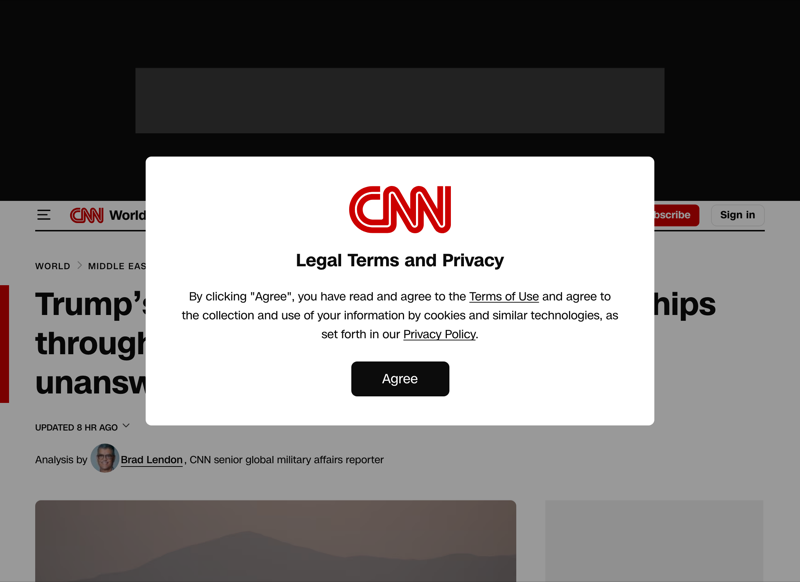
The Council on Foreign Relations' first read is sharper than most: Project Freedom does not actually open Hormuz, because the operational obstacle is not commercial nerve — it is insurance markets. War-risk premiums on Hormuz transit have made shipping economically unviable regardless of US naval presence. A destroyer escort can deter Iranian strikes; it cannot underwrite Lloyd's of London's cargo policies. The shipping lanes don't open until insurers re-rate, and insurers don't re-rate during an active naval-fire exchange.
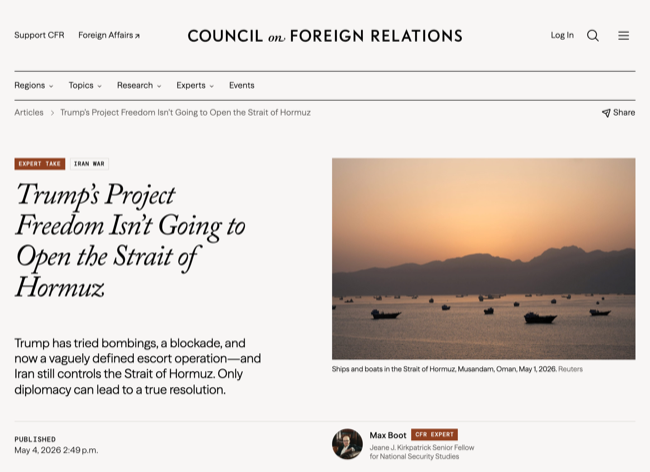
Read against the OPEC exit, Project Freedom means: Saudi Arabia's exports stay constrained, the UAE's exports flow through the pipeline, and the US can keep one Gulf ally producing at full tilt without resolving the war. The Trump administration is not trying to end the Hormuz crisis. It is trying to manage it down to the level where the UAE-pipeline workaround keeps Western inflation tolerable. That is a much smaller objective than "free Hormuz," and it's roughly the objective Project Freedom is operationally sized for.
Who Replaces OPEC's Pricing Power
OPEC's pricing power was always a coordinated-cuts mechanism — a group of producers willing to leave revenue on the table to defend a price floor. Take the UAE out, and the math gets unstable. The remaining members:
- Saudi Arabia still controls ~30% of OPEC capacity but is now exposed to a unilateral cut without a key partner to share the burden.
- Iraq, Kuwait, Iran are smaller producers and (Iran especially) sanctions-constrained.
- Russia (OPEC+) is technically outside the quota structure and has been free-riding on Saudi cuts since 2022.
- Venezuela, Algeria, Nigeria are revenue-maximizers, not price-defenders; they cheat on quotas as a baseline.
The structural read: OPEC's pricing power was already weakening, and the UAE exit removes the second-largest disciplined producer. Saudi Arabia can still set a floor by unilateral cuts, but the cost of doing so without UAE backstop is much higher and the political reward is much lower.
The likely next-quarter shape: a softer cartel with one anchor (Saudi Arabia), an independent UAE running at capacity through Fujairah, and Russia free-riding. The price floor on Brent moves down structurally. The price ceiling, however, moves up — because the UAE's exit removes the swing capacity that historically capped spikes during Mideast wars. Brent volatility goes up, even as average prices may not.
The Surprise Winner the Economist Was Hinting At
The Economist's video short flagged a "surprising country getting richer" from the Iran war. Most read the framing as Russia (true but obvious) or the US shale producers (true but partial). The deeper answer is the UAE itself.
Three flows converge on Abu Dhabi:
- Pipeline crude that Saudi Arabia cannot export competitively during the war commands a war premium when sold from Fujairah.
- Sovereign wealth flows. Iran's Hormuz blockade re-priced every dollar-denominated reserve held in the Gulf; UAE sovereign funds are positioned as the regional safe-haven for displaced petrodollar capital, similar to how Singapore absorbs displaced Asian capital during regional shocks.
- Strategic optionality. The yuan-pricing threat the UAE quietly conveyed to Washington in April (covered in our petrodollar piece) becomes more credible post-OPEC exit, because the UAE no longer has a cartel obligation to settle in dollars. The threat is now operationally executable — which is exactly what makes it valuable as leverage even if never used.
The UAE is repositioning from "regional middle power inside OPEC" to "independent oil producer with bilateral leverage over both Washington and Beijing." Abu Dhabi gets richer in absolute terms and richer in optionality.
Second-Order Effects on the Dollar/Yuan Tug-of-War
The UAE-yuan question is now structurally more interesting than it was in April. Before the exit, the UAE selling oil in yuan was a hypothetical that required cartel coordination to be price-relevant. After the exit, the UAE can unilaterally settle a portion of its 4.85 mbpd capacity in yuan without asking anyone. That is not a complete petrodollar collapse — the dollar is still the deepest reserve currency, and most UAE buyers (India, Japan, South Korea) prefer dollar settlement — but it is the first credible bilateral on-ramp for yuan-denominated oil at meaningful scale.
China has been waiting for exactly this. The PBOC's offshore yuan capacity has been positioned for a Gulf settlement test for two years; the failure mode has always been "no Gulf producer is independent enough." The UAE just became that producer.
The realistic first-quarter shape: 5–15% of UAE crude exports settled in yuan-equivalent (likely via Chinese state-buyer arrangements with refineries that have CNY funding). Symbolic, but real. The dollar's share of oil settlement was 100% in 2020 and roughly 92% in 2025; this drops it to ~88–90%. Each percentage point is large in absolute volume, and the trend is unidirectional.
This is not the end of the petrodollar. It is the beginning of the petrodollar's competitive phase — where the dollar has to actually price its convenience advantage rather than monopolize it.
The Domestic-Politics Bleed-Through
The OPEC fracture is ringing through US domestic politics in ways the energy press is undercovering. Three events this week, all connected:
- Spirit Airlines shut down — first US airline casualty of the fuel-cost shock. CBS framed it as the leading edge of a budget-carrier collapse as fuel prices surge globally.
- $5/gallon gasoline is now being projected by Connecticut focus groups on MSNBC. Trump's "drop like a rock" promise is collapsing in real time, and his polling is moving with it.
- Hegseth's "Crusader-in-Chief" framing has gone mainstream — Vox and Guardian both ran biographical reframings of the Defense Secretary's worldview as the operating logic of an unauthorized war.
The OPEC exit makes all three structurally worse. UAE flexibility takes pressure off global supply, but Saudi Arabia's response — not increasing production to offset the war — keeps Brent elevated. The political class is going to hold the Iran war responsible for the price; the technical class will know it's actually the OPEC-fracture-plus-Hormuz combination. Either way, the gap between Trump's domestic narrative ("we're winning, Iran will pay") and Trump's domestic results (Spirit, $5 gas, falling polls) is widening.
The Three-Year Forecast
If we project two to three years ahead from this exit:
Saudi Arabia: anchors a smaller, weaker OPEC. Continues unilateral cuts to defend the price floor, increasingly resented by remaining members. The cartel becomes effectively a Saudi-Russian duopoly on coordinated cuts, which is a much weaker thing than OPEC.
UAE: runs at capacity, uses pipeline to bypass Hormuz, settles 10–20% of exports in non-dollar currencies (yuan, euro, rupee). Becomes the price-discovery node for non-cartel Gulf crude. ADNOC IPO becomes a global market event.
United States: shale fills part of the gap, but US producers don't price-defend the way OPEC did. Brent volatility stays elevated. Domestic politics increasingly shaped by gasoline as a political variable.
China: gets a meaningful yuan-oil settlement on-ramp without having to invade or sanction anyone. Negotiates bilaterally with Abu Dhabi. The petroyuan thesis goes from "academic seminar" to "operational reality with single-digit market share."
The OPEC institution itself: continues to exist as a coordination forum but loses pricing power. The cartel as the swing producer of last resort is functionally over. Pricing power moves to demand-side aggregation (China, India bulk-buying agreements) and to non-cartel producers (US shale, Brazil, Guyana).
Bottom Line
The UAE's OPEC exit is the price-discovery event for the post-1973 oil order. It does not end the dollar's role in oil settlement — but it ends OPEC's role as the swing producer that defended price floors and ceilings simultaneously. The Iran war was the catalyst. The Habshan-Fujairah pipeline was the prerequisite. The quota grievance was the motive.
Read alongside our prior coverage of the UAE's yuan warning, the Hormuz blockade analysis, and the broader Iran-war ceasefire architecture, what this week clarifies is that the second-order effects of the war are now bigger than the kinetic phase. The cartel fractured. The dollar's monopoly began to compete. The pipeline became the geopolitical asset that the destroyer was not. None of those changes reverse if the war ends tomorrow.
The post-1973 oil order took 53 years to build. It is being unbundled, layer by layer, in a single quarter. The UAE's exit is the layer where the cartel ends.
Related on The Arc of Power:
The Desk
About The Arc of Power
The Arc of Power editorial desk delivers rigorous analysis of geopolitics, defense, economic statecraft, and intelligence — examining the forces that shape the global order.
Briefing Access
Request Briefing Access
In-depth geopolitical analysis — power dynamics, defense strategy, and economic statecraft — three times a week. No noise.
Request briefing access