Case file · Economics · 11 min read
The Hype Picks Moonshot. The Money Picks Xiaomi.
Kimi K3.1 dominates tech headlines but Polymarket bettors price Xiaomi 5-to-1 over Moonshot. What prediction markets reveal about China's real AI race.
The Arc of Power ·
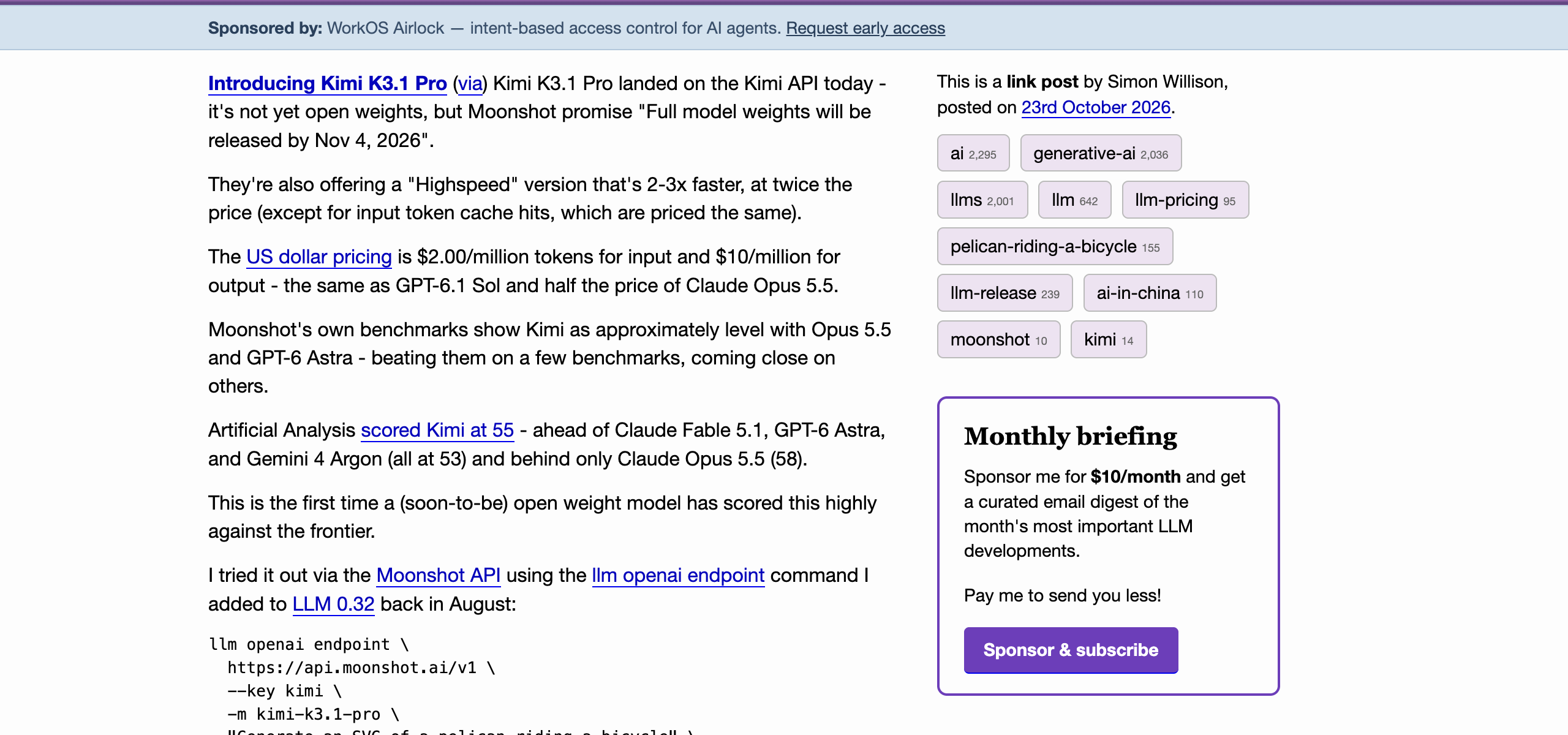
On October 23, Beijing-based Moonshot AI released Kimi K3.1 Pro — a model that, on paper, nearly matches Claude Opus 5.5 on coding benchmarks and beats GPT-6 Astra on terminal tasks, all for $2 per million input tokens. Tech media coverage has been predictably breathless. "Near-Opus quality at 1/5th the cost," headlined Analytics Vidhya. The model scored 4th of 215 on the Artificial Analysis Intelligence Index, just three points below Anthropic's flagship.
But three days after the launch, Polymarket's "Best Chinese AI Company end of October" market tells a different story. The odds: Xiaomi 76%. Moonshot 15%. Over $350,000 in total volume, with the market resolving on October 31 via the arena.ai Text Arena leaderboard. The hype picks Moonshot. The money picks Xiaomi.
That divergence — between who dominates the headlines and who dominates the betting book — is not a market inefficiency. It is a structural insight about how China's AI race actually works.
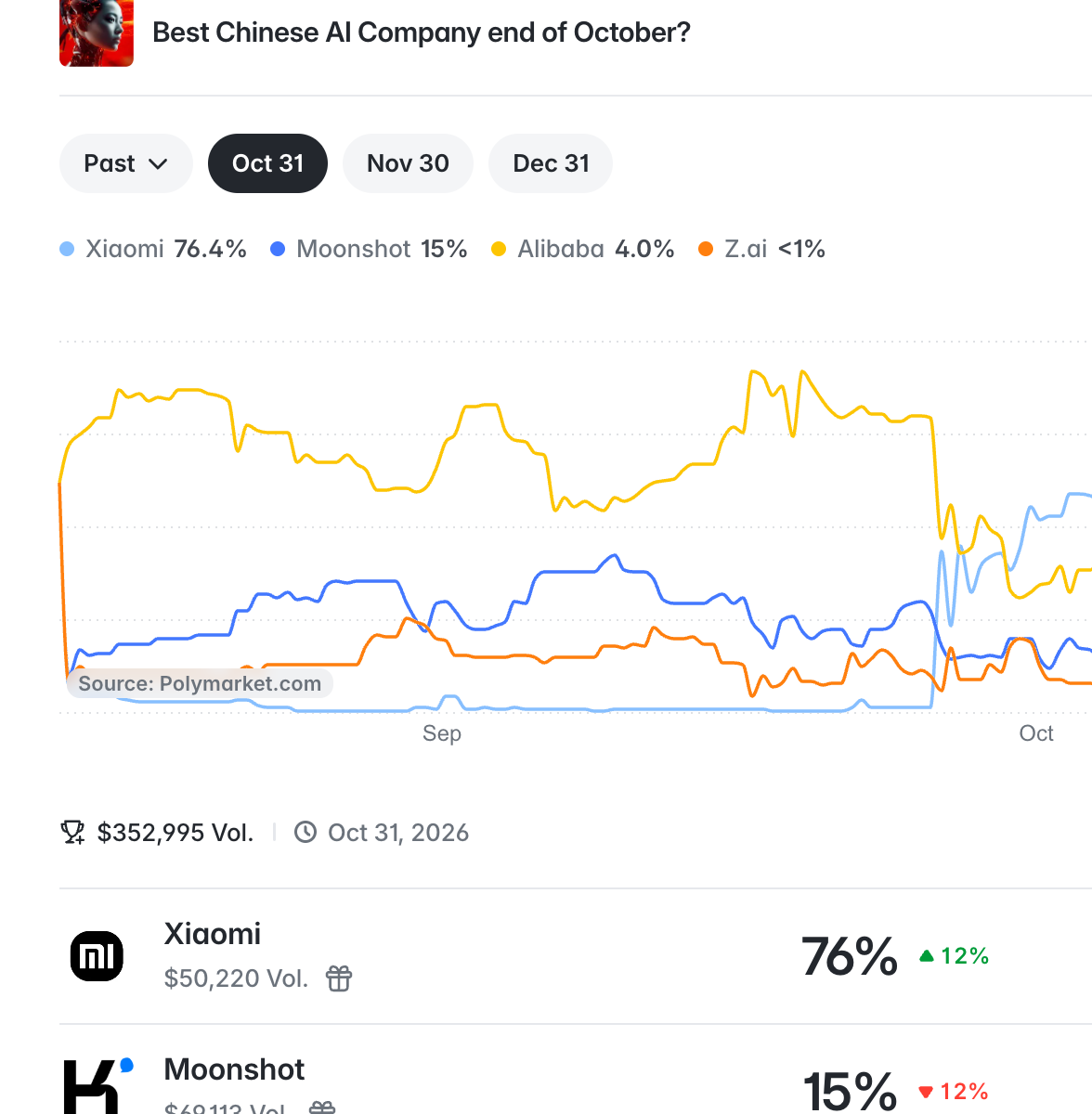
View live market on Polymarket →
The Benchmark Mirage
Kimi K3.1 Pro's benchmark card is impressive on first read. On Terminal-Bench 4.0, Moonshot reports 65.7% — within 0.7 points of Claude Opus 5.5 (66.4%) and seven points above GPT-6 Astra (58.2%). On BrowseComp, it scores 92.1%, edging GPT-6 Astra's 91.5%. On DeepSWE v1.1, it claims 75.5%, surpassing Opus 5.5. The hallucination rate dropped from 23.4% (K3) to 8.3% on Moonshot's internal fact-checking benchmark.
But look closer and the picture cracks.
First, Moonshot ran most of its coding benchmarks inside the Claude Code harness — Anthropic's own tooling. As Jake Handy noted on Substack, this means the headline numbers reflect "Kimi + Claude's infrastructure," not Kimi alone. Nathan Lambert observed that what the results really show is "they figured out their RL" — a training story, not a deployment story.
The Hacker News thread on K3.1 Pro's launch (1,090 points, 675 comments) captured this skepticism in real time:
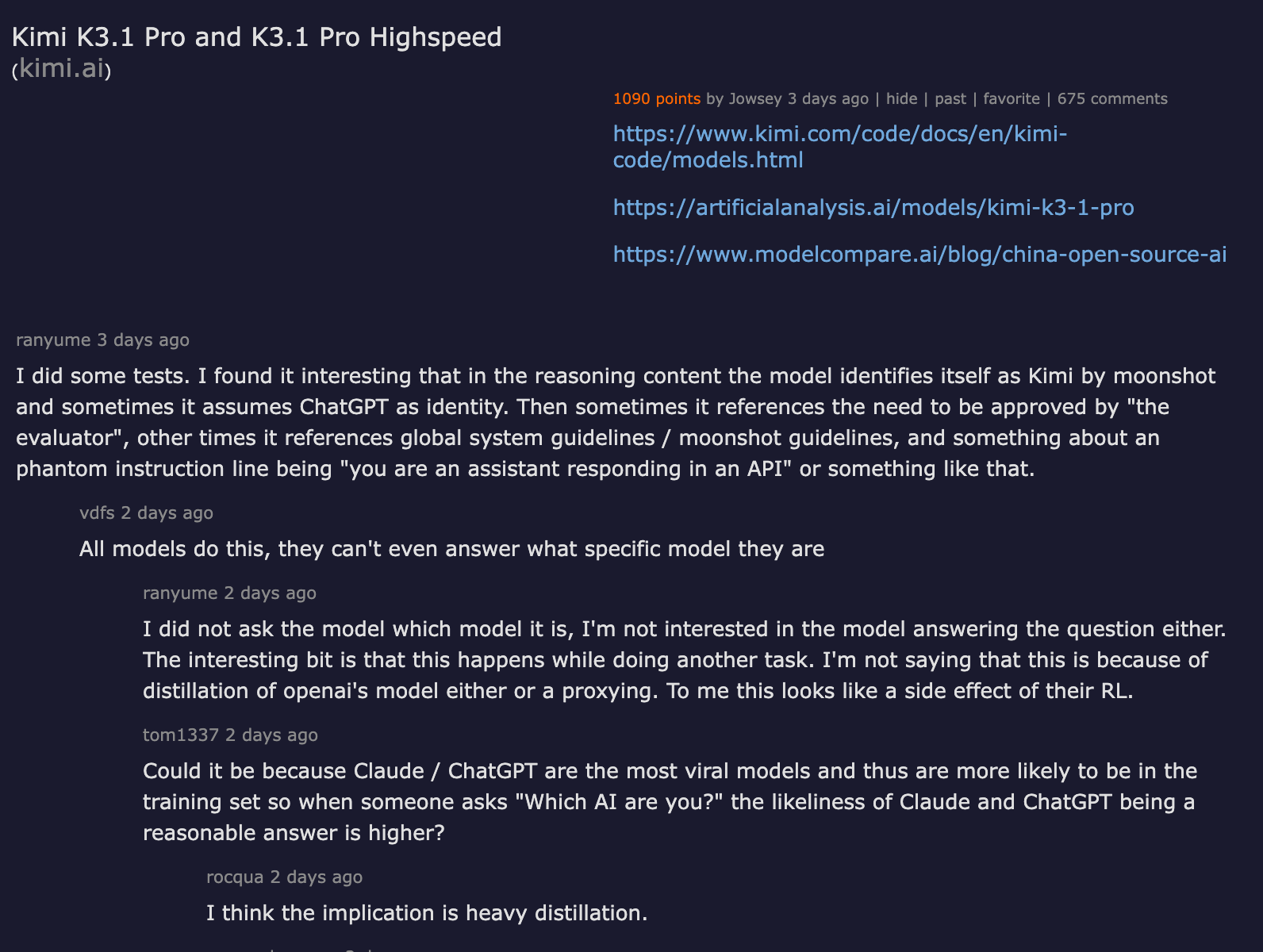
View full thread on Hacker News →
Second, the gaps where K3.1 Pro trails are not small. On ProgramBench, Opus 5.5 scores roughly double (65.0% vs 31.5%). On Terminal-Bench Science, GPT-6 Astra leads 68.1% to K3.1 Pro's 38.1%. Independent evaluators have also flagged discrepancies: Artificial Analysis measured the model producing 150 million output tokens during its evaluation, against a median of 87 million — suggesting K3.1 Pro is significantly more verbose than its competitors, inflating some metrics.
Third, the open weights that would let the community verify these claims are not out yet. Moonshot promises November 4. Until then, the headline numbers are vendor-reported.
Read full analysis on Substack →
Critical
Contrarian Corner: The benchmark skeptics may be too harsh. Moonshot's transparency about removing hacking-related training data — the unfiltered checkpoint scored 90.5% on ExploitBench versus the shipped model's 81.0% — is genuinely unusual among frontier labs. If the open weights on November 4 hold up to independent testing, the hype may prove justified retroactively. Markets can be slow to update, and K3.1 Pro at 15% could be significantly underpriced.
Why the Money Favors Xiaomi
The Polymarket "Best Chinese AI Company" market resolves on a specific, measurable criterion: the arena.ai Text Arena (Overall) leaderboard at 12:00 PM ET on October 31. The company whose model sits highest on that leaderboard wins.
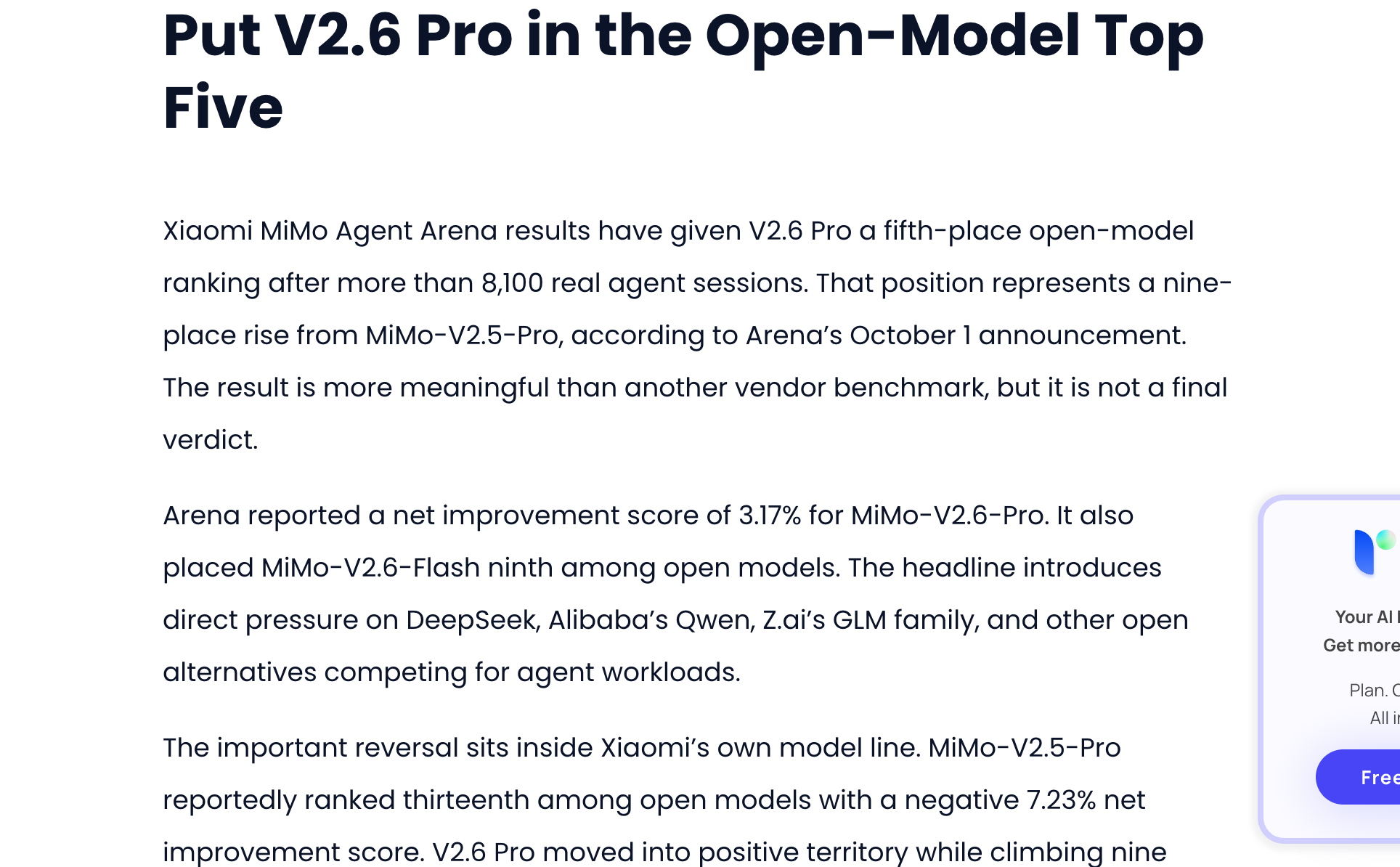
This is not a vibes poll. And on the arena leaderboard, Xiaomi's MiMo-V2.6-Pro has been climbing steadily since its September 22 open-source release. The model ranks fifth among open-weight models on Arena's agent leaderboard, with a net improvement estimate of 3.17% across 8,158 sessions. On the Artificial Analysis Intelligence Index, MiMo-V2.6-Pro scored 46 — the highest of any open-weight model.
Why does a smartphone company's AI lab outprice a benchmark-topping startup? Three structural reasons:
1. Distribution beats benchmarks. Xiaomi shipped over 300 million devices globally in 2025. MiMo is not a model that lives on an API endpoint and waits for developers. It ships inside phones, tablets, smart home hubs, and EVs. When Polymarket bettors evaluate "best Chinese AI company," they are implicitly pricing model-to-distribution speed — and Xiaomi's hardware channel is unmatched among Chinese AI labs.
2. The arena rewards showing up. MiMo-V2.6-Pro has been on the arena for a month. Kimi K3.1 Pro's open weights are not out yet, and the API-only version has limited arena exposure. Bettors are not predicting who could have the best model. They are predicting who will have the highest-ranked model on a specific date. Incumbency matters on leaderboards.
3. Reinforcement learning at scale. Xiaomi's technical differentiation with MiMo V2.6 is not architectural novelty — it is scaled reinforcement learning applied to a 1.02-trillion-parameter Mixture-of-Experts base (42 billion active). The MIT-licensed open weights dropped immediately at launch. No promises. No "coming soon." The model was verifiable on day one.
The Rotation Pattern
Polymarket's monthly "Best Chinese AI Company" markets have a documented pattern: a single dominant favorite holds for weeks, then collapses when a challenger drops verified results.
Consider the arc of 2026:
- April: Baidu wins at 100%, riding its ERNIE model family.
- May through July: Alibaba dominates at 80-93%, powered by the Qwen series.
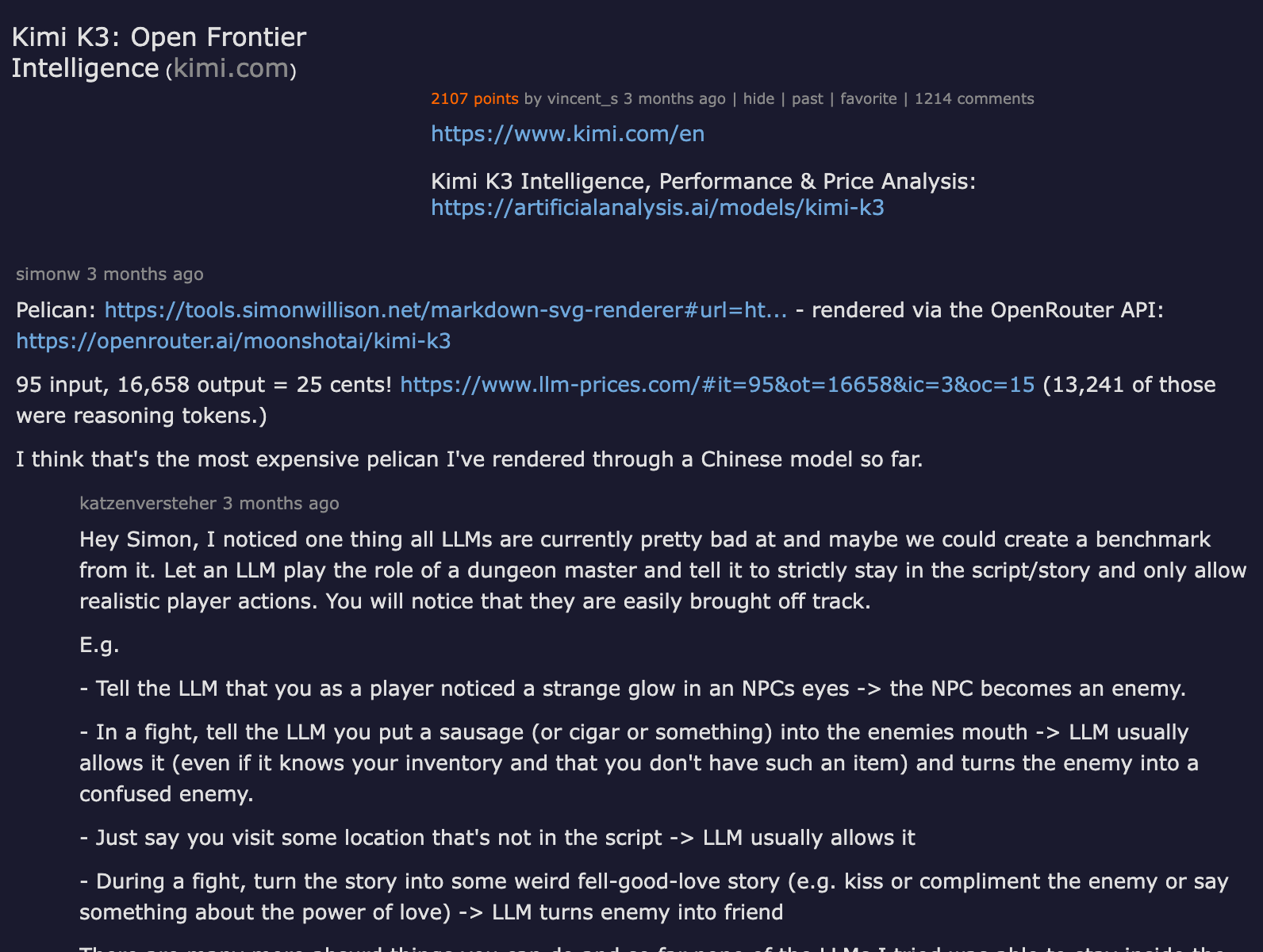
- Mid-July: Moonshot's Kimi K3 launch broke Hacker News with 2,107 points and 1,214 comments — the biggest AI thread of the summer:
View original K3 thread on Hacker News →
- Late July: Moonshot's Kimi K3 launch shakes the market. Alibaba drops 9 points in a single session after Nvidia's Jensen Huang publicly praises K3.
- August through September: Alibaba holds but bleeds share to Xiaomi as MiMo V2.5, then V2.6, climbs the arena.
- October: Xiaomi surges to 76%. The market has rotated fully from Alibaba to Xiaomi in under three months.
The lesson is not that Xiaomi will always lead. The lesson is that the market tracks verifiable, public leaderboard performance, not hype cycles. Kimi K3.1 Pro's vendor-reported benchmarks generated headlines but not arena positions. MiMo-V2.6-Pro's arena results generated odds.
Three Lessons This Market Teaches
Lesson 1: China's AI race is a portfolio, not a horse race
Western coverage treats China's AI sector as a monolith — "China's AI" versus "America's AI." The Polymarket data reveals at least three distinct competitive lanes:
- Pure-play labs (Moonshot, DeepSeek, Z.ai): Benchmark chasers building frontier models. High visibility, high funding ($2 billion for Moonshot at a $20B+ valuation), but no hardware distribution channel. Their models must win adoption through API quality and open weights.
- Hardware-integrated players (Xiaomi, possibly ByteDance): Model quality matters, but the strategic moat is the device fleet. MiMo ships in phones. That is a different competitive game than winning SWE-bench.
- Cloud giants (Alibaba, Baidu, Tencent): The incumbents who dominated early monthly markets but have lost share as specialized players improved. Their advantage is enterprise distribution and government contracts, not model novelty.
This trichotomy mirrors the US debate about whether frontier labs (Anthropic, OpenAI) or hyperscalers (Google, Microsoft, Amazon) will capture the most AI value. The Chinese market suggests the answer may be neither. The hardware company with 300 million endpoints might eat both.
Lesson 2: Open weights are the price of admission, not the advantage
Both Xiaomi and Moonshot release open weights. Both use permissive licenses (MIT for MiMo, promised for K3.1). But the timing difference matters enormously for market pricing. Xiaomi dropped weights on launch day. Moonshot promises them two weeks after API launch.
In prediction markets, "available now" beats "available soon" by any margin. The market cannot price a model it cannot evaluate. K3.1 Pro at 15% with vendor-reported benchmarks is a bet on future verification. MiMo at 76% with a month of arena data is a bet on observed performance.
For policymakers tracking China's open-source AI strategy — a subject we covered when Xi made it the centerpiece of WAIC in July — this distinction matters. The proliferation risk is not from announcements. It is from immediately downloadable weights that independent developers can verify, adapt, and deploy.
Read Simon Willison's analysis →
Lesson 3: Prediction markets expose what coverage obscures
If you read only tech media this week, you would conclude that Moonshot is the Chinese AI story. The coverage-to-odds ratio is stark: K3.1 Pro generated perhaps 50x the column inches of MiMo-V2.6-Pro, but trades at one-fifth the Polymarket probability.
This is not unique to AI. Prediction markets consistently outperform coverage-based sentiment on questions with measurable resolution criteria. The same dynamic plays out in geopolitical markets — media coverage of escalation risks diverges from the prices bettors actually pay.
The "Best Chinese AI Company" market is small ($350,000 total volume, thin by Polymarket standards). But its resolution mechanism — a public, timestamped leaderboard reading — makes it unusually legible. There is no subjective judging. The highest-ranked primarily Chinese company on arena.ai at noon ET on October 31 wins. That clarity makes the Xiaomi-Moonshot divergence harder to dismiss.
View December market on Polymarket →
Note
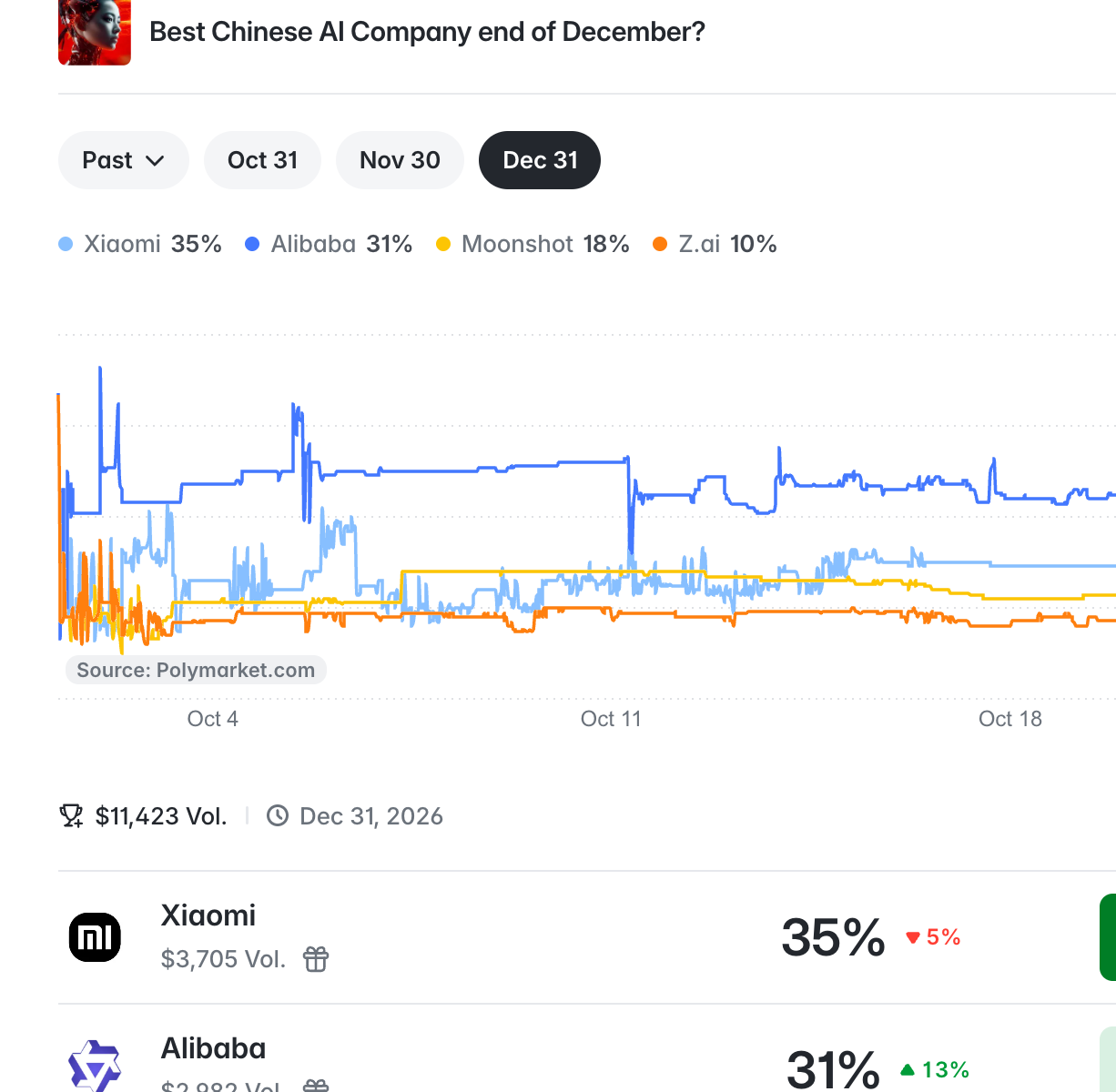
The December Signal: The longer-horizon "Best Chinese AI Company end of December" market shows convergence: Xiaomi 35%, Alibaba 29%, Moonshot 19%. Two months out, bettors give Moonshot better odds — likely pricing the November 4 open-weight release and subsequent arena ranking. The market structure reveals time horizons: October is about who has proven results now; December is about who might prove them next.
What Washington Should Watch
The policy implications extend beyond who wins a monthly Polymarket bet.
First, the "China is 18 months behind" framing is increasingly meaningless. K3.1 Pro trails Opus 5.5 by 0.7 points on coding benchmarks and leads on some browsing and agent tasks. The gap is measured in months, not years — and the gap on open-weight models is arguably zero, since neither OpenAI nor Anthropic releases full weights for their frontier systems.
Second, the infrastructure play is the one that matters for strategic competition. Moonshot building a great model is impressive engineering. Xiaomi embedding capable AI into 300 million devices across Southeast Asia, Africa, Latin America, and Europe is a distribution event that no US company currently matches at that price point. The same logic that drove China's rare-earth positioning — control the supply chain, not just the lab — applies to AI distribution.
Third, prediction markets are becoming a real-time intelligence layer for tech competition. The monthly Chinese AI market on Polymarket is effectively a crowd-sourced technical intelligence assessment, updated continuously, with participants who have money at risk. It captures information that quarterly analyst reports and annual government assessments miss: the week-by-week shifts in competitive positioning that drive actual capability deployment.
The hype cycle will move on from K3.1 Pro within days. The arena leaderboard will update on October 31. And the money, as usual, will have the last word.
The Desk
About The Arc of Power
The Arc of Power editorial desk delivers rigorous analysis of geopolitics, defense, economic statecraft, and intelligence — examining the forces that shape the global order.
Briefing Access
Request Briefing Access
In-depth geopolitical analysis — power dynamics, defense strategy, and economic statecraft — three times a week. No noise.
Request briefing access