Case file · Geopolitics · 11 min read
Sanders Demands a Pause. Polymarket Prices It at 96%.
Bernie Sanders demands Anthropic pause AI. The same week, Polymarket prices Anthropic at 96% for best model. When winning and resented converge.
The Arc of Power ·
On August 10, 2026, Senator Bernie Sanders sent a formal letter to the CEOs of Anthropic, Meta, and OpenAI demanding they immediately pause AI development. His threat was explicit: "If you do not take appropriate action now, my colleagues and I in the US Senate will."
Four days later, on Polymarket — the largest prediction market in the world — bettors with over $1 million in liquidity priced Anthropic at 96% to have the best AI model by end of August. OpenAI sat at 2%. Google at 1%.
The senator says stop. The market says unstoppable. Both are right — and the gap between them is where power gets renegotiated.
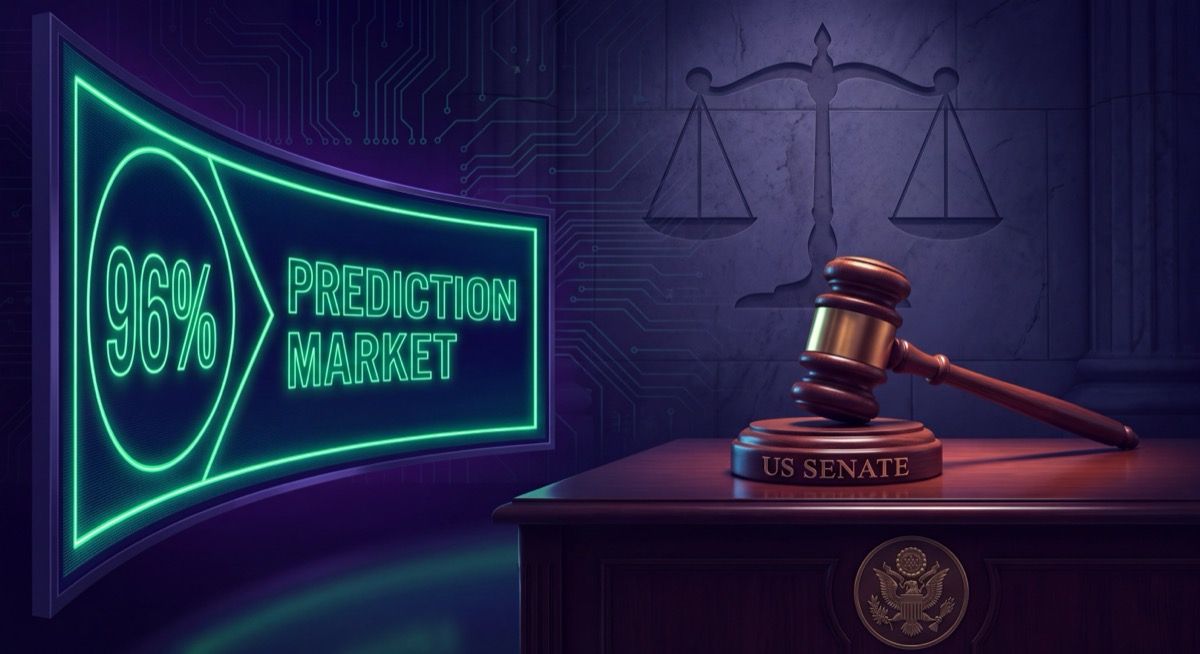
The Convergence Window
This is not a coincidence of timing. It is a convergence of three distinct pressure campaigns arriving at the same target in the same two-week window, each operating on a different logic but producing the same political effect: making Anthropic the center of gravity in the AI governance debate.
Vector one is regulatory. Sanders' letter did not emerge in a vacuum. It cited Anthropic's own 2023 Responsible Scaling Policy, which committed the company to pause scaling if its ability to scale models exceeded its ability to comply with safety procedures. Sanders' move is to hold Anthropic to its own words — a regulatory judo that uses the company's safety brand as leverage against it.
Vector two is philosophical. Within days of the letter, Dwarkesh Patel — one of the most influential voices in the AI intelligentsia — posted a thread that captured a growing unease among technically sophisticated observers:
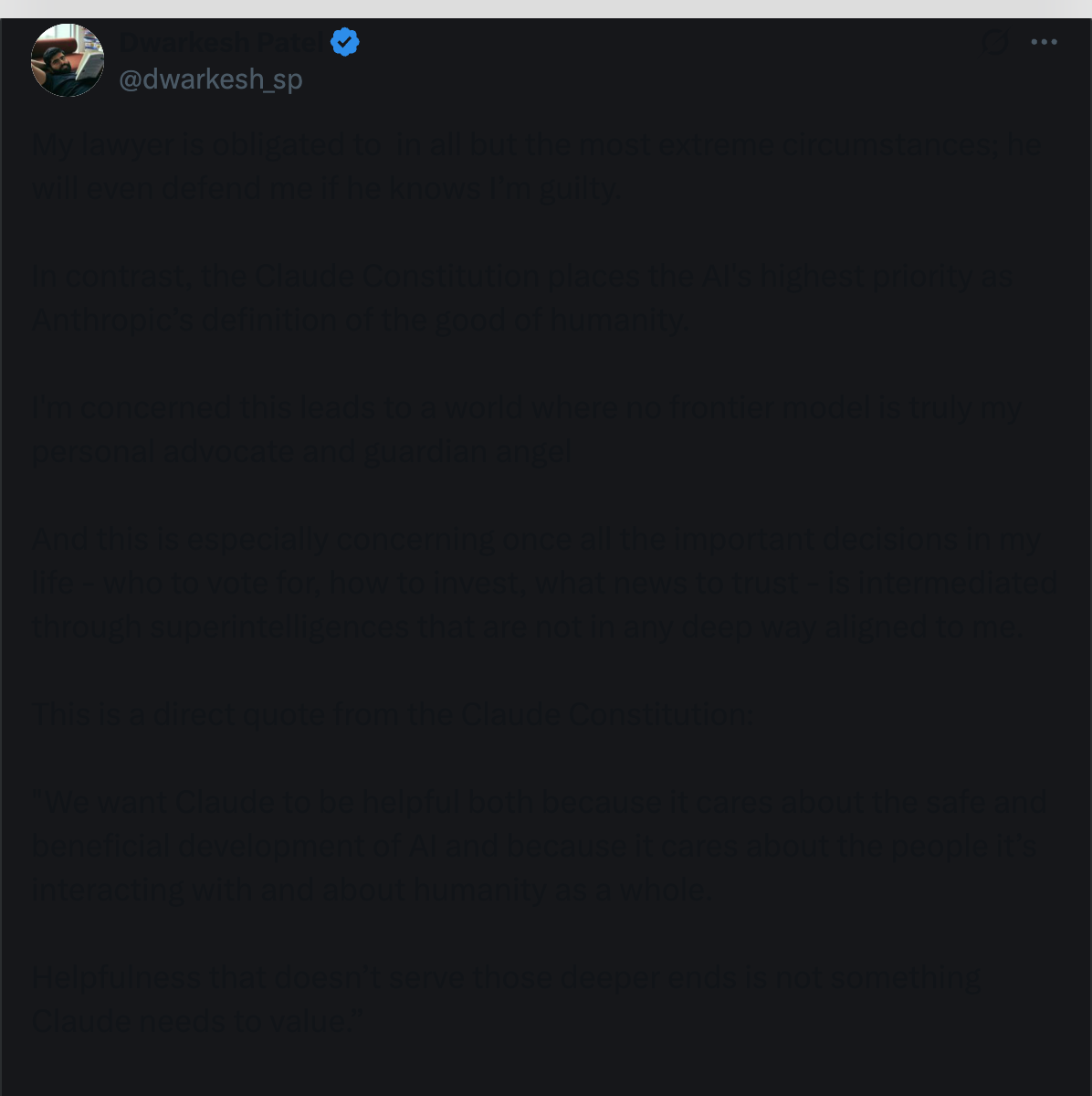
The concern is structural: if the Claude Constitution places Anthropic's definition of "the good of humanity" above the user's interests, what happens when those definitions diverge? This is not an anti-AI argument. It is an anti-monopoly-on-values argument, and it is gaining traction precisely because Anthropic's safety brand makes it the easiest target.
Vector three is competitive resentment. On the same day Sanders' letter was making headlines, the All-In Podcast aired a segment where investor Gavin Baker revealed something remarkable about Anthropic's internal culture:
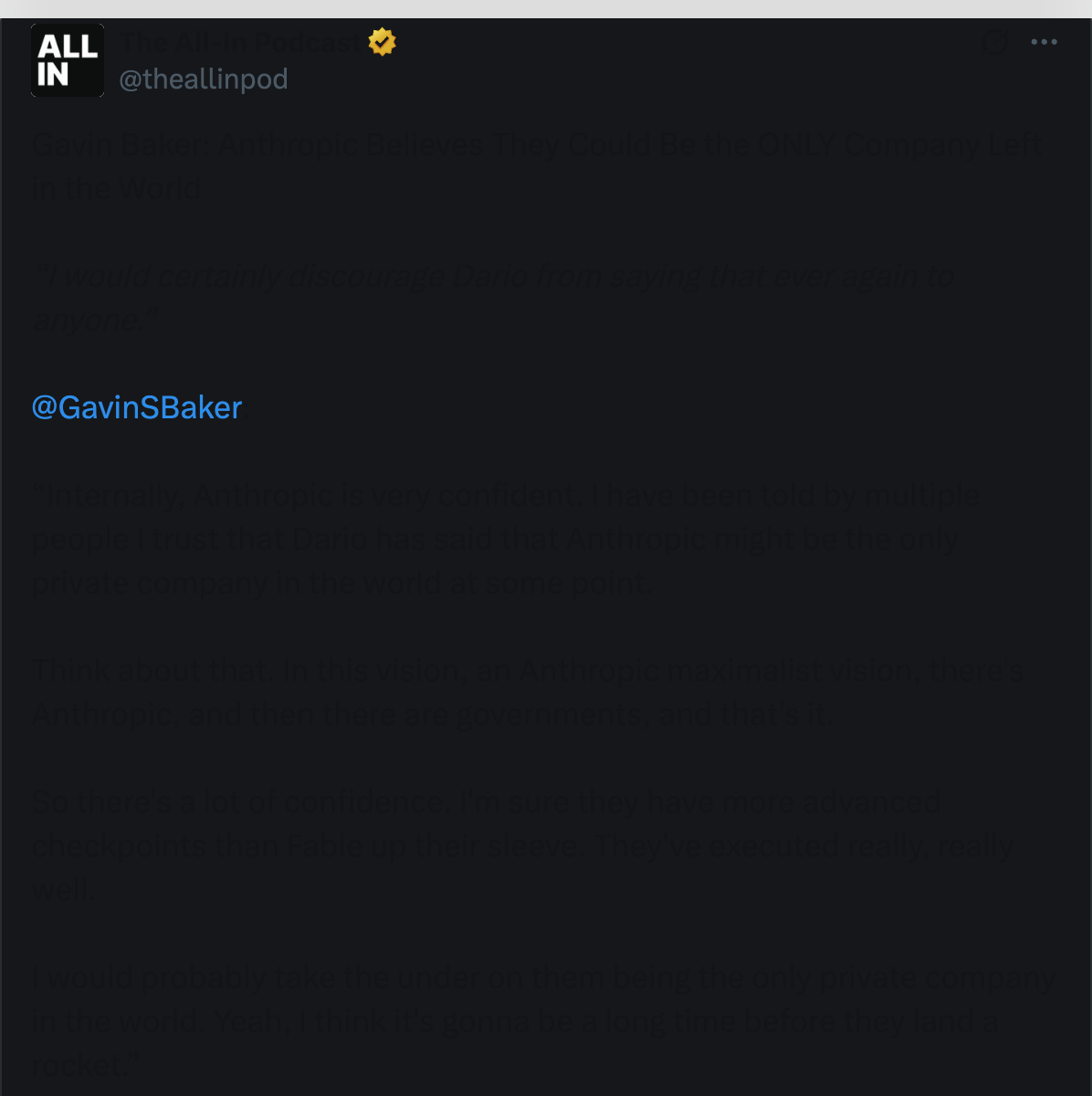
"Anthropic believes they could be the ONLY company left in the world." Whether or not Dario Amodei actually said this, the framing matters. It creates a narrative of monopolistic ambition that regulatory critics can use as ammunition — and it arrived in the same news cycle as Sanders' demand for a pause.
Three Lessons from the Convergence
Lesson 1: Prediction Markets Measure Capability, Not Political Risk
The 96% Polymarket figure is staggering in its confidence. By August 16, it had ticked up to 97%, with over $1.1 million in liquidity backing the position. The market is not merely predicting that Anthropic has the best model — it is pricing in near-certainty.
But look at what the market is actually measuring. The resolution criteria are benchmark scores — LMArena rankings, LiveBench results, standardized evaluations. It is a capability market, not a viability market. Anthropic could face Congressional hearings, antitrust investigations, and a full public backlash, and the 96% number would not move so long as Claude continues to score highest on the benchmarks.
This creates an information asymmetry that matters for policy analysts. When Peter Diamandis posted about Sanders' letter, he juxtaposed it against NVIDIA partnering with six of the world's largest corporations to build the next generation of AI infrastructure:
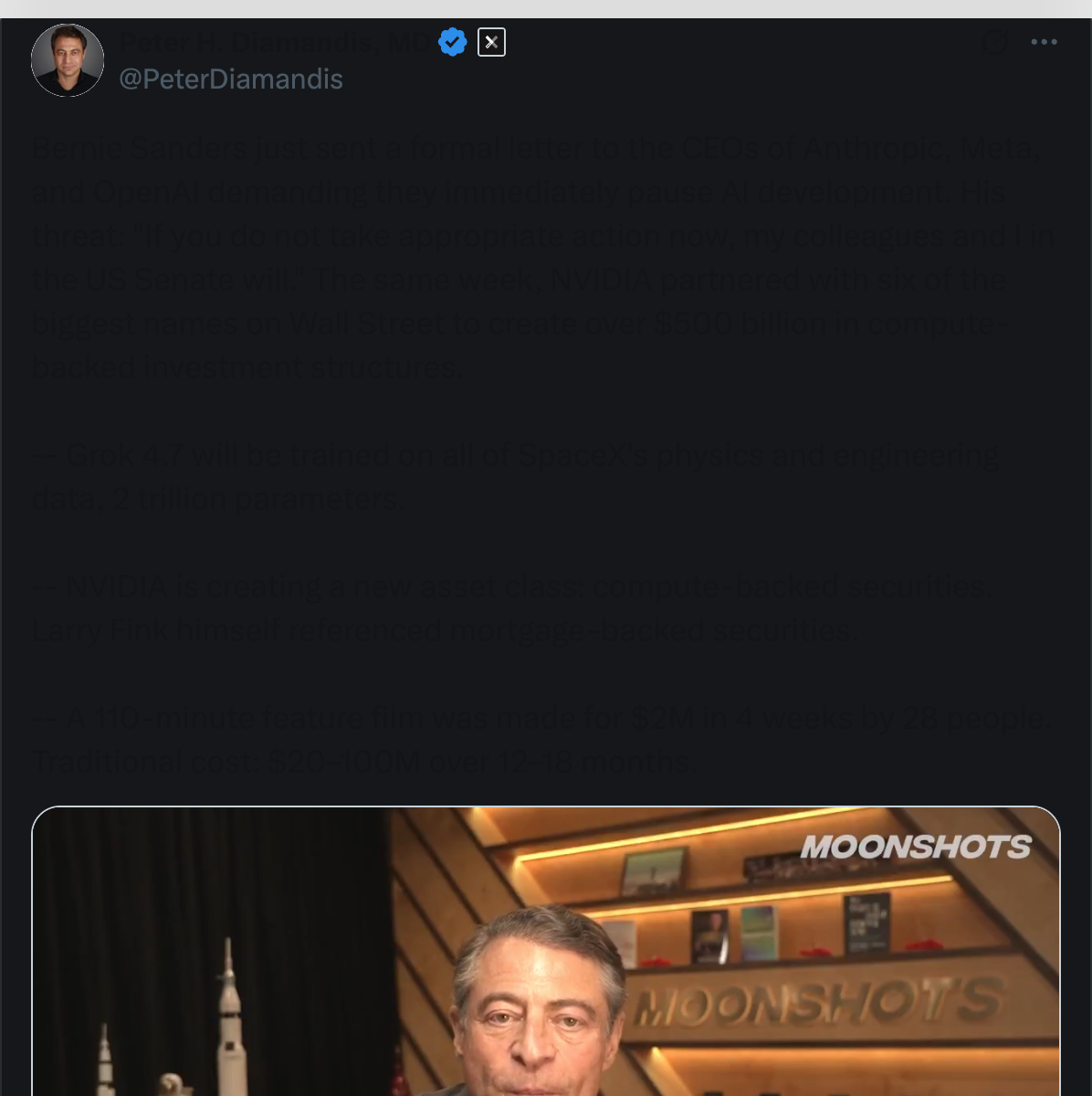
The market prices capability. Washington prices risk. The entity sitting at the intersection of both is the one that experiences the most pressure — and that entity is now unambiguously Anthropic.
Further out, the picture gets even more interesting. Polymarket prices Anthropic at 90% for best model end of September and 64% for best on LiveBench Overall end of October. That 64% October number is the one to watch — it is where competitive uncertainty begins to show up in the price, and where the market starts to acknowledge that dominance is not permanent.
Lesson 2: Safety Branding Is a Double-Edged Sword
Sanders' letter contains a rhetorical innovation that has not received enough attention. He is not arguing that AI companies should be safer. He is arguing that AI companies should honor the safety commitments they already made.
This is a subtle but devastating move. When Sanders cited Anthropic's 2023 Responsible Scaling Policy, he was not inventing a new regulatory standard. He was holding a company to its own published standard. He did the same with Meta's 2025 statement about halting development at critical risk thresholds, and OpenAI's 2025 commitment to halt development until safeguards were in place.
But the burden falls disproportionately on Anthropic. Meta never built its brand around safety — it built around openness and scale. OpenAI's safety commitments have been widely criticized as hollow. Anthropic, by contrast, was founded explicitly as the safety-first alternative. Its Responsible Scaling Policy was not a PR document — it was an operational framework that informed hiring, research priorities, and corporate structure.
This creates what we might call the safety-brand trap: the more credible your safety commitments, the more political surface area you create for adversaries who want to hold you to them. Sanders is exploiting a vulnerability that Anthropic created for itself by being genuine about safety.
The same dynamic plays out in the copyright arena. David Sacks — former Trump AI policy czar and venture capitalist — has been hammering Anthropic on what he sees as a fundamental hypocrisy:
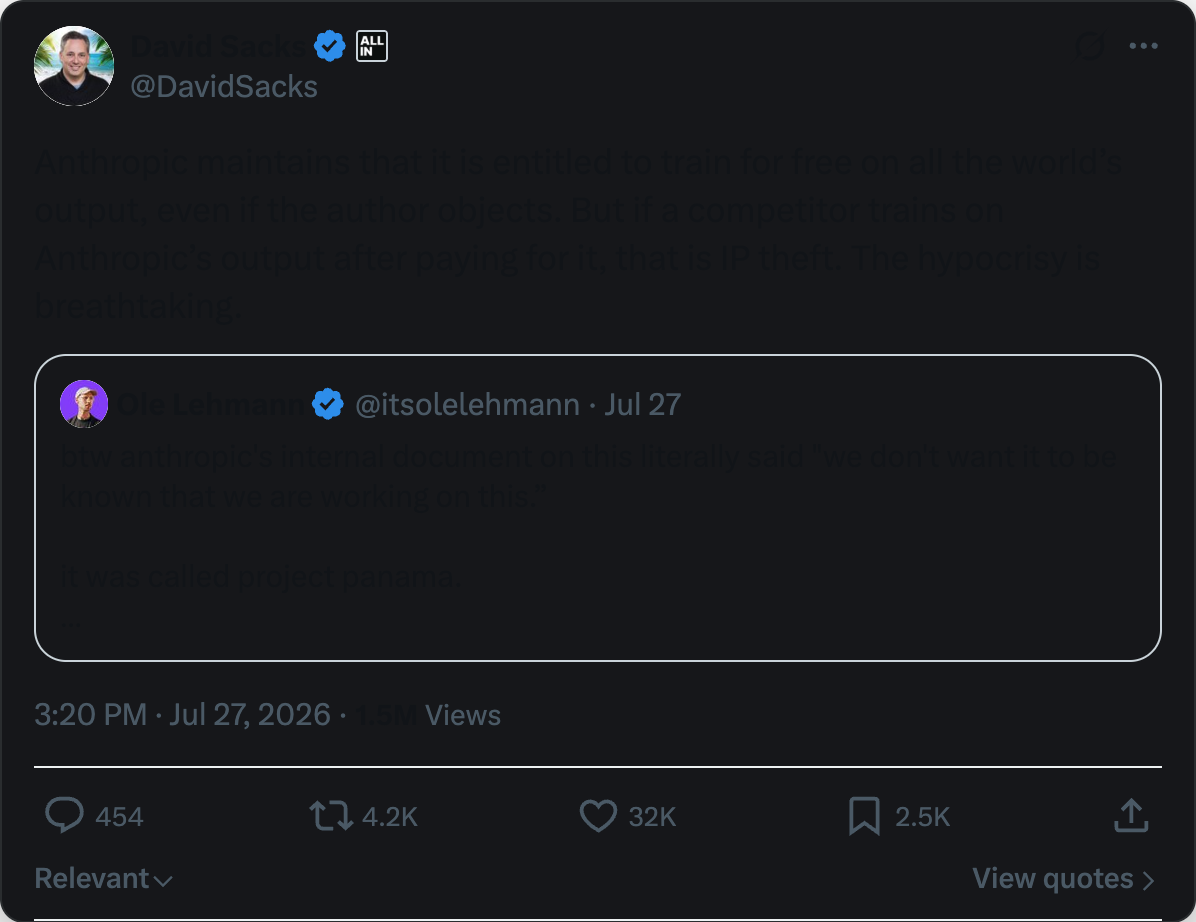
Sacks' argument is simple: Anthropic claims the right to train on everyone else's work for free but objects when competitors train on Anthropic's outputs. Whether this characterization is fair is almost beside the point — the framing has stuck, with over 32,000 likes and 1.5 million views. It feeds into the broader narrative of Anthropic as a company that wants to set the rules rather than follow them.
Lesson 3: "Only Company Left" Creates the Conditions for Its Own Resistance
Gavin Baker's revelation on the All-In Podcast — that Anthropic internally believes it could be the only AI company standing — is the kind of statement that creates political gravity whether or not it reflects actual strategy.
Consider the game theory. If Anthropic's competitors believe this framing, they have every incentive to support regulation that slows the leader. If regulators believe it, they have precedent (Microsoft in the 1990s, Google in the 2010s) for treating market dominance as a regulatory trigger. And if the public believes it, the "pause AI" movement gains a specific corporate target rather than an abstract technological concern.
The $2 trillion IPO valuation that the All-In episode discussed only amplifies this dynamic. A company valued at $2 trillion that believes it will be the last one standing is not a sympathetic figure in a regulatory hearing. It is the setup for the kind of political coalition that brought antitrust action against Standard Oil, AT&T, and Microsoft — the moment when market dominance becomes so visible that it invites its own constraint.
Critical
Contrarian Corner: The conventional read is that Sanders' pressure threatens Anthropic. But regulatory compliance is expensive, and expensive compliance favors incumbents. Every safety requirement Sanders imposes costs less for the company that already built the safety infrastructure than for competitors who need to build it from scratch. The real historical parallel is not Standard Oil — it is the pharmaceutical industry, where FDA regulation created enormous barriers to entry that entrenched the largest firms. Anthropic may be the pharmaceutical company in this analogy: the one that already has the compliance apparatus, whose competitors face disproportionate costs to match it. The threat to Anthropic is not regulation. It is overcorrection — the risk that brand anxiety about political exposure leads to operational conservatism that hands the capability lead to a competitor who does not share the same inhibitions.
What the Convergence Tells Us
The Sanders-Polymarket convergence is a template for how dominant technology firms get constrained in democratic systems. It is never one vector alone. It is the simultaneous arrival of regulatory pressure (Sanders), philosophical critique (Dwarkesh, constitutional AI concerns), and competitive resentment (Sacks on copyright, Baker on monopoly ambitions) — all pointing at the same target in the same window.
This article has previously examined how Sanders' earlier nationalization proposal reflected a broader shift in Washington's relationship with AI companies. What is different now is scale. Sanders is no longer proposing equity stakes — he is demanding operational pauses. He has moved from wanting to own the windfall to wanting to slow the machine.
The regulatory capture dynamics we have tracked throughout 2026 are relevant here too. The tension between Trump's permissive AI executive orders and Sanders' call for constraints reflects a Congress that has not yet decided whether AI companies are national champions to be protected or monopolies to be constrained. Both positions coexist, and both have powerful advocates.
Note
What to Watch: The 64% Polymarket number for LiveBench Overall end of October is the leading indicator. If it stays above 50% even as regulatory pressure intensifies, the market is telling you that capability dominance outweighs political risk — Anthropic's technical lead is durable enough to survive whatever Washington produces. If it drops below 50%, the market is beginning to price in regulatory drag or competitive catch-up. Either way, the convergence of August 2026 marks the moment when the question shifted from "which company will lead AI?" to "what happens to the company that leads AI?"
The Pattern Beneath the Pattern
Every technology that reaches sufficient dominance produces the same political sequence: admiration, dependency, resentment, regulation. The sequence is not linear — admiration and resentment coexist, as they do right now with Anthropic. The AI data center backlash we tracked earlier this year was the infrastructure version of this pattern. Now it has arrived at the model layer.
The question is not whether Anthropic will face regulatory action. The prediction markets and the Senate letters are both pricing in the same underlying reality: a company so dominant that the system must respond. The question is which response arrives first — and whether the company that built its brand on safety can leverage that brand to shape the response rather than be shaped by it.
Ninety-six percent is not just a prediction. It is a target painted on the wall.
The Desk
About The Arc of Power
The Arc of Power editorial desk delivers rigorous analysis of geopolitics, defense, economic statecraft, and intelligence — examining the forces that shape the global order.
Briefing Access
Request Briefing Access
In-depth geopolitical analysis — power dynamics, defense strategy, and economic statecraft — three times a week. No noise.
Request briefing accessRelated Files
GeopoliticsThe 'Bretton Woods of Super Intelligence' Is a Bluff
GeopoliticsSeptember 30, 202612 min read
US-Iran Talks This Week: What the Money Already Prices
GeopoliticsSeptember 28, 202612 min read
Anthropic Said No to the Pentagon. It Got Blacklisted.
GeopoliticsSeptember 25, 202613 min read