Case file · Defense · 11 min read
Four Clouds, One Roof: The Air Force Breach
Cloud One ran on AWS, Azure, Google, and Oracle. One breach hit them all. Multi-cloud was the hedge — until it wasn't.
The Arc of Power ·
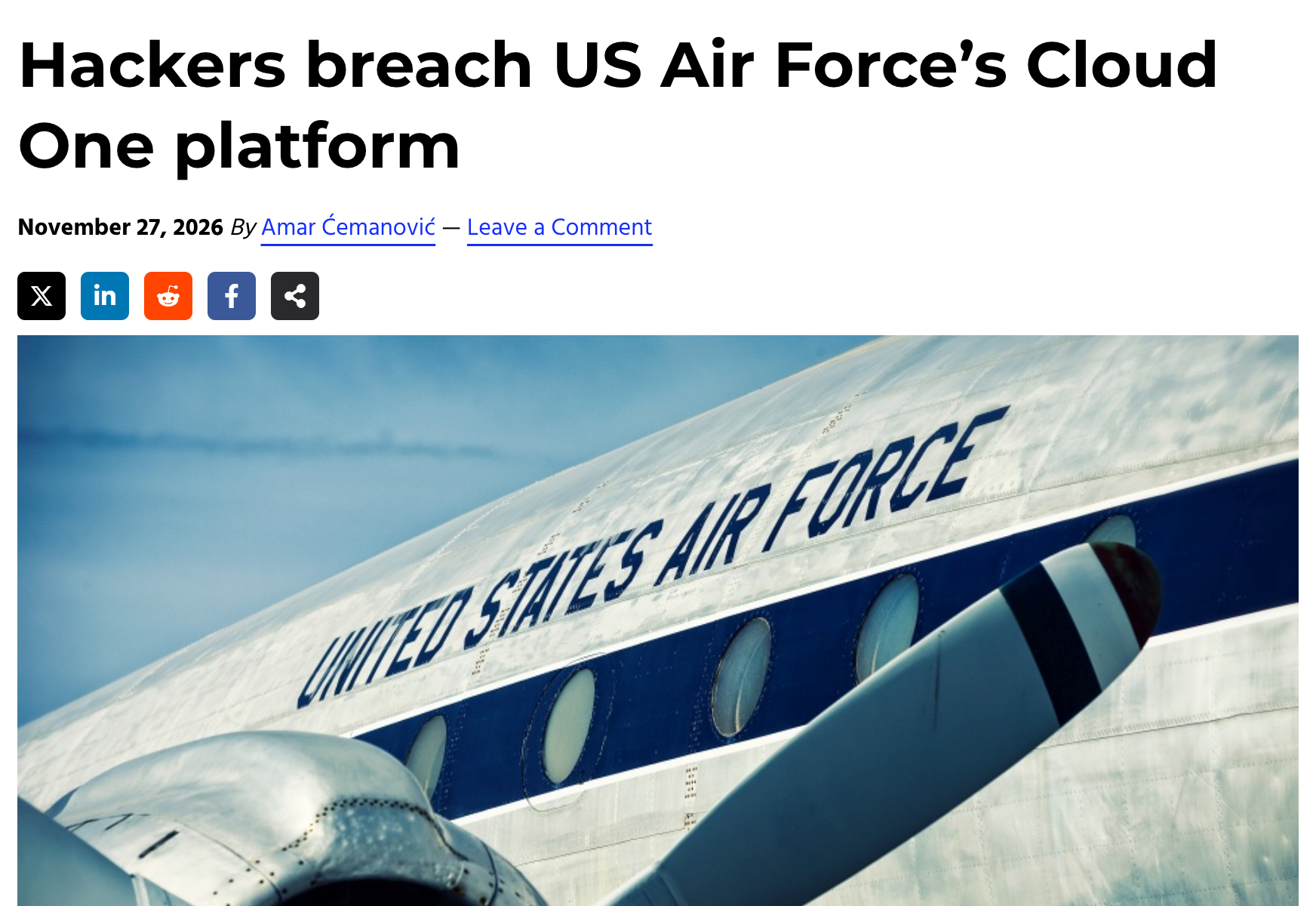
On November 27, 2026, Reuters reported that hackers breached Cloud One, the US Air Force's flagship enterprise cloud platform — a system that runs on Amazon Web Services, Microsoft Azure, Google Cloud, and Oracle Cloud Infrastructure simultaneously. Three people familiar with the matter confirmed the intrusion. Cyber Command was called in to assess the damage. The Air Force revoked administrator privileges, froze application updates, and paused all migrations to the platform.
That is the news. Here is what it means: multi-cloud was supposed to be the hedge. Four vendors, four infrastructure stacks, four independent failure domains. Instead, all four sat under one management plane, one prime contractor (Leidos, since 2025), and one set of provisioning and identity systems. The attackers did not need to breach four clouds. They breached the layer that controlled all four — the control plane — and the vendor diversity underneath became irrelevant.
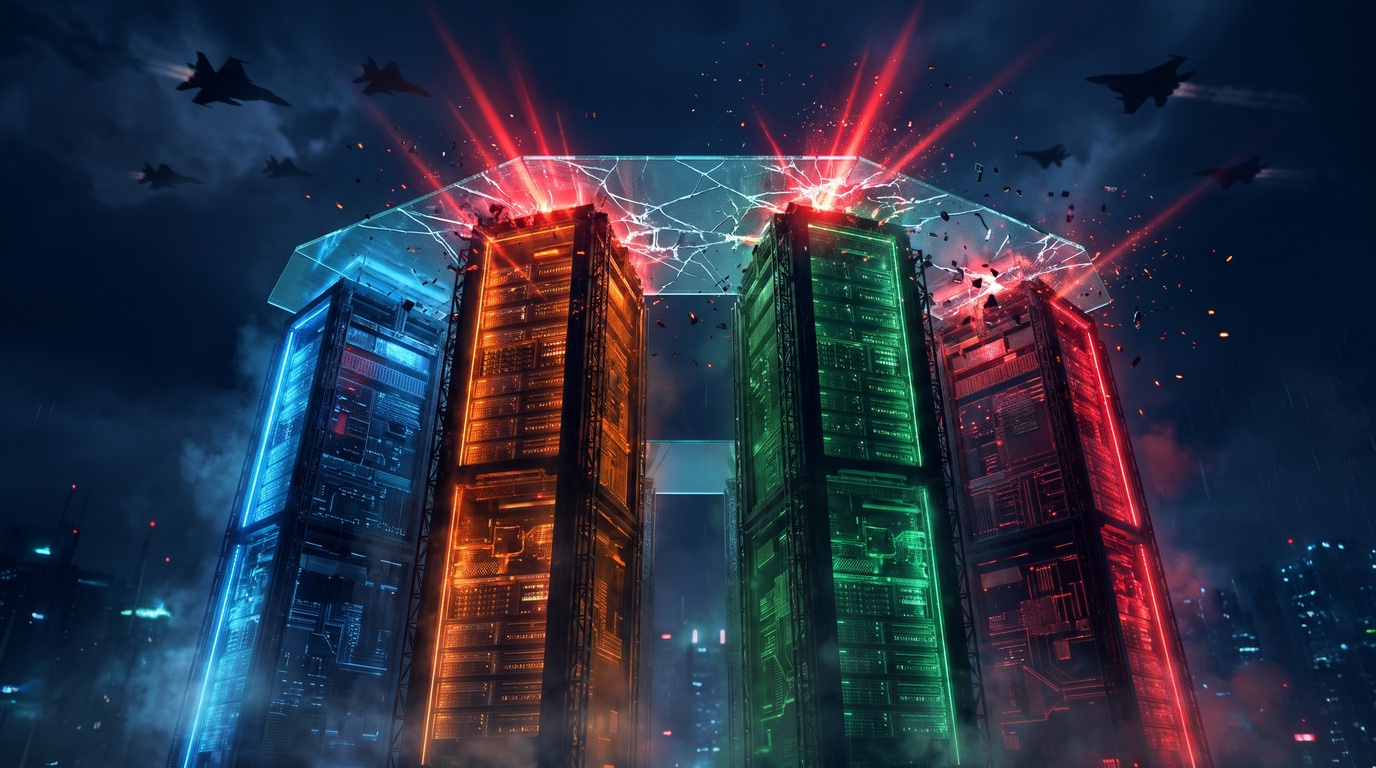
This is the most consequential cybersecurity incident the US military has disclosed in 2026, not because of the systems it exposed (though those include air defense radar, munitions tracking, and 750,000 warfighters' personnel records), but because of the architectural assumption it destroyed.
What Cloud One Actually Is
Cloud One launched in 2017 as the Air Force's centralized cloud services platform. Its selling point was vendor neutrality: mission application owners could connect to any of four commercial clouds — AWS, Azure, Google Cloud, or Oracle Cloud Infrastructure — through a single management interface. By 2026, it had grown into one of the Defense Department's largest cloud platforms, hosting applications for the Air Force, Space Force, and US Transportation Command.
The systems running on Cloud One are not back-office busywork. They include Cloud-Based Command and Control (CBC2), which aggregates air defense radar data from across North America. They include the Theater Integrated Combat Munitions System (TICMS), which tracks bombs and missiles at more than 200 Air Force locations worldwide. They include personnel, payroll, logistics, and maintenance systems serving an estimated 750,000 warfighters.
The prime contractor managing all of this — provisioning accounts, managing cloud service offerings, purchasing edge devices and software licenses — is Leidos, which took over from SAIC in 2025 on a potential five-year, $455 million "Cloud One Next" contract. SAIC protested the award in the Court of Federal Claims but withdrew the complaint in January 2026.
Read the full CyberInsider analysis →
What Happened
The breach was discovered within roughly the past month during routine work to upgrade the platform. One source told Reuters that attackers exploited a software vulnerability to reach Cloud One's control plane — the management layer that administrators use to provision resources, manage identities, and configure workloads across all four cloud environments.
Reuters could not identify the specific vulnerability, determine who was behind the attack, establish how far the intruders penetrated, or confirm whether data was taken. The Air Force said it "does not comment on the security posture, vulnerabilities or operational status of specific networks and systems." Leidos referred questions to the Air Force. SAIC did not respond.
What we do know is the response: investigators brought in Cyber Command. Some users had their administrator rights revoked. Updates to applications already running on Cloud One were blocked — meaning Air Force personnel could not apply security patches at the same moment a wave of new software vulnerabilities was being disclosed across the technology industry. Efforts to migrate additional back-office applications onto the platform were paused.
Nicolas Chaillan, who founded Cloud One while serving as the Air Force's first chief software officer before resigning in 2021, told Federal News Network that the service had "failed to keep up with my vision and requirements." He alleged the Air Force lets users access Cloud One through a less secure method than he had originally recommended.
Three Lessons from One Breach
Lesson 1: Multi-Cloud Is Not Multi-Resilient
The entire premise of Cloud One was that spreading workloads across four commercial cloud providers reduced concentration risk. If AWS went down, Azure workloads kept running. If Oracle had a vulnerability, Google Cloud applications were insulated.
That premise assumed the blast radius of a failure stays within the cloud where it originates. It does not — not when all four clouds share one management plane.
InfoWorld's 2026 analysis described this exact failure mode before Cloud One made it real: "Redundancy below the control plane does not fully protect you from a failure above it. If both regions remain dependent on the same provider control mechanisms, the same identity systems, or the same operational APIs, then you still have a shared dependency."
Cloud One was textbook: four clouds, one roof. The control plane was the roof. The breach hit the roof.
Critical
Multi-cloud is an identity architecture, not an infrastructure architecture. If your identity, provisioning, and management all flow through one plane, you have one cloud with four invoices.
A technical analysis on Dev.to put it bluntly: "True Multi-Cloud is an illusion if the two clouds are tethered by the same DNS provider, the same Identity system, and the same networking shortcuts." A single identity provider failure can halt cross-cloud failover entirely — the servers are healthy but the permissions are locked.
The question for every organization running multi-cloud is now explicit: how many management planes do you actually have?
Lesson 2: The Contractor Transition Was a Vulnerability Window
Leidos took over from SAIC in May 2026. The breach was discovered during a platform upgrade, roughly one month before the Reuters report — placing the discovery squarely in the period when a new contractor was still inheriting systems, credentials, and institutional knowledge from its predecessor.
Contractor transitions are among the highest-risk periods in any IT environment. Handoffs involve credential rotation, access reviews, and configuration audits. Doing all of this on a platform hosting air defense data and munitions tracking systems multiplies the stakes.
The Cloud Security Alliance has warned that the control plane is now the most targeted component in cloud security precisely because it concentrates power: whoever controls provisioning and identity controls everything underneath. A contractor transition that temporarily loosens those controls is an invitation.
We do not know that the transition caused the breach. But the timing invites the question, and the Air Force's silence does nothing to dismiss it.
Lesson 3: The Federal Government Has a Systemic Cyber Problem
Cloud One is not an isolated failure. It is the latest in a 2026 wave of federal cybersecurity incidents that is beginning to look less like bad luck and more like structural decomposition:
- FBI (April 2026): A breach of sensitive bureau networks classified as a "major incident" under federal law, with China-linked group involvement.
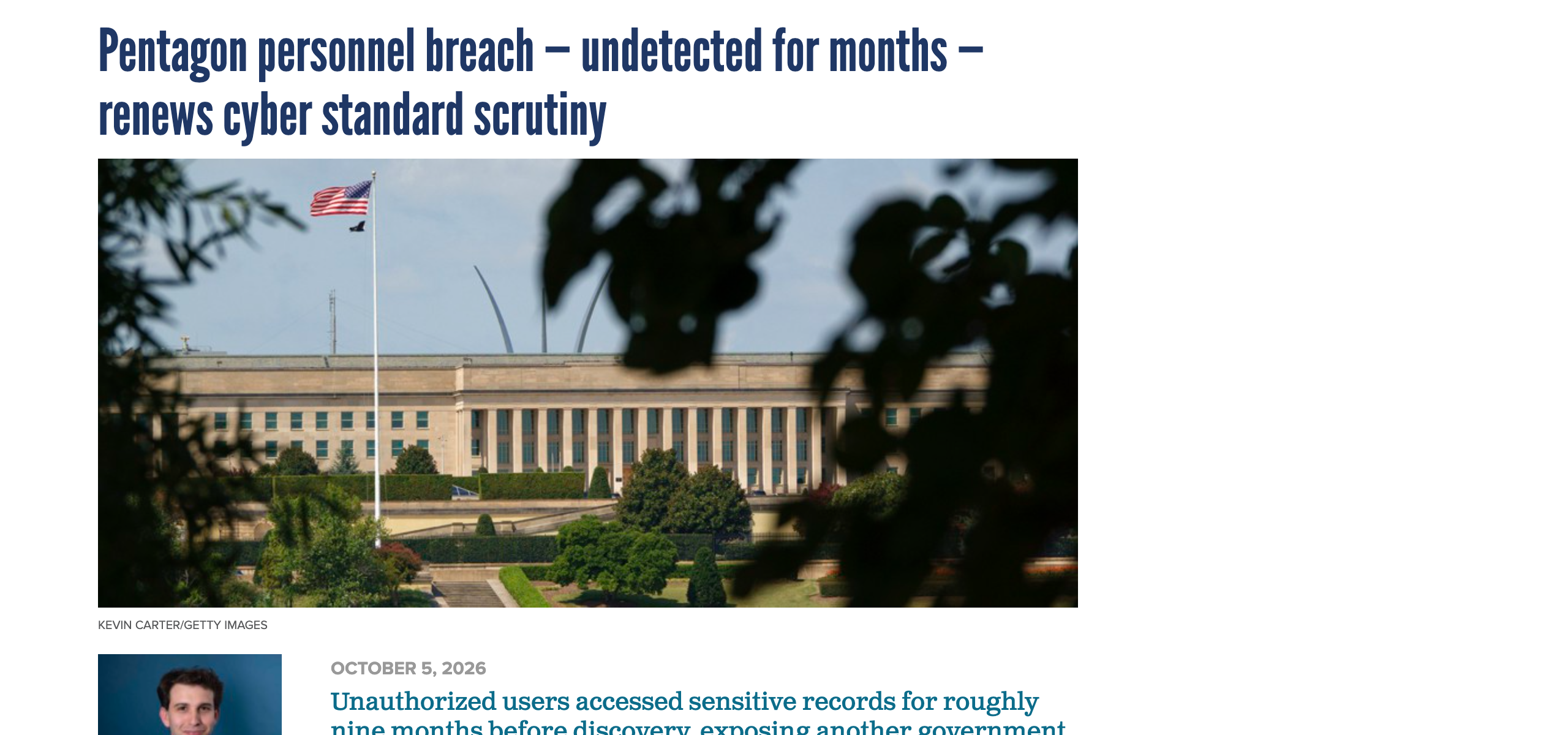
- Pentagon DMDC (October 2026): Unauthorized access to the Defense Manpower Data Center from October 2025 to July 2026 — nine months undetected — exposing unencrypted Social Security numbers and military records of 2.76 million people.
- CIA (November 2026): Hackers compromised unclassified CIA systems, details still emerging.
- Treasury FinCEN (November 2026): Intrusion into financial intelligence networks.
- Air Force Cloud One (November 2026): The breach reported today.
Five agencies, one year. The pattern is not coincidence — it is capability asymmetry. As the 16th Air Force warned in September 2026, advanced AI models can perform reconnaissance and develop exploits in minutes, tasks that once took experts months.
What the Community Is Saying
The Reddit discussion captures the public mood. The top thread on r/technology — "US Government under AI cyberattack" — drew 19,300 upvotes and 1,700 comments. The Cloud One thread pulled 11,100 upvotes and 629 comments. Combined, they represent the highest-engagement cybersecurity story of 2026 on Reddit.
On Hacker News, the Cloud One story sat at #3 with 238 points and 143 comments. The prevailing sentiment: "The 'who put all four providers under one roof' comments write themselves." Multiple commenters invoked Oxide Computer — the on-premises cloud startup — and predicted a fresh round of zero-trust procurement theater.
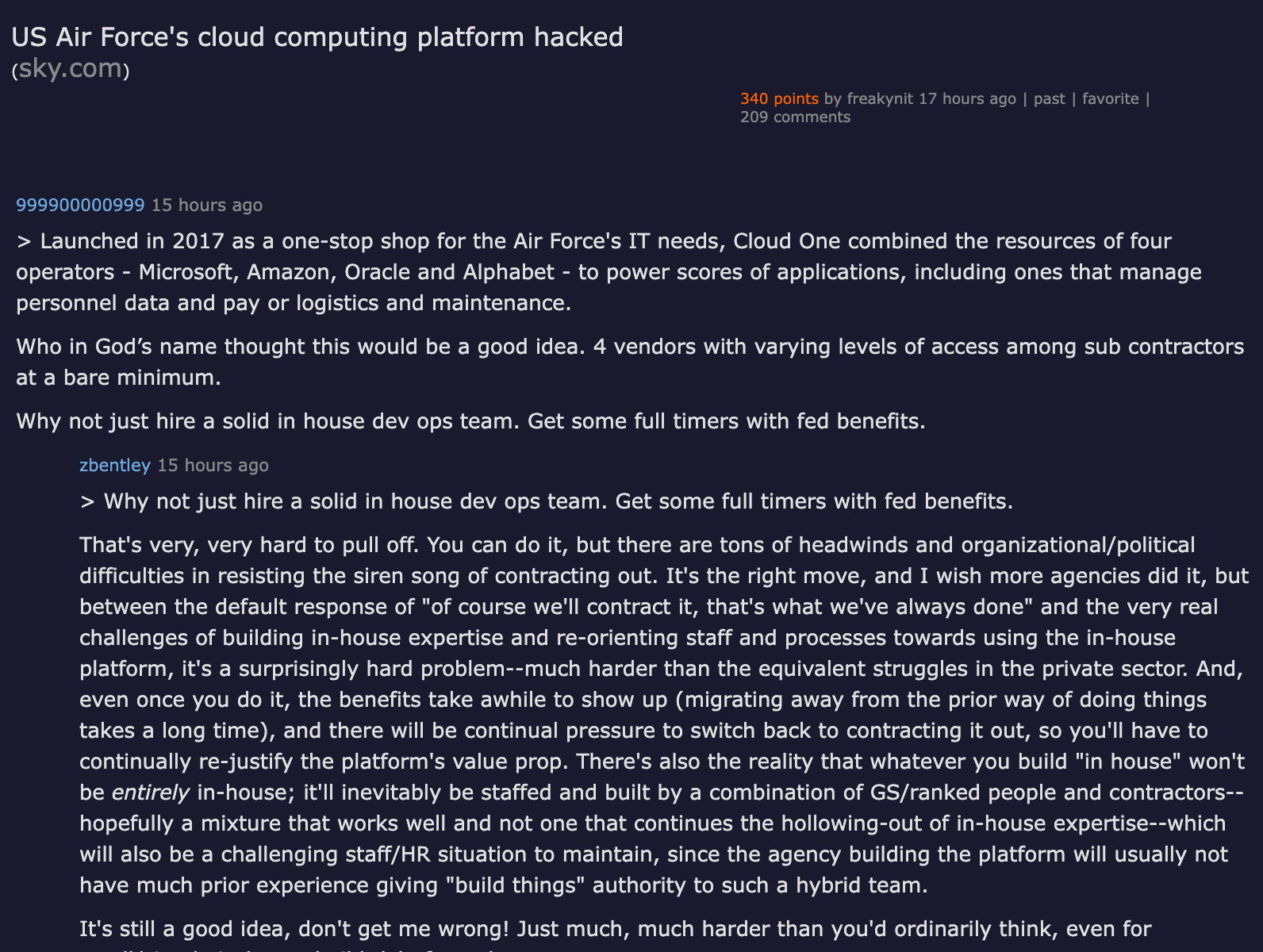
View the Hacker News discussion →
The message across both platforms is clear: the public no longer believes the government can defend its own systems.
The Contrarian View: Multi-Cloud Was Never the Problem
Critical
There is a tempting narrative forming: multi-cloud failed, go back to single-vendor or on-premises. That narrative is wrong. Multi-cloud did not fail in Cloud One. Multi-cloud was never tried.
What was tried was a single management plane that happened to provision across four vendors — a multi-vendor architecture, not a multi-independent one. The distinction matters.
A properly designed multi-cloud architecture would have independent identity systems, independent provisioning paths, and independent management planes for each cloud environment. Break-glass accounts that bypass federation. Drift detection between primary and backup environments. Regular cold-failover tests that actually shut down the primary.
Cloud One had none of this, as far as public reporting suggests. It had a convenience layer that made four clouds look like one — which is exactly what it turned out to be when the control plane was breached.
The lesson is not "fewer clouds." It is "more independence between them." And it is the difference between an architecture designed for resilience and one designed for procurement compliance.
What Comes Next
Three things to watch:
The attribution question. No one has claimed responsibility, and the Air Force has disclosed nothing about the attackers' identity or origin. Given the concurrent FBI, CIA, and Treasury breaches, the intelligence community will be looking for campaign-level coordination. If this was a nation-state operation hitting multiple federal systems simultaneously, the response calculus changes dramatically.
The Cloud One Next contract. Leidos' $455 million modernization contract was already contentious — SAIC protested it, and Defense Secretary Hegseth reportedly canceled a broader $1.4 billion Cloud One contract earlier in 2026. The breach raises questions about whether the platform's architecture should be redesigned before more money flows into it.
The procurement theology. For a decade, "go multi-cloud" has been gospel in federal IT. Cloud One was the showcase. If the breach investigation confirms that the multi-vendor architecture created a wider blast radius rather than a narrower one, the entire procurement framework for military cloud computing will need to be reconsidered — not unlike the rethinking that happened after the JEDI contract was canceled. The question is no longer "which clouds?" but "how many management planes?"
Note
The most dangerous phrase in cloud security is "vendor diversity." It suggests resilience without requiring it. What matters is control-plane independence — and Cloud One had one control plane for four vendors.
The Bottom Line
Cloud One was supposed to prove that multi-cloud works for the military's most sensitive systems. Instead, it proved that vendor diversity without architectural independence is theater.
Four clouds, one roof. One breach brought down the roof.
The attackers, whoever they are, did not need to defeat four security perimeters. They needed to defeat one control plane — the management layer that all four clouds shared. That layer was the product of a federal procurement culture that optimized for vendor neutrality over operational resilience, and an industry that sold multi-cloud as a risk reduction strategy without defining what "multi" actually meant.
Until the federal government separates the question of "how many vendors?" from "how many independent failure domains?", Cloud One will not be the last multi-cloud system to fail as a single system.
The hedge was never multi-cloud. The hedge was multi-independent. And that is a system the government has not yet built.
The Desk
About The Arc of Power
The Arc of Power editorial desk delivers rigorous analysis of geopolitics, defense, economic statecraft, and intelligence — examining the forces that shape the global order.
Briefing Access
Request Briefing Access
In-depth geopolitical analysis — power dynamics, defense strategy, and economic statecraft — three times a week. No noise.
Request briefing access