Case file · Defense · 13 min read
Europe Builds a Deterrence Stack Without Washington
Six coordinated European defense moves in 48 hours signal a continent assembling its own Russia-deterrence stack.
The Arc of Power ·
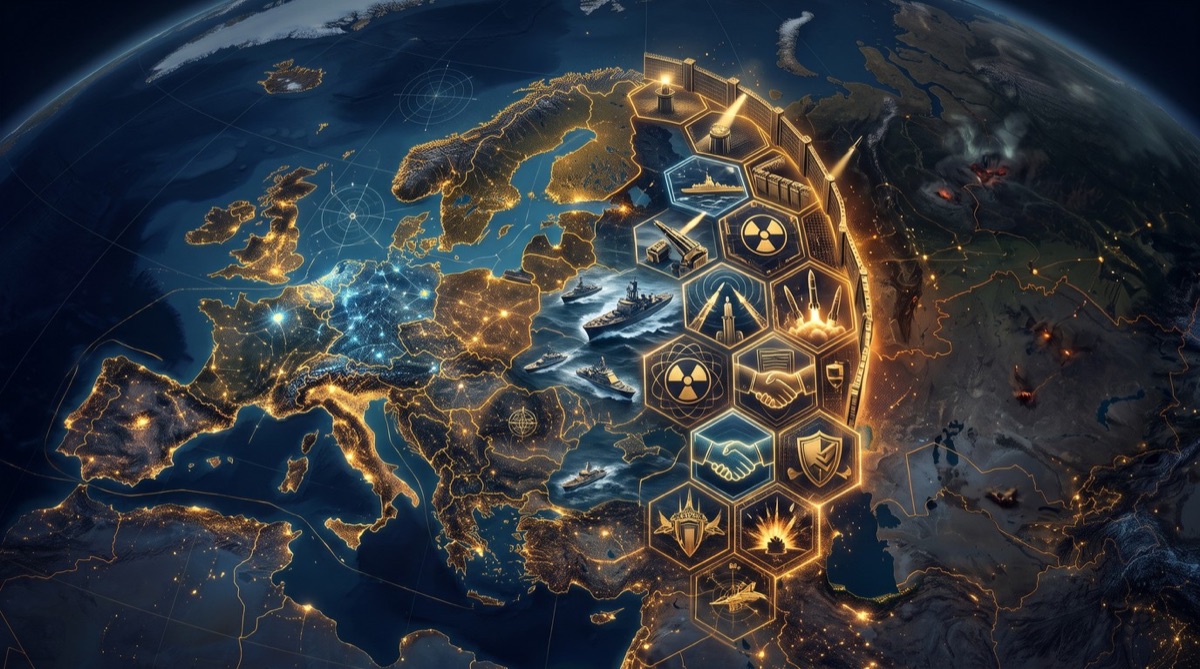
In the span of 48 hours this week, Europe executed six distinct security moves against Russia — not as a coordinated alliance operation, but as a series of parallel national and institutional actions that, taken together, form something the continent has never assembled before: an independent Russia-deterrence stack.
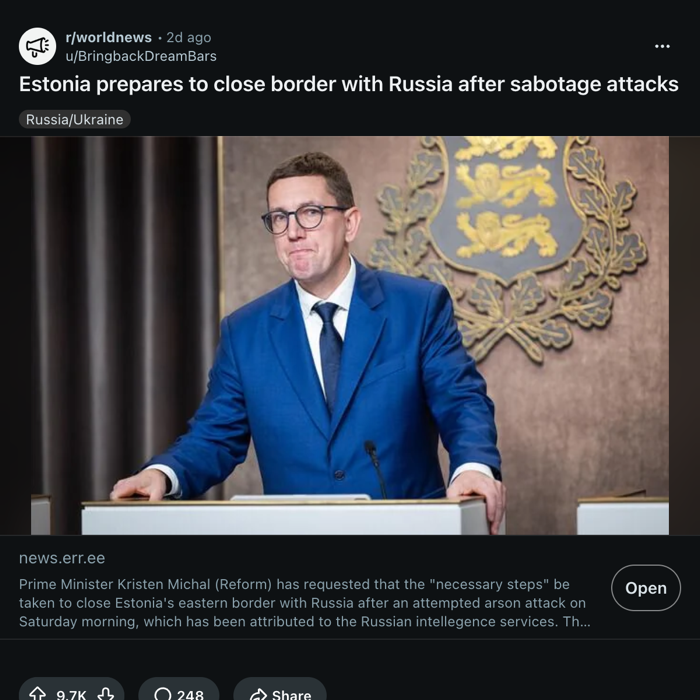
Estonia announced preparations to close its border with Russia following a pattern of sabotage attacks. EU naval forces boarded a suspected Russian shadow-fleet tanker in the Mediterranean under Operation IRINI's expanded mandate. Ukraine's FREYJA anti-ballistic missile system, backed by Danish Weibel radar and 11 European partner nations, was declared ready for active development. Russia demanded Britain stop extending its nuclear umbrella over Europe — a demand that only confirmed the deterrent's perceived effectiveness. And Emmanuel Macron warned that limiting Ukraine aid would pave the way for another war, framing continued support as a matter of French national security.
None of these was announced from a single podium. There was no joint communique. And that is precisely what makes the pattern significant. When a continent assembles a full-spectrum deterrence architecture — border hardening, maritime enforcement, missile defense R&D, nuclear signaling, and diplomatic framing — without a coordinating summit, it means the logic has become self-organizing. As we noted when the Pentagon's Europe drawdown was already priced in, the question was never whether Europe would build its own security architecture, but whether it would happen fast enough.
The Six Layers
Layer 1: Border Hardening — Estonia Closes the Gate
Estonia's decision to prepare border closures with Russia is not a new phenomenon — Finland closed four of nine checkpoints in a similar move, and Norway has considered the same. But Estonia's action this week carries a different charge. The trigger was not migration, as in Finland's case, but sabotage operations that Estonian intelligence has attributed to Russian state actors.
This is Layer 1 of any deterrence stack: physical boundary control. Estonia, with 294 kilometers of land border with Russia and a population of 1.3 million, occupies the most exposed position in NATO's northeastern flank — a geography that military planners call the "Suwalki Gap of the Baltics." By hardening that border, Tallinn is not just protecting against hybrid threats. It is signaling to Moscow that the gray zone between peace and conflict — where sabotage, electronic warfare, and provocations operate — is shrinking.
Note
Estonia's border sits at NATO's most vulnerable point. The "Saatse Boot" — a 1-kilometer strip where the main road between two Estonian towns passes through Russian territory — has been a flashpoint since at least October 2025, when Estonia temporarily closed it after Russian military personnel appeared nearby.
Layer 2: Maritime Enforcement — The Shadow Fleet Crackdown
In June 2026, the European Union granted Operation IRINI the authority to stop and board vessels suspected of belonging to Russia's shadow fleet — the network of aging, poorly insured tankers that has been circumventing Western oil-price caps since 2022. By November, IRINI had conducted at least six flag-verification boardings in the Mediterranean, using UNCLOS Article 110 — the international maritime law provision that permits boarding of stateless or falsely flagged vessels.
The shadow fleet is not a minor irritant. CEPA estimates the EU has designated 444 shadow-fleet vessels, and Russia has begun deploying warships to escort them. The Kremlin's willingness to use naval assets to protect commercial oil evasion tells you everything about the stakes: oil revenue funds the war in Ukraine, and Europe's maritime enforcement directly threatens that funding mechanism.
The EU also expanded boarding authority to Operation ATALANTA in the western Indian Ocean — meaning the enforcement net now covers two of the three major maritime corridors Russia's shadow fleet uses.
Layer 3: Missile Defense R&D — FREYJA Changes the Interceptor Math
The FREYJA anti-ballistic missile system is perhaps the most consequential of the six moves, because it addresses the most dangerous gap in European defense: the near-total inability to intercept Russian ballistic missiles without American-made Patriot systems.
Launched in Paris on July 13, 2026, the Integrated Anti-Ballistic Missile Coalition now includes 11 nations: Denmark, France, Germany, Italy, the Netherlands, Norway, Spain, Sweden, Ukraine, the UK, and later additions. The division of labor is deliberate: Ukraine supplies the interceptor — Fire Point's FP-7.X missile — while European partners provide the sensors, radars, and guidance systems. Denmark contributes a Weibel Scientific GFTR-2100 target-detection radar. Sweden offers Saab radar integration. The architecture is open, meaning any country can plug in its own sensor package.
The economics are striking. Each FREYJA interceptor is projected at roughly $700,000 — against $4 million for a PAC-3. That is not a marginal improvement. It is a structural shift in the cost-curve of ballistic missile defense, one that could allow European nations to stockpile interceptors at volumes that the Patriot supply chain has never supported.
Critical
FREYJA has not intercepted a single ballistic missile. The prototype target is mid-2027. In the first two weeks of July 2026, Ukraine failed to intercept any of 24 Russian ballistic missiles fired at its territory. The gap between the program's promise and the battlefield's reality is measured in years — and Russia is not waiting.

Layer 4: Nuclear Signaling — Moscow's Demand Proves the Deterrent Works
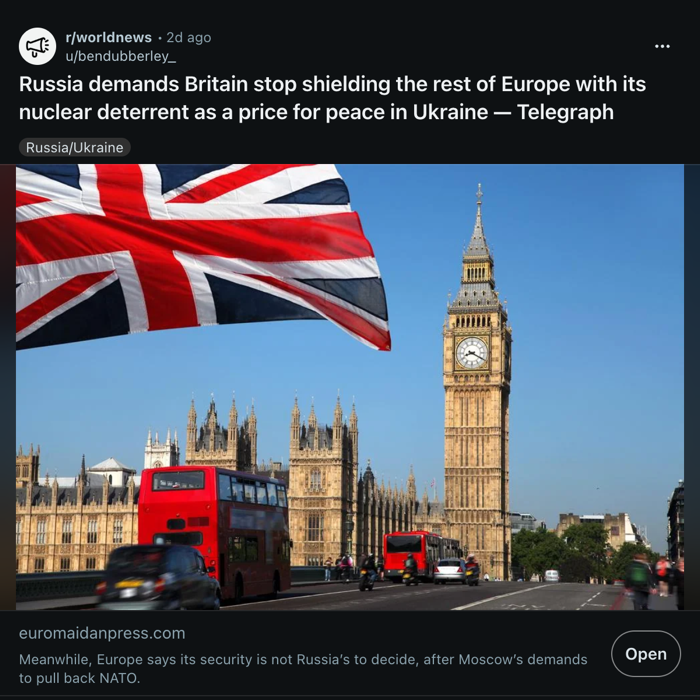
Russia's demand that Britain stop extending its nuclear umbrella over Europe was not, despite the alarming headlines, a threat escalation. It was an acknowledgment.
Ambassador Andrey Kelin's statement to Izvestia — that the British nuclear umbrella "cannot offer extra security guarantees" to NATO allies — came after German Chancellor Friedrich Merz stated publicly that he wanted Germany covered by the UK and French deterrents. Moscow's response was to insist the concept was meaningless. That is what powers say about adversary capabilities they find concerning.
This layer connects directly to Macron's March 2 speech at the Ile Longue submarine base, where he announced France's new doctrine of "forward deterrence" — the willingness to deploy French nuclear-capable aircraft to allied European territory and to signal that threats to European security could trigger a French nuclear response. Eight European nations, including Germany and Poland, agreed to participate in the scheme. Chatham House called it "Gaullist policy, updated for a more unstable world."
The Franco-British nuclear alignment is real but limited. France fields 290 warheads; the UK, approximately 225. Together, that is roughly one-third of Russia's deployed strategic arsenal. But deterrence is not arithmetic. It is about credibility — and a European nuclear posture that Moscow feels compelled to publicly dismiss is, by definition, one that Moscow finds credible.
Layer 5: Diplomatic Framing — Macron's Aid Warning as Doctrine
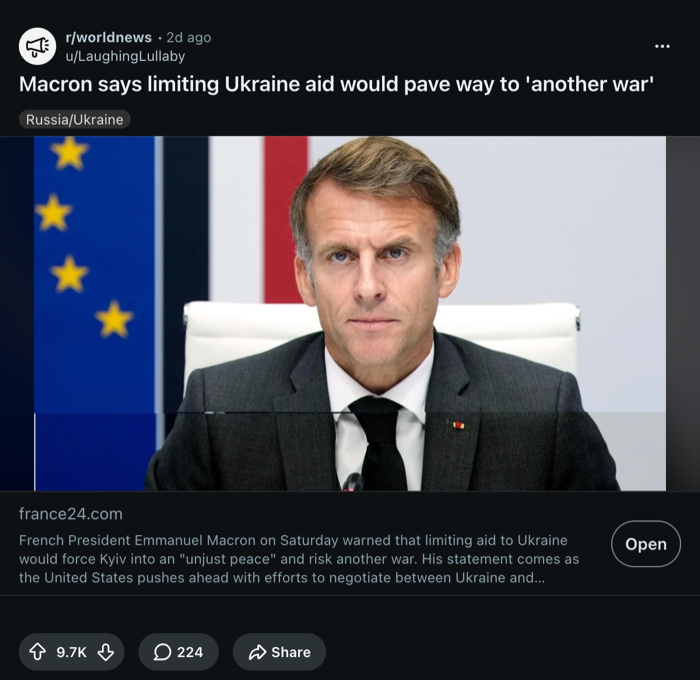
Macron's statement that limiting Ukraine aid would pave the way for "another war" was not a sound bite. It was a doctrinal assertion: the security of France is inseparable from the security of Ukraine, and any European leader who suggests otherwise is not pursuing peace — they are enabling the next conflict.
This framing matters because it closes a rhetorical escape route that has been popular in European populist politics. Marine Le Pen's National Rally has pushed to reduce French involvement in Ukraine on sovereignty grounds. Macron's response — that such cuts would endanger France's own security — redefines the domestic debate. It is no longer "interventionism vs. restraint." It is "deterrence vs. vulnerability."
As we analyzed when allies broke ranks over Ukraine, the transatlantic fracture had already split into two separate foreign policies operating under one flag. Macron's November statement accelerates the European side of that split from reactive to doctrinal.
Layer 6: Offensive Demonstration — Astrakhan as Proof of Reach
Ukraine's strike on a Russian military airfield in Astrakhan — reportedly producing 30 or more explosions — is the kinetic punctuation mark on the deterrence stack. Astrakhan lies approximately 1,200 kilometers from the Ukrainian border. The strike demonstrates that Ukrainian long-range capabilities, enhanced by European-provided intelligence and technology, can reach deep into Russian territory.
This is Layer 6 not because Ukraine is a European nation executing European policy, but because the strike's effectiveness depends on European inputs — Danish radar data, Swedish sensors, British Storm Shadow cruise missiles whose production resumed in 2025 after a 15-year hiatus, and French SCALP missiles. The deterrence message is not "Ukraine can hit Astrakhan." It is "Europe's defense-industrial network enables strikes at 1,200 kilometers."
What the Community Is Saying
The Reddit community response to this 48-hour cluster was immediate and substantial. The thread on Russia's nuclear umbrella demand drew 10,500 upvotes and 1,200 comments, with the dominant sentiment being that Moscow's protest validated the deterrent's credibility. Macron's warning attracted 9,200 upvotes, with commenters noting the shift from American-led messaging to French-led framing.
The FREYJA thread garnered 3,200 upvotes, with significant discussion about the interceptor's $700,000 unit cost versus Patriot's $4 million — a ratio that multiple commenters flagged as the most strategically significant number in the entire cluster. The Estonia border preparation thread drew 4,300 upvotes, with comments highlighting the sabotage context rather than the migration framing that accompanied Finland's earlier closures.
As our Reddit digest noted, this represents "the most coordinated Western posture shift we've seen in months" — and notably, the coordination happened without any formal coordination mechanism.
Note
The Carnegie Endowment's September 2026 analysis argued that Europe needs a governance framework for collective defense that does not rely on American will or capability. What this week's cluster suggests is that the governance may be emerging bottom-up — through parallel national actions — rather than top-down through a new institutional architecture.
Three Structural Implications
1. The Burden-Sharing Debate Becomes Irrelevant
For decades, the central tension in NATO has been American complaints that European allies do not spend enough on defense. EU defense spending is projected at 454 billion euros in 2026, or 2.4% of GDP — a 47% increase since 2022, the fastest growth rate since 1953. The ReArm Europe initiative targets 800 billion euros by 2030.
But the deterrence-stack model suggests the debate is evolving past spending levels. If Europe is building parallel deterrence capabilities — its own missile defense, its own maritime enforcement, its own nuclear signaling — the question shifts from "are you paying your share?" to "whose architecture are you operating under?" Washington loses leverage not because Europe started writing bigger checks, but because it started building its own systems.
As we explored in Sovereign Compute, Sovereign Army, the 2026 through-line across European policy is sovereign capacity — whether in AI chips, cloud infrastructure, or now, missile interceptors.
2. The Deterrence Stack Has a Critical Gap
The honest assessment: Europe's deterrence stack has six layers, but only two are currently operational. Border hardening (Estonia) and maritime enforcement (Operation IRINI) are real capabilities producing real outcomes today. Nuclear signaling (Macron's doctrine) is a credible but untested posture. FREYJA is R&D. Offensive demonstration (Astrakhan) depends on Ukrainian execution. And diplomatic framing, while powerful, is not kinetic.
The gap that analysts have flagged — that Russia could be ready to test European defenses by 2028 or 2029 — means the stack needs to become operational before it faces pressure, not after. Europe is building the right architecture. The question, as the Ankara NATO summit revealed, is whether it can build it fast enough.
3. Washington's Response Will Define the Next Phase
The Biden-era model was complementary: American and European defense investments reinforced each other. The emerging model is substitutionary: Europe is building capabilities that duplicate, rather than supplement, American ones. This is not hostile to Washington — it is a rational response to the Pentagon's own drawdown signals.
But it creates a new dynamic. If Europe's deterrence stack succeeds, Washington's ability to condition European security on European compliance — on trade, on technology policy, on China — diminishes. The transatlantic relationship does not collapse — it restructures. Europe becomes a security producer, not just a security consumer. And that changes every negotiation, from semiconductor export controls to AI governance frameworks.
Tip
Europe is not building a deterrence stack because it wants independence from Washington. It is building one because Washington's reliability became a variable rather than a constant. When your security guarantee turns probabilistic, you hedge. Six hedges in 48 hours is not coincidence — it is a system emerging.
What Comes Next
The test of whether this deterrence stack is real or performative will come in three forms.
First, procurement budgets. If FREYJA countries allocate development funding in their 2027 defense budgets, the program is on track. If they defer to "further study," it is vaporware.
Second, shadow-fleet enforcement escalation. Russia has begun using warships to escort its tankers. The next IRINI boarding that faces a Russian naval escort will be the first real test of Layer 2.
Third, Macron's domestic politics. France's cost-of-living protests — which have escalated into a general strike — could force Macron to choose between defense spending and domestic appeasement. If the defense budget holds through the crisis, the deterrence doctrine is durable. If it does not, Moscow will notice.
Europe did not hold a summit to announce a new security architecture. It simply started building one. Whether that architecture holds will determine whether the continent's most dangerous border — not Estonia's, but the one between deterrence and complacency — stays closed.
The Desk
About The Arc of Power
The Arc of Power editorial desk delivers rigorous analysis of geopolitics, defense, economic statecraft, and intelligence — examining the forces that shape the global order.
Briefing Access
Request Briefing Access
In-depth geopolitical analysis — power dynamics, defense strategy, and economic statecraft — three times a week. No noise.
Request briefing access