Case file · Defense · 15 min read
The Starlink Chokepoint
SpaceX throttled Ukraine's drones overnight. One company now decides who fights and who dies.
The Arc of Power ·
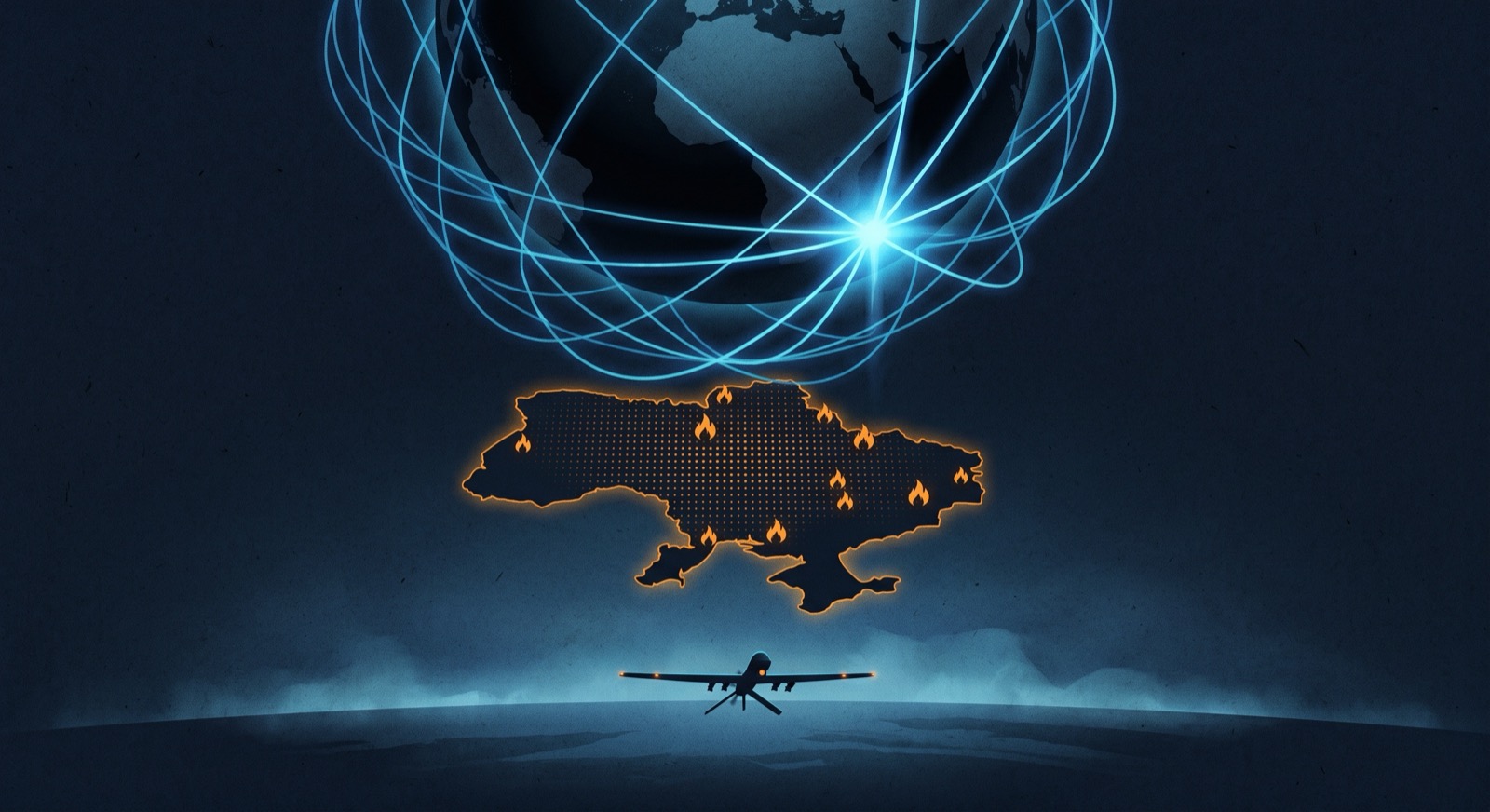
Overnight on October 13-14, 2026, SpaceX imposed a speed limit on Starlink terminals used by Ukraine's military. No warning. No negotiation. No bilateral consultation with the country whose soldiers depend on the network to fly drones, intercept Russian Shaheds, and coordinate across a 1,200-kilometer front line. Serhii Beskrestnov, a presidential adviser on military technology, confirmed the restriction within hours: the cap applies to the Starshield military service package, cutting connectivity when terminals move faster than 160 km/h (100 mph). Several missions were disrupted. The 7th Air Assault Corps reported connection drops at speeds as low as 110-120 km/h. A drone unit in the Huliaipole sector canceled operations outright.
"Obviously, this action cannot be a coincidence and is associated with the current political situation," Beskrestnov wrote on Telegram.
He is right — but the "current political situation" is not the real story. The real story is structural: NATO's most drone-dependent military force runs on a network owned and operated by a single private company, whose founder has his own political preferences, his own diplomatic relationships, and his own terms of service. That is not a partnership. It is a dependency. And on the night of October 13, the cost of that dependency came due.
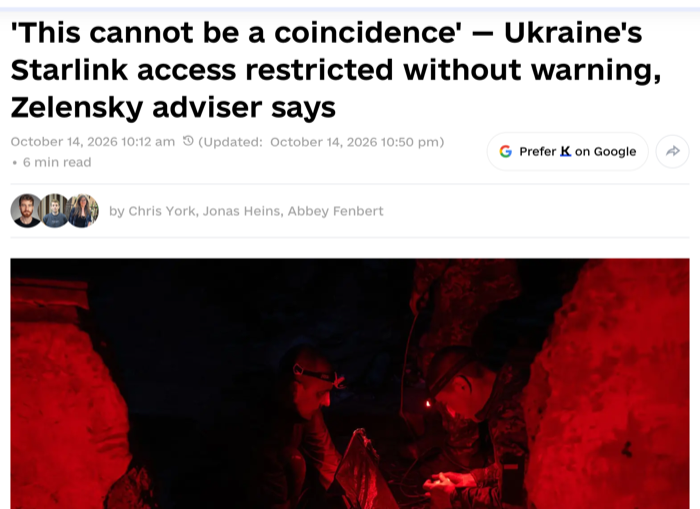
Read the full Kyiv Independent report →
What Happened — and What Musk Says
The restriction came the same week that U.S. President Donald Trump announced a surprise "energy ceasefire" — a deal to import Russian diesel to lower American pump prices ahead of the midterm elections. Kyiv says the ceasefire was "news to me." Moscow struck Zaporizhzhia anyway, killing more than 20 people including children, and hit Ukrainian refineries. Trump then declared it was "time for Ukraine to get a new president."
Against this backdrop, the Starlink throttle landed like a signal — whether or not it was intended as one.
Elon Musk's response on X was revealing for what it conceded and what it obscured. "Starshield systems are owned and controlled by the U.S. government," he wrote. "Any limits on speed or usage are decided by the U.S. military and ultimately POTUS." In other words: don't blame me, blame Washington.
But this defense unravels under scrutiny. If SpaceX merely executes government orders, then the U.S. military imposed a speed cap on a Ukrainian ally's drone fleet without informing the ally. If SpaceX acted unilaterally — as Ukrainian officials believe — then a private company disrupted a sovereign military's combat operations on its own authority. Either scenario is damning. The question is only who deserves the blame.
Ukrainian volunteer and activist Serhii Sternenko was blunter: SpaceX "likely took these measures at the request of the Trump administration." The PBS NewsHour reported that the throttle coincided with Kyiv's fears of a broader intelligence squeeze — CBS News reported that the U.S. may have withheld advance warnings of Russian strikes that killed six people and cut power to 600,000 others.
By evening, service was partially restored at the 160 km/h limit. But the damage was done — not to the network, but to the assumption that an allied military's communications infrastructure is under allied control.
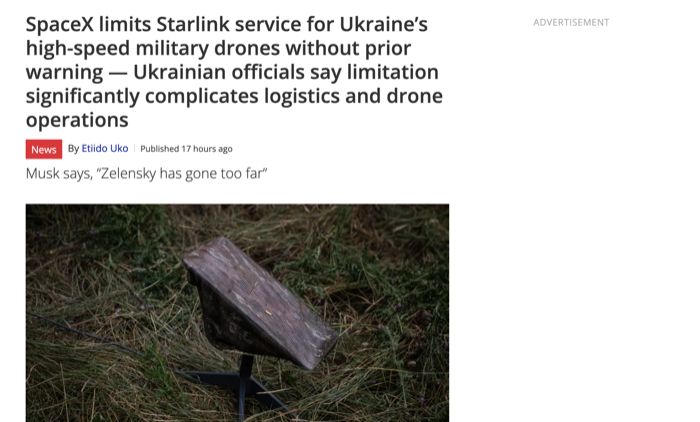
Read Tom's Hardware analysis →
Three Lessons the Starlink Throttle Teaches
1. Private Infrastructure Is Not Neutral Infrastructure
The defining feature of Starlink's role in the Ukraine war is not that it works — it is that someone can turn it off.
SpaceX deployed terminals to Ukraine within days of Russia's February 2022 invasion. By early 2025, Ukraine had secured at least 47,000 terminals, most supplied through partner governments. The system became, as Musk himself once boasted, "the backbone of the Ukrainian army." Drone operators use it to maintain links with strike and reconnaissance platforms over hundreds of kilometers. Commanders use it for real-time coordination across the front. Interceptor units rely on it to track and engage Russian Shaheds — the jet-powered Iranian-designed drones that Russia launches in waves against Ukrainian cities.
Foreign Policy's March 2026 analysis described SpaceX as "a gatekeeper in orbit, helping decide who connects as well as where, under what conditions, and with what technical constraints." Stanford's Freeman Spogli Institute put it more sharply: Starlink's "major policy choices are primarily controlled by a single individual — Elon Musk — who has his own political preferences and agenda, distinct from the U.S. or other countries."
This is not a novel observation. But the October 14 throttle turned academic concern into operational fact. When a single company can degrade an army's drone capability with a software update, the distinction between "private infrastructure" and "weapon system" has collapsed.

Read the Foreign Policy analysis →
2. The Speed Cap Is a Strategic Weapon Disguised as a Technical Limit
The 160 km/h speed limit is not a neutral engineering constraint. It is a targeting choice.
Ukrainian FPV drones — the close-range weapons used for trench warfare and armored-vehicle strikes — typically fly below 160 km/h. They are largely unaffected. But the systems designed to intercept Russian Shaheds need speed. The Shahed 136 cruises at approximately 185 km/h. A Starlink-connected interceptor drone chasing a Shahed loses connectivity at the moment it needs it most — the final approach.
Beskrestnov warned that the speed cap could undermine Ukraine's ability to protect its skies from jet-powered Shaheds, calling Starlink "the most effective solution" for the interceptor mission. The Tom's Hardware analysis noted that the restriction "significantly complicates logistics and drone operations."
The cap also affects mid-range strike drones operating behind Russian lines — the weapons Ukraine uses to hit ammunition depots, command posts, and infrastructure targets. These platforms fly faster than close-range FPVs and slower than manned aircraft. They sit precisely in the gap the speed limit creates.
Critical
The speed cap does not affect all Starlink terminals equally. It targets the military-grade Starshield service while leaving standard consumer Starlink operational. But Starshield is what Ukraine's most capable systems depend on — the interceptors, the deep-strike drones, the platforms that matter most.
This is what makes the restriction surgical rather than blunt. It does not switch off Ukraine's army. It degrades the specific capabilities that most threaten Russian assets — and most anger Moscow. Whether that precision is coincidental depends on how much credit you give SpaceX's engineering team and how much you give their policy team.
3. The Dependency Is Structural — and Nobody Built the Exit Ramp
The most uncomfortable lesson is that Ukraine has no alternative. Not right now, and not soon.
Poland pays approximately $50 million per year to maintain Starlink service for Ukrainian forces. Foreign Minister Radoslaw Sikorski has warned that Poland "will be forced to look for other suppliers" if SpaceX proves unreliable — a threat he sharpened in August 2026 when SpaceX excluded Poland from its European roaming zone, a move widely interpreted as retaliation for Polish criticism.

Zelenskyy has said Ukraine is developing a Starlink alternative with a European partner. Russia, he added, is building its own system with China — the Rassvet network — targeted for December 2026. But Russia's first 16-satellite Rassvet launch reportedly failed, with all satellites decaying in orbit. Europe's Eutelsat OneWeb has some capacity but nothing approaching Starlink's 9,357-satellite constellation or its battlefield-proven terminal ecosystem.
The structural problem is not that alternatives are impossible. It is that they require years of investment, launch capacity, and terminal manufacturing — years that Ukraine does not have, and that NATO has not used. The window to build a sovereign alternative was 2022-2024. It closed. Now Ukraine negotiates from a position where the vendor holds all the leverage and the customer holds none.

What the Prediction Markets See
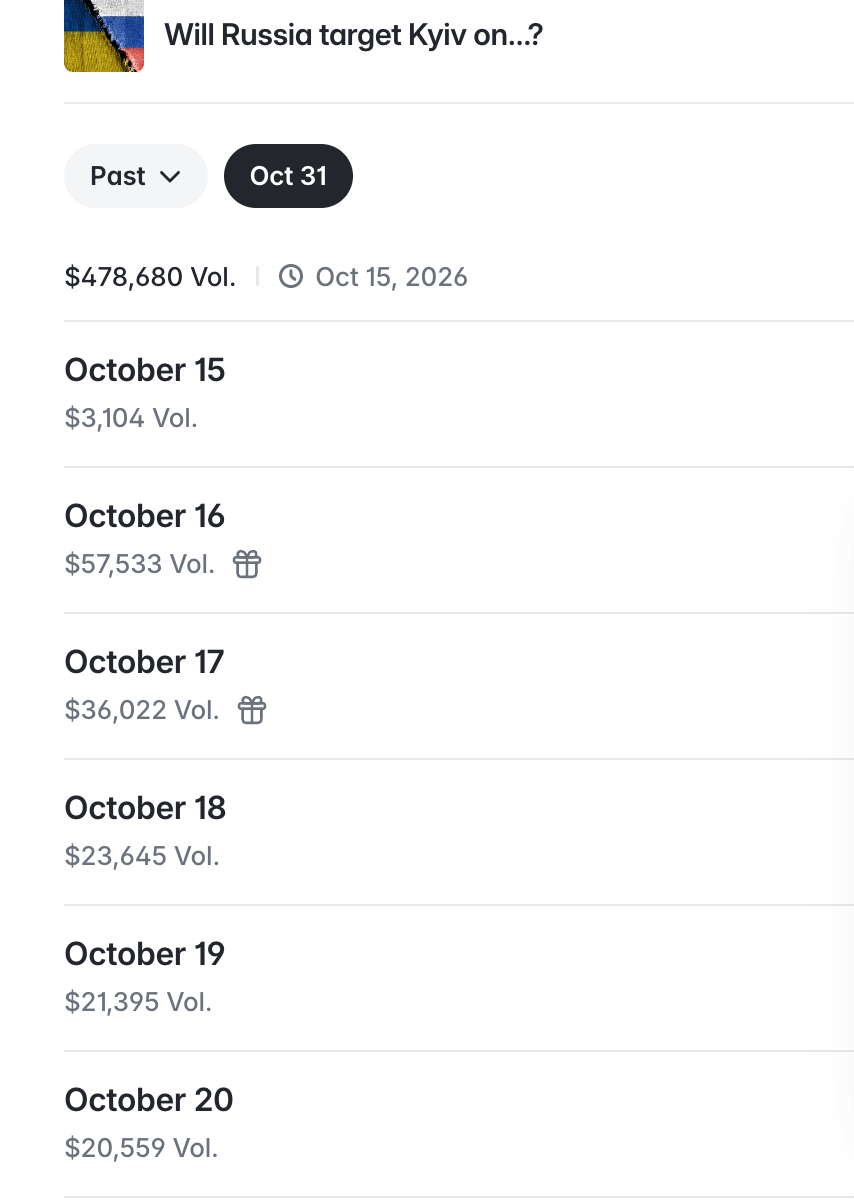
Polymarket's geopolitics board tells the story in real time. As of October 14, 2026:
- Russia targets Kyiv (October): approximately 96%, up 21.5% in one week
- Ukraine targets Moscow (October): approximately 86%, up 20% in one week
- Russia-Ukraine peace talks by October 31: down 21.5% this month
- Any diplomatic meeting: down 35.5% this month
Strikes up, diplomacy down. The markets are pricing a sharp escalation in reciprocal attacks at the same moment that the infrastructure enabling one side's attacks is being throttled by a private company aligned with the other side's political leadership. That is not a market anomaly. It is a market correctly reading a power asymmetry.
This is the same divergence pattern we tracked in Money Bets on Iran Peace, Bails on Ukraine — prediction markets showing the Russia-Ukraine war intensifying while diplomatic channels narrow. The October 14 throttle adds a new variable to that equation: the private-infrastructure chokepoint. When the company that provides your army's communications is politically aligned with the government pressing you to stop fighting, the market correctly prices escalation higher, because the tools of de-escalation are being removed from the side that needs them most.
The Yandex Irony
Two days before SpaceX throttled Ukraine's drones, Ukraine struck three of Yandex's six data centers in Russia — crippling half of Russia's largest tech company, knocking out cloud services across four countries, and destroying supercomputers used to train Russia's domestic AI models.
The contrast is instructive. Ukraine can strike Russia's digital infrastructure with kinetic drones. But Ukraine's own digital infrastructure — the satellite network that those drones depend on — is controlled by a private American company that can degrade it overnight. Ukraine can project power against Russia's tech stack. It cannot secure its own.
This asymmetry defines the new battlefield. The old model assumed that infrastructure was either sovereign (built by the state) or commercial (built by companies, regulated by the state). Starlink is neither. It is a private monopoly on a military-critical capability, subject to the preferences of a single owner, operating in a regulatory vacuum that no existing framework was designed to handle.
The Contrarian Case: Blame Washington, Not Hawthorne
Critical
There is a serious argument that the outrage is misdirected. If Musk is telling the truth — that Starshield systems are "owned and controlled by the U.S. government" and that "any limits on speed or usage are decided by the U.S. military and ultimately POTUS" — then the October 14 throttle is a U.S. policy decision, not a corporate one. The villain is not SpaceX. It is a White House that chose to degrade an ally's combat capability as leverage in a diesel deal.
This framing has some support. The U.S. government has a Starshield contract with SpaceX specifically for military applications. If the Pentagon ordered the speed cap, SpaceX was following instructions, not freelancing. And the timing — simultaneous with the "energy ceasefire" push and Trump's call for a new Ukrainian president — looks more like a coordinated pressure campaign than a rogue CEO.
But the contrarian case actually makes the structural problem worse, not better. If the U.S. government can instruct SpaceX to degrade allied military capability in pursuit of a unilateral diplomatic objective — without informing the affected ally — then the Starlink dependency is more dangerous than critics assumed. It means the chokepoint is not just commercial. It is political. And the politics can change overnight.
What Should Happen Next
NATO's 100-year drone partnership with Canada, which we analyzed last month, signals the alliance's commitment to drone-centric warfare. But drones without assured communications are expensive paperweights. The October 14 throttle demands a concrete response:
1. Continuity-of-service guarantees with teeth. Poland's $50 million annual Starlink bill should come with a NATO-enforceable continuity clause — not a Terms of Service document that SpaceX can update unilaterally. Defense procurement contracts routinely include assured-access clauses. Satellite connectivity should be no different.
2. Sovereign LEO constellation acceleration. The European alternative cannot remain a talking point. The EU, the UK, and Canada should pool launch contracts with Eutelsat OneWeb, Amazon's Project Kuiper, or a new European consortium to build redundant low-Earth orbit capacity within 36 months. This is expensive. It is also cheaper than discovering your army has no comms during a Russian offensive.
3. Terminal interoperability mandates. Ukrainian drone manufacturers should design multi-constellation receivers — terminals that can hop from Starlink to OneWeb to Kuiper depending on availability. The technology exists. The procurement incentive does not. Change the procurement incentive.
4. Contractual kill-switches that work for the buyer. The current model gives the seller (SpaceX) the kill-switch and the buyer (Ukraine, through Poland) no recourse. NATO should negotiate transition clauses that give the customer 90 days of guaranteed service before any restriction takes effect, with binding arbitration and pre-funded service bonds.
The deeper question — whether critical military infrastructure should ever be controlled by a single private vendor — has already been answered by the market. It should not. The October 14 throttle is the proof.
What the Community Is Saying
The Starlink throttle dominated Reddit on October 14. The Kyiv Independent's report reached 32,803 upvotes and 1,519 comments on r/worldnews — the single highest-engagement Ukraine story of the day. The Guardian's coverage hit 3,384 upvotes on r/technology with 406 comments, while the Reuters report drew 3,542 upvotes and 300 comments.


The Poland angle drove its own thread: "We Are Watching You" — Poland's warning to Musk — pulled 5,959 upvotes. Bloomberg's reporting on the same exchange earned 2,258 upvotes.
Across all threads, the dominant sentiment was not surprise — it was recognition. Commenters had been warning about single-vendor dependency since 2022. The October 14 throttle validated those concerns in the most concrete way possible: disrupted missions, canceled operations, and a military force discovering in real time that its communications backbone serves someone else's interests.
On r/technology, the conversation centered on the structural question: should critical military infrastructure ever be privately owned? The consensus skewed overwhelmingly toward "no" — but with a pragmatic acknowledgment that there is no short-term alternative. One highly upvoted thread pointed out that this is the same chokepoint pattern as rare-earth supply chains: the dependency is obvious, the alternative is expensive, and the political will to build the alternative only materializes after the dependency is exploited.
The Precedent
The Starlink throttle of October 14, 2026 will be studied in war colleges for decades. Not because it was the largest disruption — service was partially restored within hours — but because it demonstrated, in operational terms, what analysts had been theorizing: that private infrastructure in a war zone is a chokepoint controlled by the vendor, not the customer.
The age of the privately-owned battlefield has arrived. The question is no longer whether it is here. The question is who learns the lesson first — the nations that depend on it, or the adversaries who exploit it.
The Desk
About The Arc of Power
The Arc of Power editorial desk delivers rigorous analysis of geopolitics, defense, economic statecraft, and intelligence — examining the forces that shape the global order.
Briefing Access
Request Briefing Access
In-depth geopolitical analysis — power dynamics, defense strategy, and economic statecraft — three times a week. No noise.
Request briefing access