Case file · Defense · 10 min read
Ukraine's Mediterranean Reach Changes the War's Math
Naval drones sink a Russian corvette in Libya as ceasefire odds drift and Moscow preps for a Kaliningrad blockade.
The Arc of Power ·

On November 22, Ukraine's SBU launched seven naval drones against the Russian corvette Merkury at Benghazi, Libya — roughly 2,000 kilometers from Ukrainian territory. Satellite imagery confirmed the ship capsized at its berth. The cargo vessel Angara was also hit. A Ka-27 helicopter aboard the corvette was destroyed. Zelenskyy claimed the strike publicly, and the SBU said the drones were launched from a "mother ship" positioned near the target.
The Merkury was not some rusting Soviet-era hulk. Commissioned in 2023, it had joined Russia's Mediterranean squadron in 2024. It was one of Russia's newest operational warships. And Ukraine just sank it in a port on the coast of North Africa.
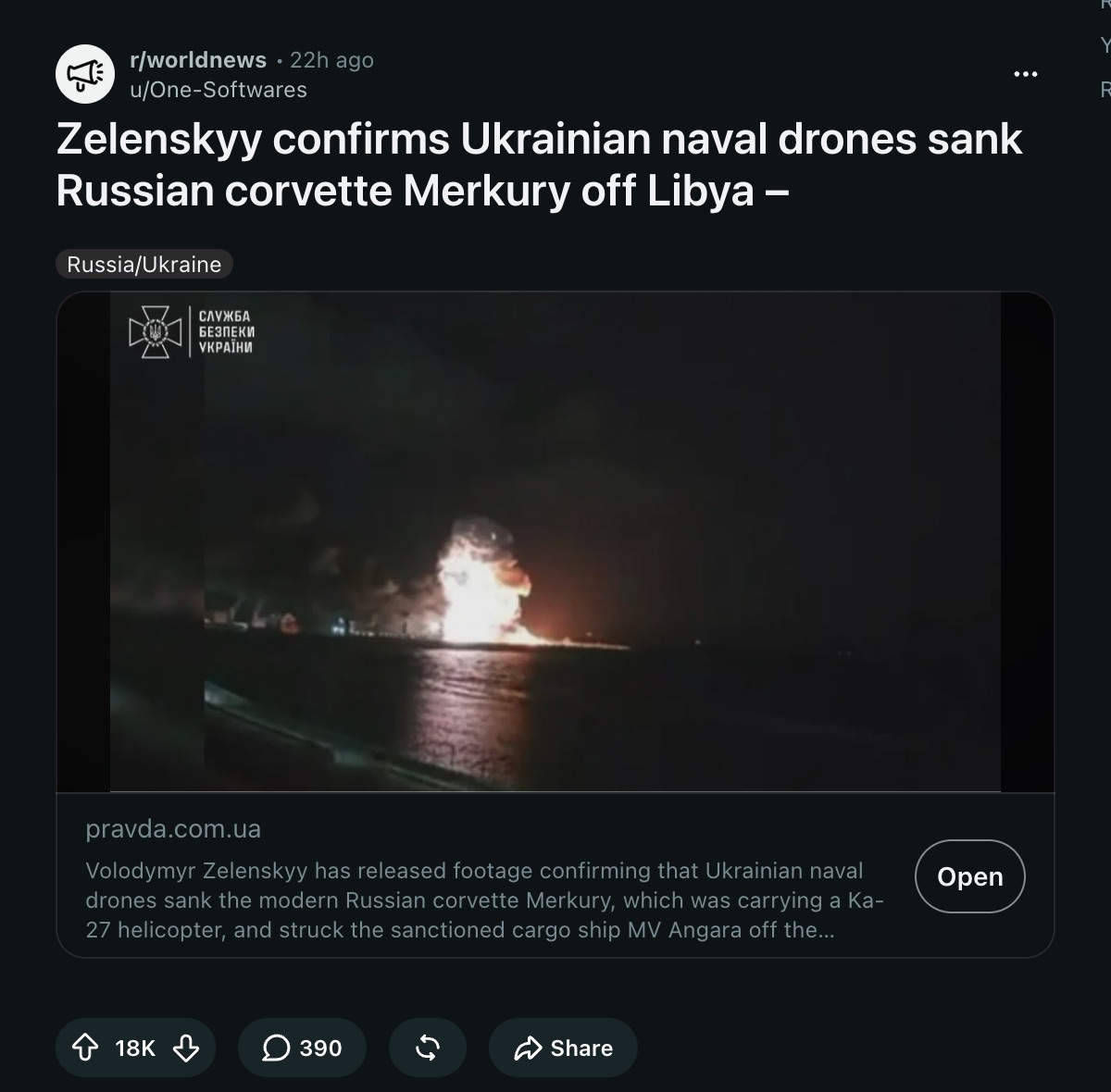
That is the fact. Here is what it means: the geography of this war has permanently expanded. Ukraine has demonstrated, in operational terms, that it can sink a modern warship at distance — far from the Black Sea, far from any recognized front line, using autonomous systems launched from a support vessel. This is not a tactical success. It is a strategic signal.
Four Strikes, One Pattern
The Merkury is not an isolated incident. It is the fourth confirmed or attributed Ukrainian strike on Russian-linked vessels in the Mediterranean in twelve months:
-
Qendil (December 2025): SBU aerial drones struck this shadow-fleet tanker between Crete and Malta — the first time Ukraine targeted Russian vessels outside the Black Sea. The tanker drifted for weeks before running aground in Turkey.
-
Arctic Metagaz (March 2026): An LNG tanker bound for Egypt was hit by what Russia blamed on Ukrainian naval drones. It caught fire and sank between Libya and Malta. Ukraine's SBU declined to comment.
-
Lady Mariia (September 2026): A sanctioned Russian cargo vessel was disabled by aerial drones near Crete.
-
Merkury (November 2026): A commissioned Russian Navy corvette sunk at Benghazi by naval drones launched from a mothership.
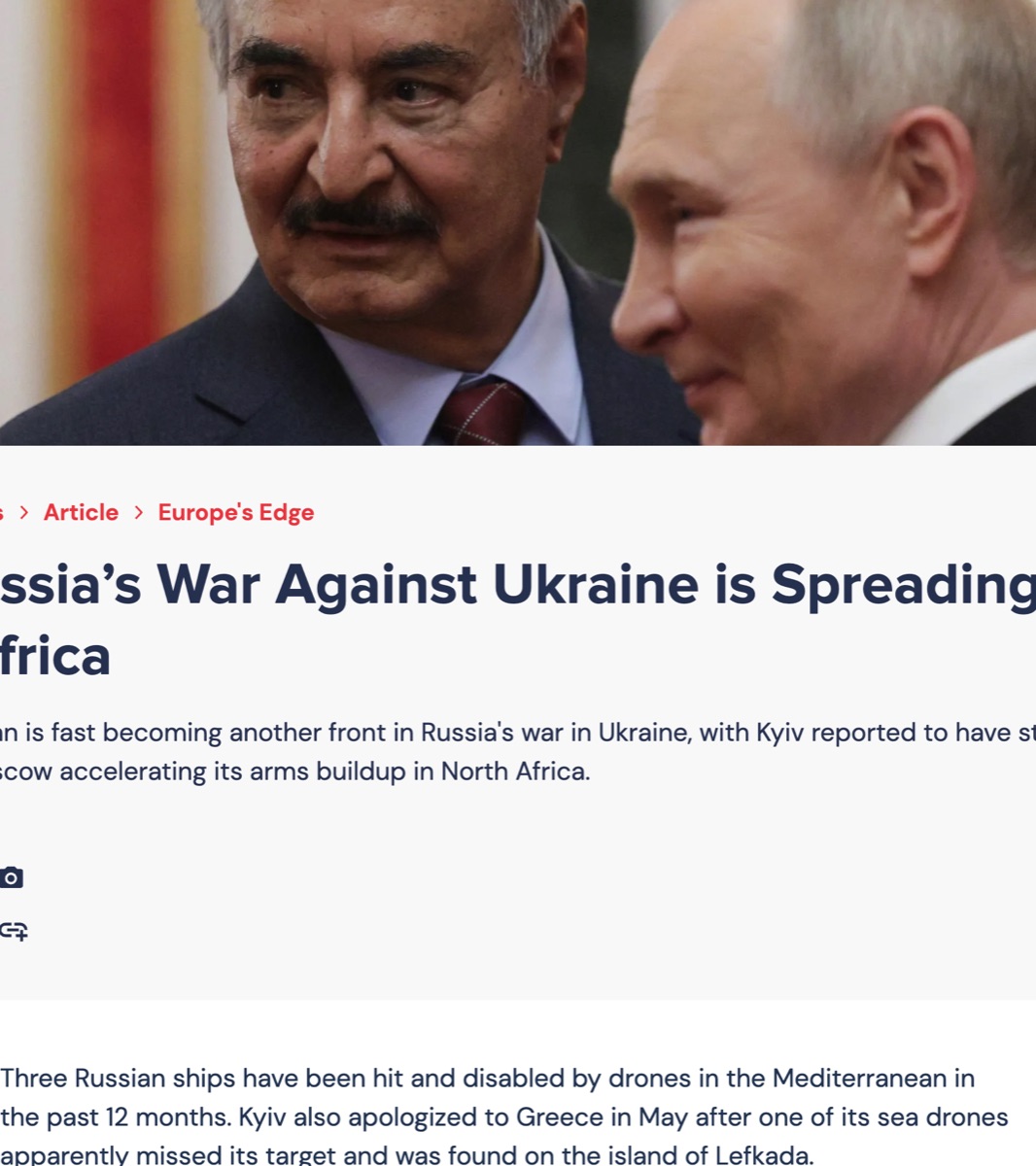
The pattern is unmistakable: strikes are growing more frequent, the targets are escalating from tankers to warships, and the launch infrastructure — reportedly a 200-strong Ukrainian drone unit operating from western Libya — is becoming more capable.
Note
Russian military shipping cannot use the Dardanelles or Suez Canal to reach its forces in Libya. Every Russian vessel heading to Tobruk must transit the western Libyan coast — squarely within the demonstrated range of Ukraine's Mediterranean drone operations. Russia's supply lines to its African expeditionary presence now run through a contested zone.
What Markets Are Missing
Here is where the prediction markets get interesting — and arguably wrong.
Polymarket currently prices a Ukraine-Russia ceasefire by December 31, 2026 at approximately 46%. That number has drifted down 9.2% this month, but it still implies a coin-flip probability that this war sees a formal pause within five weeks.
The ceasefire-agreement market (a higher bar — not just a pause but a signed deal) has also softened, down 8% this month. And the "next senior diplomatic meeting" contract has dropped 19% in just one week.
All three numbers are moving in the same direction: down. But they are not moving fast enough to reflect what just happened on the ground.
Critical
Consider what the last two weeks look like from an escalation standpoint: Ukraine sinks a Russian warship in North Africa. NATO intelligence warns Russia may launch a nuclear-armed satellite by December. Moscow announces $620 million in emergency Kaliningrad supply ferries. Drones strike five Russian military-linked vessels across the Baltic and Mediterranean between November 11 and 22. Abu Dhabi talks yield zero ceasefire progress. That is not a 46% ceasefire environment.
The Diplomacy That Is Not Happening
The Abu Dhabi round on November 10-11 was the first direct Russia-Ukraine contact in nine months, mediated by American envoys Witkoff and Kushner. It produced an agreement in principle on a large prisoner exchange. It produced nothing else.
Worse, the leaked negotiating framework reveals that Moscow has shifted its demands from the operational (ceasefire terms, territorial lines) to the structural (NATO force posture, alliance expansion bans, bilateral nonaggression pacts with individual European states). As Boris Bondarev, a former Russian diplomat, told Al Jazeera: "NATO will collapse" if individual pacts replace collective defense. That is not a negotiating position designed to reach agreement. That is a position designed to run out the clock.
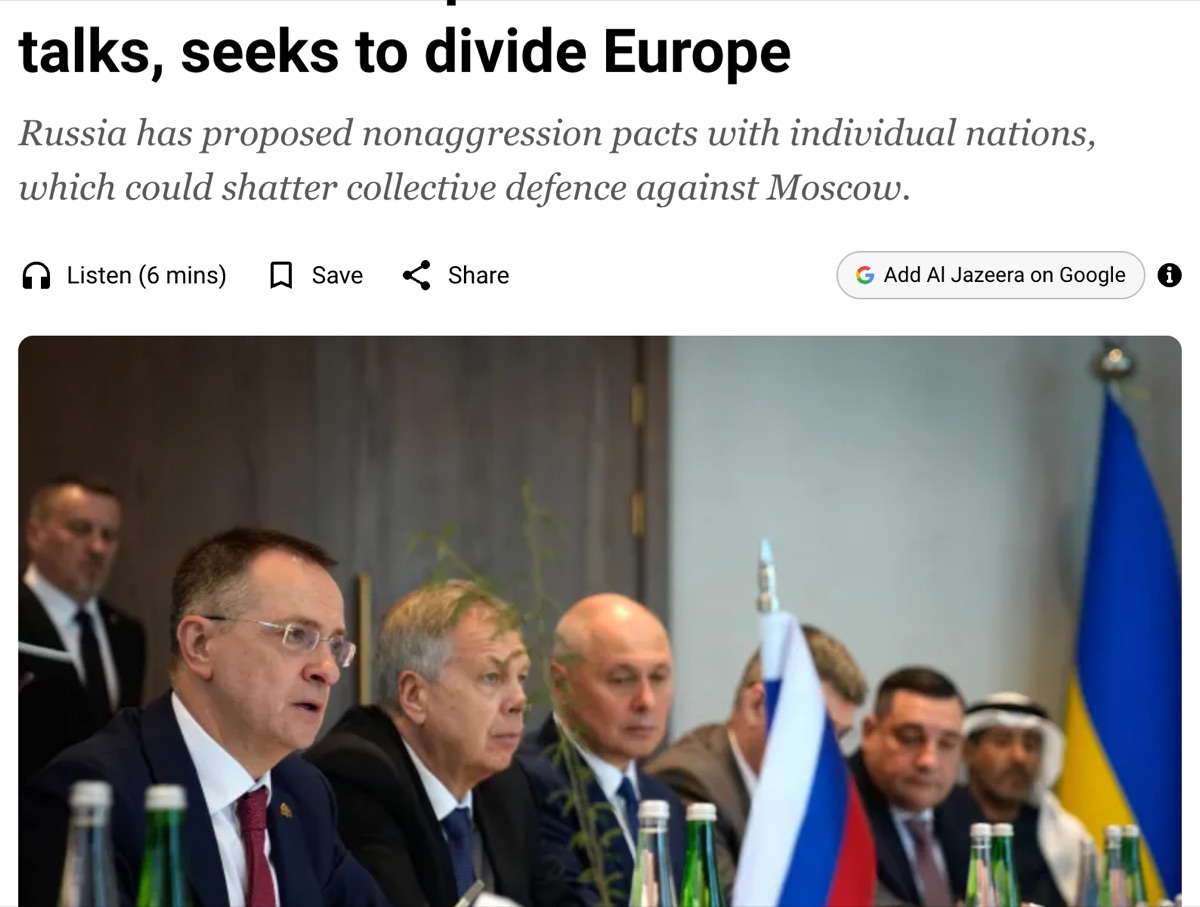
Kremlin aide Yuri Ushakov said on November 16 that Moscow had not agreed to European participation in future rounds and that "several more" US-Russia-Ukraine sessions might be needed first. The Kremlin has not confirmed a date for the next round. Ukrainian negotiator Davyd Arakhamia called the Abu Dhabi session one of the most difficult, saying the Russians appeared to have "very strict instructions."
The diplomatic pattern matches the kinetic one: Moscow is escalating demands at the table while Ukraine is escalating capabilities in the field. Neither side is building toward a landing zone.
Three Lessons from the Mediterranean Front
Lesson 1: A Non-Navy State Can Project Blue-Water Power
Ukraine does not have a conventional navy. What it has is a fleet of autonomous surface drones, a mothership concept for forward deployment, and personnel operating from Libyan territory. This model — drones plus forward basing plus plausible deniability — is now a proven template for maritime force projection by states that cannot afford or maintain a traditional fleet. Every defense ministry watching this conflict just learned something about the future cost curve of naval power.
Tip
The strategic implications extend beyond this war. If a country without a navy can sink a modern corvette 2,000 km from home using autonomous drones and a support vessel, the entire calculus of naval deterrence — built around billion-dollar surface combatants — faces a structural challenge. This is what defense analysts mean by "asymmetric disruption."
Lesson 2: Each New Theatre Makes De-Escalation Exponentially Harder
The war began on land in Donbas and Crimea. It expanded to the Black Sea. Then to the Baltic (strikes on vessels at Kronstadt and Ust-Luga). Now to the Mediterranean and North Africa. When a conflict spreads across five geographical domains, the number of potential escalation triggers multiplies. A ceasefire that covers the front lines in Donetsk does not cover drone operations in the Mediterranean, shadow-fleet tankers near Crete, or the emerging proxy contest in Libya. As we analyzed in Russia's Frozen War Is Cracking at the Table, prediction markets tend to price the visible front while ignoring the multiplying periphery.
Lesson 3: Russia Is Signaling Siege Mentality
Two simultaneous Russian moves this week betray a defensive posture that Moscow's rhetoric does not acknowledge:
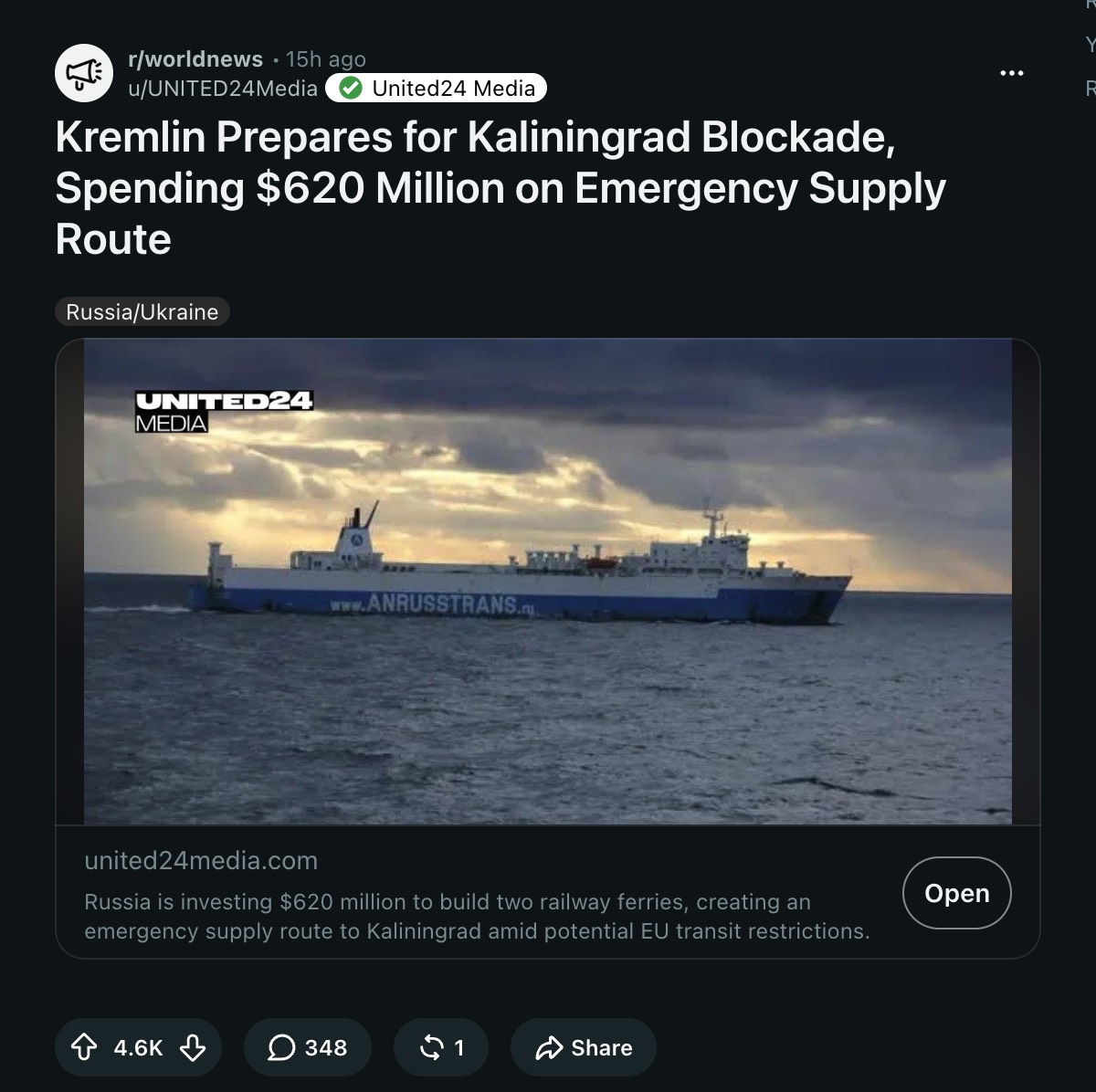
The $620 million Kaliningrad ferry project (Ust-Luga to Baltiysk, completion 2030) is explicitly designed to bypass land transit through NATO territory. Maritime shipping already carries over half of Kaliningrad's supplies, up from 8% in 2021. Moscow is planning for a world in which Baltic land corridors are permanently closed.
Western intelligence reports indicate Russia has assembled "Sputnik-S," a nuclear-armed satellite, and may launch it by year's end. The Kremlin dismissed the German reporting — but the signal is telling. Escalating to space-based nuclear weapons while your surface fleet gets sunk in the Mediterranean reads as deterrence by desperation, not strength.
As we noted when Europe built its deterrence stack without Washington, the shadow-fleet crackdown was already tightening the maritime noose. Ukraine's strikes in the Mediterranean are a different category: not enforcement of sanctions, but direct military action against Russian naval assets on a third continent.
The Contrarian Case
Critical
The strongest counter-argument: this is overread. One mothership-launched drone raid on a docked corvette is a commando operation, not "blue-water power projection." The ceasefire market is rational because both sides are exhausted and a frozen conflict serves everyone's short-term interests — Ukraine gets time to rebuild, Russia consolidates territorial gains, Western capitals get political cover. The $620 million Kaliningrad ferry is mundane logistics planning, not war preparation.
The counter to the counter: Russia itself does not behave as if this is mundane. The ferry investment, the nuclear satellite, and five vessels hit in twelve days all point in the same direction. And the Mediterranean strike pattern — four incidents across twelve months, with targets escalating from tankers to warships — is not a one-off that can be dismissed. When CEPA calls the Mediterranean a "pivotal strategic theatre" for this conflict, they are describing an observable trajectory, not a prediction.
What Comes Next
The article's thesis resolves into a forecast: the ceasefire probability curve should steepen. Each new theatre of operations makes the conditions for a comprehensive pause harder to negotiate, harder to verify, and harder to enforce. A ceasefire covering Ukrainian front lines, Black Sea shipping lanes, Baltic naval bases, Mediterranean shadow-fleet tankers, Libyan forward operating bases, and Russian satellite launches is not a ceasefire — it is a comprehensive peace treaty. And comprehensive peace treaties do not happen at 46% probability five weeks before the deadline.
For defense planners, the signal is cleaner: Ukraine has built a replicable model for a non-navy state to project maritime force using autonomous systems and forward-deployed personnel. That model will be studied, copied, and adapted. The age of cheap maritime power projection has arrived, and it was forged not in a Pentagon lab but in the desperate innovation cycle of a country fighting for survival.
For NATO, the immediate question is operational: the Mediterranean is now a contested zone in what is nominally a European land war. Operation IRINI's mandate covers shadow-fleet enforcement, not combat between belligerents. If Ukrainian and Russian forces clash directly in Libyan waters — a scenario CEPA considers possible — the alliance will need a framework it does not yet have.
The map of this war just got bigger. The odds of ending it just got longer. Markets have not caught up.
The Desk
About The Arc of Power
The Arc of Power editorial desk delivers rigorous analysis of geopolitics, defense, economic statecraft, and intelligence — examining the forces that shape the global order.
Briefing Access
Request Briefing Access
In-depth geopolitical analysis — power dynamics, defense strategy, and economic statecraft — three times a week. No noise.
Request briefing access