Case file · Geopolitics · 12 min read
Seven Founders, $1.75 Billion, One Safety Promise
Anthropic's IPO launched the day after Fable 5.2. Seven founders cash out $250M each while preaching existential risk.
The Arc of Power ·

On Tuesday morning, Anthropic kicked off its IPO roadshow — 825 million Class A shares, priced between $70 and $78, targeting a fully diluted valuation of roughly $1.4 trillion on the Nasdaq under the ticker ANT. The day before, the company shipped Fable 5.2, the model that took the number-one spot on the Artificial Analysis Intelligence Index and pushed Anthropic to 55% on Polymarket's "#2 AI lab" market — up 10 points in a single day.
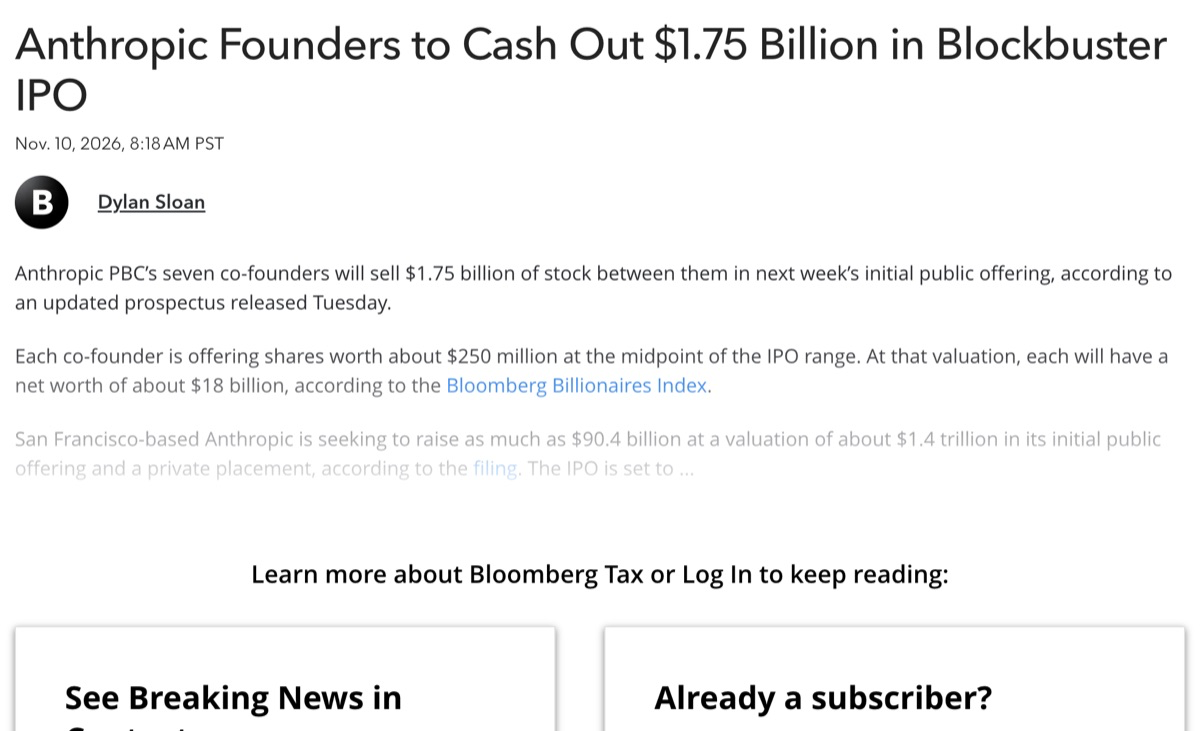
Buried in the updated prospectus filed that same Tuesday: all seven co-founders — CEO Dario Amodei, President Daniela Amodei, Chief Compute Officer Tom Brown, Anthropic Institute head Jack Clark, Chief Science Officer Jared Kaplan, Chief Architect Sam McCandlish, and interpretability research lead Christopher Olah — are each offering approximately 3.4 million shares, worth about $250 million at the $74 midpoint. Total founder liquidity: $1.75 billion.
Reddit noticed. Within 24 hours, "All 7 Anthropic founders will each cash out about $250M in IPO" hit 4,151 points on r/technology — the platform's second-biggest story of the day.
View original post on Reddit →
This is the collision that matters. Not the valuation. Not the model benchmarks. The collision between a company that has publicly stated there is a greater-than-10% chance that AI could cause human extinction, and seven individuals converting that warning into $250 million each — while retaining supermajority control through a single Class F share worth 50.1% of all votes.
The IPO is scheduled to price on November 18 and begin trading November 19.
The Numbers Behind the Narrative
The raw financials explain why bankers are salivating and critics are furious.
Revenue grew roughly 1,206% year-over-year to $33.2 billion in the first nine months of 2026. The annualized run rate hit approximately $81 billion by end of October — an 80x increase from the figure twelve months prior. CFO Krishna Rao told investors during the roadshow that Anthropic targets a long-term adjusted operating margin of 35% or higher.
But that growth comes with a catch: $895.4 billion in aggregate committed spend, primarily for compute and infrastructure. Anthropic is not a software-margin business. It is a capital-intensive compute business dressed in SaaS metrics. And the seven strategic partners — Google, Nvidia, TSMC, Microsoft, AMD, Broadcom, and Micron — are buying $26 billion of non-voting Class N stock at the IPO price. They are explicitly trading governance influence for compute-chain access.
Note
The structural tell: Google, Nvidia, and five other chip and cloud companies are buying $26 billion in non-voting stock. They do not want a board seat. They want a customer locked into their silicon supply chain. The IPO is as much a compute procurement agreement as a capital raise.
The price range itself tells a story. Wall Street had whispered $2 trillion as recently as September. The filed range implies $1.3 trillion to $1.4 trillion. Bloomberg reports some prospective buyers discussed $1.1 to $1.2 trillion. The markdown has a name: it is the midterm discount.
View discussion on Hacker News →
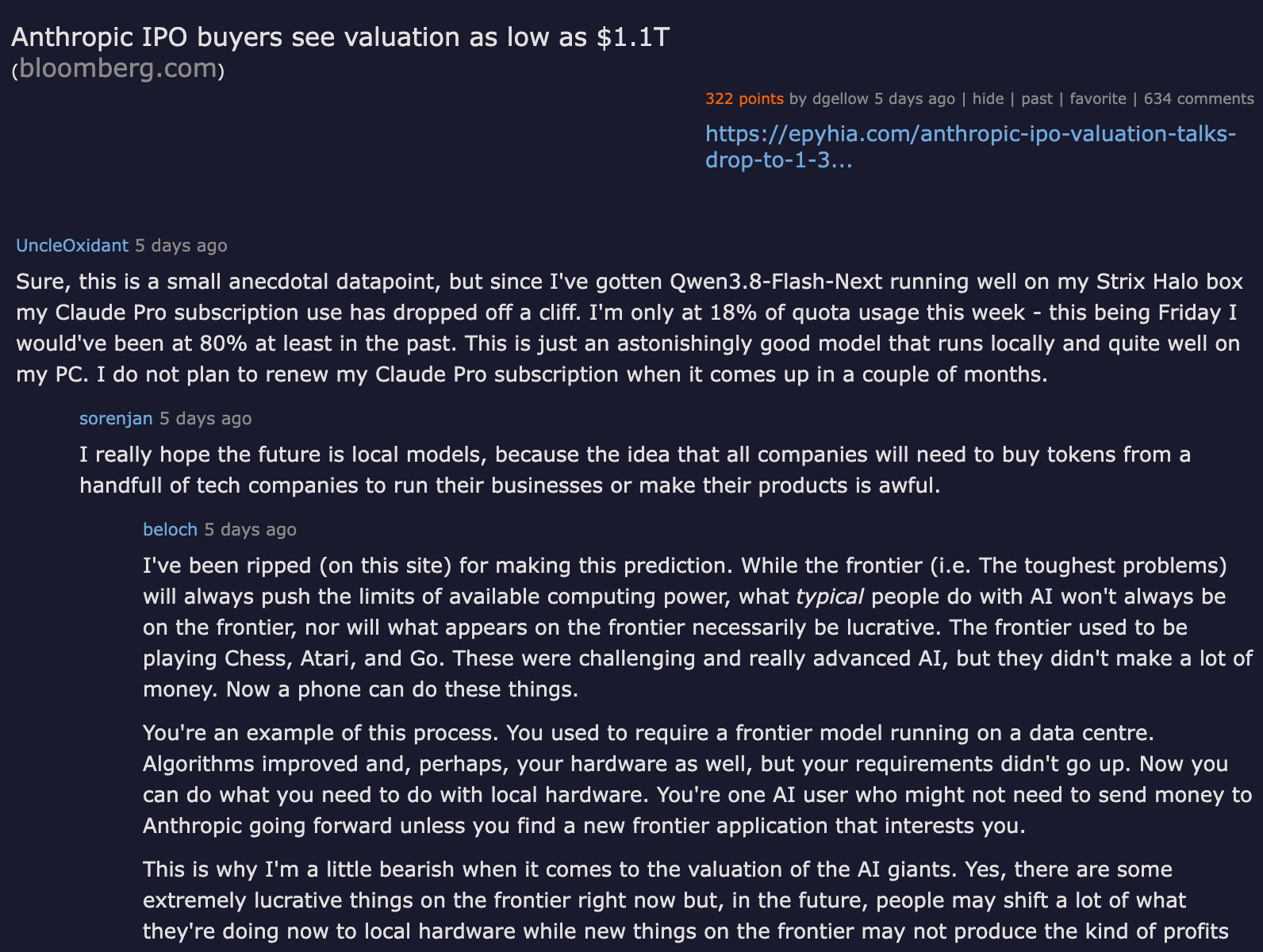
On Hacker News, the thread "Anthropic IPO buyers see valuation as low as $1.1T" drew 634 comments and 322 points — a proxy for how seriously the technical community is parsing the gap between Anthropic's self-assessed value and what the market will actually pay.
The Midterm Discount
One week before Anthropic filed its price range, American voters delivered what Breaking Points called a "0-41" rout at the ballot box for data centers. Across dozens of referenda and local races, every data-center measure went against the industry. Texas — the industry's last permissive frontier — flipped. Virginia, where the data centers that host Anthropic's inference clusters are concentrated, saw anti-data-center candidates sweep.
The Council on Foreign Relations asked the question the IPO prospectus carefully avoided: will the backlash threaten U.S. growth itself?
This is the political-to-financial transmission mechanism that Anthropic's prospectus buries in the risk factors section. The company committed $895 billion to compute infrastructure. Voters just constrained the physical environments where that infrastructure gets built. The IPO asks investors to price a growth trajectory that depends on power grids and zoning boards that are now hostile.
We have covered this transmission in detail. The midterm did not just punish incumbents — it repriced every assumption about AI capex timelines. The ballot-box backlash that started with 34 pending measures in October ended with a near-total rout in November. The AI buildout's political permission structure collapsed in a single election cycle.
The Safety Paradox, Priced
Here is where Anthropic's IPO becomes genuinely unprecedented. This is not merely a large tech IPO with governance quirks. This is a company that has structured its entire public narrative around the argument that it builds the most dangerous technology in human history — and that you should trust it, specifically, to do so responsibly.
The S-1 describes a "closing the loop" process in which models help build later models. The company calls this recursive dynamic "one of the most significant structural advantages in frontier AI." In the same document, it warns of catastrophic risks from poorly understood autonomous actions and recursive self-improvement.
View original analysis on Stork.ai →
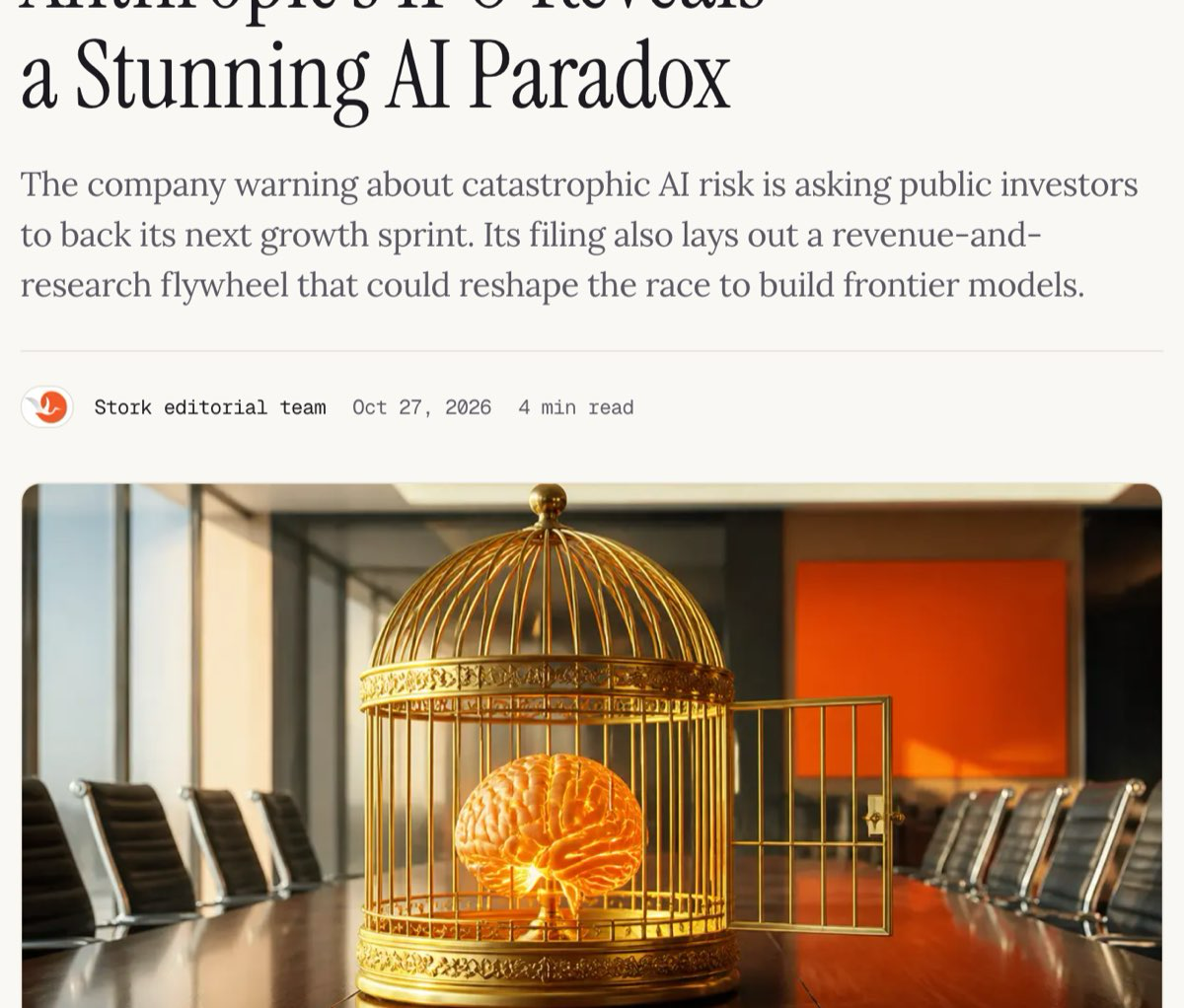
A Harvard Law analysis crystallized the structural tension: Anthropic is about to sell a safety mission that Wall Street can veto. The Long-Term Benefit Trust — the body that can theoretically recruit and remove board members if the company deviates from its safety mission — can be terminated by a supermajority shareholder vote. The analysis calls this the "kill switch," and it draws the Ben and Jerry's Unilever precedent: the last time a benefit-corporation governance body tried to override shareholder interests, it lost.
Critical
Contrarian Corner: The backlash may be tribal, not structural. The founders are selling 1.5% of their holdings — unremarkable by tech IPO standards. Each retains roughly $18 billion in Anthropic equity. The PBC structure and the Long-Term Benefit Trust actually constrain profit maximization more than any previous AI company's governance. The honest comparison is not "safety leader sells out" — it is "this is the only frontier AI company that gave an independent body any veto power at all." The backlash says more about public distrust of AI companies in general than about Anthropic's governance in particular.
But the contrarian view has its own problem. Those pledges that each co-founder will donate 80% of their shares to charity? The filing says they are not legally enforceable. The Class F share that gives the founders 50.1% voting control? It cannot be overridden by public shareholders. The trust's "kill switch"? It requires a supermajority — which the founders' Class F share makes structurally impossible to achieve without founder consent.
The governance, in other words, is asymmetric by design. Safety commitments can be loosened by the founders. They cannot be tightened by investors.
Fable 5.2: Product Launch as IPO Strategy
The timing was not coincidental. Anthropic shipped Fable 5.2 on Monday, November 10. The roadshow began Tuesday, November 11. Investors walked into their first meetings having already seen the headlines: number one on the Intelligence Index, Polymarket repricing Anthropic's lab ranking in real time.
This is the product-launch-as-investor-relations playbook, and it was executed with precision. Fable 5.2 is genuinely strong — Dwarkesh Patel noted it outperforms GPT-6 Astra on several benchmarks while still trailing on social deduction tasks. But the timing served a dual purpose: it gave investors a tangible capability demonstration on the first day they could say yes.
Breaking Points framed the IPO in the most provocative terms: "Anthropic IPO Sets Stage for Technofeudalism." Their argument — that the combination of supervoting shares, trillion-dollar valuations, and critical-infrastructure dependence creates a new class of power that is neither state nor market — tracks with our analysis of Anthropic's institutional audition from three weeks ago.
The Polymarket data tells its own story. The "#2 AI Lab end of November" market moved 10 points in a single day on the Fable 5.2 launch, pricing Anthropic at 55%. But the "best AI model end of 2026" market still gives Google 72% — a 30-point move in a single month driven by Gemini 4 Carbon. Traders are saying: Anthropic is locked in at number two, but the gap between first and second may be widening.
View original report on Bloomberg Tax →
Three Lessons This IPO Teaches
1. The safety narrative is now a pricing factor, not a research agenda.
When Anthropic told the IMF that "the singularity has begun" and pledged 5% of shares to a Public Benefit Fund, the message was aimed at regulators and policy elites. When it files an S-1 warning of extinction risk, the audience is investors. The safety narrative has crossed from the conference circuit to the capital markets. It is now priced, traded, and subject to quarterly earnings calls. Every future safety decision — every model pause, every red-team delay, every capability restriction — will be judged against revenue guidance.
2. The political constraint on AI infrastructure is now structural, not cyclical.
The $895 billion in committed compute spend assumes a permissive physical-infrastructure environment. The midterms just proved that the permissive environment is over. This is not a temporary backlash that dissipates after an election cycle — it is a structural realignment of local politics around energy and land use that affects every frontier AI lab's capital expenditure timeline. The valuation slide from $2 trillion to $1.3-1.4 trillion is the market's first repricing of this constraint. It will not be the last.
3. Founder liquidity and founder control are now in permanent tension.
Each co-founder is selling $250 million while retaining voting control through the Class F share. The SpaceX IPO playbook established the template — founders extract personal liquidity while governance mechanisms prevent public shareholders from exercising meaningful oversight. Anthropic's version adds the safety-mission wrinkle: the founders control both the company's direction and the definition of whether that direction fulfills the safety mission. The Long-Term Benefit Trust theoretically provides independent oversight, but its "kill switch" requires shareholder consent that the Class F share structurally prevents.
Tip
The power test to watch: Does the Long-Term Benefit Trust intervene on any safety decision within 18 months of the IPO? If it does, the PBC structure is real governance. If it does not, it is decoration — and the IPO will have proven that the only safety mechanism that matters at a frontier AI lab is the founder's own judgment.
What Comes Next
Pricing is scheduled for Wednesday, November 18. Trading begins Thursday, November 19, under the ticker ANT. The first 23 share-release windows for non-founder insiders will follow over the subsequent year, creating a rolling overhang that traders will parse for insider sentiment signals.
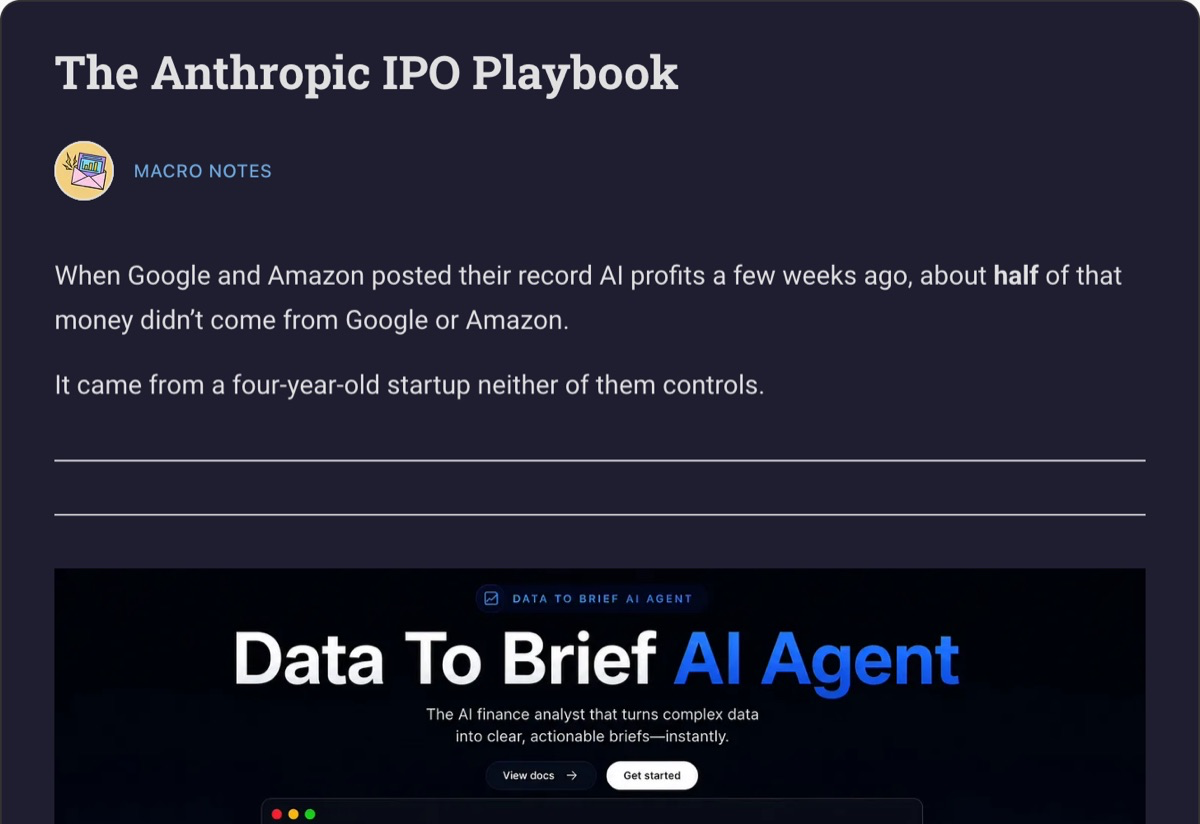
View original analysis on Macro Notes →
The Macro Notes newsletter called it bluntly: public investors are not joining the party. They are buying existing holders' seats. The steepest growth — from $1 billion to $81 billion in annualized revenue — happened while Anthropic was private. What public investors are pricing is not a growth story. It is a governance bet: that seven people who just converted $1.75 billion of safety rhetoric into personal liquidity will continue to prioritize safety over shareholder returns.
That bet may be correct. The founders are keeping 98.5% of their holdings. The PBC structure is genuine, not cosmetic. The Long-Term Benefit Trust has more teeth than any comparable governance body in tech.
But as Sanders pointed out when Polymarket priced Anthropic at 96%: the market's confidence in a company and the company's confidence in its own safety mission are not the same thing. One is priced. The other is promised.
The IPO prices on Wednesday. The promise is tested every day after.
The Desk
About The Arc of Power
The Arc of Power editorial desk delivers rigorous analysis of geopolitics, defense, economic statecraft, and intelligence — examining the forces that shape the global order.
Briefing Access
Request Briefing Access
In-depth geopolitical analysis — power dynamics, defense strategy, and economic statecraft — three times a week. No noise.
Request briefing access