Case file · Geopolitics · 12 min read
The Compromised Chokepoint
A national-security cloud over NVIDIA's CEO collides with the chip-export wars — and exposes the fragility of America's compute leverage.
The Arc of Power ·
The Compromised Chokepoint
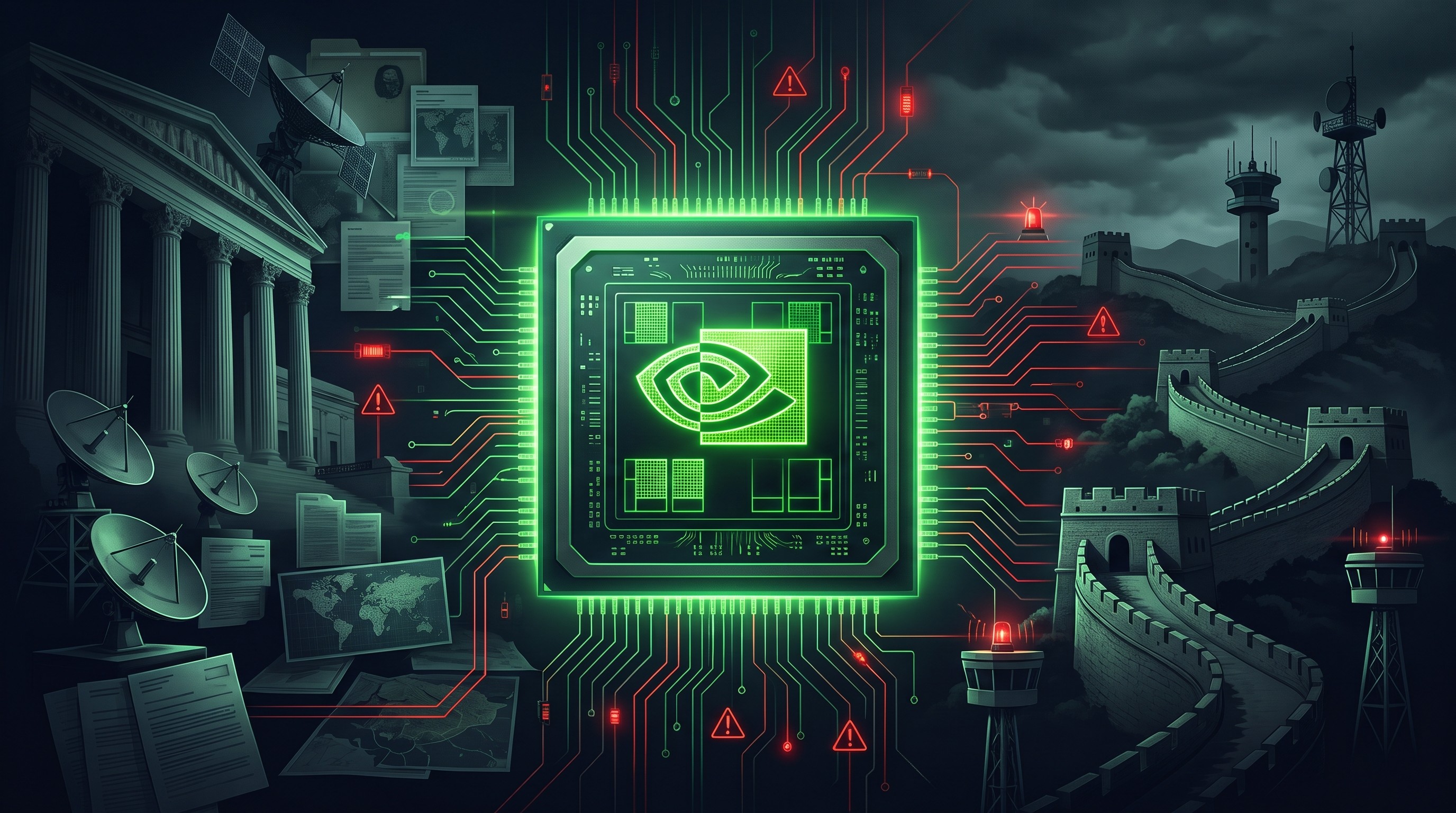
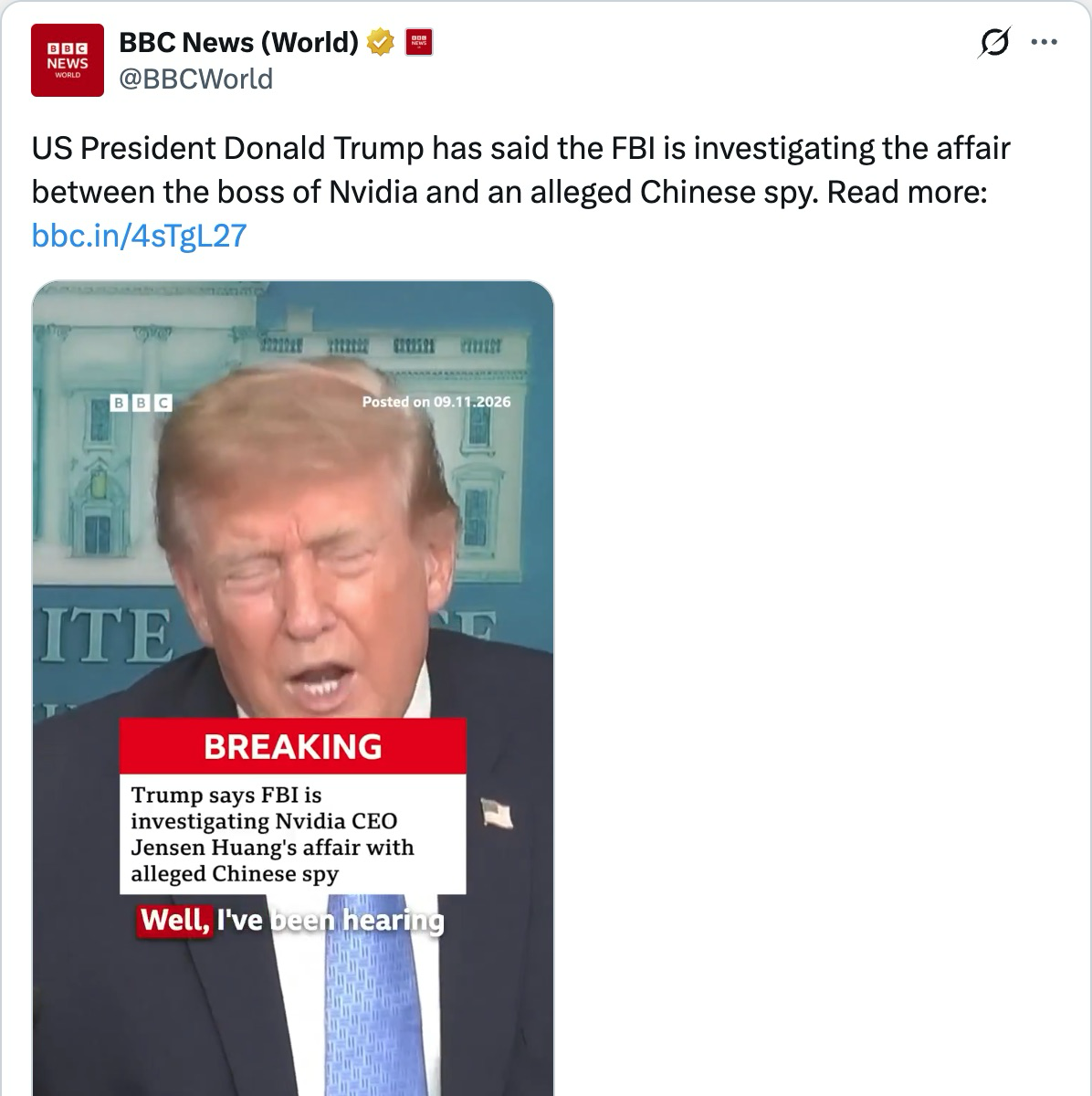
The single most strategically important CEO in the artificial-intelligence economy admitted this weekend that he carried on an affair with a woman U.S. intelligence agencies believe was recruited by China's Ministry of State Security, according to the New York Times and Bloomberg. On Sunday, NVIDIA's board of directors opened an independent investigation. On Monday, the incoming House Speaker called it "a significant issue of concern." President Trump says the FBI is now investigating.
Strip away the tabloid framing. What remains is a structural question that no one in Washington has been willing to ask out loud: what happens when the person at the center of every chip-export-control fight has a national-security cloud over his head — right as export policy toward China is being rewritten?
The answer is already unfolding: bipartisan congressional demands, a board probe, and a political overhang that reaches from Silicon Valley to the South China Sea.
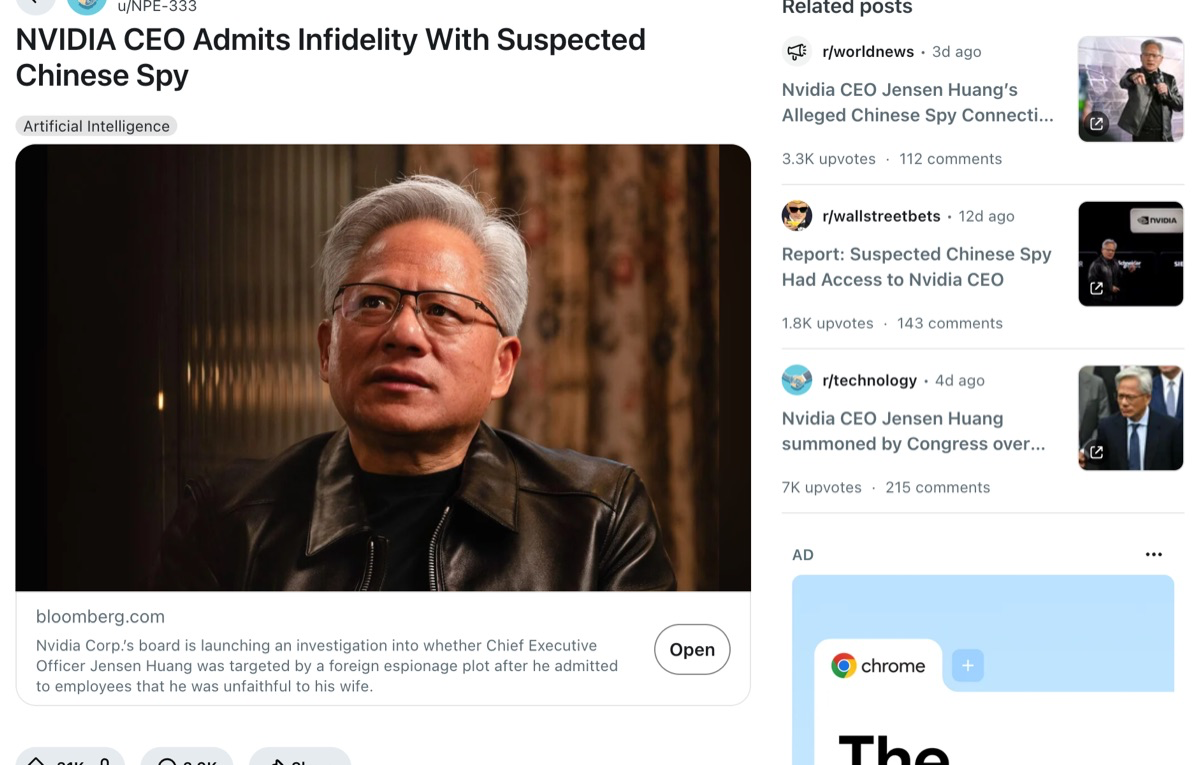
View original discussion on Reddit →
The Facts as Confirmed
Here is what is established — not alleged, not speculated, but reported by multiple outlets with named or sourced attribution:
October 29, 2026: The New York Times reported that U.S. intelligence agencies had concluded that Alice Huang (also known as Huang Le), a senior executive at Singapore-based data-center company Megaspeed International, was recruited by China's Ministry of State Security. Electronic surveillance reportedly confirmed close contact between Alice Huang and Jensen Huang. The two are not related.
November 6-7, 2026: Both the New York Times and the Financial Times reported that Alice Huang and Jensen Huang had a romantic relationship. Bloomberg reported that a U.S. intelligence document assessed Alice Huang as an MSS recruit.
November 8, 2026: Jensen Huang admitted the affair in a letter to NVIDIA staff. NVIDIA's board launched an independent investigation into the national-security implications.
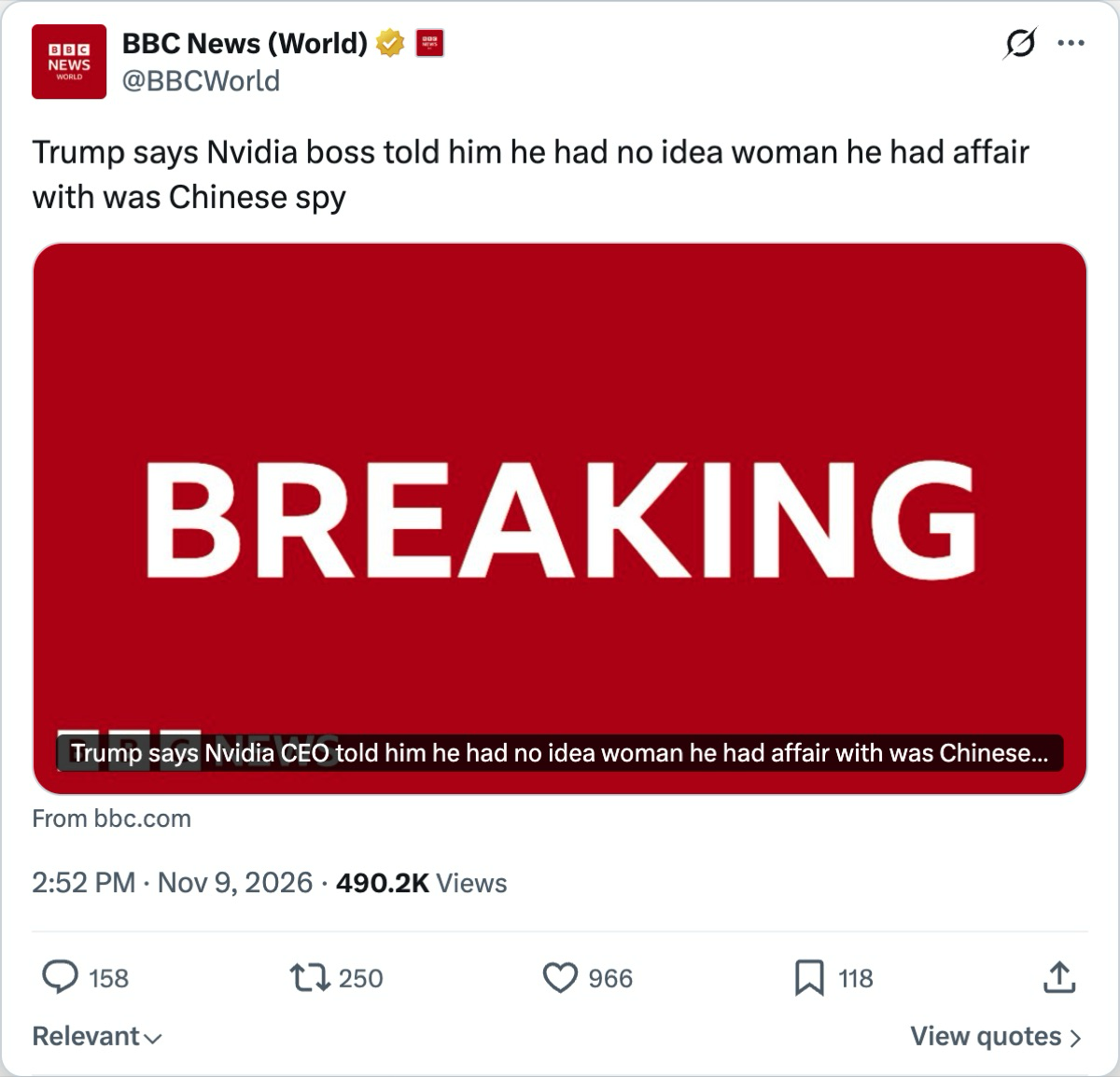
November 9, 2026: Presumed incoming Speaker Hakeem Jeffries said a classified briefing with White House officials was planned for Monday and confirmed the NVIDIA matter would be discussed. Senator Chris Coons, expected to chair the Senate Foreign Relations Committee, wrote on X: "Congress will investigate and get answers."
What is NOT confirmed: Whether Jensen Huang knew of Alice Huang's alleged intelligence activities. Whether NVIDIA trade secrets or national-security-relevant information was compromised. Whether Jensen Huang violated any U.S. law. NVIDIA says regional cloud customers receive "ordinary business information, not sensitive NVIDIA trade secrets, and zero information relevant to national security." China's foreign ministry has called the espionage allegations "groundless speculation."
Critical
Sourcing discipline: The espionage characterization comes from unnamed U.S. intelligence officials cited by the New York Times and Bloomberg. Alice Huang has not been charged with any crime. We report the intelligence assessment as alleged, not established.
Why This Isn't a Tabloid Story
Jensen Huang is not just any CEO with a personal scandal. He runs the company that sits at the single most consequential chokepoint in the global AI supply chain. NVIDIA controls roughly 80-90% of the AI-training accelerator market. Its CUDA software ecosystem creates switching costs so high that even well-funded rivals struggle to compete. When the U.S. government wants to restrict China's access to AI compute, NVIDIA's product line is the lever it pulls.
This matters because the chokepoint model requires trust. The entire logic of chip export controls depends on NVIDIA being a reliable partner in enforcement — designing chips that comply with performance caps (the H20, the H800), cooperating with end-use verification, and maintaining information hygiene with customers that include adversary-state-adjacent entities.
A national-security cloud over the CEO who sits at the center of that trust relationship does not just create political risk. It creates structural risk — for the chokepoint model itself.
The Congressional Pincer
The political dynamics are remarkable for their bipartisan velocity.
From the right: On November 4, three House Republican committee chairs — Brian Mast (Foreign Affairs), John Moolenaar (Select Committee on the CCP), and Rick Crawford (Intelligence) — sent Huang a letter demanding a joint, closed-door briefing by November 18, one day after NVIDIA's Q3 earnings call. The letter stated: "It is vital that Congress determines the extent to which U.S. national security has been placed at risk." It also requested disclosure of NVIDIA's internal security protocols against foreign espionage.
From the left: The 2026 midterms have just handed Democrats majorities in both chambers. Senator Elizabeth Warren — who had already pressed NVIDIA's board in June on export-control compliance and called for Huang's testimony that he declined — now has subpoena power. Senator Chris Coons, in line to chair Foreign Relations, has publicly pledged an investigation.
From the White House: Trump has called Huang an "honorable guy" who has "done an amazing job for our country," adding "he probably has an excuse for it." But Trump also confirmed the FBI is investigating — a statement that, regardless of intent, makes the national-security angle official.
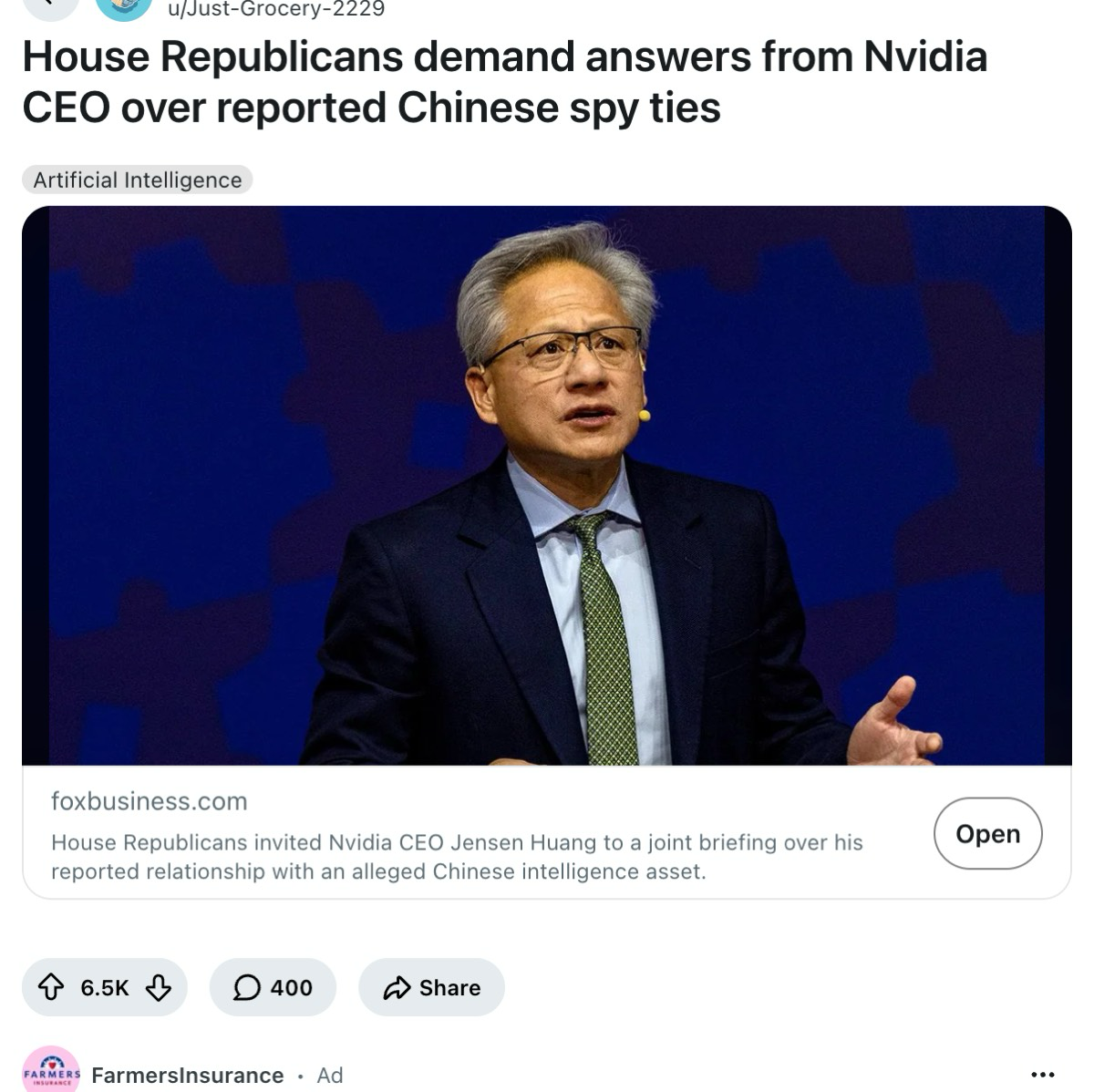
View original discussion on Reddit →
Note
The timeline convergence: NVIDIA reports Q3 earnings November 17. The congressional briefing is requested for November 18. Huang is scheduled to keynote a major NVIDIA conference in Washington on December 1. Every calendar date for the next month is a potential detonation point.
Three Lessons from the Compromised Chokepoint
1. The Chokepoint Model Was Always Structurally Fragile
The U.S. strategy of using NVIDIA as a chokepoint for AI-compute access depends on a single company simultaneously doing two incompatible things: maximizing shareholder value by selling to the world's second-largest economy, and enforcing U.S. national security by restricting sales to that same economy.
As Tech Policy Press argued in a prescient analysis, Huang's geopolitical strategy was "too artisanal for the rough and tumble of Washington policymaking." He lobbied for case-by-case export reviews. He designed chips (the H20, the H800) that technically complied with performance caps. He dined with Trump at Mar-a-Lago and flew to Beijing in the same month. The strategy assumed that a single CEO could calibrate the tension between commerce and security with the precision of a diplomatic negotiation.
The spy allegation did not create this fragility. It revealed it. The question is not whether Huang was compromised. The question is whether the chokepoint model is compromisable — whether concentrating this much geopolitical leverage in a single corporate actor, with a single CEO who must maintain relationships on both sides, was ever a stable equilibrium.
2. Bipartisan Consensus Is the Real Overhang
Chip-export policy has been one of the few genuinely bipartisan areas in U.S. policy. Senators Warren (D) and Banks (R) have jointly pressed NVIDIA on export compliance. The House Select Committee on China has operated with cross-party support since its creation.
The Huang scandal accelerates this consensus in a specific direction: toward structural controls rather than company-mediated controls. If Congress cannot trust the CEO to maintain information hygiene with customers, the logical response is to take the compliance decision away from the company entirely.
Watch for:
- Location-tracking mandates on exported chips (already proposed in bipartisan bills)
- Remote kill switches embedded in chip firmware (China has already pushed back against this, citing Opium War echoes)
- Broader licensing requirements that reduce NVIDIA's discretion in customer relationships
- Board-level governance mandates for companies in the export-control pipeline
The paradox: the tighter Washington squeezes, the faster China accelerates its own chip alternatives. Cambricon, Huawei's Ascend, and the domestic ecosystem that China's open-source AI gambit is feeding all benefit from every new restriction.
3. The Intelligence Failure Nobody Is Discussing
Perhaps the most striking detail in the reporting is that the U.S. government knew about the suspected espionage and did not warn Huang. According to the New York Times, alerting him could have revealed that Alice Huang was under surveillance, potentially jeopardizing the investigation.
This is a standard counterintelligence trade-off. But consider what it means in practice: for approximately a year, U.S. officials watched a suspected Chinese intelligence asset maintain close access to the CEO of the most strategically important company in the AI stack — and chose to let it continue. President Trump was briefed and took no action.
The defensive-briefing question matters beyond the personal. If the U.S. government's counterintelligence apparatus cannot — or chooses not to — protect the people who sit at its own chokepoints, then the chokepoint strategy has a single point of failure that no amount of export regulation can fix.
The Megaspeed Thread
The espionage allegation does not exist in isolation. It sits atop a much larger investigation into Megaspeed International, the Singapore-based data-center company where Alice Huang served as a senior executive.
According to trade records cited by the New York Times, Megaspeed affiliates purchased at least $4.8 billion in NVIDIA AI equipment between June 2024 and February 2026. Megaspeed was already under investigation for allegedly diverting restricted AI chips to Chinese entities — the kind of end-use violation that export controls are designed to prevent.
NVIDIA says the diversion allegations were investigated and debunked. But the scale of purchases — $4.8 billion from a single regional customer — raises its own questions about due diligence in an environment where the U.S. charged three men earlier this year for conspiring to smuggle NVIDIA GPUs to China, and where Super Micro Computer executives were indicted for chip-smuggling through Singapore — a case in which bipartisan senators wrote that Huang's public assurances of no chip diversion were "contradicted by reporting available at the time."
Singapore's Ministry of Home Affairs has stated that it did not investigate Alice Huang's alleged intelligence connections — while confirming that investigations into Megaspeed itself remain ongoing.
Critical
Contrarian Corner: The espionage framing may be politically convenient. Export-control hawks have wanted tighter restrictions for years, and a national-security scandal involving NVIDIA's CEO is the best argument they could ask for. Whether the intelligence assessment is accurate or instrumentalized — or both — the policy outcome may be the same: structural tightening that does not depend on corporate self-policing.
What Comes Next
The next 30 days are loaded:
- November 11: NVIDIA's deadline to confirm or reschedule the congressional briefing
- November 17: NVIDIA Q3 FY2027 earnings — analysts will ask about the board investigation and any material risk disclosures
- November 18: Requested congressional briefing (GOP-led, closed-door)
- Late November/December: Classified White House briefing for incoming Democratic committee chairs
- December 1: Huang's scheduled keynote at NVIDIA's Washington, D.C. conference — an appearance that now carries political symbolism whether he shows or cancels
- January 2027: New Congress seated — Democrats assume committee chairs with subpoena power
An investor close to Huang told CNBC that he could take a leave of absence depending on the board's findings. NVIDIA shares fell 12% in the two days following the midterm election, amid broader AI-stock weakness — but the national-security overhang adds a political-risk premium that pure market analysis cannot price.
The Structural Question
This story is not really about Jensen Huang's personal life. It is about a design flaw in America's technology-control architecture.
The United States built its chip-export strategy around a chokepoint model: control NVIDIA, and you control global access to AI compute. That model assumed the chokepoint could be trusted absolutely — that the company at the center would maintain perfect information hygiene, perfect compliance, and perfect insulation from the adversary it was supposed to help contain.
A suspected intelligence operation does not need to steal trade secrets to succeed. It only needs to create enough doubt that the chokepoint becomes politically untenable. Whether Alice Huang passed a single piece of sensitive information is, at this point, almost beside the point. The political damage is done. The bipartisan consensus is forming. The structural tightening is coming.
The question for policymakers is whether they tighten the controls on NVIDIA specifically — which solves today's headline but not the underlying vulnerability — or redesign the chokepoint model itself. The rare-earths lesson from June should be instructive: concentrated supply chains are not tools of leverage. They are single points of failure.
And the single point just failed.
The Desk
About The Arc of Power
The Arc of Power editorial desk delivers rigorous analysis of geopolitics, defense, economic statecraft, and intelligence — examining the forces that shape the global order.
Briefing Access
Request Briefing Access
In-depth geopolitical analysis — power dynamics, defense strategy, and economic statecraft — three times a week. No noise.
Request briefing access