Case file · Geopolitics · 12 min read
After Jensen: Nvidia's Geopolitical Moat
Jensen Huang built Nvidia into a geopolitical chokepoint. Can the moat survive his exit — or was it always a one-man bridge?
The Arc of Power ·
Jensen Huang's resignation as Nvidia's CEO on November 11, 2026 did not just remove a corporate leader. It removed the human bridge between three nodes of power — Silicon Valley's chip design floor, Washington's export-control apparatus, and Taipei's foundry complex — that together constitute America's most potent technology chokepoint. The question everyone is asking is whether Nvidia's stock recovers. The question that matters is whether Nvidia's geopolitical moat survives the handover.
We covered the scandal itself four days ago. This piece is not about the affair, the alleged Chinese intelligence connection, or the board investigation. It is about what comes after: the succession question as a geopolitical stress test.
The answer, in three theses: Nvidia's technological moat — CUDA lock-in, 80-plus percent data center GPU share, Pentagon contracts — is real and durable. But the geopolitical moat — the personal diplomacy, the congressional credibility, the supplier relationships — was always a one-man bridge. And that bridge is now out.
The Three Pillars of a Personal Moat
To understand what Nvidia just lost, you have to understand what Jensen Huang actually did beyond running a chip company.
Pillar 1: The TSMC Relationship. Nvidia designs chips but manufactures nothing. Every H100, every Blackwell GPU, every next-generation accelerator is fabricated at TSMC's facilities — a dependency we analyzed in September. But TSMC allocates capacity based on relationships, not just purchase orders. Huang built a three-decade rapport with TSMC's leadership, starting from the Morris Chang era, that gave Nvidia preferential access to advanced packaging (CoWoS) and leading-edge nodes. SemiAnalysis's Dylan Patel told CNBC that Huang personally persuaded executives at smaller component makers to commit capacity to Nvidia, helping the company secure "the majority of supply chain capacity." Those handshake commitments do not transfer with a business card.
Pillar 2: The Washington Corridor. Huang was not merely a lobbyist. He was the face of American chip power — the executive who flew on Air Force One to Beijing with Trump, who briefed Congressional committees on export-control implications, who framed the chip war as a story about American leadership rather than corporate profit. That framing gave Nvidia extraordinary influence over how restrictions were designed. The company's lobbying against overly broad export controls was effective precisely because Huang could deliver it personally with technical authority. Now that authority is gone — and as we will show below, Congress is already moving to fill the vacuum with harder lines.
Pillar 3: The Diplomatic Circuit. Huang met with heads of state from Japan to India to the UAE, pitching sovereign AI infrastructure deals that positioned Nvidia as a de facto arm of American technology diplomacy. Duncan Clark, a longtime China-tech observer, summarized it for CNBC: "I don't think you can replace him with one individual."
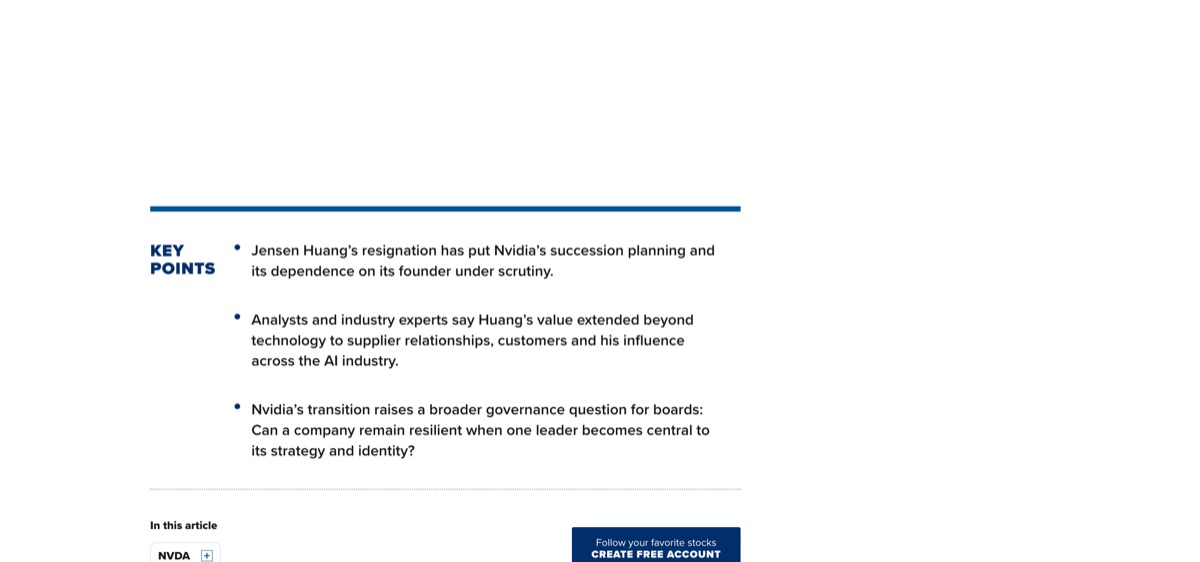
View the full analysis on CNBC →
Note
Nvidia flagged this exact risk in nine straight annual filings. Since 2018, every 10-K has warned that the company is "highly dependent on the services of our longstanding executive team" and that poor succession planning could "hinder strategic planning and long-term success." The five named executive officers have a combined 95 years at the company. Huang alone accounts for 33. The company saw the single point of failure — and chose not to fix it.
The Succession Vacuum
Colette Kress, Nvidia's CFO since 2013, is serving as interim CEO while the board searches for a permanent replacement. Harvey Jones has been named the board's first-ever independent chair. A search firm has not yet been formally selected.
The names being floated tell you how wide the vacuum is. Axios listed eleven possible successors, ranging from AMD's Lisa Su and Arm's Rene Haas to — remarkably — former Apple CEO Tim Cook, whose name entered the conversation after Trump publicly suggested it. The Financial Times reported that Huang's daughter Madison has emerged as a possible long-term candidate. Internal names include Ian Buck (VP of accelerated computing), Bryan Catanzaro (VP of applied deep learning research), and Jay Puri (EVP of worldwide field operations).
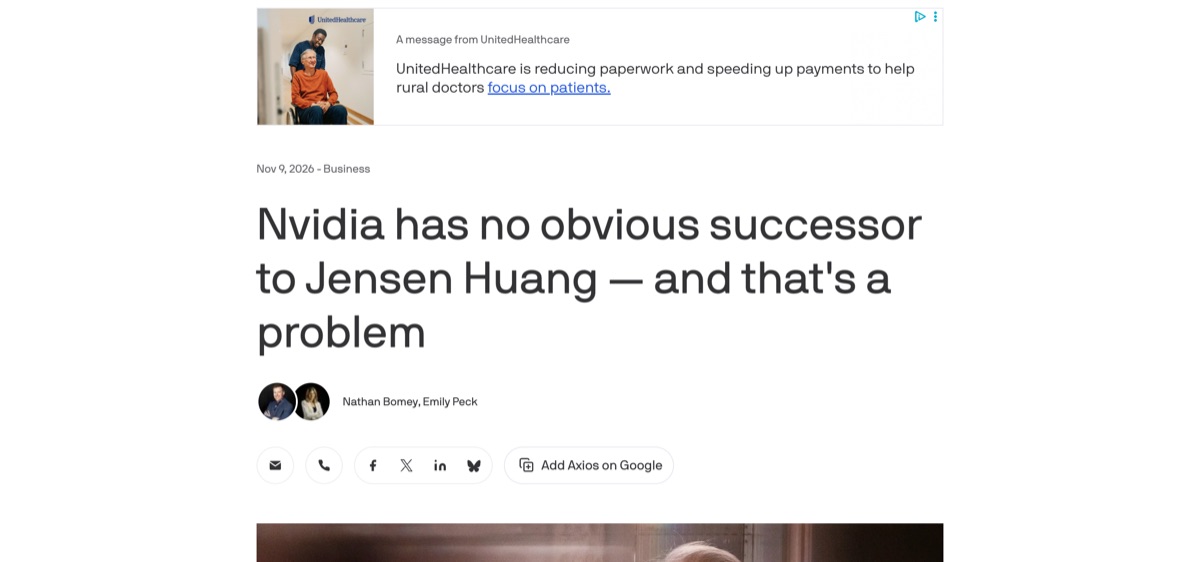
View the full report on Axios →
None of them are Jensen Huang. Stacy Rasgon of Bernstein captured the problem precisely: "They need a visionary like that." The Bernstein line that has circulated most widely is starker: "Jensen Huang is Nvidia, and Nvidia is Jensen Huang."
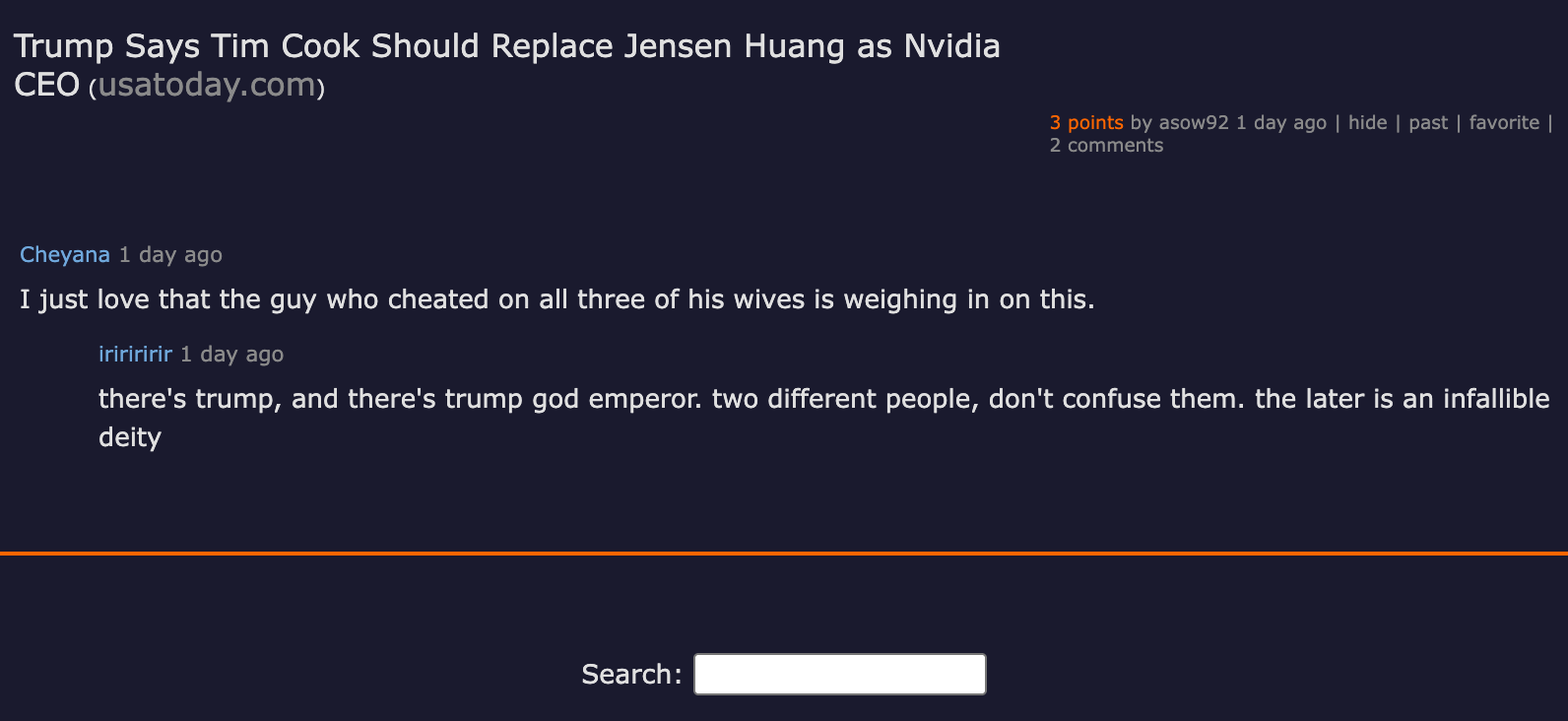
This is not hyperbole. Huang ran a flat organization with approximately 60 direct reports — a structure that concentrated decision-making rather than distributing it. Yale's Jeffrey Sonnenfeld argued this leaves virtually no bench strength. The governance failure, as Clark called it, is not that Nvidia lacked talent. It is that the company was architecturally designed around a single node.
Three Theses on What Breaks
The standard analyst framing is that Nvidia's technology moat is strong enough to survive any CEO change. CUDA ecosystem lock-in, market share, and R&D pipeline are institutional assets, not personal ones. That framing is correct — but incomplete. It accounts for the commercial moat and ignores the geopolitical one.
Thesis 1: The Export-Control Window Is Closing Faster
Jensen Huang was the chip industry's most effective voice against overly restrictive export controls. He argued, with credibility, that blanket bans on chip sales would push allied nations toward Chinese alternatives without meaningfully slowing Beijing's AI programs. That argument worked — until the scandal made him politically toxic.
Rep. John Moolenaar, chair of the House China Committee, told Roll Call that the scandal "shines a whole new light on that discussion." The Senate's fiscal 2027 NDAA already includes a manager's amendment requiring chip security mechanisms and banning exports of certain powerful chips to countries of concern. The House NDAA lacks equivalent language — but that gap is narrowing. Rep. Brian Mast has requested testimony from Huang on December 1 and from Commerce Undersecretary Jeffrey Kessler on December 3. Sen. Elizabeth Warren has asked Commerce Secretary Lutnick and Secretary of State Rubio to preserve all export-related records.
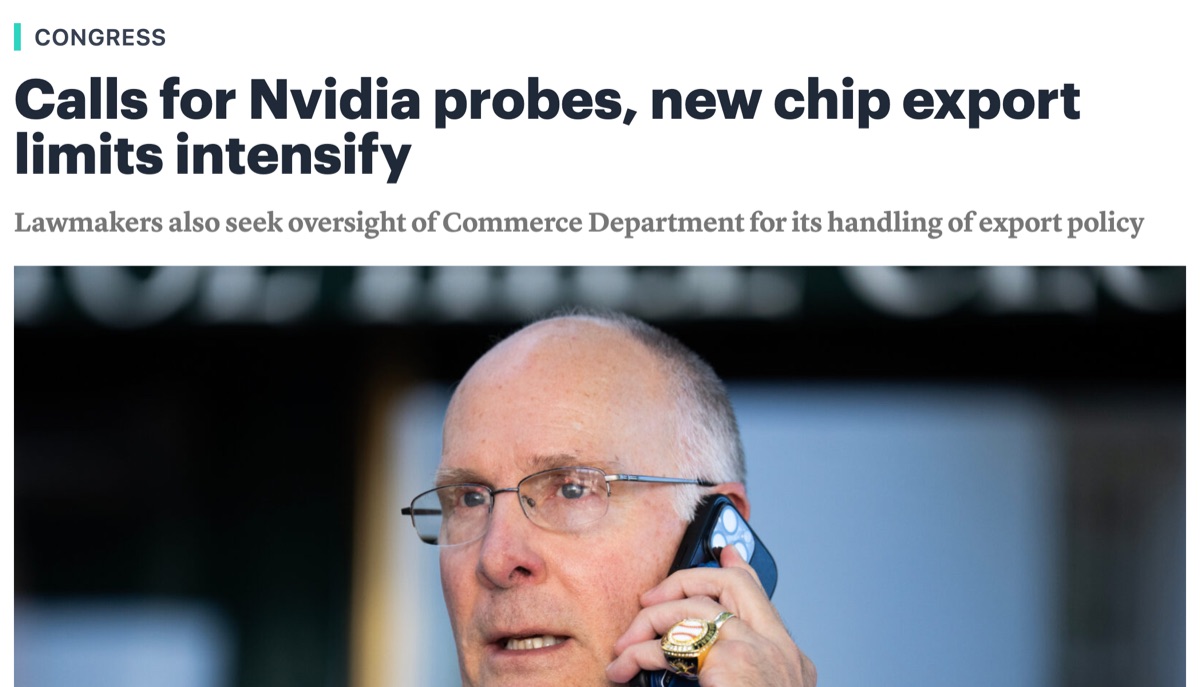
View the full report on Roll Call →
The political arithmetic is brutal. A newly elected Democratic Congress that already showed appetite for tech regulation now has a bipartisan opening to tighten chip controls. The scandal provides political cover for hawks on both sides. And the person who would normally counter that momentum — Jensen Huang — just lost all political capital.
Critical
Contrarian Corner: Removing Huang might actually help Nvidia's export-control position. A new CEO without scandal baggage could reset the relationship with Congress. The Chip Security Act — which passed the House Foreign Affairs Committee unanimously — focuses on verification mechanisms, not blanket bans. A cooperative CEO who embraces verification rather than fighting it could preserve more market access than Huang's combative approach did. The scandal may be the catalyst that forces Nvidia from lobbying against controls to shaping them constructively.
Thesis 2: The TSMC Dependency Becomes a Vulnerability Without the Relationship
Nvidia's entire product line depends on TSMC fabrication. The Foreign Direct Product Rule (FDPR) extends American jurisdiction to foreign-made chips produced with US tools — which covers virtually all TSMC output. But enforcing the FDPR requires cooperation, and cooperation is built on trust between specific people.
Huang's personal standing in Taipei was an asset that doesn't appear on any balance sheet. TSMC's advanced packaging lead times run 52 to 78 weeks. When allocation is tight, relationships determine who gets priority. A new Nvidia CEO — especially an outsider like Rene Haas or Tim Cook — will start from zero with TSMC's decision-makers.
Meanwhile, the Taiwan scenario adds urgency. TSMC's Arizona fabs are years from matching Taiwan's output. If cross-strait tensions escalate during the leadership transition, Nvidia faces a supply chain crisis without the diplomatic back-channel that Huang maintained.
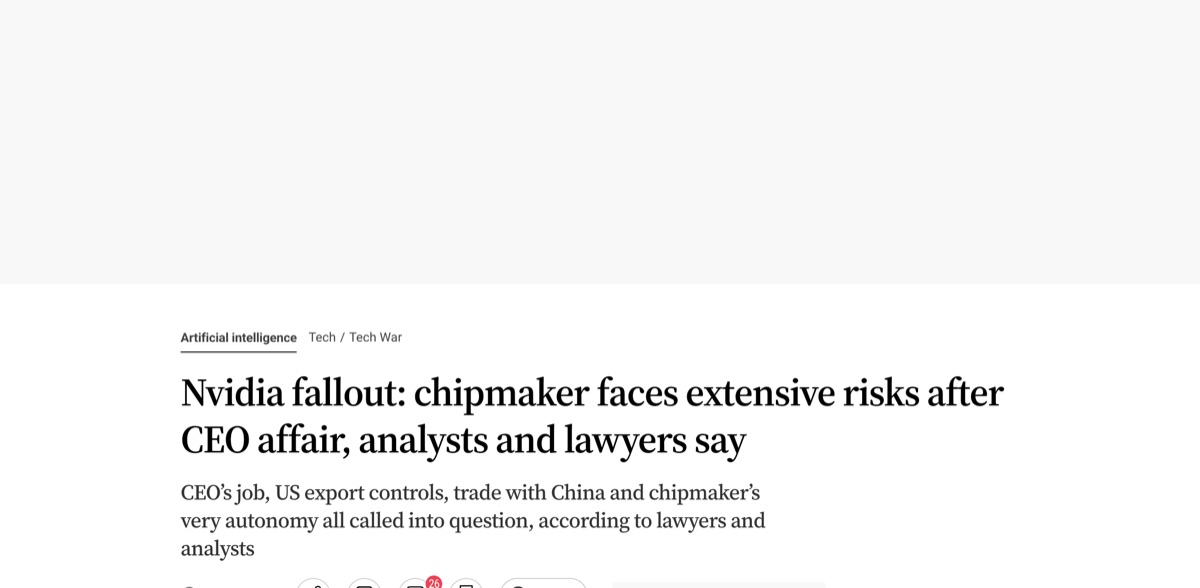
View the full analysis on SCMP →
Thesis 3: The Pentagon Contracts Introduce a Security Clearance Question
In May 2026, Nvidia won Pentagon contracts for classified AI deployments at Impact Level 6 and IL7. These are not routine commercial sales — they involve classified defense networks where the CEO's security posture matters. Nvidia agreed not to impose usage restrictions beyond what US law requires.
A CEO transition at a company holding IL6/IL7 contracts during an active counterintelligence investigation is unprecedented in the modern defense-tech complex. The next CEO will need to pass security reviews that will inevitably reference the scandal. External candidates from non-defense backgrounds (Cook, Su) may face extended vetting. Internal candidates may be tainted by association.
The broader pattern here connects to China's rare-earth leverage and the distillation paradox: America's chip advantage is real but fragile, and it depends on institutional relationships that have been held together by a remarkably small number of individuals. Huang was the linchpin. Removing him does not destroy the advantage — but it exposes how personal, how non-institutional, that advantage actually was.
The Political Dimension
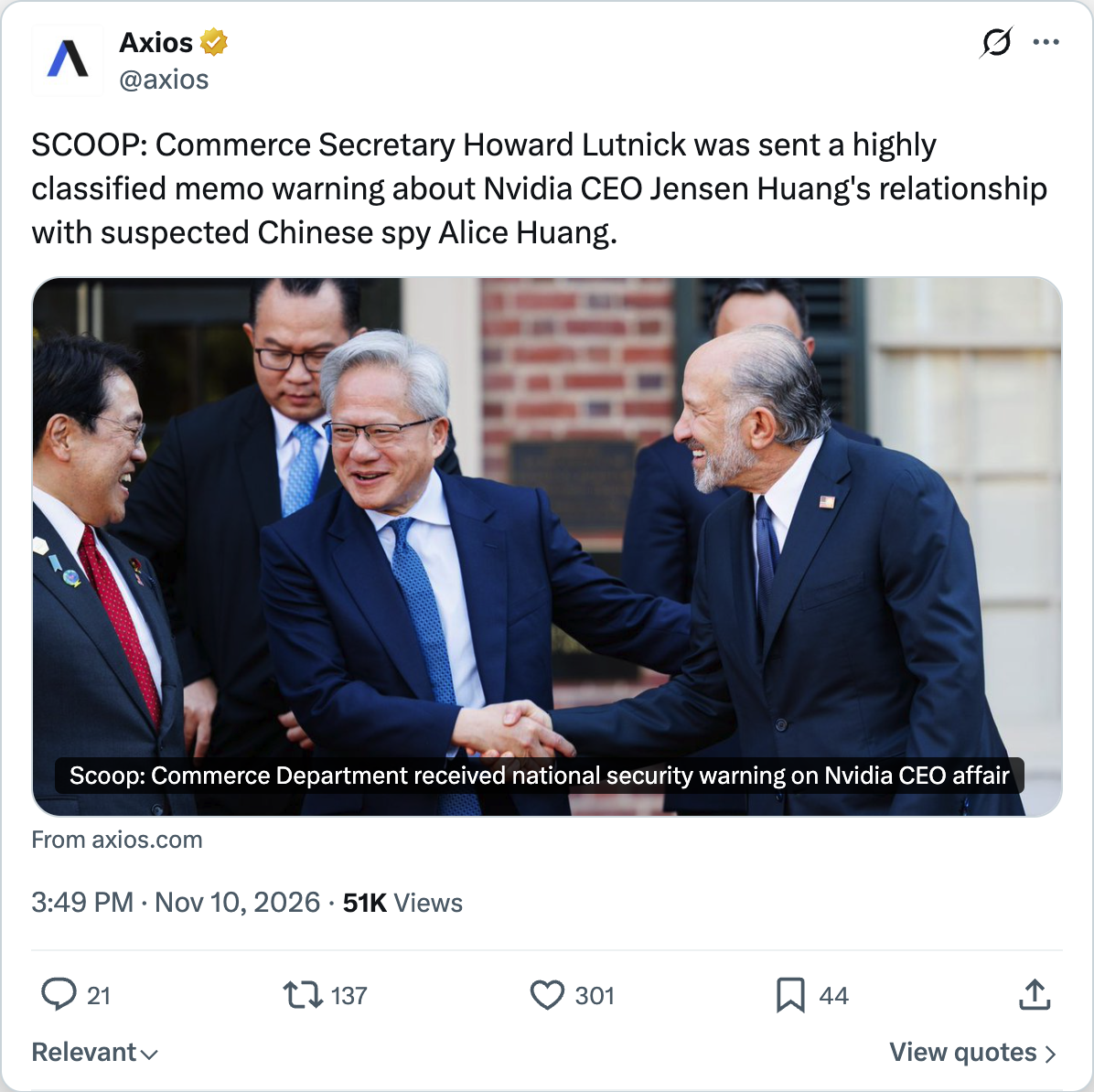
The political dynamics compound the geopolitical ones. Axios reported that Commerce Secretary Howard Lutnick received a classified memo warning about Huang's relationship with suspected Chinese agent Alice Huang. Separately, Sen. Tim Scott has asked Lutnick to testify on December 10. The congressional calendar through year-end is now dominated by Nvidia hearings:
- Dec 1: Huang testimony (House Foreign Affairs / China Committee)
- Dec 2: Nvidia General Counsel Tim Teter (House Foreign Affairs)
- Dec 3: Commerce Undersecretary Jeffrey Kessler (House Foreign Affairs); Huang (Senate Banking)
- Dec 10: Commerce Secretary Lutnick (Senate Banking)
This is not normal corporate-scandal oversight. It is the framework for a policy overhaul. Every hearing is an opportunity for lawmakers to build the case for stricter export controls, enhanced chip-verification mechanisms, and potentially a restructuring of how defense-critical semiconductor companies are governed. The Huang vacuum gives Congress an opening it would not have had with a sitting CEO fighting back.
Note
Market Signal: Nvidia closed below $4 trillion in market capitalization on Friday for the first time since July 2025. The stock has shed roughly 13% from pre-scandal highs. But the market is pricing scandal risk, not geopolitical restructuring risk. If the NDAA amendments pass with chip export restrictions — and if TSMC allocation shifts during the leadership transition — the repricing has barely begun.
What the Next CEO Inherits
The job description for Nvidia's next CEO is not "run a chip company." It is: maintain the technological moat while rebuilding the geopolitical one, without the personal relationships, political capital, or diplomatic access that made both possible.
The candidate who best fits that description is probably not on the current list. Nvidia needs someone who can:
- Navigate Washington — not as a lobbyist but as a credible interlocutor who can shape export controls rather than just fight them
- Maintain Taipei — sustain TSMC relationships during the most precarious period in cross-strait relations since the 1990s
- Clear Pentagon vetting — pass the security reviews required for IL6/IL7 classified work, under a counterintelligence cloud that will shadow any successor
- Lead technologically — sustain Nvidia's R&D advantage in a market where AMD, Intel, and a dozen well-funded startups are closing the gap
That is a unicorn profile. The realistic outcome is a CEO who does some of these well and delegates the rest — which is exactly the institutional weakness that created the problem in the first place.
The Uncomfortable Precedent
The closest historical analogue is not a tech CEO departure. It is the removal of a geopolitical actor from a critical node in a supply chain. When Boeing's leadership crises undermined trust with the FAA and international regulators, the company's market position held but its institutional credibility eroded for years. The defense contracts continued, but the relationship with oversight bodies was permanently altered.
Nvidia's situation is more acute because the supply chain it anchors — advanced AI compute — is the defining strategic resource of the decade. Boeing made planes. Nvidia makes the chips that train the models that every major power considers essential to economic and military competitiveness.
The moat will survive. The question is what it looks like after the transition — whether it remains an American advantage executed through a single dominant company, or whether the succession crisis becomes the catalyst for a more distributed, more contested, and ultimately weaker chokepoint.
Jensen Huang built a geopolitical moat. He built it around himself. Now it needs to stand without him. The next six months will show whether that was ever possible.
The Desk
About The Arc of Power
The Arc of Power editorial desk delivers rigorous analysis of geopolitics, defense, economic statecraft, and intelligence — examining the forces that shape the global order.
Briefing Access
Request Briefing Access
In-depth geopolitical analysis — power dynamics, defense strategy, and economic statecraft — three times a week. No noise.
Request briefing access