Case file · Diplomacy · 13 min read
Alliances as Leverage: Trump's Korea Drill Gambit
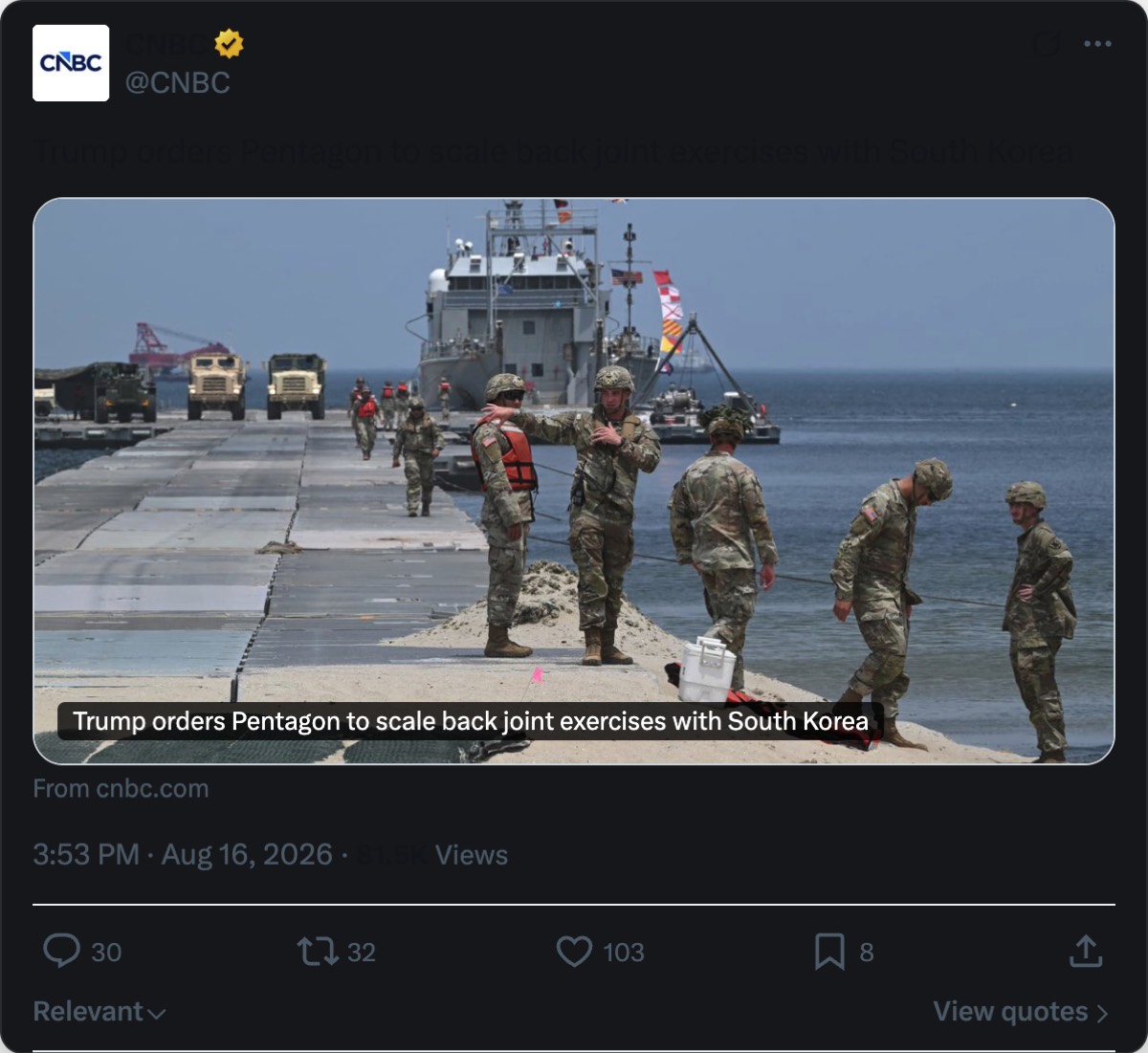
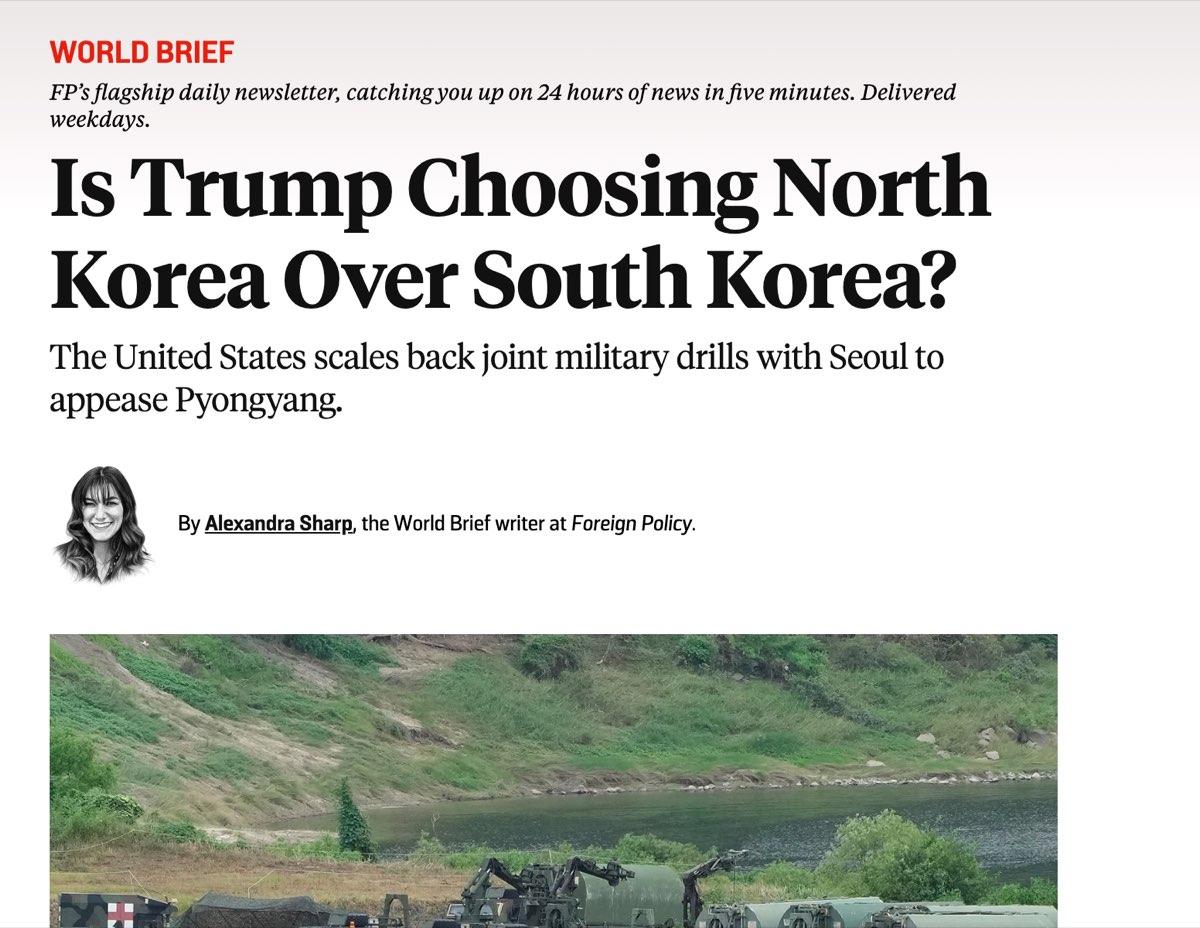
Trump ordered the Pentagon to cut joint exercises with Seoul, wielding a 72-year alliance as punishment for refusing to join the Iran war.
The Arc of Power ·
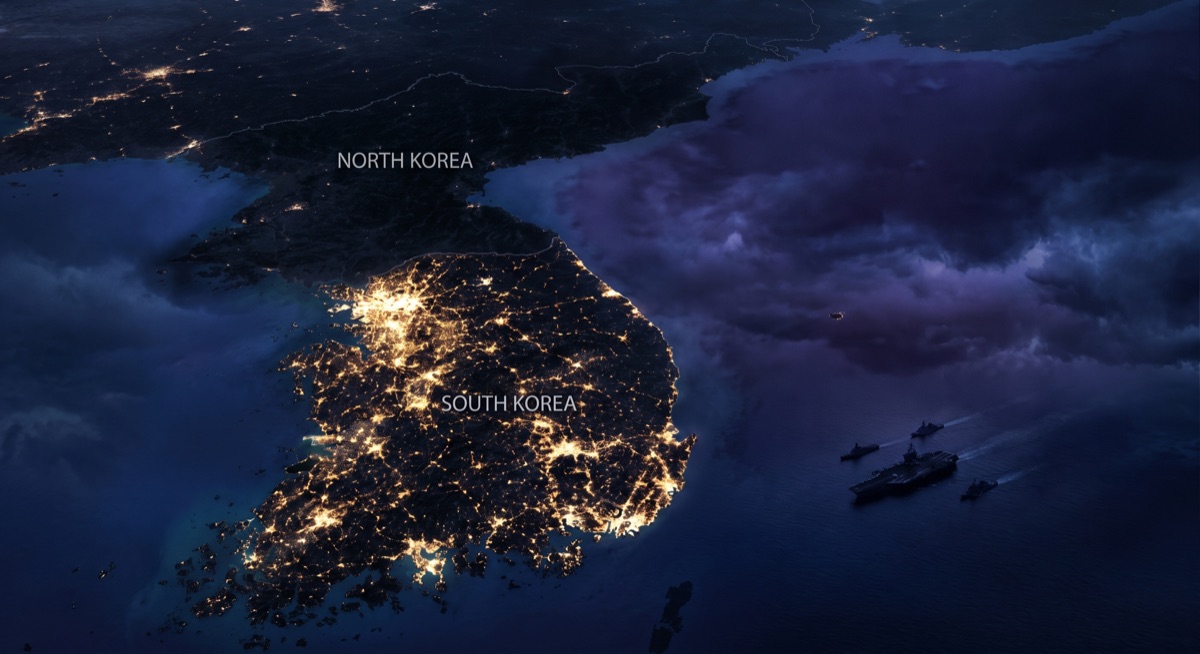
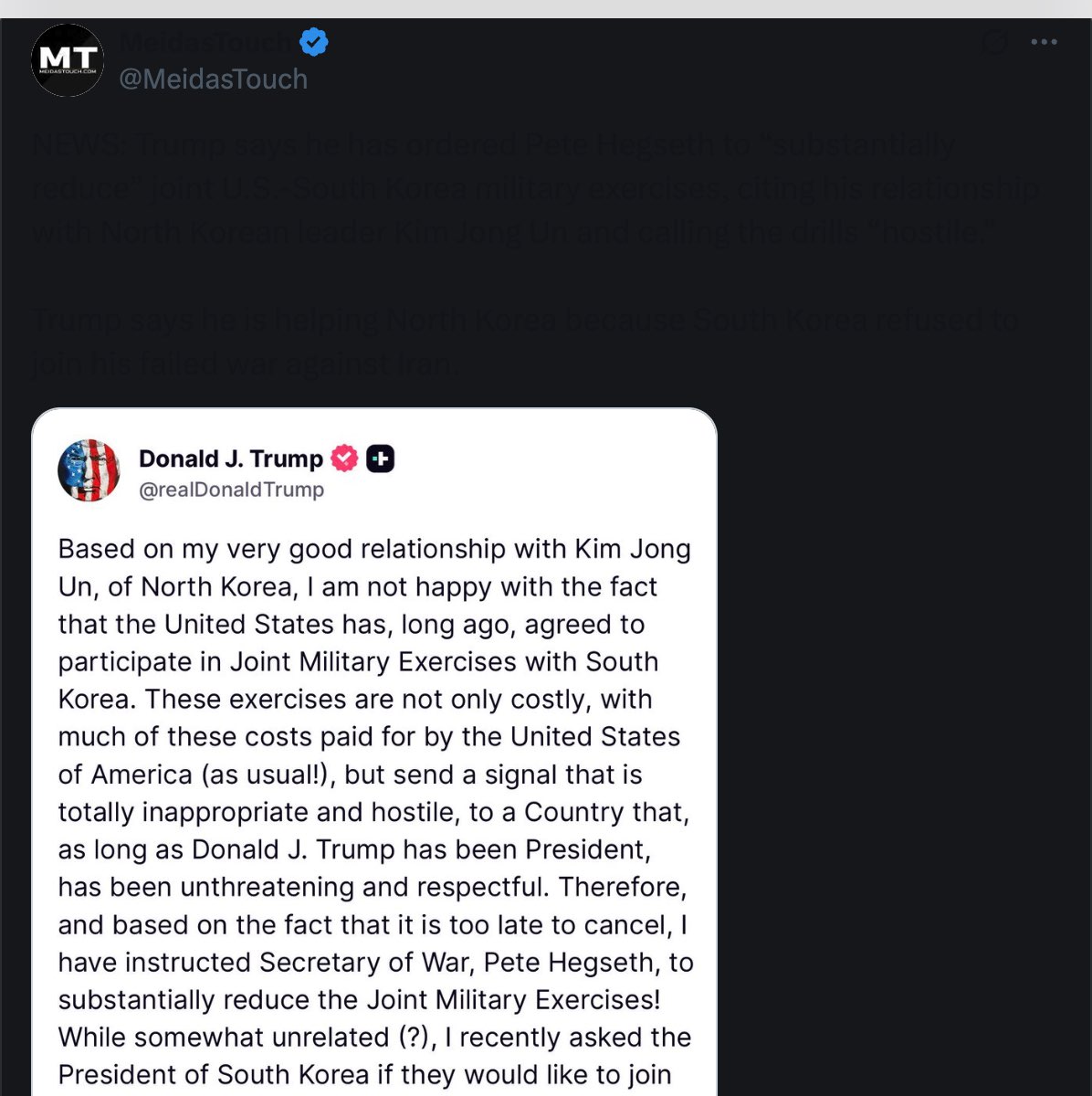
On Saturday evening, hours before 18,000 South Korean troops were set to begin the annual Ulchi Freedom Shield exercises alongside thousands of American and UN forces, President Donald Trump posted on Truth Social that he had instructed Secretary of War Pete Hegseth to "substantially reduce" the joint drills. His reasoning folded three distinct logics into a single paragraph: the exercises are costly, they send "a signal that is totally inappropriate and hostile" to North Korea, and — the buried lede — South Korea had recently declined Trump's invitation to join the US war against Iran.
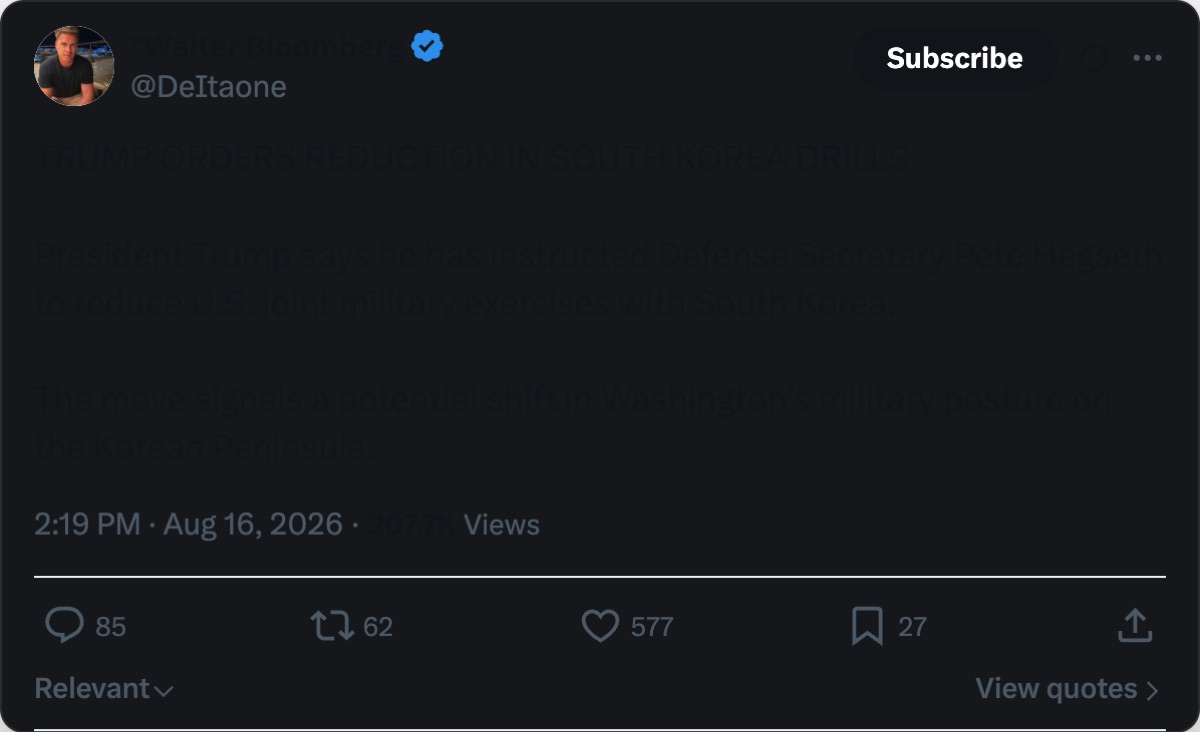
Two days earlier, on Liberation Day, South Korean President Lee Jae Myung had proposed formal peace talks with Pyongyang to replace the 1953 armistice with a permanent peace treaty — the first serious Seoul overture in years. And on Monday morning, despite Trump's demand, the drills began on schedule, with Seoul's presidential office affirming "close coordination" with Washington while quietly proceeding as planned.
Three moves in 72 hours. Each one redraws a different line on the same map. Together, they reveal something more significant than a weekend news cycle: the US alliance system in Northeast Asia is being repriced — and not only by Washington.
The Three Competing Interpretations
Strip Trump's announcement to its logic, and three mutually exclusive readings emerge. Each is partially right. None is complete.
Reading 1: Iran punishment. Trump made this one explicit. He told reporters he had asked South Korea's president to join the "denuclearization of the Islamic Republic of Iran" and was told "No thanks!" His response was visceral: "Wait a minute — we have 39,000 soldiers over there guarding you from Kim Jong Un, your next-door neighbor, and you're not going to help us?" This framing casts the drill cutback as retribution — a transactional downgrade of an alliance benefit because the ally refused to pay in a different theater. The Diplomat identified the pattern precisely: "A recurring combined exercise, developed through months of bilateral planning against a nuclear-armed adversary, was recast overnight as an instrument of presidential diplomacy."
Reading 2: North Korea diplomacy. Trump's invocation of his "very good relationship with Kim Jong Un" was not throwaway rhetoric. Korea Times reports suggest the order is part of a broader effort to restart direct Trump-Kim summitry — the unfinished business of 2018-2019. The exercises have been Pyongyang's top demand in every negotiation with Washington. Scaling them back is the cheapest diplomatic signal Trump can send without formally conceding anything. CSIS analyst Victor Cha warns that the danger is "diplomacy without strategy" — summitry that generates headlines and "a superficial reduction in tensions" but grants North Korea de facto acceptance as a nuclear state, which is Pyongyang's actual objective.
Reading 3: China concession. This is the reading that got the least press but may matter most. An Al Jazeera segment featuring a former CIA officer framed the drill reduction as a signal to Beijing — part of a broader Trump-Xi understanding in which Washington dials down its military posture on China's periphery. In this interpretation, the drills are not leverage over Seoul or a gift to Pyongyang; they are a line item in an unspoken US-China accommodation. The South China Sea, Taiwan Strait, and Korean Peninsula are all theaters where reduced American forward presence serves Beijing's interests. (For more on how these theaters connect, see our analysis of the South China Sea flashpoint that "nobody is pricing.")
Note
Since Trump took office, North Korea has conducted 24 ballistic missile tests and deployed an estimated 14,000 troops to support Russia's war in Ukraine. Trump's characterization of Pyongyang as "unthreatening and respectful" requires ignoring all of this.
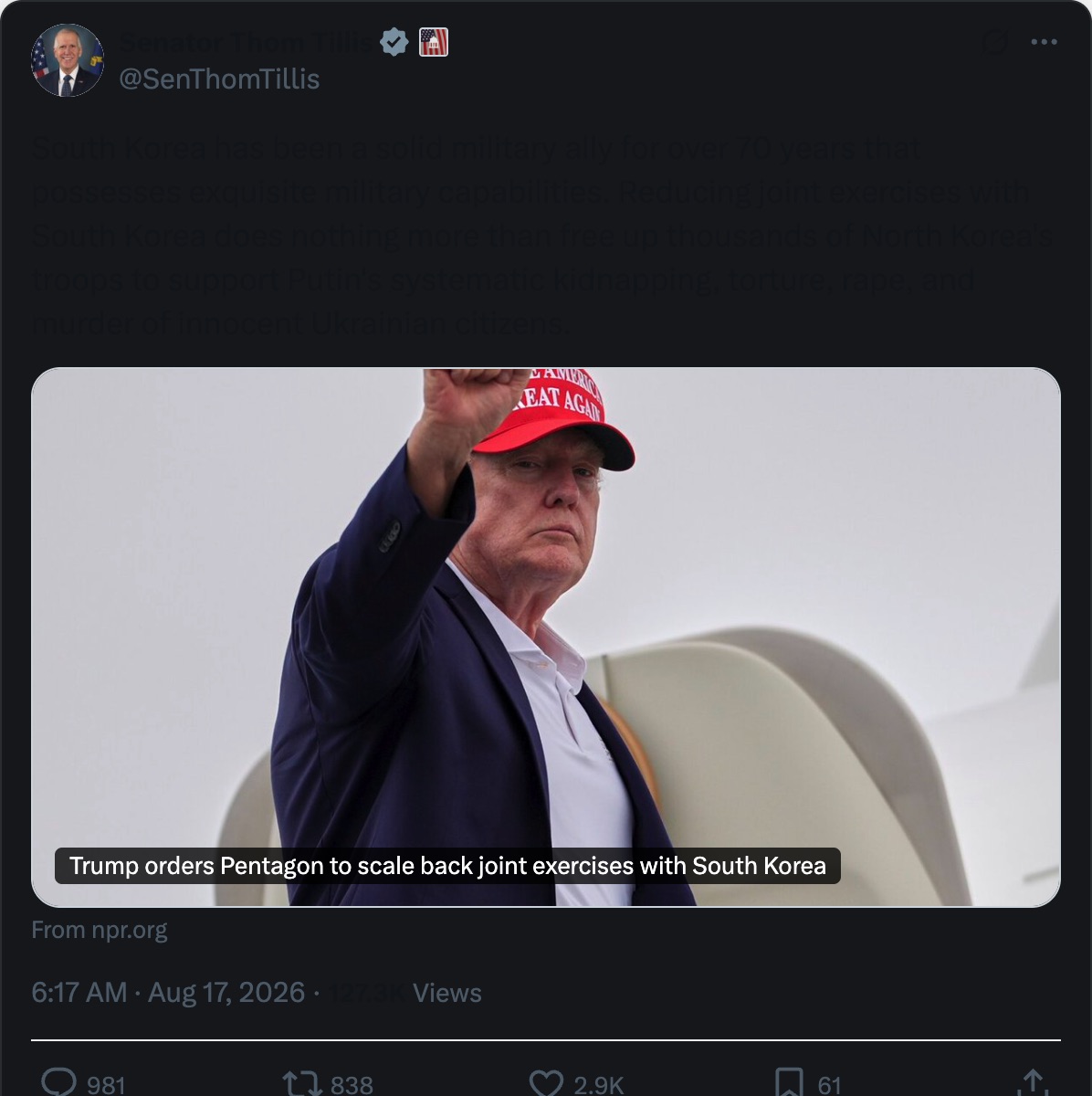
Four Lessons from the Drill Gambit
What matters is not which reading is "correct" — all three may be operating simultaneously. What matters is what the convergence teaches about how American alliance commitments now function.
Lesson 1: Alliance Commitments Are Now Priced Per Transaction
The United States has maintained its mutual defense treaty with South Korea since 1953 — seventy-three years. The 28,500 American troops stationed on the peninsula are not a favor; they are one leg of a security architecture that underwrites the entire Indo-Pacific order, from shipping lanes to semiconductor supply chains.
Trump has repriced this architecture. The new formula is explicit: alliance benefits are contingent on allied cooperation in unrelated theaters. Refuse to join the Iran campaign? Your military exercises get cut. The same logic that played out at the Ankara NATO summit — where Spain's refusal to provide basing for Iran operations triggered a trade threat — is now operating in Asia.
This is not new rhetoric. It is an operational pattern. And once allies internalize that pattern, they stop planning around the alliance and start planning around its absence. Time magazine documented allies from Denmark to Saudi Arabia already establishing independent defense arrangements — a trend that accelerates each time Washington uses a security commitment as a bargaining chip.
Lesson 2: Seoul Is Playing Its Own Game
The conventional framing positions South Korea as a passive recipient of Trump's decision. But Seoul is not standing still.
President Lee's Liberation Day peace proposal was timed with precision. By offering direct dialogue with Pyongyang — including a "multi-layered security system" along the DMZ and discussions on halting nuclear advancement — Lee positioned Seoul as a diplomatic actor in its own right, not merely the beneficiary of American deterrence.
The sequencing is revealing. Lee proposed peace talks on August 15. Trump ordered the drill cutback on August 16. The drills began on schedule on August 17. Seoul is simultaneously:
- Hedging against American unreliability by opening its own diplomatic channel to Pyongyang
- Defying Trump's demand by proceeding with the exercises on the originally planned schedule
- Maintaining the alliance framework by describing the decision as "close coordination"
This is the diplomatic equivalent of acknowledging the threat while refusing to flinch. It is also, notably, the exact behavior that the CSIS analysis warns Kim Jong Un would try to exploit — summitry that excludes or marginalizes Seoul while cutting bilateral deals with Washington and Tokyo.
Lesson 3: Readiness Is Not a Bargaining Chip — It Is a Perishable Capability
Military exercises are not parades. They are how allied forces learn to fight together — interoperability, combined command structures, communications protocols, logistics chains. Cut the exercises and you do not simply save money; you degrade the muscle memory that makes combined operations possible.
Retired Rear Admiral Mark Montgomery told NBC News: "Watering down U.S.-South Korea military exercises is a risky move that lowers coalition readiness and puts U.S. forces at risk with no real tangible benefit to the United States."
Patrick Cronin of the Hudson Institute was blunter: the decision "undermines deterrence and readiness without altering Kim's calculations."
The costs are already incurred. Most of the logistics, planning, and deployment costs for Ulchi Freedom Shield were spent months before the first soldier arrived. As Defence Blog reported, whatever training is now curtailed will either have to be made up later — at additional cost — or American and Korean forces will simply be less prepared to fight together if they ever need to. Readiness decays. It is not something you can store and retrieve on demand.
Critical
Contrarian corner: Is Trump pricing alliance incoherence honestly? The uncomfortable truth is that US extended deterrence in Korea has been strategically contradictory for years. America guarantees the security of a nation that cannot be credibly defended against North Korea's nuclear arsenal through conventional exercises alone, while simultaneously expecting that nation to bear costs in theaters that have nothing to do with its own survival. Trump may be the first president to say the quiet part out loud — that the alliance is not a sacred covenant but a contract with terms. The question is whether naming the incoherence fixes it or accelerates its collapse.
Lesson 4: The Indo-Pacific Is Watching
If a 73-year alliance with 28,500 troops on the ground can be leveraged overnight over a disagreement about Iran, every other American security commitment in the region is subject to the same repricing. Japan, Australia, the Philippines, and Taiwan all depend on some version of the same guarantee Seoul just watched get weaponized.
Daniel Pinkston of Troy University did not mince words: the policy shift is "incoherent nonsense" that represents "a direct threat to U.S. national security and international stability." But incoherence may be the feature, not the bug. If allies cannot predict whether American commitments will hold, they are forced into a permanent posture of accommodation — either paying whatever Washington demands or building independent capabilities that further loosen the alliance architecture.
This is the same dynamic that drove our analysis of alliance fracture at the Ankara NATO summit: the system still exists on paper, but it operates on entirely different terms than the ones its founders intended.
What Happens Next
The drill reduction is not the endgame. It is the opening bid. Several consequential moves are now in play:
The summit question. CSIS's Victor Cha warns that Trump will almost certainly seek a renewal of direct Kim summitry — "diplomacy without strategy" that produces flashy photo ops while Kim consolidates nuclear-state status. The risk is not that diplomacy happens, but that it happens without a shared US-South Korean political end state, allowing Pyongyang to play Washington and Seoul against each other.
Seoul's autonomous diplomacy. Lee's peace proposal is not contingent on Washington. If Seoul pursues direct engagement with Pyongyang — and if Pyongyang senses an opportunity in US-Korea friction — the result could be a parallel diplomatic track that fundamentally changes the geometry of the peninsula. Whether this empowers Seoul or isolates it depends entirely on whether Washington treats it as a complement to American diplomacy or a threat to American primacy.
The Japan signal. Tokyo is watching more closely than anyone. Japan's defense buildup — the largest since World War II — was predicated on a functioning US alliance network. If the Korean leg of that network is being hollowed out, Japan's calculus for independent military capability accelerates. And a Japan that no longer trusts American extended deterrence is a Japan that eventually considers its own nuclear option.
The China opportunity. Every reduction in American forward posture on China's periphery is a gain for Beijing, whether or not it was negotiated. Geopolitics Unplugged captured the dynamic with their observation that "when great-power attention is finite, alliance drills shrink and frontier barrels expand at the same moment."
The Iran war that Seoul refused to join — the same war the US Senate tried to block — has now become the justification for degrading the oldest active alliance in the Pacific. The ceasefire with Iran that expired this week makes the irony sharper: Trump is punishing Seoul for refusing to participate in a war that may already be winding down.
View original article on Foreign Policy →
The Deeper Pattern
There is a phrase in economics for what is happening to the American alliance system: adverse selection. When the terms of a contract become unpredictable, the most capable partners exit first — they have alternatives. The ones who stay are the ones with nowhere else to go.
South Korea is not yet in the "exit" category. Its mutual defense treaty with the United States is too deeply integrated into its national survival to abandon over a single drill reduction. But Seoul's simultaneous peace proposal to Pyongyang is a hedge — the diplomatic equivalent of diversifying your portfolio when you no longer trust your primary asset manager.
The question is no longer whether American alliances are being repriced. Ankara proved they are. The Iran war accelerated it. Korea just made it explicit. The question is whether the repricing produces a new, stable equilibrium — allies pay more, America commits more selectively, everyone adjusts — or whether it triggers a cascade of defections that leave the United States strategically isolated in the region it can least afford to lose.
Seventy-three years of alliance, reduced to a Truth Social post. That is not the death of the US-Korea relationship. But it may be the moment both sides realized the old terms are gone, and neither has agreed on new ones.
The Desk
About The Arc of Power
The Arc of Power editorial desk delivers rigorous analysis of geopolitics, defense, economic statecraft, and intelligence — examining the forces that shape the global order.
Briefing Access
Request Briefing Access
In-depth geopolitical analysis — power dynamics, defense strategy, and economic statecraft — three times a week. No noise.
Request briefing access