Case file · Geopolitics · 12 min read
Switzerland Just Fired Microsoft
3,000 machines, one Cyber Command, and Europe's real declaration of digital independence.
The Arc of Power ·

On September 3, 2026, the Swiss Federal Council quietly published the results of a feasibility study called "PoC BOSS." The findings: 172 federal employees had spent months testing openDesk, a German-built open-source collaboration platform, as a replacement for Microsoft 365. Core office tasks — document processing, email, calendar — passed. Video conferencing at scale still wobbled. The verdict: proceed to pilot. Three thousand federal workstations — roughly 7 percent of the Swiss government's 54,000 machines — will now run openDesk in parallel with Microsoft 365, backed by a CHF 9 million investment from the Federal Chancellery.
That is the press release version. Here is the power version.
Switzerland's military cybersecurity unit — Cyber Command, led by Simon Mueller — is not waiting for the civilian pilot. It is fast-tracking a complete replacement of Microsoft 365 with openDesk by October 2026. Not a parallel test. Not a gradual transition. A full cutover for the unit responsible for protecting Swiss military IT systems, including classified data rated "secret."
Mueller's reasoning, stated on the record: "As long as corporations are subject to laws such as the US Cloud Act, they cannot be used for certain military contexts."
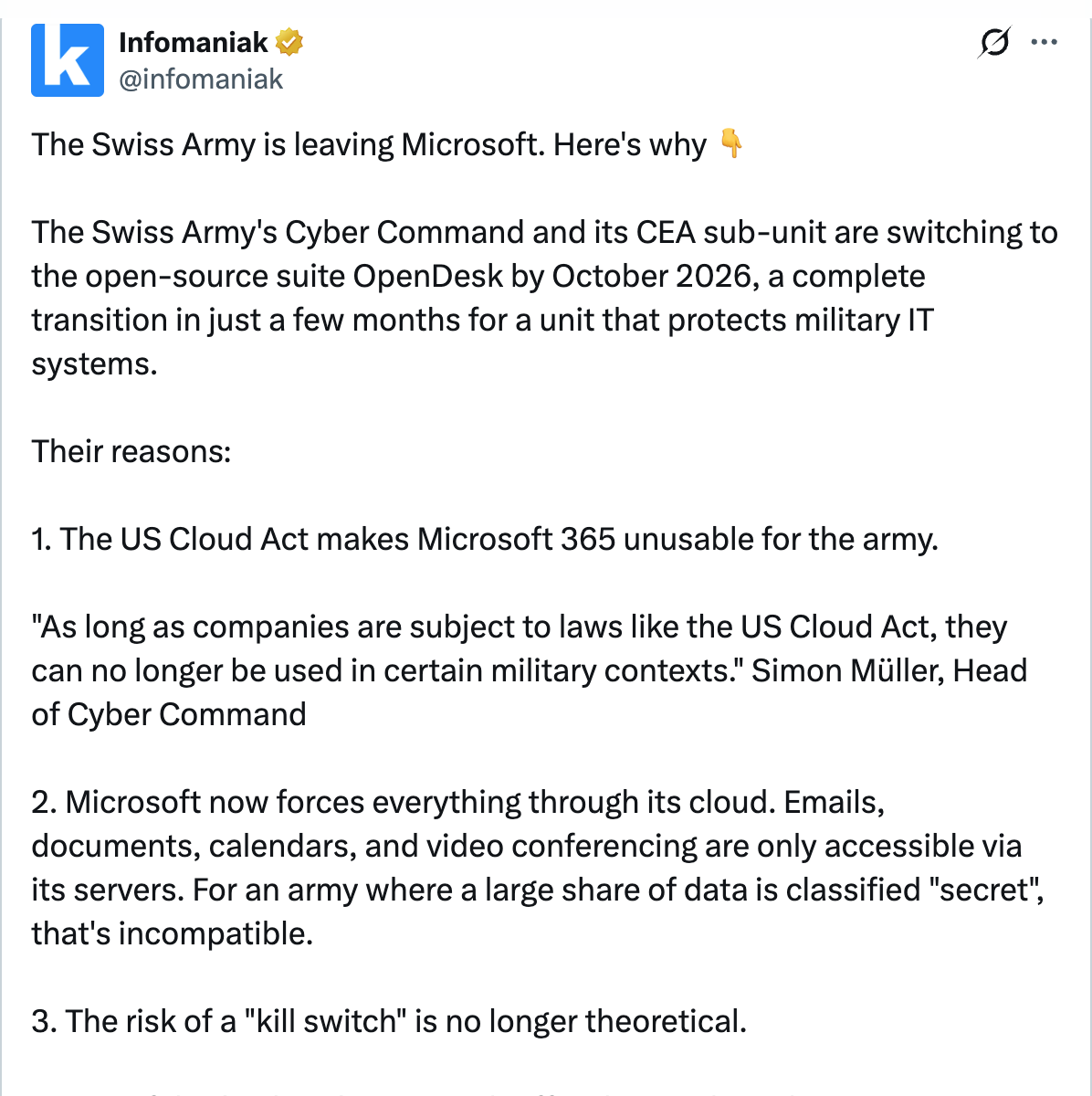
That sentence is the article. Everything else is context.
The Kill Switch Is No Longer Theoretical
The standard European objection to US cloud dependence has always been the CLOUD Act — the 2018 statute that grants US law enforcement unilateral authority to compel American cloud providers to surrender data stored anywhere in the world. For years, this was a theoretical concern. European officials cited it in policy papers. Microsoft cited it back, arguing that they would litigate any improper request. The debate stayed academic.
It stopped being academic in 2026.
Microsoft disabled the accounts of nine International Criminal Court judges following Trump administration sanctions. The Dutch government discovered that Microsoft had been compelled to hand over officials' emails to US authorities. These were not hypothetical scenarios from a think-tank white paper. They were operational demonstrations of what "subject to laws such as the US Cloud Act" means in practice.
Note
The structural point is not that Microsoft is malicious. It is that Microsoft is compliant — with US law. And US law does not recognize European data sovereignty as a constraint. When a Microsoft executive was asked directly whether the company could guarantee that EU data would never be requested by US authorities, the answer was honest: no. "Microsoft must comply with the US CLOUD Act regardless of where European data physically sits."
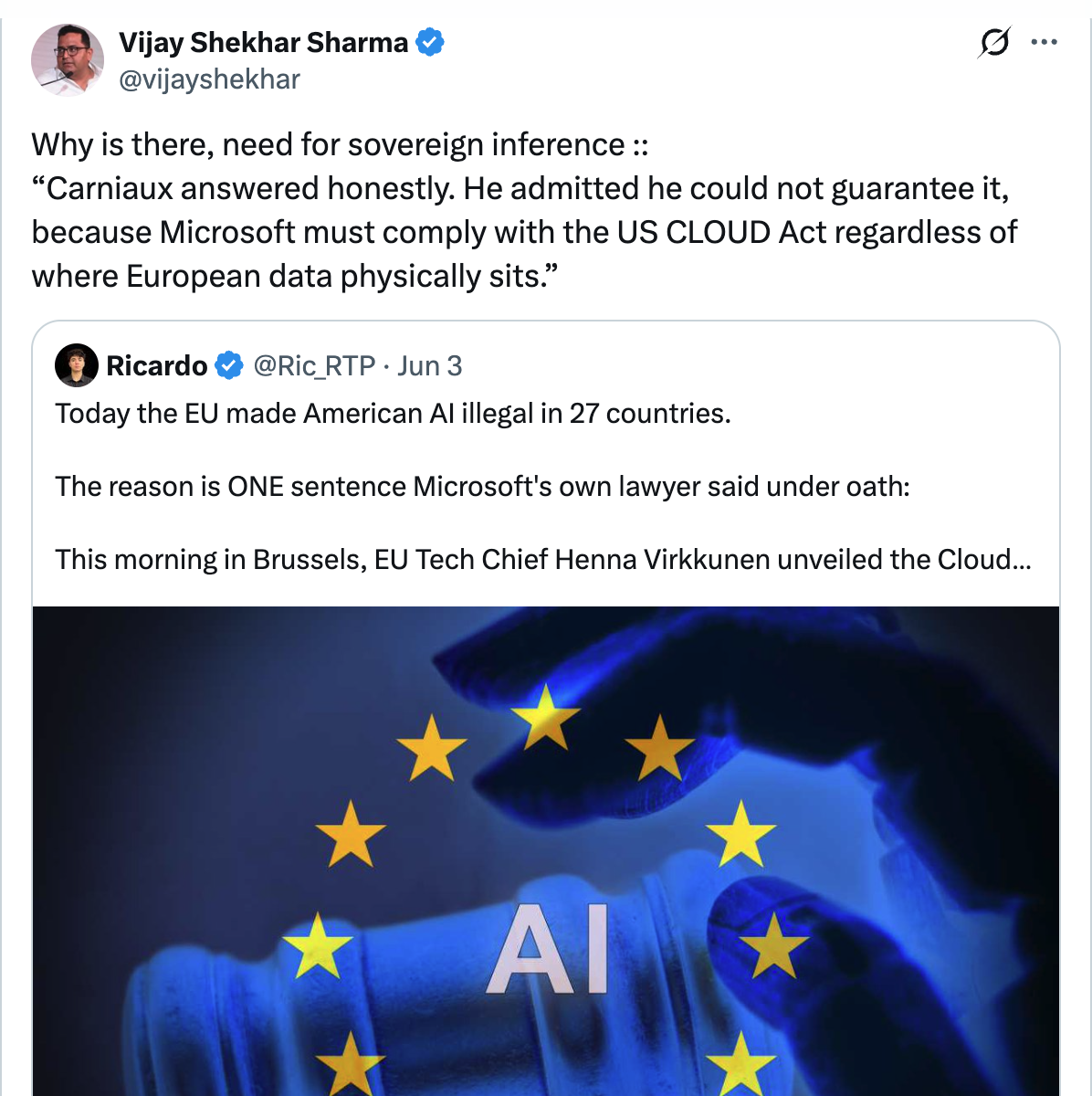
For a country whose military classifies significant volumes of data as "secret," compliance with a foreign government's legal demands is not a governance inconvenience. It is an intelligence vulnerability. Switzerland's Cyber Command is not moving off Microsoft 365 because open-source software is cheaper or because Linux is technically superior. It is moving because Microsoft's legal jurisdiction is incompatible with Swiss operational security.
Three Lessons from Switzerland's Digital Decoupling
Lesson 1: Neutrality Now Requires Digital Self-Sufficiency
Switzerland's brand is neutrality — a two-century commitment to not depending on any single great power for its security posture. That commitment has historically been expressed through military readiness (universal conscription, alpine fortifications, one of the highest per-capita defense budgets in Europe) and financial independence (the Swiss franc as a global reserve asset).
In December 2025, the Federal Council formally designated digital sovereignty as a "primary focus theme," defining it as "the federal government being able to fulfil its essential mission without depending on an external supplier or country." Read that definition carefully. It is not about data privacy. It is not about GDPR compliance. It is about mission capability — the same language used for ammunition stockpiles and energy reserves.
This is the frame shift that matters. Switzerland is not treating cloud migration as an IT decision. It is treating cloud dependence as a strategic vulnerability in the same category as energy dependence or weapons-supply dependence. The 3,000-machine pilot is a procurement exercise. The Cyber Command fast-track is a national security operation.
Lesson 2: This Is a European Movement, Not a Swiss Outlier
Switzerland is not acting alone. It is the latest — and in some ways the most revealing — expression of a coordinated European withdrawal from US digital infrastructure.
In January 2026, France announced that 2.5 million civil servants would stop using Microsoft Teams, Zoom, Webex, and GoTo Meeting by 2027, replacing them with Visio, a homegrown platform hosted on Dassault Systemes' sovereign cloud. Germany's state of Schleswig-Holstein has completed its migration to open-source email and is replacing Microsoft Office with LibreOffice across government. The Austrian Armed Forces switched from Microsoft 365 to LibreOffice in 2025. The German Bundeswehr signed a framework agreement with ZenDiS, the agency behind openDesk.
And in May 2026, the European Commission published its Tech Sovereignty Package — restrictions on US cloud providers for sensitive government data across all 27 EU member states. In June, the Cloud and AI Development Act (CADA) created a formal four-level sovereignty assurance framework governing which cloud services may handle public-sector workloads.
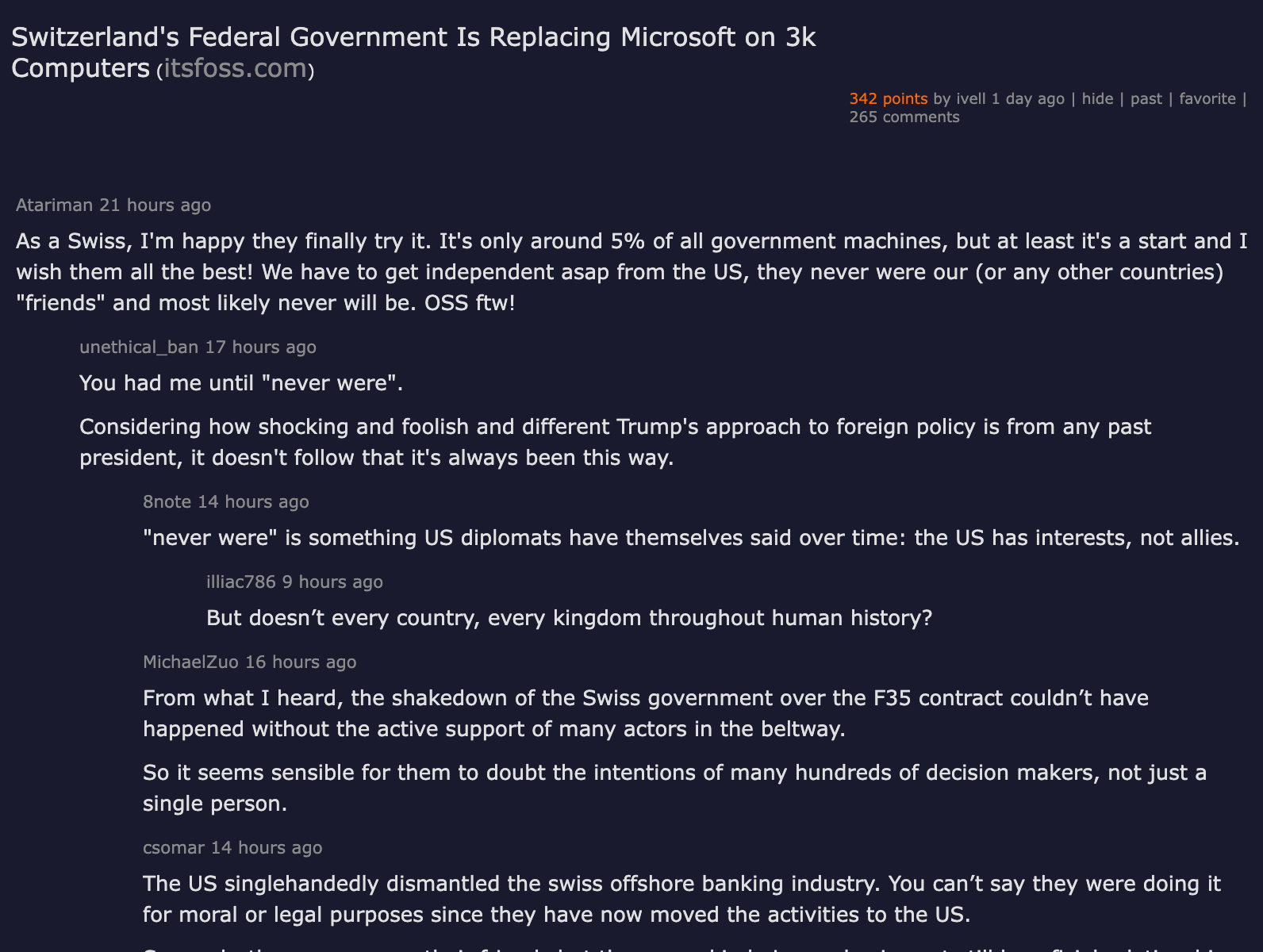
The Hacker News thread on Switzerland's announcement — 341 points, 265 comments — captured the temperature. The top comment, from a user identifying as Swiss: "We have to get independent asap from the US." The debate that followed was not about software quality or migration costs. It was about transatlantic trust, alliance obligations, and whether US technology companies can function as neutral infrastructure providers when their government treats data access as a sovereign prerogative.
The numbers tell the same story from the supply side. Three US cloud companies — Amazon, Microsoft, and Google — control over 70 percent of the European cloud market. The EU relies on non-EU countries for over 80 percent of digital products, services, and infrastructure. Worldwide sovereign cloud IaaS spending is forecast at $80 billion in 2026, up 35.6 percent year-over-year. European sovereign cloud spending alone will grow 83 percent in 2026.
This is not a niche trend. It is a market restructuring driven by government procurement mandates — the software equivalent of the defense-industrial reshoring that followed Russia's invasion of Ukraine.
Lesson 3: Microsoft's Counter-Move Reveals the Stakes
Microsoft is not passive in this realignment. In April 2026, Satya Nadella announced expanded Sovereign Cloud capabilities — public, private, and partner cloud options designed to keep European government data within European data centers, managed by European personnel, under European legal jurisdiction. Forrester named Microsoft a Leader in its Sovereign Cloud Platforms Wave. Intel is building dedicated Xeon 6 hardware for Microsoft's sovereign private deployments.
The pitch: you do not need to leave Microsoft to get sovereignty. You just need a different tier of Microsoft.
Critical
The Contrarian Corner. Microsoft's sovereign cloud argument is not frivolous. The CLOUD Act has never actually been invoked to compel Microsoft to hand over European government classified data. The ICC judges' accounts were disabled under executive sanctions, not CLOUD Act warrants — a different legal mechanism. And the productivity gap between Microsoft 365 and openDesk is real: Switzerland's own PoC BOSS found that video conferencing "showed technical limitations" at scale. If 82 percent of German companies want to end technical dependence on US cloud but 78 percent remain dependent in practice, the reason is not propaganda. It is that the alternatives are not yet competitive at enterprise scale. Sovereignty-motivated procurement that locks governments into inferior tools is its own kind of strategic vulnerability — a self-inflicted capability gap dressed up as independence.
But the structural problem with Microsoft's sovereign cloud offering is the one that Lawfare's analysis identified precisely: service-level agreements cannot override legal obligations. Microsoft can promise European data residency. Microsoft can hire European personnel. Microsoft can build European data centers. What Microsoft cannot do is stop being an American company subject to American law. Nextcloud CEO Frank Karlitschek called it "sovereignty washing" — and the label stuck because it names the structural gap between what a contract promises and what a court order can compel.
The Wider Board: Digital Sovereignty as Power Realignment
The Switzerland story reads differently when you place it on the wider board alongside stories we have covered previously on The Arc of Power.
In May, we analyzed Jack Clark's "Radical Optionality" thesis — the Anthropic co-founder's argument that governments should stop debating whether to regulate AI and start building their own compute capacity. Clark's frame: the right policy axis is not regulate/don't-regulate but does the government have the option to act on its own AI capacity, yes or no? Switzerland's Cyber Command is answering that question. So is France. So is the EU's CADA framework. The pattern is the same: states re-acquiring capacity they had outsourced to private contractors operating under a foreign legal jurisdiction.
The physical parallel is just as stark. We covered China's rare-earths chokehold — the realization that while the US restricts the bits (chip export controls, entity lists), China owns the atoms (critical minerals required to build the hardware). Digital sovereignty is the European version of the same logic: you cannot claim strategic autonomy while your entire communications infrastructure runs on servers that respond to another government's subpoenas.
And the regulatory-capture dynamics we tracked in the US AI executive order story explain why this is accelerating now. The Trump administration's posture — explicitly linking EU digital regulation to tariff negotiations, pausing EU-US e-evidence negotiations without explanation, sanctioning ICC officials hosted on US cloud infrastructure — has converted digital sovereignty from a European policy preference into a European strategic imperative.
What the Community Is Saying
The Slashdot thread, also front-paged on September 7, echoes the Hacker News debate but with a sharper edge. The discussion is not whether open-source alternatives can match Microsoft's feature set — most commenters acknowledge the gap — but whether that gap matters when the alternative is running classified government communications through infrastructure subject to a foreign power's legal jurisdiction.
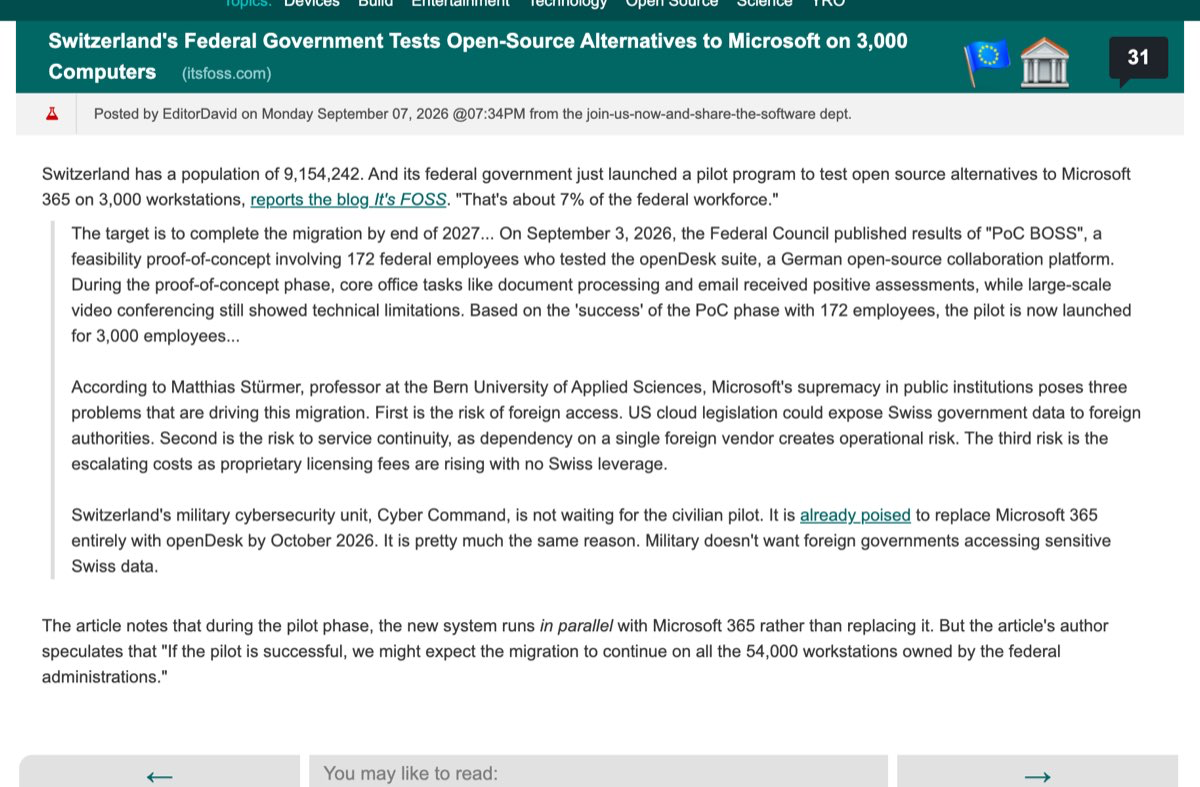
The Infomaniak thread on X — from Switzerland's largest independent cloud provider — laid out the case most bluntly: the US Cloud Act makes Microsoft 365 unusable for the army; Microsoft now forces everything through its cloud; the risk of a "kill switch" is no longer theoretical; and hyperscalers' aggressive licensing strategies are accelerating the decision. The framing is notable: this is a Swiss cloud company positioning the military's move as validation of a market thesis it has been arguing for years.
What to Watch
Tip
Three signals that will tell you whether this is a real decoupling or sovereignty theater:
-
The October deadline. Swiss Cyber Command has committed to a full Microsoft 365 replacement by October 2026. If they ship on time, it proves that a military-grade migration off US cloud is operationally feasible. If they slip, the "alternatives aren't ready" argument gains credibility.
-
CADA tier enforcement. The EU's Cloud and AI Development Act creates four sovereignty tiers for cloud services. Watch whether Tier 1 (highest sovereignty) actually excludes US hyperscalers or whether lobbying creates carve-outs. The procurement mandates are where the real money moves.
-
The $80 billion sovereign cloud market. Gartner forecasts $80B in sovereign cloud IaaS spending for 2026. Follow whether this money flows to genuinely independent European providers or gets captured by US hyperscalers offering "sovereign" branding over the same infrastructure — sovereignty washing at industrial scale.
Switzerland is not the most powerful country making this move. But it may be the most revealing one. A militarily neutral state with no alliance obligations, no EU membership forcing its hand, and no anti-American political agenda — choosing to pull its classified communications off Microsoft infrastructure because the legal structure of US cloud services is incompatible with sovereign operations. That is not an IT decision. That is a verdict on the architecture of digital power in 2026.
The 3,000 machines are a pilot. The Cyber Command cutover is a signal. And the $80 billion sovereign cloud market is the trade. The question is not whether European governments will reduce their dependence on US cloud infrastructure. The question is whether they will do it fast enough to matter before the next subpoena, the next sanctions order, or the next kill switch demonstrates why they should have moved sooner.
The Desk
About The Arc of Power
The Arc of Power editorial desk delivers rigorous analysis of geopolitics, defense, economic statecraft, and intelligence — examining the forces that shape the global order.
Briefing Access
Request Briefing Access
In-depth geopolitical analysis — power dynamics, defense strategy, and economic statecraft — three times a week. No noise.
Request briefing access