Case file · Geopolitics · 10 min read
California vs Washington on AI: Polymarket Says 10%
Newsom signed an AI job-loss EO. Polymarket priced Trump's federal review out from 43% to 10% in a day. The states-vs-feds AI arbitrage is open.
The Arc of Power ·
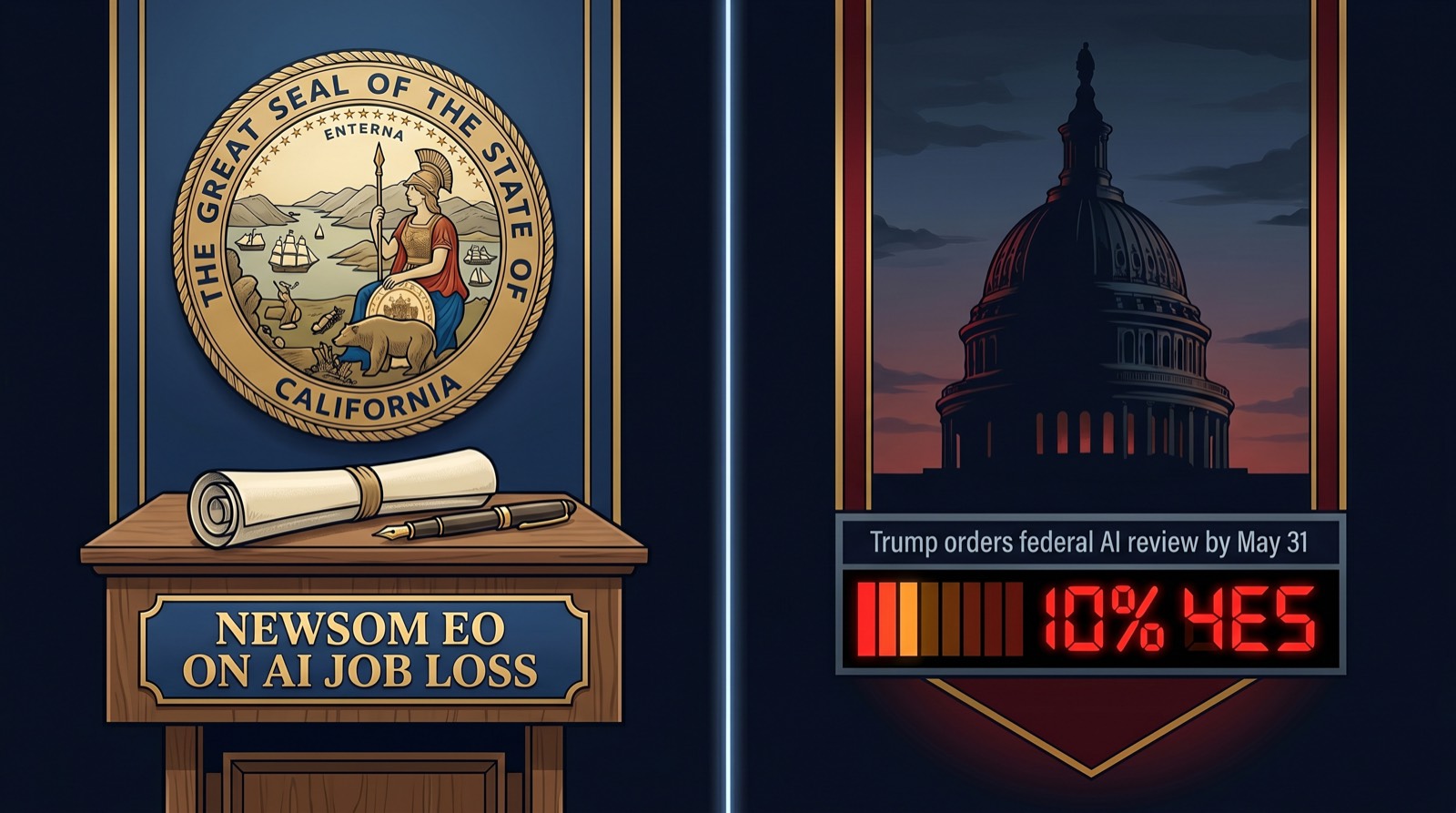
In a single trading day this week, two pieces of AI-policy news landed in the same window. Gavin Newsom signed a California executive order targeting AI-driven job loss — the r/technology #3 story of the day, 3K upvotes. On Polymarket, the market "Trump orders federal review of AI model releases by May 31" collapsed 33.5% in 24 hours, from ~43% to 10% YES — the largest single-day move on the AI policy board this month.
Those two moves are not unrelated. They are the same trade, expressed twice. The federal AI-review window is being priced out of the market while California escalates. That divergence opens a state-vs-federal arbitrage window — narrower than most operators realize, but real — and the data-center moratorium pattern we covered earlier this month has now formally jumped layers: from city/county zoning into state-level executive action on labor.
This piece does three things. First, read the Newsom EO as a sequenced political move, not an isolated press event. Second, read the Polymarket collapse as the market doing the work the press hasn't caught up to yet. Third, identify the four-to-six-week window in which companies hiring junior tech talent have a temporary differentiation moat before the next regulatory layer lands.
Polymarket: Trump orders federal AI review by May 31
1. The Newsom signal — state-level escalation
Newsom signed the EO into law in the same news cycle as the Wozniak commencement speech framing labor as "actual intelligence" — a speech that landed at the #11 HN story (505 score) and #1 r/technology story (28K upvotes). The cultural undercurrent and the executive action arrived together. That is rarely a coincidence in California politics.
The EO itself does what executive orders typically do: directs state agencies to study, report, and prepare — in this case, the labor-market impact of AI deployment in regulated industries, with explicit attention to entry-level positions. It does not, by itself, restrict hiring or impose new compliance burdens. But it does three structural things:
- It moves the political ownership of the labor-AI question from federal to state, in a state that contains the largest concentration of frontier-AI labs in the world.
- It pre-stages legislation. California EOs that direct study-and-report frequently produce SBs the following session. Operators should expect a labor-impact AI bill on the calendar for the 2027 legislative session.
- It is unfalsifiable as a political signal. Even if no legislation follows, Newsom now owns the political brand of "the governor who took AI job loss seriously" — a positioning that matters in both his next California race and any national race that follows.
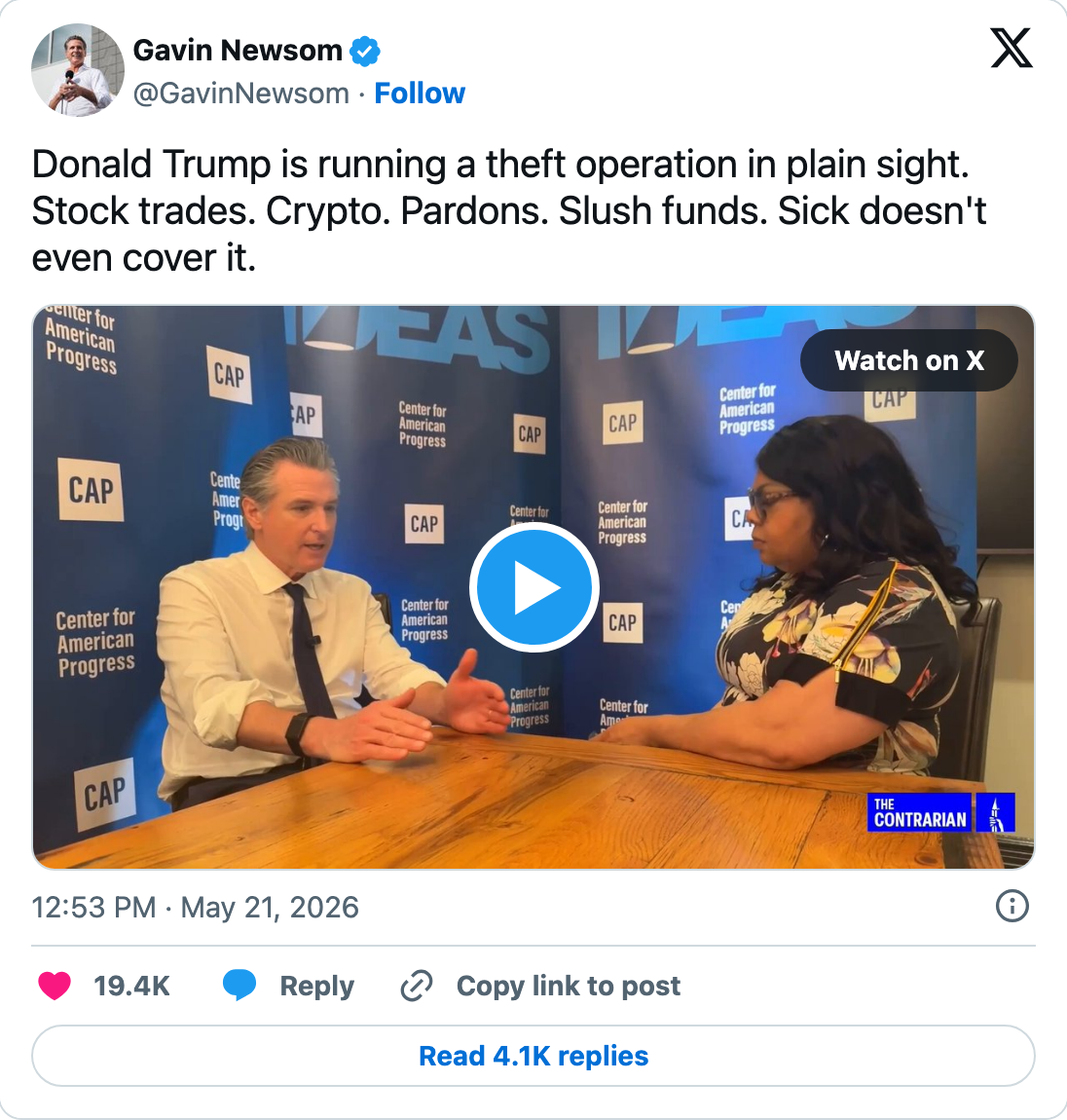
Cross-reference: in the same week, ylecun retweeted Newsom calling Trump's administration a "theft operation in plain sight" — 30K engagement on X. (source). When the most-cited AI scientist on the planet boosts a state governor framing the federal executive as corrupt, the state side of the AI policy story is being deliberately consolidated as the more credible policy address. That's a long-term position-building move, not an outburst.
2. The Polymarket collapse — federal action priced out
The headline data point is the federal market collapse:
- "Trump orders federal review of AI model releases by May 31" — fell from ~43% YES to 10% YES in a 24-hour window. $26.2K of 24-hour volume on a market sized to support real conviction. Source.
- That 33.5% intraday drop is the single largest 24-hour move on the AI-policy board since the market opened.
A 33.5% intraday move on a binary policy market is unusual. It either reflects (a) a specific piece of information the market just absorbed (a Trump speech, a leaked timeline, a deprioritization signal from an OMB-level source) or (b) the slow grind of date-decay finally crossing the conviction threshold as the May 31 deadline approached. In this case, the consensus on X among the policy-watchers is closer to (b): the market is acknowledging that the federal window will close empty.
That matters for two reasons:
- It vacates the field. When the federal action is priced at 10% with eight days to go, state-level action is the only credible AI-policy address through the second half of 2026. California, New York, Texas, and Washington are the states with both the capacity and the political incentive to fill that vacuum.
- It re-prices the regulatory risk on the AI labs themselves. A federal AI review would have given the labs a single legible regulator. A state patchwork gives them 50 — but California's patchwork tile is the only one that matters in the short term, because the labs are physically in it. That dependency is the unspoken backdrop to every Anthropic, OpenAI, Google AI policy filing for the next 12 months.
3. The state-vs-federal arbitrage window
The contrarian read: there is a four-to-six-week window in which companies hiring junior technical talent in California (or in California-adjacent labor markets) have a temporary differentiation moat before the next regulatory layer lands.
Why a window, and why now:
- The Newsom EO has been signed, but the implementing regulations have not been drafted. The agencies have ~120 days to report.
- The federal review market is at 10%; federal pre-emption risk is essentially off the table through mid-summer.
- The labor-anxiety story is at maximum political salience (the Wozniak speech is the most-engaged AI-and-labor story of the cycle), which means hiring-into-it carries an asymmetric reputational upside for the firm that publicly does so.
The companies that announce a junior-tech-talent expansion in California in the next 30 days will get the political-narrative tailwind. The companies that wait will be subject to whatever the EO's implementing regulations end up requiring. The window is real because it is structurally short — the regulations will come, the federal window is opening narrower than expected, and the prediction market is telling you the timing.
The downside risk is also real and worth naming. The EO does not yet specify what "AI impact on entry-level jobs" looks like as a compliance metric. Companies that over-announce will face audit risk in 2027 once the regulations are published. The play here is substantive hiring, modest announcement — not the reverse.
Critical
A 33.5% intraday move on a binary policy market is unusual. When the federal AI-review window is priced at 10% with eight days to go and the most-cited AI scientist on the planet is publicly boosting state-level political framing, the state layer is not just acting first — it is being deliberately consolidated as the more credible policy address.
4. The federalism layer: this is the data-center moratorium pattern, scaled
If 69 US jurisdictions can quietly ban data-center construction and Polymarket can price an AI data-center moratorium at 93% YES, the same dynamic is now activating at the labor layer. The pattern is recognizable: the political cost of AI deployment is being absorbed by states and localities while the federal layer pretends the problem is not its own.
Three signals point at this consolidating:
- Polymarket prices federal AI action out — 10% YES on the federal review market.
- California acts first — Newsom EO on AI job loss.
- The cultural undercurrent is mainstream — Woz commencement speech as top-3 r/technology and top-15 HN story; 43% of CEOs publicly admit they'll cut junior roles.
The natural completion of the pattern is another two-to-three states signing similar EOs through Q3, a major federal news cycle (likely a Senate hearing) by Q4, and a 2027 state-by-state legislative session producing the first actual AI labor compliance bills. The market is already pricing this — the federal review collapse is the inverse signal of the state escalation conviction.
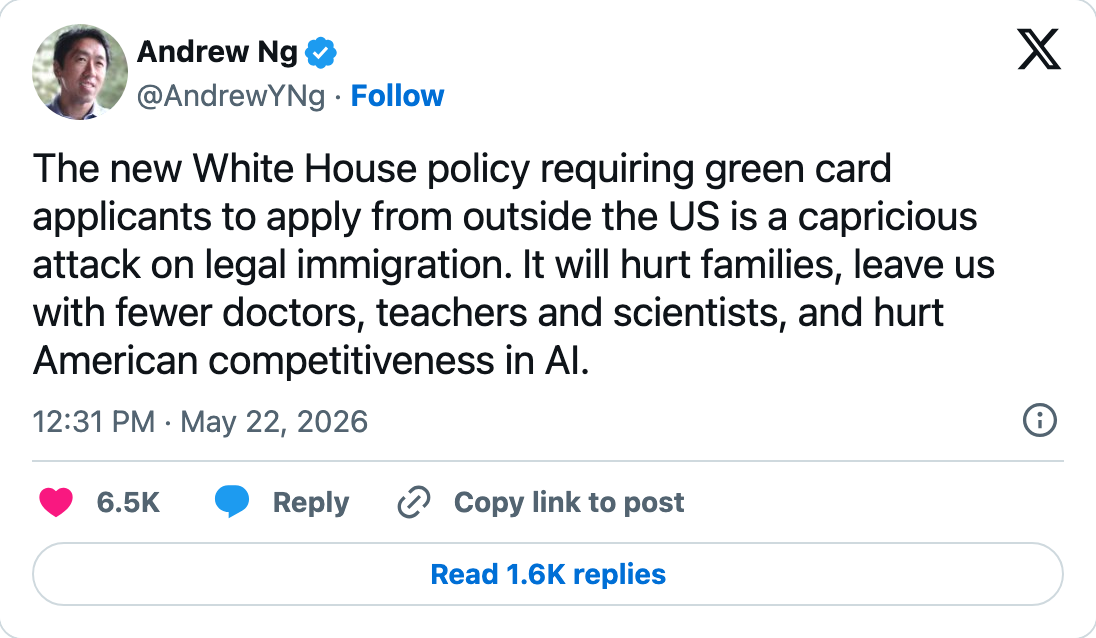
The labor-side power-politics fight is being joined on multiple flanks. AndrewYNg framing federal green-card-from-outside policy as a "capricious attack on legal immigration" (source) is the immigration-side flank; Newsom's EO is the displacement-side flank; the Woz speech is the cultural-narrative flank. When three different political flanks open on the same labor story in the same week, the political center of gravity has moved.
5. What to watch in the next 30 days
- Will a second state EO follow? Watch New York and Washington state. If either signs a parallel AI labor EO before mid-June, the federalism layer is consolidating faster than the federal layer can respond — and the four-to-six-week arbitrage window collapses to two-to-three weeks.
- Does Polymarket open a new federal market? If a "Trump orders federal AI review by July 31" market spins up and prices in the 25%–40% range, the federal window has merely been pushed back, not closed. If it opens lower than 25%, the federal layer has structurally ceded.
- Does the EO get challenged in court? A state-vs-federal preemption suit would force the question into the 9th Circuit. That is a 12–18 month process — the labor-AI question doesn't get settled in 2026 regardless of timing.
- Does Anthropic, OpenAI, or Google publicly file in response? A lab filing publicly with California's agencies under this EO would set the template for how the labs engage with state-level AI policy. Whoever files first defines the procedural ground.
Bottom line
The press will frame this as a Newsom press event. The market read is harder: the federal AI-policy window is closing in real time, the state AI-policy window is opening into the vacuum, and the labor-side political constituency is at maximum salience for the first time. That combination produces a short, real arbitrage window for operators who can hire credibly in California in the next four-to-six weeks — and a longer political reordering of where AI policy lives in the United States.
The Polymarket Trump federal review collapse to 10% is not noise. It is the cleanest live signal we have that the AI policy game is moving to the states. Read accordingly.
The Arc of Power covers power dynamics, prediction markets, and the second-order political consequences of AI infrastructure. Related: AI Data Center Bans Hit 69 Jurisdictions — Polymarket: 93% YES and Chamath: 18 Months to Taiwan Decoupling — Polymarket Doesn't Buy It.
The Desk
About The Arc of Power
The Arc of Power editorial desk delivers rigorous analysis of geopolitics, defense, economic statecraft, and intelligence — examining the forces that shape the global order.
Briefing Access
Request Briefing Access
In-depth geopolitical analysis — power dynamics, defense strategy, and economic statecraft — three times a week. No noise.
Request briefing access