Case file · Geopolitics · 8 min read
Xi Said the Quiet Part: Taiwan 'Could Trigger Conflict'
Xi told Trump in Beijing that mishandling Taiwan could spark clashes. Polymarket prices a 2026 invasion at 7%. One of them is wrong.
The Arc of Power ·
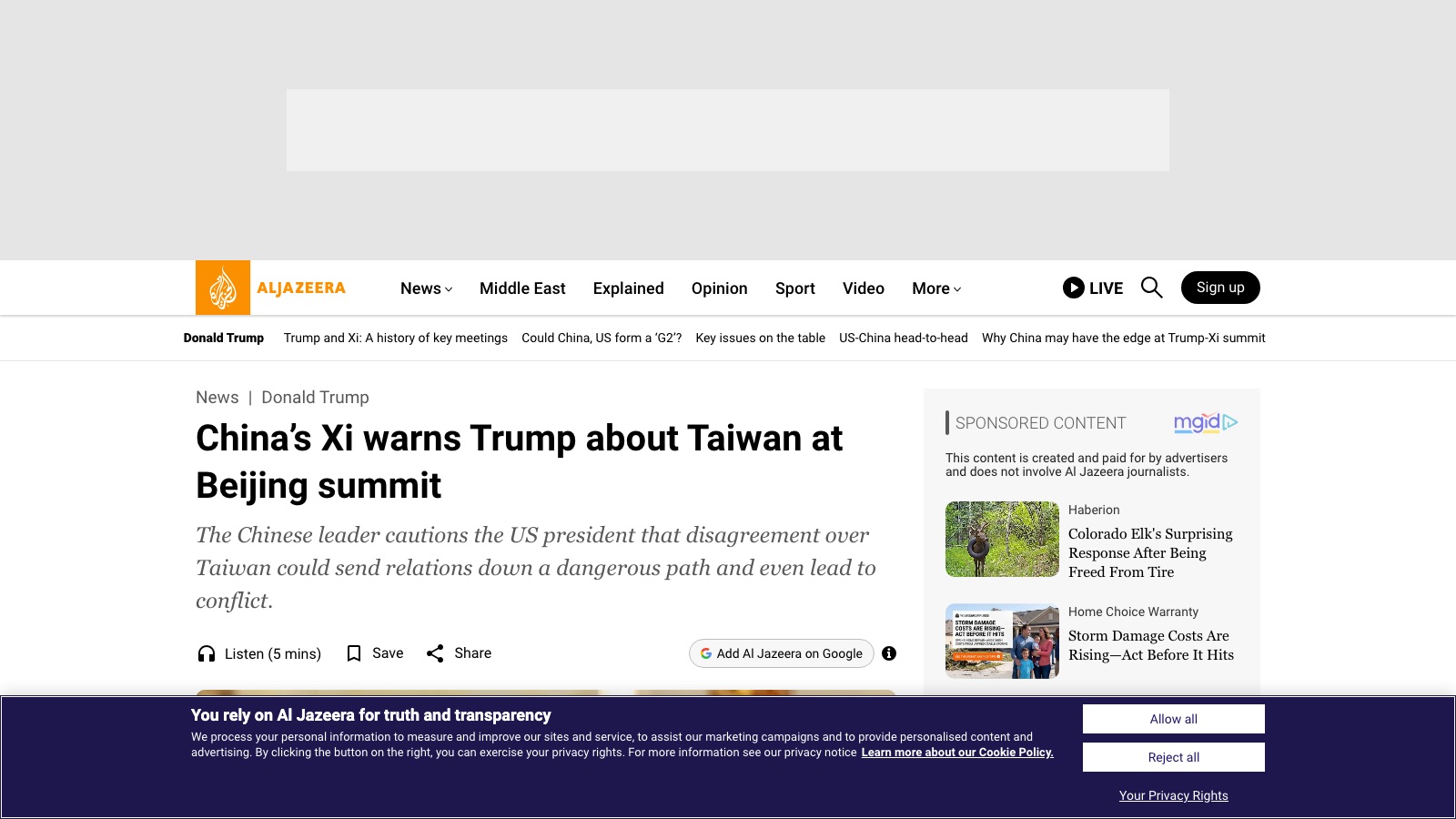
On May 14, 2026, inside the Great Hall of the People in Beijing, Xi Jinping told Donald Trump directly that "if mishandled, the two nations could collide or even come into conflict" over Taiwan, calling the island "the most important issue" between the world's two largest economies. The language has been reported with near-identical phrasing by NBC, NPR, Al Jazeera, Bloomberg, Democracy Now, Time, and CNBC — every major desk got the same readout, which means it was the line Beijing wanted delivered.
Two things happened simultaneously this week and they do not agree. Xi escalated the rhetoric to the highest temperature of any post-2017 US-China bilateral. Polymarket's "Will China invade Taiwan by end of 2026" market, with $23.4M in volume, sits at 7%. When the loudest authoritarian leader in a generation tells the US president to his face that Taiwan could trigger a war, and the market with skin in the game prices that war at 7%, one of them is wrong.
This piece argues which.

The Rhetoric Side of the Trade
Strip the language down to its constituent claims:
- "The most important issue" — Xi is foregrounding Taiwan above trade, AI, rare earths, and Iran on the formal agenda of a state visit. That is a positioning move. It says: every other concession you want from us routes through this one.
- "Could trigger conflict" — the word the readouts converge on is collide (碰撞), with conflict (冲突) reserved for the consequence. This is the highest-temperature word Beijing has used about Taiwan in a presidential bilateral since the 1996 Strait crisis. It is calibrated escalation, not improvisation.
- The forum — Xi chose to deliver this in person, in Beijing, on day one. Not through a Foreign Ministry spokesperson. Not in a Politburo readout. Direct, leader-to-leader, on Chinese soil. The forum is itself the message.
Layer on the troop-positioning context. Coverage from The Economist and DemocracyNow over the past two weeks documented US forces concentrating on Okinawa and Guam, the Penghu and Dongyin HIMARS deployments, and the US-Taiwan asymmetric warfare "firepower center". Beijing watches all of this. Xi's read of these movements as adversarial preparation is rational from where he sits — and his warning is the proportional verbal response.
Critical
The Market Side of the Trade
Now look at the prices.
Will China invade Taiwan by end of 2026?
- End of 2026: 7%
- By September 30, 2026: 5%
- By June 30, 2026: 2%
- By March 31, 2026 (resolved no): trended near 0
The market is not pricing Xi's rhetoric as informational. It is treating the warning as expected behavior — exactly what an authoritarian leader does in a year of US weakness — and pricing the actual probability of an amphibious assault separately. The market's logic is the same logic the US intelligence community published in its annual threat assessment: Beijing prefers unification without force; an opposed amphibious crossing of the strait is "extremely difficult" and carries high failure risk if the US intervenes; the cost of failure to Xi personally is catastrophic.
A 7% implied probability across $23M of capital is not "the market is asleep." It is the market saying: rhetoric and capability are separate variables, and the capability variable does not yet support a 2026 invasion.

Which One Is Wrong
Both can be partially right. Neither is fully right.
Where the market is right: A literal 2026 amphibious invasion is implausible. The PLA has not telegraphed mobilization. The logistical preconditions — Type-076 LHD numbers, civilian-fleet pre-positioning, reservist callup — are not visible at the satellite-imagery layer. Polymarket is correctly pricing a base case that the year ends without Chinese marines on Taiwanese beaches.
Where the market is wrong: It is anchoring on full invasion as the event of interest. That is the wrong event to model. The events that are actually load-bearing for 2026 are:
- A maritime quarantine or partial blockade — coast guard plus maritime militia, not PLA Navy — using customs and inspection regimes to choke Taiwan's energy and chip imports. This is not "invasion." It is escalation that the Polymarket question definition does not capture.
- A Taiwan policy concession from Trump — the F24 line on Trump rewriting Taiwan policy in Beijing without Congress — that materially reduces deterrence without firing a shot. Xi extracts this from a weakened US bargaining position. The market does not price policy concession; it prices kinetic conflict.
- A miscalculation in the Strait — a destroyer shouldering, a J-20 incident, a coast guard ramming — that escalates faster than the slow base-rate-priced markets can update. Markets at 7% do not absorb a tail-event well; their structure assumes slow news, not strait incidents.
So the right read is: the market is correctly pricing the literal question and underpricing the adjacent risks that look like the same trade to anyone who is not a quant. Xi knows this. The rhetoric is calibrated to scare Washington into pre-emptive concession before any of those adjacent risks materialize. That is the strategy. The market measures the wrong event.
What to Watch in the Next 30 Days
Six concrete data points will tell you which way the trade resolves:
- The summit communiqué language on Taiwan. If it includes the phrase "peaceful reunification" without "freedom of navigation through the Strait" or "current status quo," that is the policy concession scenario. Read line-by-line.
- US Pacific Command public posture. A movement of carrier groups away from the first island chain in the two weeks after Beijing is a tell that concessions were made off-camera.
- Taiwan domestic politics. The DPP government's response — its public confidence vs. quiet calls for more US assurances — is the highest-fidelity signal of what Taipei believes was discussed.
- PLA maritime activity around Taiwan. Not exercise count — exercise type. Combined arms with logistics simulation is qualitatively different from rote naval drills. The shift, if it happens, is the precondition for a quarantine scenario.
- Polymarket movement. If the 7% creeps to 12-15% over June without a specific shock, the market is rebalancing toward the broader-risk framing. If it stays flat through a summer of Strait incidents, the market structure has a known blind spot.
- Congressional reaction. Specifically: bipartisan Taiwan Relations Act reaffirmation, Senate Foreign Relations Committee hearings on the Beijing readout, Hegseth's defense ask survival in markup. If Congress folds, the deterrence equation rebalances toward Beijing without a shot fired.
Note
The Bottom Line
Xi told Trump, in front of every wire service in the world, that Taiwan could trigger a war. Polymarket says 7%. The space between those two readings is the most important geopolitical position in the world right now, and almost nobody is sized for the trades that actually express it — partial blockade, policy concession, Strait incident. Most of the year's volatility will live there.
The companion read on the Iran-side asymmetry that brought Trump into Beijing weakened is in our Trump Arrives in Beijing Already Losing the Room piece from May 13. The arc is the same: a US president negotiating from below, an authoritarian leader who does not have to do anything except wait, and a series of markets that are still pricing the previous world.
For traders and policy operators, the practical takeaway is to stop trading the headline market. The "Will China invade Taiwan by end of 2026" line is the highest-liquidity, lowest-information instrument in this space. The information is in the adjacent markets — bilateral exchange flows, semiconductor export licensing surprises, Strait shipping insurance premia, and the price action in Taiwanese sovereign debt. Those are where the next 90 days actually move. Anyone watching only the binary invasion question will see a "calm" market right up until the moment the world has rearranged around a maritime quarantine, a defense-budget cut, or a quiet semiconductor concession that nobody bothered to make a Polymarket question about. The Taiwan trade in 2026 is everywhere except where the headline volume sits.
The Desk
About The Arc of Power
The Arc of Power editorial desk delivers rigorous analysis of geopolitics, defense, economic statecraft, and intelligence — examining the forces that shape the global order.
Briefing Access
Request Briefing Access
In-depth geopolitical analysis — power dynamics, defense strategy, and economic statecraft — three times a week. No noise.
Request briefing accessRelated Files
GeopoliticsUS-Iran Talks This Week: What the Money Already Prices
GeopoliticsSeptember 28, 202612 min read
Anthropic Said No to the Pentagon. It Got Blacklisted.
GeopoliticsSeptember 25, 202613 min read
Europe Drops Russia Sanctions as Its Airspace Gets Probed
GeopoliticsSeptember 23, 202612 min read